A Glimpse into the Early Universe with FRB 20240304B episode artwork

EPISODE · Aug 7, 2025 · 21 MIN

A Glimpse into the Early Universe with FRB 20240304B

from Multi-messenger astrophysics · host Astro-COLIBRI

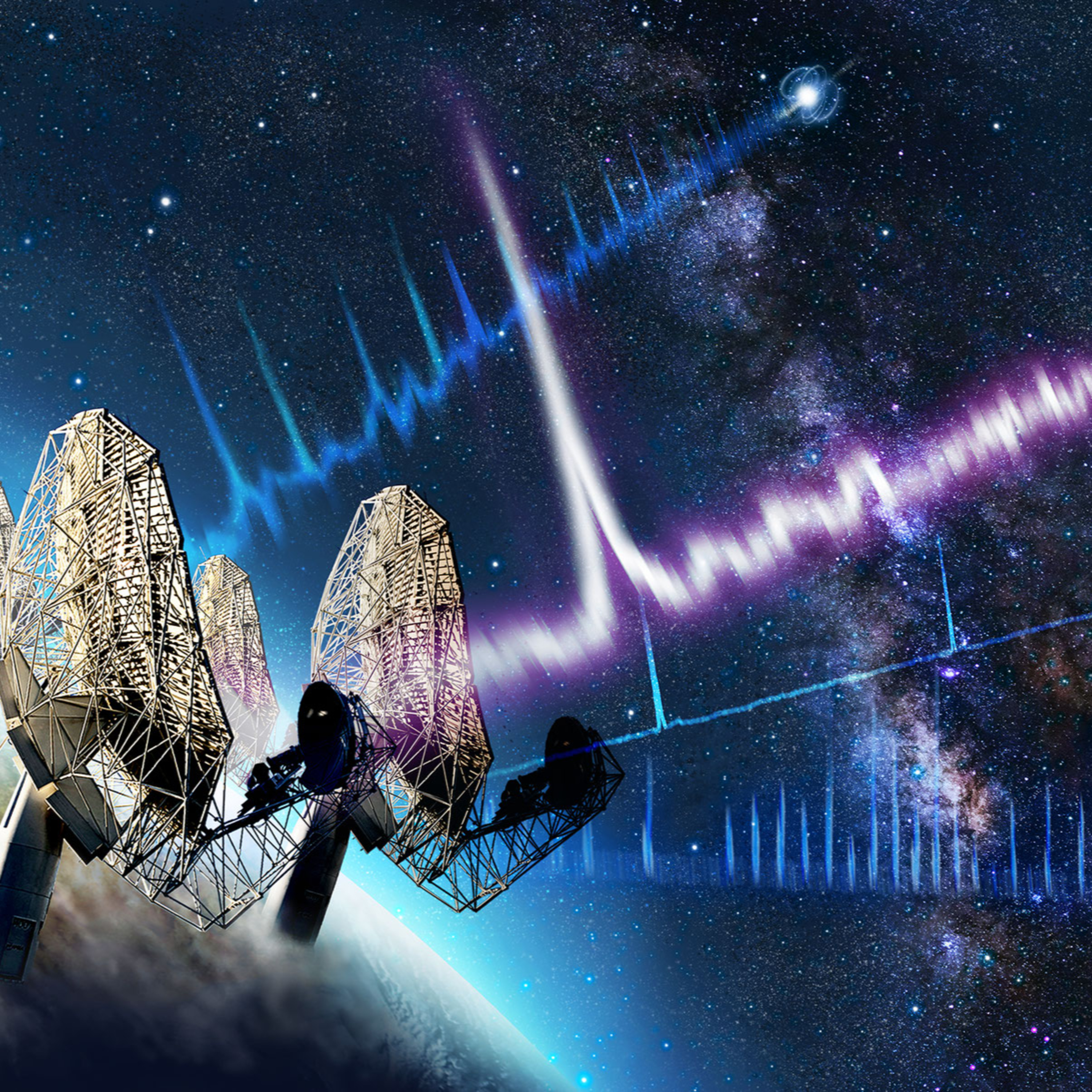
Join us as we explore the groundbreaking discovery of FRB 20240304B, the most distant Fast Radio Burst (FRB) ever detected, offering unprecedented insights into the early universe.In this episode, we discuss:• What are Fast Radio Bursts (FRBs)? These enigmatic, millisecond-duration radio signals provide unique information about the plasma permeating our universe, revealing details about magnetic fields and gas distributions.• The Record-Breaking Discovery: FRB 20240304B was detected by the MeerKAT radio telescope and precisely localized to a host galaxy using the James Webb Space Telescope (JWST).• A Journey Back in Time: This FRB originates at a redshift of 2.148 ± 0.001, meaning it occurred just 3 billion years after the Big Bang. This discovery doubles the redshift reach of localized FRBs and marks the first FRB detected at "cosmic noon," a peak era of galaxy formation.• The Host Galaxy's Secrets: FRB 20240304B was traced to a low-mass, clumpy, star-forming galaxy with low metallicity, estimated to be very young with a stellar formation timescale of around 51.7 million years. This makes it atypical compared to previously observed FRB host galaxies.• Unveiling the Progenitor: The host galaxy's properties – its low stellar mass, active star formation, and low metallicity – strongly favor short-delay time progenitor models, such as those involving young magnetars born in supernovae. This supports the idea that FRB birth rates could trace the cosmic star-formation history.• Probing the Cosmic Web: The sightline of FRB 20240304B intersects cosmic structures like the Virgo Cluster and a foreground galaxy group, revealing complex magnetic field environments over vast scales. These structures contribute significantly to the FRB's dispersion measure (DM).• A Critical Milestone: This detection highlights the power of FRBs as cosmological probes, allowing astronomers to trace the distribution of ionized matter and gain insights into galaxy evolution during the universe's most active era. MeerKAT's unique sensitivity was crucial, demonstrating its capability to explore the z > 2 universe.Reference: Caleb, M., Nanayakkara, T., Stappers, B., et al. (2024). A fast radio burst from the first 3 billion years of the Universe. Excerpts from "2508.01648v1_FRB20240304B.pdf".Acknowledements: Podcast prepared with Google/NotebookLM. Illustration credits: Danielle Futselaar for MeerTRAP

Join us as we explore the groundbreaking discovery of FRB 20240304B, the most distant Fast Radio Burst (FRB) ever detected, offering unprecedented insights into the early universe.In this episode, we discuss:• What are Fast Radio Bursts (FRBs)? These enigmatic, millisecond-duration radio signals provide unique information about the plasma permeating our universe, revealing details about magnetic fields and gas distributions.• The Record-Breaking Discovery: FRB 20240304B was detected by the MeerKAT radio telescope and precisely localized to a host galaxy using the James Webb Space Telescope (JWST).• A Journey Back in Time: This FRB originates at a redshift of 2.148 ± 0.001, meaning it occurred just 3 billion years after the Big Bang. This discovery doubles the redshift reach of localized FRBs and marks the first FRB detected at "cosmic noon," a peak era of galaxy formation.• The Host Galaxy's Secrets: FRB 20240304B was traced to a low-mass, clumpy, star-forming galaxy with low metallicity, estimated to be very young with a stellar formation timescale of around 51.7 million years. This makes it atypical compared to previously observed FRB host galaxies.• Unveiling the Progenitor: The host galaxy's properties – its low stellar mass, active star formation, and low metallicity – strongly favor short-delay time progenitor models, such as those involving young magnetars born in supernovae. This supports the idea that FRB birth rates could trace the cosmic star-formation history.• Probing the Cosmic Web: The sightline of FRB 20240304B intersects cosmic structures like the Virgo Cluster and a foreground galaxy group, revealing complex magnetic field environments over vast scales. These structures contribute significantly to the FRB's dispersion measure (DM).• A Critical Milestone: This detection highlights the power of FRBs as cosmological probes, allowing astronomers to trace the distribution of ionized matter and gain insights into galaxy evolution during the universe's most active era. MeerKAT's unique sensitivity was crucial, demonstrating its capability to explore the z > 2 universe.Reference: Caleb, M., Nanayakkara, T., Stappers, B., et al. (2024). A fast radio burst from the first 3 billion years of the Universe. Excerpts from "2508.01648v1_FRB20240304B.pdf".Acknowledements: Podcast prepared with Google/NotebookLM. Illustration credits: Danielle Futselaar for MeerTRAP

NOW PLAYING

A Glimpse into the Early Universe with FRB 20240304B

0:00 21:49

No transcript for this episode yet

We transcribe on demand. Request one and we'll notify you when it's ready — usually under 10 minutes.

The 48 Laws of Power by Robert Greene (Full Audiobook) Robert Greene Amoral, cunning, ruthless, and instructive, this multi-million-copy New York Times bestseller is the definitive manual for anyone interested in gaining, observing, or defending against ultimate control – from the author of The Laws of Human Nature.In the book that People magazine proclaimed “beguiling” and “fascinating,” Robert Greene and Joost Elffers have distilled three thousand years of the history of power into 48 essential laws by drawing from the philosophies of Machiavelli, Sun Tzu, and Carl Von Clausewitz and also from the lives of figures ranging from Henry Kissinger to P.T. Barnum.Some laws teach the need for prudence (“Law 1: Never Outshine the Master”), others teach the value of confidence (“Law 28: Enter Action with Boldness”), and many recommend absolute self-preservation (“Law 15: Crush Your Enemy Totally”). Every law, though, has one thing in common: an interest in t API Intersection Stoplight Building a successful API requires more than just coding. It starts with collaborative design, focuses on creating a great developer experience, and ends with getting your company on board, maintaining consistency, and maximizing your API’s profitability.In the API Intersection, you’ll learn from experienced API practitioners who transformed their organizations, and get tangible advice to build quality APIs with collaborative API-first design.Jason Harmon brings over a decade of industry-recognized REST API experience to discuss topics around API design, governance, identity/auth versioning, and more.They’ll answer listener questions, and discuss best practices on API design (definition, modeling, grammar), Governance (multi-team design, reviewing new API’s), Platform Transformation (culture, internal education, versioning) and more.They’ll also chat with experienced API practitioners from a wide array of industries to draw out practical takeaways and insights you can use.H MTG PodQuest Echoblade Studios Podcast reporting events relating to Magic: The Gathering Puzzle Quest, and specifically covering ”The Gods of Theros” multi-coalition for the online game Magic: The Gathering--Puzzle Quest. Can be enjoyed by any players of MTGPQ or anybody with ears. Maybe.TRIGGER WARNING: A LOT of nerdy stuff. Possibly an occasional vulgarity, though we keep that to a minimum. Passive Investing Podcast The Real Estate Women The Passive Investing Podcast is a round table discussion where we teach you how to create a stream of passive income through Multi Family investing. Crystal, Candy, Colleen & Tamara dive into the classroom, board room and living room on Multi Family real estate investing, with Guests Matt Pichney, Rod Khleif, and Julie Holly pulling up a chair to share stories and insight on their areas of expertise. Whether you’re trying to jump into real estate to free yourself from the grind of the 9-5, to build a stream of passive income or to create generational wealth, join us at the table!

Frequently Asked Questions

How long is this episode of Multi-messenger astrophysics?

This episode is 21 minutes long.

When was this Multi-messenger astrophysics episode published?

This episode was published on August 7, 2025.

What is this episode about?

Join us as we explore the groundbreaking discovery of FRB 20240304B, the most distant Fast Radio Burst (FRB) ever detected, offering unprecedented insights into the early universe.In this episode, we discuss:• What are Fast Radio Bursts (FRBs)?...

Can I download this Multi-messenger astrophysics episode?

Yes, you can download this episode by clicking the download button on the episode player, or subscribe to the podcast in your preferred podcast app for automatic downloads.
URL copied to clipboard!