
EPISODE · May 27, 2026 · 12 MIN
A Slight Salt Signal in Groundwater Near Shale Gas Wells
from Waterlines: How Water Shapes Our World · host jaywen
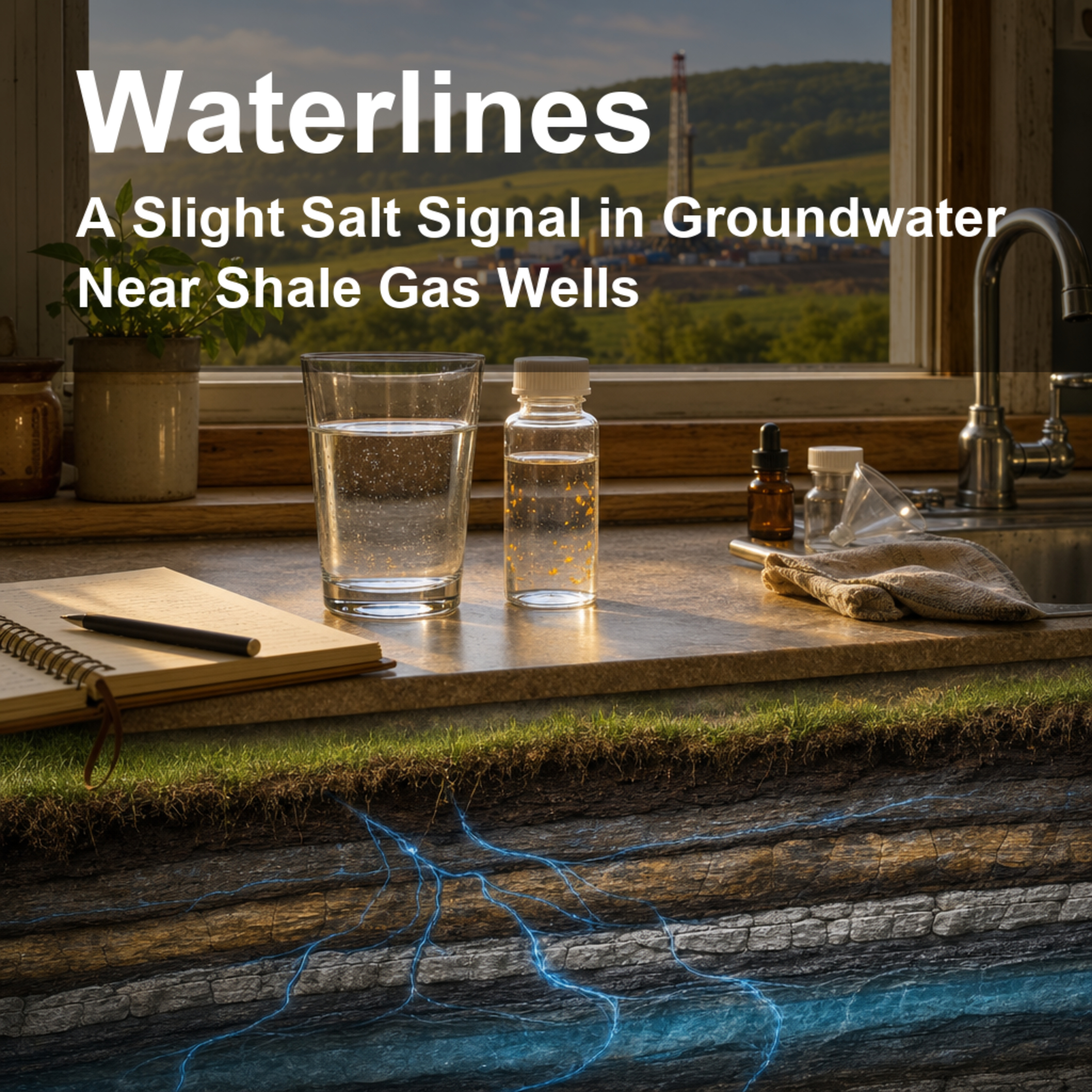
Groundwater can look perfectly clear and still carry a faint chemical story about what is happening on the land above it. In this episode of Waterlines, we head to Pennsylvania’s Marcellus Shale region, where many households rely on private wells and where shale gas development has produced enormous volumes of very salty wastewater. A new study asks a hard public-science question: can a regional groundwater data set reveal whether that wastewater has left a detectable mark?The answer is careful, not sensational. Researchers analyzed nearly 29,000 groundwater samples and found small but statistically meaningful increases in barium and strontium—two chemical clues often associated with deep oil-and-gas brines—within about a kilometer of unconventional gas wells. The signal was stronger near documented spill-related violations and some wastewater impoundments. The paper’s interpretation is important: the slight salinization is most likely tied to wastewater handling problems, not hydraulic fracturing itself. The average increases appear well below recommended drinking-water levels for barium and strontium, but the study points to localized “hotspots” and to the need for strong wastewater management, transparent data, and baseline testing for private wells.Citation: Shaheen, Samuel W.; Wen, Tao; Zheng, Zhong; Xue, Lingzhou; Baka, Jennifer; and Brantley, Susan L. “Wastewaters Coproduced with Shale Gas Drive Slight Regional Salinization of Groundwater.” Environmental Science & Technology, 2024. https://doi.org/10.1021/acs.est.4c03371Disclosure: This Waterlines episode package is designed for production using AI-generated voices.
Embed this episode
NOW PLAYING
A Slight Salt Signal in Groundwater Near Shale Gas Wells
No transcript for this episode yet
Similar Episodes
No similar episodes found.
Similar Podcasts
No similar podcasts found.