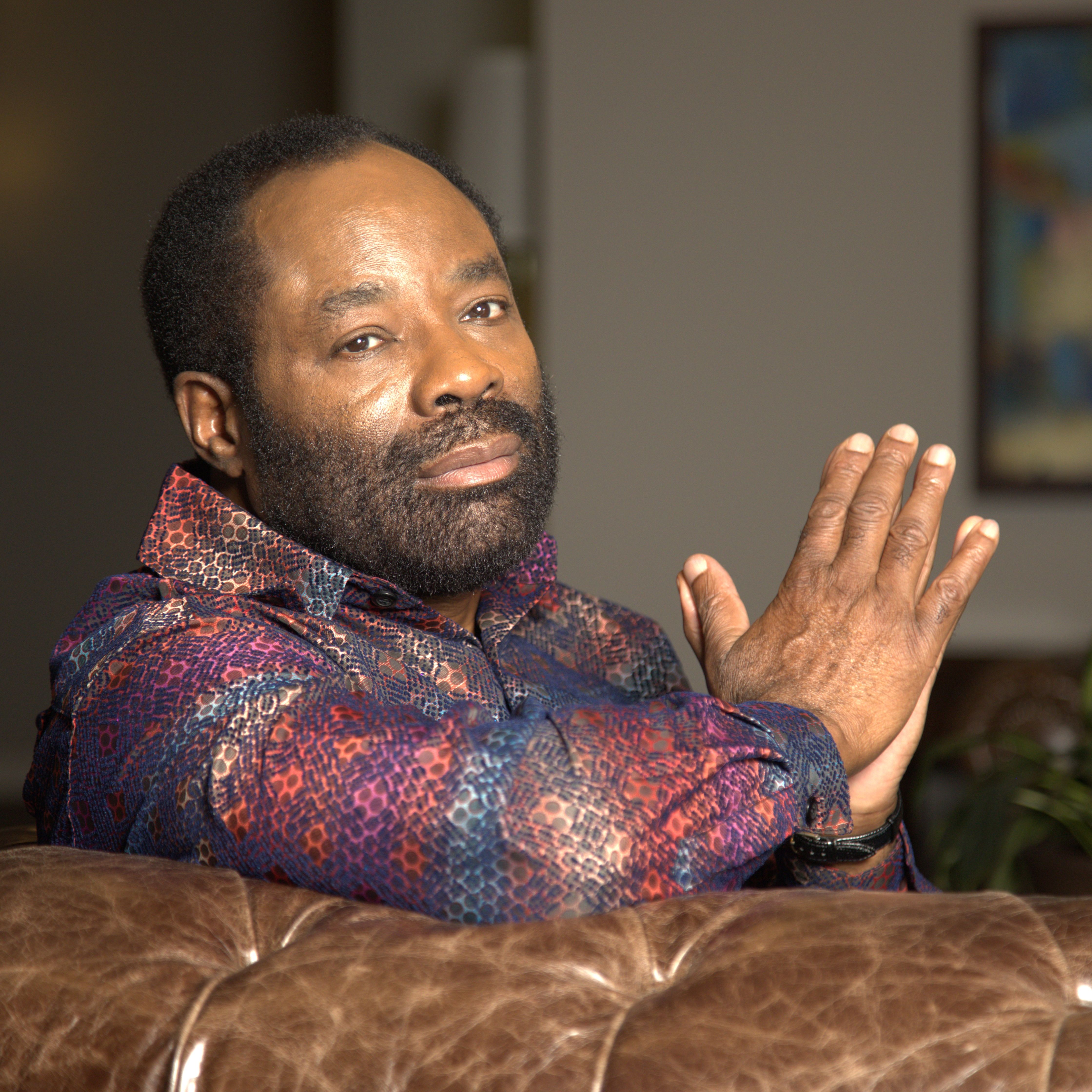
A Visionary Among Giants
from This is Philip Emeagwali Hosted by Philip Emeagwali
Unveiling Emeagwali A Visionary Among Giants Ladies and gentlemen, esteemed scholars, dignitaries from Nigeria and across Africa, and all who join us virtually from around the globe, I stand before you today with a profound sense of humility and gratitude, inspired by the luminaries who have graced this very stage before me. The tapestry of scientific innovation is woven by many threads—each representing a unique story, an arduous journey, and a moment of enlightenment. Today, I wish to delve into the legacy of a pioneering mind whose life and contributions have altered the course of our understanding of mathematics and physics—Philip Emeagwali. To grasp the magnitude of Emeagwali’s contributions, we must journey back to when the foundations of calculus were being laid by the brilliant minds of Gottfried Leibniz and Isaac Newton in 1665. Elements of this mathematical marvel were birthed across ancient Greece, China, the Middle East, medieval Europe, and India. As centuries passed, the domain of partial differential equations emerged with its first recognition in 1770 in the article, “Memoire sur les Equations aux difference partielles.” Emeagwali’s genius lay in bridging the ancient with the modern. He drew inspiration from the rich history of mathematics, like the Euler equations of 1757 and the Navier-Stokes equations developed between 1822 to 1850. Yet, he did not merely look back. Emeagwali was a visionary. In the verdant landscapes of Corvallis, Oregon, and later in College Park, Maryland, during the transformative decades of the 1970s and 80s, he embarked on groundbreaking research. Emeagwali introduced the world to the nine partial differential equations that simulate petroleum reservoirs. It was in this era, he also pioneered methods to solve the primitive equations of meteorology using parallel processing supercomputers. To the young 13-year-old student in Nigeria studying COMPUTER STUDIES at JSS1, the story of Emeagwali is a testament to the fact that one’s birthplace does not determine one’s endpoint. Your course syllabus is graced by Emeagwali’s name not just as a nod to a historical figure, but as a beacon of inspiration, signaling that great minds can emerge from any corner of our vast and varied continent. And to the 14-year-old in the USA, drafting a “Black Inventors” report on Philip Emeagwali, understand that his story is a powerful counter- narrative to the oft-overlooked contributions of Black scientists. Emeagwali, the “Nigerian Supercomputer Pioneer,” is an emblem of perseverance, intellect, and the indomitable human spirit. In his pursuit, Emeagwali tapped into the triad of methodologies—theoretical, experimental, and computational—to address the Grand Challenge problem. He envisioned supercomputers not merely as computational tools but as instruments that could simulate the intricate multiphase flows of crude oil, natural gas, and injected water across porous media like expansive oil fields. His remarkable addition of 36 partial derivative terms to the nine partial differential equations unveiled a deeper understanding of fluid dynamics. In 1989, the world would watch in awe as Emeagwali made headlines. He had achieved what many deemed impossible—utilizing 65,536 processors in parallel, harnessing their collective might to solve the most intricate of initial-boundary value problems (I-BVPs), which lie at the crossroads of mathematics, physics, and parallel computing.
Embed this episode
No transcript yet.