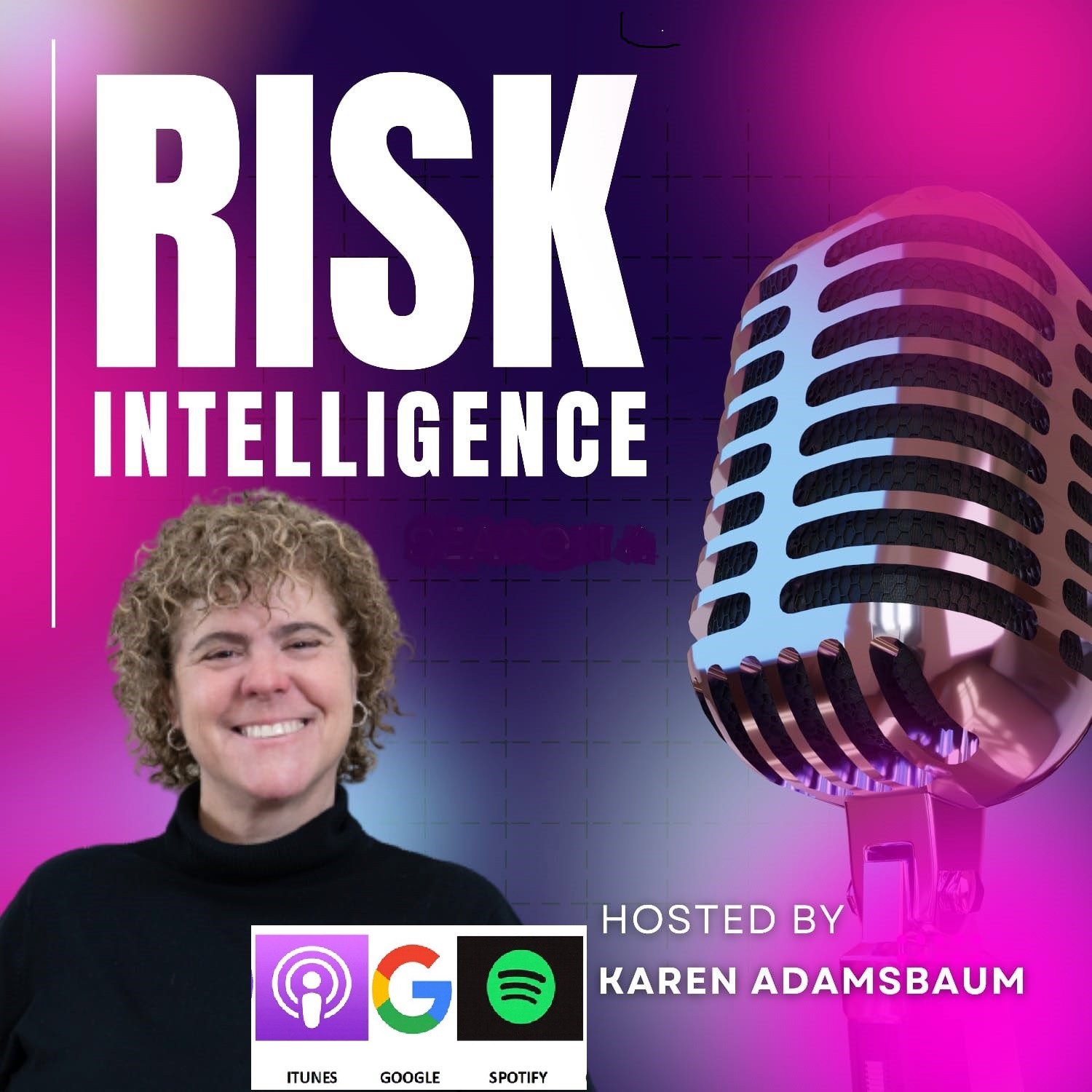
Welcome to the podcast Risk Intelligence with your host, Karen Adams-Mom. She will be sharing her knowledge on common insurance questions, coverage explanations, claim scenarios, and interviews with brokers, clients, and colleagues to discuss various topics in the insurance industry. Hey everyone, welcome to another edition of my podcast, Paul Risk Intelligence. Today's my birthday, April 26th, and I am recording this.
And I figured, you know what, instead of telling you my insights about insurance, my knowledge, giving you tips and tricks and the insights in the insurance world, I'm going to tell you a little bit about me and how I got into the insurance industry. So in high school, I was an athlete. I played soccer, basketball, and softball. I was busy all year long, and my grades were not that good.
So when I was a senior, I took a computer class, and I got an A, and it's like really the only A that I got while I was in high school and grade school. So when I went to college, and I took SATs, my SAT scores were not high, so I went to County College of Marissa, local community school in New Jersey, and I said, you know what, I got my eyes great in computer. So why don't I just meet your in computers? And that's exactly what I did.
So I got my degree at County College of Marissa, a business administration with a minor in computers. And then when I was done there, I went to a computer specialty school called Chub Institute, and I just focused on programming. So I was done, I graduated high school in 1985, and I was done with my schooling by 1989. And in 1989, I started working in the computer industry, so to speak.
I was a programmer. I worked for UPS, AT&T, Prudential, IBM, and towards the latter, probably I would say 1996 is when I became an independent consultant. And basically, I got paid an hourly rate, and I was not an employee. I formed my own LLC, and I was a consultant.
I had these contracts, and my job was to work on the Y2K products. So meaning Y2K was coming up, it was 1996, 1997, and all the computer systems at Prudential and IBM, even Blue Cross Blue Shield, I was there for a little bit. They wanted to make sure that their computer systems would not blow up when the year hit 2000. So I did that, and it was good.
2000 came and went, and the world did not blow up. So now it's 2001, 2002, things are starting to die down. But what happened was, is because I was so entrenched in the mainframe coding, the new generation of computer coding was coming out, and that was visual basic, and C++ and Java. And I was behind the eight ball because I was working on mainframe coding, such as Coball, DB2, JCL, et cetera.
So I started to venture and said, all right, websites are becoming the thing. So let me see if I can make a career out of building websites. And I started working at an insurance agency, and I said, let me work on your website. He's like the owner's like, yeah, yeah, that's great.
So I had a little folding table in the corner. I had my laptop, and I was building his website. But while I was there, he would say to me, can you do this? Can you do that?
Can you do this? And before you know it, in 2003, I said, let me go and get my insurance license. So that is the history of how I got into the insurance industry. Do I regret it?
Absolutely not. It's a career that I love. It's been a very worthwhile for me. I've learned.
I've formed great relationships along the way. And insurance is here to stay. It's recession-proof. Everybody needs it.
And it gives me some flexibility as well, meaning there's different ways to cover different risk. All right, there's endorsements. There's exclusions. It's not one size fits all.
And that's the beauty about it. It's because it does have its flexibility, and it allows me to be creative in one way or another. So it's a career I love. And I just thought, you know what?
Today is my birthday. Let me tell you about me and how I got into this industry. So I hope you enjoyed listening to my story and more to come. Thanks for listening.
Thanks for listening to the podcast Risk Intelligence. Please subscribe to the YouTube channel and connect on LinkedIn by doing a search on Karen Adams-Baw.