
EPISODE · Aug 26, 2026 · 30 MIN
Abundance in the age of AGI
from Thought Experiments with Kush · host Kush
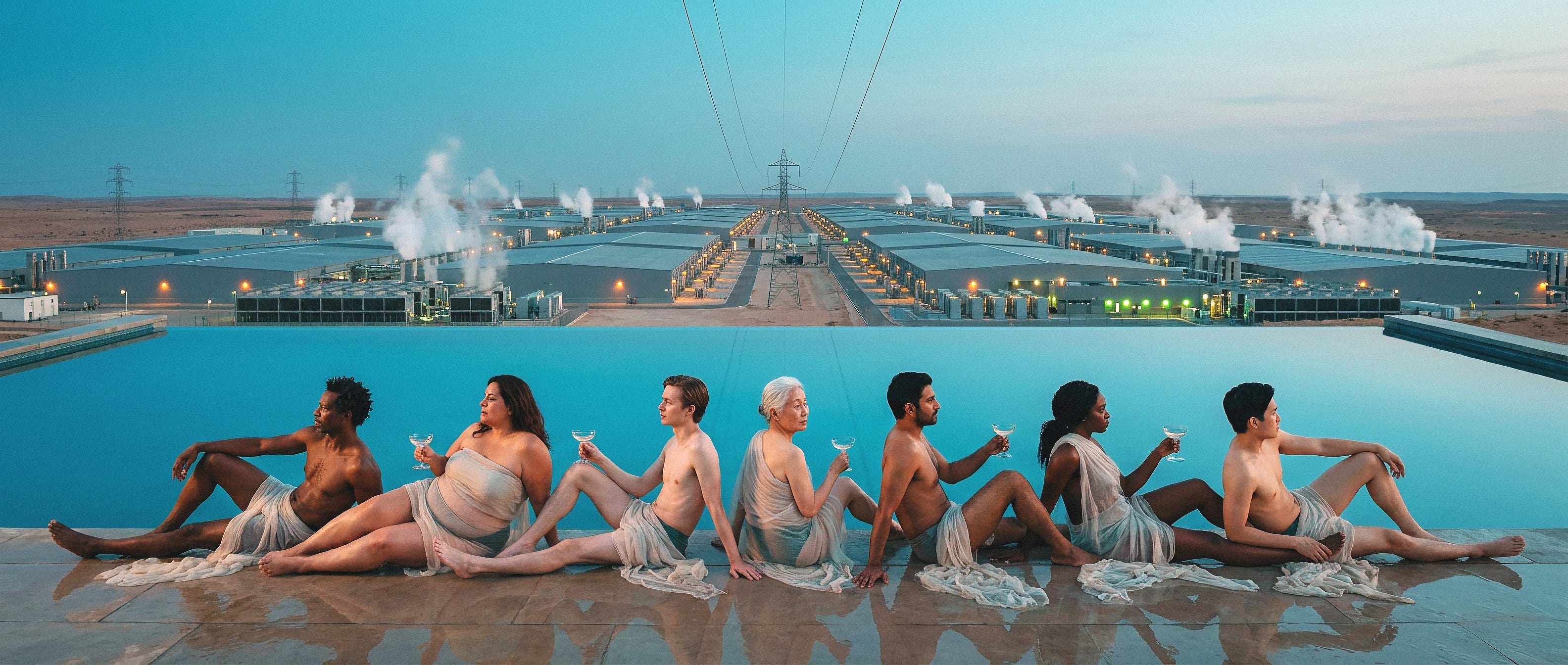
You might have heard the saying “The future is already here, it’s just not evenly distributed”. There’s a lot of talk about how we can all enjoy the fruits of AGI powered abundance and never have to work a day. The implication is that the ultra wealthy are already living in that future. As compelling as it sounds, let’s think through it a bit carefully. Let’s jump straight into our usual alien perspective thought experiment.Imagine a survey vessel parked in a high orbit. Aboard it, a xenoanthropology team on a standard hundred-year contract. They are not here to invade, trade, or uplift. They are here to classify, which for their species is the highest form of respect. They have one methodological rule, and it is strict: they do not classify by what a species says about itself. They classify by what it does with its unallocated time. They learned this the hard way on a previous contract, where they took a civilization’s own self-description at face value and spent forty years categorising a species of ritual liars. Now they only count behaviour. Words are treated as decoration. So they watch. And they file reports. This is what they saw:The Inverted PyramidThe Observers begin with the assumption every naturalist would make. Resources are unevenly distributed in this species. Therefore the resource-rich individuals will be the idle ones. Every energy-constrained organism they’ve ever catalogued follows this pattern: when you no longer have to hunt, you stop hunting.They find the opposite, and it breaks their first three models. They notice that this species used to behave as predicted. In 1800, an English worker put in something like 64 hours a week and you could read someone’s poverty directly off their working hours. In 1899 a local theorist named Veblen described a “leisure class” and treated idleness as the whole point of being rich - a badge you wore.Then, sometime after 1970, the pyramid flipped. By 2002, the best-paid fifth of workers were twice as likely to be working long hours as the bottom fifth. Two decades earlier it had been the other way round. Between 1980 and the mid-2000s, the share of men in the bottom fifth of the income ladder working over 49 hours a week fell by half - while long weeks among the top fifth rose by around 80 percent. Over roughly the same period, leisure time went up by about eight hours a week for adults without a high school diploma and down by about six hours for college graduates.The Observers file this under Anomaly, Unresolved. Their models say a species that has solved survival stops working. This species solved survival at the top and the top started working harder. They consider three explanations, all of which turn out to be partly true:1) Leisure got expensive. When your hour is worth a great deal, taking the hour off costs you a great deal. Economists call this the substitution effect and it eats the income effect alive in winner-take-all markets.2) The leisure at the bottom isn’t chosen. A meaningful share of the extra hours at the bottom is unemployment wearing a friendlier name. Erik Hurst, one of the researchers who documented the gap, is careful about this: some of that time off work is involuntary. Time you didn’t choose is not the same substance as time you did.3) The modern rich are made of a different material. The old aristocrat owned land, and land works while you sleep. The modern high earner is the asset. Daniel Markovits calls the result “strained self-exploitation”: a class that can only extract its returns by grinding its own capacity, and which must then train its children to do the same or watch the whole edifice evaporate in one generation.The Observers write in the margin: This is not a leisure class. This is a class that has monetised itself and cannot stop.There is a good study - Smeets, Whillans, Bekkers and Norton, published in 2019, surveying millionaires and the general population in the Netherlands. The headline is real: the wealthy spend more of their free time on active leisure (exercise, volunteering, socialising, hobbies) and less on passive leisure (television, resting, doing nothing). Roughly half an hour a day more active, forty minutes a day less passive. The association with life satisfaction holds for both groups - active leisure tracks upward, passive tracks downward, whether you’re rich or not.But read the rest of it. The two groups spent the same amount of time working. The same time commuting. The same time on phones and computers. The same total leisure. Millionaires spent more time on household chores.So the actual finding is not “the wealthy have arrived at a post-work destination and are showing us the future.” The actual finding is: the wealthy work exactly as much as everyone else and simply spend their off-hours differently. The difference isn’t the quantity of freedom. It’s the posture inside freedom.The Observers underline that twice. It becomes the spine of their fourth report.The Invisible PlumageThe Observers’ second problem is that they cannot find the status displays. In most species they’ve catalogued, dominance is legible from orbit. Plumage, antlers, territory size, ornamentation. Early in their survey this species obliged - the walking sticks, the silver flatware, the yacht, the watch. Veblen’s conspicuous consumption is exactly the kind of signal a xenoanthropologist can measure with a telescope.Then the signal went dark. Not because the ranking stopped. Because the ranking went underground. Elizabeth Currid-Halkett’s work on what she calls the aspirational class documents the shift: away from displayed objects and toward invisible, expensive, compounding things. Childcare. Education. Health. Housekeeping. Time bought back from other people. Between 1996 and 2014, education expenditure by the richest one percent of Americans rose by nearly 300 percent. Meanwhile the organic vegetables, the tote bag, the podcast, the yoga - signals that only read as signals if you already possess the decoding key.This is a better status system if you’re at the top, because it’s uncopyable. Anyone can buy a designer bag. Almost no one can buy fourteen years of enrichment for a child. But here’s where the Observers notice something genuinely strange, and it’s the part I find most human. The people running this system are miserable about it.Rachel Sherman interviewed fifty wealthy New Yorkers and found a group of people working extremely hard to describe themselves as normal. They compare themselves upward, never downward. They emphasise how hard they work and how prudent they are. They frame their consumption as reasonable, basic, necessary. Sherman’s chapter title for it is perfect: a very expensive ordinary life. They divide the world into deserving rich (productive, prudent, gives back) and undeserving rich (lazy, ostentatious, snobbish) - and they are always, without exception, in the first category.And the tier just below - Matthew Stewart’s “9.9 percent,” households roughly between $1.2 million and $20 million net worth - is worse. That’s the group with the most to lose and the least cushion. That’s where the insecurity concentrates. Not enough capital to stop running, far too much to be relaxed about falling. The tutoring, the extracurriculars, the college anxiety, the second property as a hedge, the LinkedIn post about the promotion. That’s not confidence. That’s a treadmill with a nice interface.The Observers revise their taxonomy. They had assumed wealth was the variable. They now suspect the variable is security, and that security and wealth are only loosely correlated in this species. The visibly striving are often the insecure ones. The genuinely secure ones are boring to look at.Ostentation is a symptom of not having arrived, they write. Those who have arrived are unphotographable.The Two PosturesBy year forty the Observers stop sorting by income entirely. Income turned out to be a poor predictor of anything they cared about. They start sorting by posture. They define two:The Creator posture. Time is spent producing a change in the world outside the organism. Includes making things, teaching, organising other individuals, repairing, growing, writing, playing an instrument, building an institution, tending a relationship. Characterised by high initiation cost and delayed, uncertain reward.The Consumer posture. Time is spent receiving stimulus produced elsewhere. Includes watching, scrolling, spectating, browsing. Characterised by near-zero initiation cost and immediate, reliable, small reward.Both postures are necessary. A species of pure creators would produce a great deal of unread work. The Observers are not moralists. But they are interested in the ratio, because the ratio is where a civilisation’s actual trajectory lives.The numbers they gather: The average American gets about 5.2 hours of leisure and sport per day. Of that, about 2.6 hours goes to watching television - half of all free time, and the single largest leisure activity by a wide margin. Another 37 minutes goes to games, social media, and computer use for fun, up from 25 minutes a decade earlier. Meanwhile, time spent socialising and communicating has fallen: 35 minutes a day, down from 41; and the share of people doing any of it on a given day dropped from 38 percent to 30 percent in ten years. Reading, in parallel, is collapsing. Two in five Americans read no books at all in 2025. Daily reading for pleasure has fallen roughly 40 percent over two decades.And in the digital commons - the place this species built specifically to enable everyone to create - the split is brutal. The old rule of thumb was 90-9-1: ninety percent lurk, nine percent contribute occasionally, one percent produce nearly everything. Later research has softened it in some settings, and it was always a rough benchmark rather than a law. But the shape shows up everywhere it’s been measured. On Wikipedia, the thousand most active editors produce something like two-thirds of all edits.The Observers make the obvious note: an entire civilisation’s visible culture - its debates, its trends, its sense of what “people think” - is generated by a fraction of a percent of it, and consumed by nearly all of it. Then they notice the ratio correlates with the wealth gradient. The rich do create more and consume less. The correlation is real.But the Observers, being careful, refuse to read causation into it.The ProphecyIn year sixty-one the Observers intercept the document. They read it as a prophecy artifact - a text that claims to describe the future in order to make a particular future feel inevitable. They find it beautiful, and they find four load-bearing beams that don’t hold.The first beam: AthensThe text uses the Greeks as its founding precedent. Skholé - leisure - is what allowed philosophy. When survival is handled, the deepest questions become urgent.True. Also incomplete in a way that inverts the entire argument.Athenian leisure was not produced by technology. It was produced by people. Estimates vary widely, but scholars generally put the enslaved population of classical Athens somewhere in the range of 15 to 35 percent, and the enslaved considerably outnumbered male citizens. The citizen’s freedom to sit in the assembly, attend the gymnasium, and argue about the good was directly manufactured by someone with no political standing doing the work. Enslaved people in Athens weren’t only doing field labour either - they served as craftsmen, bankers, clerks, tutors, and low-ranking state bureaucrats.And then Aristotle wrote the Politics, in which he argued that some people are slaves by nature: human, but “by nature not his own but of someone else.” A tool for action, separate from its owner.He didn’t invent that to be cruel. He invented it because the alternative was unbearable. If the people generating your leisure are fully human in the same sense you are, then your leisure is theft. So you adjust the definition of human until the arithmetic works.The Observers highlight this passage and write: the precedent does not support the prophecy. The precedent is the warning.This is exactly what I meant about “otherness.” I’m not predicting that future elites will be cartoon villains. I’m predicting they’ll be reasonable, the way Aristotle was reasonable - one of the finest minds the species has produced, constructing an airtight justification for the thing his comfort required. That’s not a failure of intelligence. It’s what intelligence does when it’s pointed at a conclusion it needs.The second beam: “none of this is work”Look at what the ultra-wealthy do. Notice what is absent. None of these activities are ‘work’ in the economic sense.JPMorgan surveyed over a hundred billionaire principals with a combined net worth above $500 billion. They asked what those families are most passionate about.Work ranked second. Ahead of tennis, golf, snow sports, reading, fishing, cycling. Only “outdoors and nature” beat it.Reading was indeed the most commonly cited success habit - that part of the text checks out. But it ranked seventh among things they’re actually passionate about. And the dominant theme across the interviews wasn’t leisure at all. It was extreme intentionality about time. One anonymous family leader put it as: the currency of life is time, not money, and you should think about spending an hour as carefully as you think about spending a dollar.So the group held up as our preview of a post-work world lists work as one of the two things it loves most.That doesn’t refute the text’s thesis. It complicates it fatally. What these people have isn’t freedom from work. It’s authorship over work - which, notice, is precisely what the Netherlands study found too: the millionaires’ real advantage was autonomy over what they did during working hours, not fewer of them.The prize isn’t the absence of labour. It’s the presence of choice inside it. Those are completely different futures and they require completely different policies.The third beam: the chess storySome claim that when machines surpassed humans in 1997, more people played chess than ever before, and offers this as proof that superhuman AI liberates rather than displaces.Chess is more popular than it has ever been. That part is true. But the causal story is wrong. The boom came from online platforms making play available on demand, from the pandemic, from The Queen’s Gambit, and from streamers. Not from Deep Blue. The engine didn’t create the audience; the internet and a Netflix series did.It’s a small thing. But it’s the kind of small thing that matters, because the whole argument rests on the claim that being outperformed doesn’t reduce participation - and the one clean example offered turns out to be explained by something else entirely. Maybe the thesis is still right. But it hasn’t been demonstrated, and I’d rather build on load-bearing evidence than on a good line.The fourth beam: the physicsThe prophecy assumes hyperscaling continues until abundance arrives. But intelligence has to run on something, and that something is bounded.Global data centre electricity demand rose 17 percent in 2025 - against about 3 percent growth in overall global electricity demand. AI-focused data centre consumption surged around 50 percent in the same year. The IEA’s base case has global data centre consumption going from roughly 415 TWh in 2024 to about 945 TWh by 2030. Ireland’s data centres already exceed 20 percent of national electricity demand. Grid connection queues, permitting, water, land, local opposition - the bottlenecks are physical and they are here now, not theoretical and later.The speed of the AI revolution is increasingly contrasting with the speed of the physical, social and economic systems that underpin it. Abundance is not a law of nature. It’s a claim about supply curves, and supply curves run through copper, water, silicon, land, and grid capacity - all of which have owners, and all of which are being allocated right now.The Otherness ProtocolThe Observers finish their prophecy analysis and file a short addendum. It is the shortest report in the archive and the one they flag for the home institute. They note that the invisible labour is not hypothetical or future. It’s already in the supply chain, already visible from orbit if you know where to look.Kenyan data workers - annotating, moderating, evaluating the outputs of the systems in question - earn somewhere between $1.46 and $3.74 an hour. US content moderators doing equivalent work earn $21 to $27. Researchers describe a “regime of entrapment”: if workers in one country organise, the work moves to another country where people are more desperate. Gray and Suri named the category a decade ago - ghost work - and the name stuck because the invisibility is the product, not a side effect.The Observers’ addendum reads, in full: The prophecy states that AGI will free humanity from labour. Our measurements indicate that the labour has not been eliminated. It has been relocated, renamed, and made difficult to see. The species has repeatedly demonstrated the capacity to define the boundary of “humanity” precisely at the edge of whatever population is doing the unglamorous work. We predict this capacity will be exercised again, and that it will be exercised sincerely rather than cynically, which will make it far harder to oppose.That’s the argument I’ve been making in rooms where it’s not always welcome. And the ultra-wealthy people I’ve discussed it with - the thoughtful ones - don’t argue. They tend to nod, sometimes uncomfortably, because they can see the shape of it from where they’re standing better than I can.AGI on its current trajectory won’t save the world. It will save its authors. Which is a very good reason to be one of the authors, and to build the inclusive version while the architecture is still soft.The Question the Observers Could Not AnswerAfter eighty years the team has one unresolved question, and it’s the only one I actually care about. Is the consumer posture chosen, or inherited? They can’t determine this from orbit, because the two hypotheses predict identical behaviour.Hypothesis A - the probability function. Posture is structurally determined. Wealth buys the conditions for creation: uninterrupted time, tolerance for failure, an instrument, a workshop, a network, the ability to be bad at something for two years without consequence. The higher your resources, the higher the probability you can afford the creator posture. Under this reading, exhorting people to create more is like exhorting them to be taller.Hypothesis B - the engineered environment. The consumer posture is being manufactured. Not by wealth, but by design. An enormous industry exists to make receiving stimulus frictionless and producing anything effortful by comparison. The reward schedules are variable and tuned. The feed never ends. The default is optimised. Under this reading, the gradient is real but it’s not destiny - it’s a strong current, and currents can be swum against by anyone who notices they’re in one.Both are true. We don’t have a lizard brain nested inside a mammal brain nested inside a human brain. Vertebrate forebrain organisation turns out to be broadly similar across species; the differences are matters of degree, not stacked layers with separate agendas. It’s a beautiful metaphor and it is not how brains work.The real mechanism is less flattering to us and more actionable. There’s no ancient enemy inside your skull. There’s one integrated system that is extremely good at learning from reward - and an industry that has spent two decades studying that system and building environments precisely tuned to it. Variable, unpredictable rewards produce the most persistent behaviour. Immediate payoffs beat delayed ones. Low-effort options win by default when both are available.You’re not losing to a reptile. You’re losing to a team of very smart people who studied you. Which is better news, actually. You can’t argue with an evolutionary inheritance. You can notice a designed environment and change your relationship to it. That’s an engineering problem, and engineering problems have solutions.What Can We Do?Let me drop the aliens. There is a real gradient between people who spend their discretionary hours shaping the world and people who spend them receiving it. That gradient correlates with wealth. And it is one of the most consequential differences between human lives that almost nobody talks about directly.We are told that the ultra-wealthy have arrived at the destination and AGI will bring the rest of us there. I say: the destination is being built right now, by a small number of people, with physical resources that are already constrained, on top of labour that is already being made invisible, and the historical precedent it invokes for its own optimism is a society that solved the leisure problem by inventing a philosophical justification for treating some humans as tools.But here’s the part I refuse to be fatalistic about. You do not need to be wealthy to take the creator posture. You need to notice you have a choice, and then keep noticing. Five point two hours a day. That’s the average leisure budget. Two point six of them currently go to a screen showing you something someone else made.I’m not going to pretend that it’s evenly distributed. If you’re working two jobs, caring for a parent, and sleeping six hours, your wiggle room is close to zero and anyone telling you to “just create more” is selling something. The structural constraint is real and I’d rather fix it than lecture people inside it.But most of us reading this are not in that position. Most of us have somewhere between thirty minutes and three hours a day of genuinely discretionary time, and we are spending the majority of it in the receiving posture - not because we chose to, but because that’s what the default does when you don’t choose.The Medici model is presented as something that arrives when abundance does. It isn’t. Patronage at a small scale is available right now. Buy the thing your friend made. Fund the tiny project. Show up to the community night. Fix the broken appliance instead of replacing it - I do this at a repair café some months and I’ll tell you it does more for my sense of agency. Learn the instrument badly. Write the thing nobody asked for. Invite the group of people who wanted to meet each other and didn’t know how.None of that requires permission. None of it requires AGI. None of it requires a foundation, an endowment, or a preview of the post-work future. Waiting for a select few to define what human purpose looks like after AGI is itself the consumer posture applied to the largest possible question. Don’t wait. Author something.Somewhere in a high orbit, the Observers file their final note and prepare to depart: Classification incomplete. The species retains the capacity for both postures throughout life. No individual is permanently assigned. The determining variable appears to be whether the individual notices the choice exists.I’ll conclude with a real conversation I once had with an ultra-wealthy person who chose to spend the rest of their life doing charity work. I told them that they inspire me to be like them and contribute my efforts to good causes if I ever get wealthier. They smiled and said, “Why wait? You already can make a difference. Start somewhere no matter how small it is”. Ever since, I’ve been testing that theory. This is a public episode. If you would like to discuss this with other subscribers or get access to bonus episodes, visit thekush.substack.com
Embed this episode
Ready to play
Abundance in the age of AGI
No transcript for this episode yet
Similar Episodes
No similar episodes found.
Similar Podcasts
No similar podcasts found.