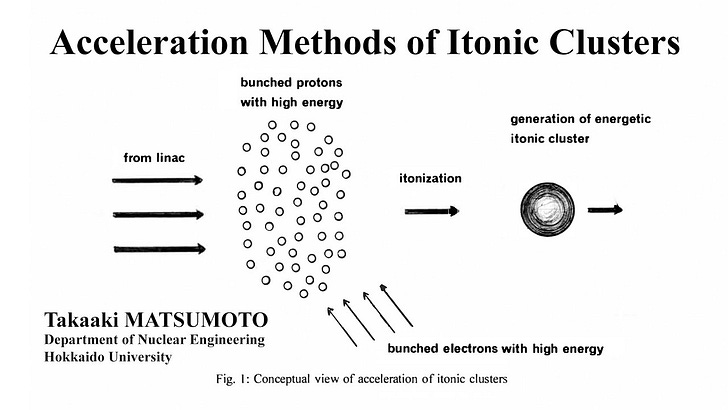
Acceleration methods of Itonic clusters
from Remote View Hosted by Bob Greenyer
This is a brief overview of a presentation I recorded on 30th December 2020 called “Acceleration methods of Itonic clusters by Takaaki Matsumoto” At the 25th Linear Accelerator Meeting in Japan (July 12-14, 2000), Takaaki Matsumoto discussed the extraordinary capabilities of what he called 'Itonic Clusters'. The behaviour of which, he said, resembled that of natural ball lightning. Key points Right from the outset of the paper, in the abstract, Matsumoto notes that: new physics could be expected with an accelerated beam of the [itonic] clusters What he is stating is obvious if you think about it. Typically linear accelerators accelerate individual particles (including sub-atomic) and ions, such as protons, electrons and helium nuclei. What is proposed, in this paper, is the opportunity to accelerate a large package of matter, at the same time. He notes that these itonic clusters have properties very similar to natural ball lightning and this is interesting because I have argued that condensed coherent matter like phenomenon, occur in VEGA and other LENR experiments and have wide implications. He then states that as these itonic clusters are negatively charged, they are able to be accelerated in a linear accelerator. What he is effectively suggesting, in 2000, is the ability to create a condensed coherent matter beam, but in a way different to that proposed by Lockheed Martin in their 2013 patent. Matsumoto also details all of the various reactions he has observed with Itonic clusters, such as: * gamma-free fusion of deuterons to helium 4 * Stepwise transmutations involving addition of protons or electrons * Many body fusion reactions * mini neutron star formation * electro-nuclear collapse and * electro-nuclear regeneration He then concludes by re-stating that new physics and new applications will be made possible and gives the example of producing and colliding tiny black holes. It is known that colliding black holes produces gravity waves. So with that, I encourage you to look at the video of my presentation, it has a lot more detail in there and examples and also there are references given at the end of this article. Some examples of similar observations Itonic mesh clusters White hole exhaust Cold fusion stars Ultra dense hydrogen crystals References * Acceleration methods of Itonic clustersProceedings of the 25th Linear Accelerator Meeting in Japan (July 12-14, 2000, Himeji, Japan) Takaaki MATSUMOTO Department of Nuclear Engineering Hokkaido University * Matsumoto Papers collection * Relationship between the research of Nikola Tesla, Winston Bostick, John Hutchison and Ken Shoulders [see references in video description] * Cold Fusion Experiments with Ordinary Water and Thin Nickel Foil, Takaaki Matsumoto, Fusion Technology, 1993 * MFMP Hutchison Effect Sample 'Fracture' - SEM & EDS * Observation of Stars produced during Cold Fusion, Takaaki Matsumoto, Fusion Technology, 1992 * ECCO - Macro photography of 'strange radiation' tracks in fuel container * Exotic Vacuum Objects in various LENR systems * Physical evidence of EVOs in Correa and Chernetsky devices? * SPACE. EARTH. HUMAN. - Dr. Alexander Parkhomov, Fellow of the Russian Academy of Science * Video Recording of Long-Lived Plasmoids near Objects Exposed to Remote and Direct Effects of High-Current Pinch Discharges, B. Yu. Bogdanovich, N. V. VolkovN. A. Len’, A. V. Nesterovich, Technical Physics, April 2019, Volume 64, Issue 4, pp 465–469 * Disruptive - Striking evidence making the core of LENR, [direct link to Bogdanovich et. al. like cluster] * EV - A Tale of Discovery, Kenneth R. Shoulders This is a public episode. If you'd like to discuss this with other subscribers or get access to bonus episodes, visit remoteview.substack.com/subscribe
Embed this episode
No transcript yet.