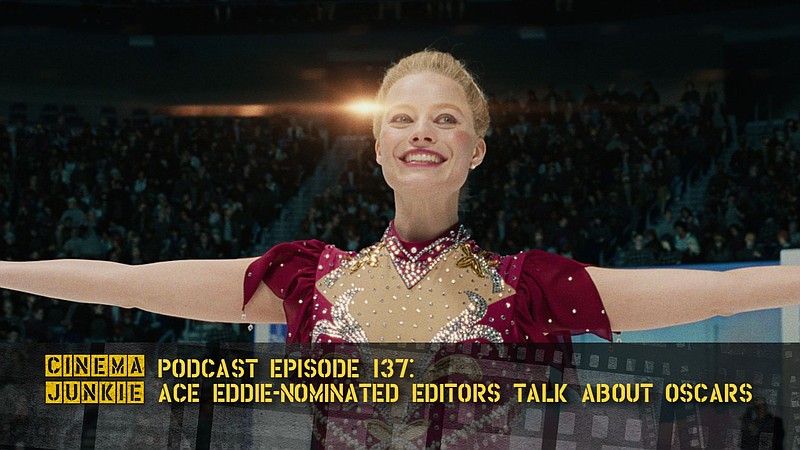
KPBS On Demand is supported by the Museum of Photographic Arts at the San Diego Museum of Art, presenting Cecil Beaton's Fashionable World through January 10. Spanning the 1920s through 1950s, the exhibition includes fashion photography for Vogue, portraits of Hollywood stars, and more. Welcome back to another edition of KPBS Cinema Junkie Podcast. I'm Beth Accomando. Film editors don't get enough love. I'm sure there are directors and actors who appreciate what an editor can do, but film editing is one of the most misunderstood and least appreciated of the craft categories. When an editor does their best work, nobody notices. And nobody should notice, because like I said, the editing is that element which kind of invisibly strings it all together. It's easy to see what an actor does in a movie, or what a cinematographer or a makeup artist contributes to a film. But to the average filmgoer, the editor is merely the person who lets a film run too long or fails to match a cut. Yeah, I mean, I think a lot of people think that editing is...
Sometimes as simple as cutting out the bad part or just doing what the director wants. But an editor can significantly contribute to a film's storytelling. Take Elmo Williams' work on High Noon. He added repeated shots of clocks ticking down to the 12 o'clock hour and made the film play out in real time to add tension to the story. Some editors form longtime partnerships with directors that result in stunning collaborations, as with Martin Scorsese and his editor Thelma Schoonmaker. I think that the fact that we collaborate so well, that as I said, it doesn't become a battle of egos. And that's, I think, why we get along so well. He knows that I'm going to do the best for his movie.
And that's the way we shape this raw material, very much the way a sculptor takes a lump of clay and shapes it into a portrait of someone. So I think people may not understand how raw the material is that comes to us and what we have to do to manipulate it and cut it to make it work. I can't tell you how much joy it gave me to see Frances McDormand play a film editor in the Coen Brothers' Screwball Valentine to Hollywood, Hail Caesar. Hello, Cece. Oh, hi, Eddie. Want to lace up what you got on there that we dance? It's up now. I'll put some music on it.
We see her masterfully rack up film on a 35mm upright movieola, slapping sound onto picture and running a scene for the studio head. It's not just a nod to that person who sits in a darkened room all the time, but also recognition that from the beginning, women were working as editors and proving their value to a production. Plus, it points out the dangers of wearing a scarf on the job. Mission, wear scarves. But since editing still seems to be something of a mystery to many, even to some who work in the industry, I'm going to talk with some brilliant editors about their work on this year's Oscar-nominated films. For this podcast, I'll speak with a trio of editors who were all nominated for this year's American Cinema Editors, or Ace Eddy Awards. The editors are Tatiana S. Regal for I, Tonya, Paul Matchless for Baby Driver, and Gregory Plotkin for Get Out. Ace has been celebrating the art and craft of editing since 1951. It recognizes that an editor can control the pace of a film and craft a performance. Editors can also begin working as soon as shooting starts and stay with the film all the way through post-production.
Regal and Matchless are also both up for editing Oscars this year, while Plotkin worked on the Oscar-nominated Get Out. All three discuss the challenges and rewards of editing in a new digital age. And all three display innovation in dealing with narrative structure and storytelling. And for Matchless, there was also innovation in the actual process of how Baby Driver was assembled. Whether you're a casual filmgoer who's just curious about what makes a well-edited film, or if you're a filmmaker who wants to learn more about the craft of editing, these skilled artists will provide enlightenment about their profession. First up is Tatiana Regal, who spoke with me the day before she won the Eddie Award for Best Edited Feature Film Comedy.
I began by asking her how she ended up in the rather unglamorous job of a film editor. Not very many people know what editors do, and I certainly didn't when I first started. But when I got out of college, I moved back to Los Angeles, knew I wanted to get into movies. I just didn't know what I should do. So I sort of created this list of possible jobs in my head and went through and crossed off all the ones that I didn't think I would be appropriate for or interested in, which kind of left me with a very short list of one, which was editing. And that kind of turned out to be a perfect combination of both.
sides of my brain, very creative and yet very technical, which suited my personality. And my father was a professor at UCLA when I was growing up, and my mother was a school teacher, and I grew up in L.A. and saw films being shot all around, and I was fascinated by it, and I loved going to movies. And then eventually, when I wanted to try to find a job, I was asking people, friends of friends of my parents and stuff, if they knew anybody, and developed this list and finally got a job, in quotes, working for free in exchange for training on a very low-budget feature film called River's Edge. where they taught me, you know, how to sync dailies and code and log and all of the things that an apprentice and assistant editor does. And I just fell in love with the job. Looking at your credits, you had some directors early on that you worked under that would seem to give you a lot of interesting perspectives because you worked on a film that Alan Rudolph directed, that Oliver Stone and Quentin Tarantino. I mean, these are all directors who, their films feel very different in terms of kind of their narrative structure. So how was it working early on with directors like that? Oh, it was wonderful. It was so fortunate.
Not just the directors, but the editors. When I was an assistant, I got to witness remarkable relationships and wonderful collaborations between those directors and their editors, which was a graduate film school class to me. The directors are amazing, and I was very lucky. Some of that is just dumb luck, and some of that is trying to search out the filmmakers that I really like and try to work with them. But yeah, I mean, for example, Quentin Tarantino, I worked on three Quentin films with Sally Menke, his longtime editor, and I just tried to be a sponge and watch and learn.
You mentioned Sally Menke, and one thing that had always impressed me about editing is that from a very early time, women were recognized editors early on in the industry. And that seemed, for me, like growing up when I was a teenager, it was neat to see women in those roles kind of being featured. Yeah, it's really interesting. There are a few, and there are pretty famous relationships between directors and their female editors, Gwen and Sally, Martin Scorsese and Thelma. It's wonderful. I think it's a very, very unique collaboration. I think it's something that's very important to have a director and an editor that obviously have the same taste and sensibilities and yet have different histories that they come from and points of view that they can bring to the film. If you're sitting in the room with somebody who thinks exactly like you do, I just don't think you're going to get as good a story told. Whereas if the director and the editor have a real collaboration and use each other as sounding boards and build creatively on top of each other, which happens when you think a little differently, when you come from different backgrounds, you just end up with something so much more rich. And it's really fun. Having said that...
There aren't that many women editors. Our union, the Motion Picture Editors Guild, I think is only around 23% female. And what I understand, many film schools now are really sort of 50-50. And something happens pretty early on in the process where I think women drop out of these careers, either because of family or having children or whatever, but I think more so because of a lack of opportunity. And I think that's what's...
coming forward right now with a lot of conversation that I think is totally going to be very helpful. Yeah, I mean, it's still the minority, but I just remember seeing editors like Dee Dee Allen and Verna Fields, and I wasn't seeing women cinematographers or that many women directors. Absolutely. Of all of the departments, editing is definitely the best. It's not equal yet, but it's definitely better than cinematographers or composers. I mean, name the last female composer. It almost never happens. Yeah, that's true. It's definitely a field that makes it a little easier. Editing is something that I think most people going to a film, just watching,
don't really understand what it is. So is there one kind of misconception you'd like to address? Is there something that you get asked a lot and go like, yeah, that's not really what it is? Yeah, I mean, I think a lot of people think that editing is sometimes as simple as cutting out the bad parts or doing what the director wants. I mean, I get the material that they've shot. I work as they're shooting, and I get the material the next day. And I watch the dailies, and I go through and pick performances. I pick the angles that are used, and I assemble the scene, you know, from a storytelling perspective. So I have to have an understanding of that. I have to have an understanding of performance, of camera, of all of that. And I want to find the takes and the scenes that are emotionally real to me.
and assemble them. And then I start working with the director when they're done shooting and we go through all of that. But the editor has a tremendous amount of influence on what that movie is. There are times where I can take a line reading from one take and put it with the visual of another take. Sometimes I only use a word from another take and put it in. I can manipulate time by expanding or contracting, giving more pause between dialogue to give something gravity or speeding something up to give something tension. That's really what it is. It's like I've sometimes described it like if you're sitting at a dinner table and there are a number of conversations going on at that dinner table.
If you really try to pay attention to where your eyes go, you don't know exactly when somebody's going to start talking, somebody starts talking, and then your eyes move to them. Sometimes you're looking at the other end of the table and you see two or three people having their conversation. Sometimes you see what's happening underneath the table, maybe somebody's playing footsie or whatever, or you watch somebody above reach for the salt shaker and do that. If you imagine those are all different camera angles that are telling the story of your experience at that dinner, and everybody from every different angle has a different experience. And that's what editing is. It's where your eyes go to tell that story. And I think people don't quite understand.
the idea of pacing in the sense of, you know, they're very conscious of some action scene that's cut fast or getting impatient with a film that goes on too long. But I don't think they appreciate when an editor chooses not to cut or to let something play out and that that's as much an editing choice as cutting fast or something. Absolutely. And that's always the test. I mean, and we screen it for people and try to see what works. For example, there's a sequence in I, Tonya, that I love for that exact thing for when not to cut, which is...
There's a scene between Tonya Harding and her mother. Nothing's ever your fault. You skated like a graceless bull dyke. I was embarrassed for you. They're sitting at the table and it escalates into an argument very quickly and her mother is very mad and starts grabbing stuff off the table and just heaving it across the room at Tonya, towards Tonya. You fucking alienize at me when I'm talking to you. I didn't roll my eyes at you. You fucking... Selfish bitch. You fucking crazy. You fucking that mustache. And eventually one of those things that she picks up is a knife and throws it at her. And the whole audience gasps. You fucking whore.
It's so unexpected. And the characters don't even expect it. They're both shocked that it happened. And then there's just holding and holding and holding that creates this tension where you don't know the audience member and honestly the characters. You feel like they don't even know what the other person is going to do next. And you cut back and forth between that slowly, expanding this time, just to the point where I like to describe, just before it breaks.
And it's just creating more and more tension. And then the way that tension is eventually released is by a cut to a scene that happens to be a very funny line. Oh, please, show me a family that doesn't have ups and downs. And it is such a tense, unexpected, brutal scene that you're watching, and then it just gets broken in this wonderful way by this humorous moment that is a release and lets you move on. And that is something that's created in editing. I, Tanya, is the film that you've been nominated for an Ace Award for.
Talk about the particular relationship you had with the director, Craig Gillespie, who you've worked with before. But talk about on this particular film, like what was the dynamic in terms of the script, the director, and kind of how your work played out in it? It's very nice because I've actually worked with Craig Gillespie now off and on for the last 10 years. We've done five features together in one pilot, and it is a real luxury to work with a director that you know. You know, it's always scary because you're, if you've not worked with a director before because you're presenting your work to them and you don't have a relationship and a trust and a shorthand.
to understand exactly what they're going for, and vice versa. So working with Craig was just an absolute thrill. It always is. We understand each other very well. We have the same sensibility, the same sense of humor, and yet we come to it from very different places and can really build and add to the movie. I, Tanya, is a film that really plays with narrative structure. For a film like this, how much of it is that kind of jumping around and changing kind of perspectives built into the script, and how much of that comes about during the editing process? Yeah, that's an interesting question. It's a little hard to describe. The script was fantastic.
and absolutely had a lot of that built in. What was really added in post and sort of worked with is that there are these interview sequences. Originally, Jeff and Tanya wanted to take out Nancy Kerrigan. Take her out. And I was the one who popped up and said, there are other ways to disable people. So, you're welcome. I mean, at 27, I was the most hated man in America. Maybe the world. With a mustache, I still can't apologize enough for. My name was a verb.
Like, if you bash someone in the kneecap, you'll glue it up. That was cool, though. There are interview sequences, there's voiceover, and then there are situations where the actors sort of turn and break a fourth wall and talk to the audience. All of that was scripted as just on-camera interview. And so we then had to work and weave this material in and out of the scenes by switching some of it from on-camera to voiceover and in these certain situations to breaking the fourth wall, which is just a very delicate little dance to go through and figure out exactly what that's supposed to be in the correct way to convey what is a very emotional and tragic story for many, many of the parties concerned, and also a ridiculously absurd and funny story, working with a director that you know.
It just makes it that much easier because I knew what he was going to be going for based on other films that we've done. The film feels really fresh in terms of how the story plays out. Did you feel that you were finding new challenges on this film that you hadn't had in other films? Yeah, we would laugh about that a lot, actually, because we felt like we had this license to sort of break every rule of filmmaking. We did a little bit of everything. I mean, there are different formats used. There are different framings used. There are split screens. There's jumping around in time. There's voiceover. I mean, there's just all sorts of stuff. And so it really allowed us to try anything that we could come up with.
that oddly worked somehow and didn't feel like we were doing something not organic with the movie because there were just so many different elements. And it was fun. I mean, surprisingly, surprisingly fun to do without being constricted by, oh, you know, it's a little weird to use a split screen here because we've never done it before. It just worked. because I'm a film critic, I got a screener early on because we had critics voting. And I looked and I was going like, I don't know if a story about Tonya Harding is like really what I want to see. And I popped that in and I have to say within seconds, like it had me hooked. Well, you know, that's the exact same feeling that I had when Craig called me and said, hey, I just got this script that I might be directing about Tonya Harding. I had that exact same sort of, I had a deflation. Like, really? That's what you want to do next? Why?
And then I read the script and I immediately also, I was like, oh, I get it. This is not at all what I expect it to be. And I think that's one of the most unique things about this film is that a lot of people have, and it's sort of the point of the film too, a lot of people have a very preconceived notion of Tonya Harding. Generally, people either love Tonya or are not big fans. Just like people either love America or they're not big fans. Tonya was...
Totally American. Because of what we've been told, what we were told 25 years ago by the media and that story, and what we remember over the course of the last 25 years. There's a line in the movie that one of the characters says, yeah, a lot of people thought Tanya hit Nancy herself. And I remember when I read that line, I was like, I thought... case. It's not the case. But you just misremember history. And I think that this is one of the really unique things about this film is that it's not trying to solve a mystery. It's not trying to tell you that something that you thought is wrong. It's not trying to absolve anybody or whitewash anything that happened. It's just trying to give you a little bit more perspective about who these people were as people, a three-dimensionality of who they are rather than who we were told to think they are. And I think it just makes it more fair. Most people's impression of me that I'm a real person.
You know, I never apologized for growing up poor or being a redneck, which is what I am. You know, in a sport where the friggin' judges want you to be this old-timey version of what a woman's supposed to be, for being the first U.S. woman to land a triple axel. Everybody going into that movie feels differently when they come out. than they thought they would feel. That doesn't mean it's changing your opinion. You just feel very differently. Well, what I thought worked so well is the fact that you're dealing with a story that's kind of this tabloid headline and this story that you remember mostly through a lot of quick media cuts and things like that. And the format that's chosen to tell it kind of emphasizes all those kind of elements. So it's like the style of telling the story perfectly matches kind of the content of it.
It does, yeah, and that was the really unique tactic that the writer took. He watched the 3 for 30 documentary about Tonya Harding, and she thought it was such a fascinating story, and decided to find her and interview her. And so he did, and then he decided to do the same with her ex-husband, Jeffrey Lully, and interviewed him, and they had, as it says on the very front card of the movie, wildly contradictory stories. And when he was sitting there listening to Jeff after hearing Tonya, he was like, oh my goodness, this is exactly how I have to tell this story. And it works so well. You know, you not only have them, but you have other characters telling their point of view.
It just makes it extremely unique and quite fresh. and unexpected. Looking at your credits, you have a mix of films where there are some films that are kind of action and horror. You worked on Fright Night, but then also kind of small indie films like The Way, Way Back, where it's more about character and dialogue. What are the different challenges in working in those kind of different films? I really enjoy working on different types of films. It keeps my job very, very interesting. I think that editors, like actors or writers or directors or anybody, can very quickly become typecast as a particular type. You know, that's the horror person, that's the action person.
you know, whatever, and then the comedy guy, you know, whatever, you can get stuck having only those opportunities to work on and not being able to break out of that. I've tried to sort of actively, as much as anyone can control one's own career, try to shake that up as much as I can and work on different kinds of films. Mostly also just because I like different kinds of films. I go to all different kinds and it's interesting. I want to work on the same movie over and over again. They're very different. You know, a small little indie is a very different experience than a big studio movie. Neither is better or worse. They're just very different. You know, in a big studio movie, there are many, many people, more people involved.
And, you know, you sort of have to please a big team of people because they're going for a specific thing. Whereas on an indie film, like the way, way back, and certainly I, Tonya, was this way. It was very much an independent film. We are left much more alone and really get to make, it really becomes. kind of more of a filmmaker's thing. It is the film that the director wanted to make, or at least much more close to that. And it's wonderful. It's really, really wonderful and refreshing. It's oftentimes a lot more difficult because the schedules are much shorter and the budgets are much smaller, and you have a lot of constraints that way. But it's a very unique and wonderful and gratifying way of storytelling. What is it about editing that you personally just are the most attracted to? What is it about the job that kind of it's like, this is exactly why I love doing it?
It's very challenging, and it's really rewarding. And it's one of the few positions, besides directing the movie yourself, where you... You get to have such an impact on the movie. On a set, there are 100-plus people all grasping at the director for their attention and getting answers and this and that, and you have the time schedule constraints and everything, and you're just frantically trying to get everything done. In post-production, after it's shot, you're sitting there in a room with the director, just the two of you, for the next six to nine months together, and it's a very, very intimate, collaborative way of working where you get to really be precise and try and experiment.
and be very vulnerable about the material and try things in a safe space and really create and make a movie. That's what editing is. It's a lot like writing. People have often described it as the third rewrite of the script, and you don't know what that's going to be until you're actually in there working on it. The movie that is made is often and usually very different than the movie that is intended or thought would be made, and almost always for the better. It's always very, very fun to get to know the movie. You don't know what it is. It's like being pregnant. You know and love your child.
And then when they're actually born, you get to actually meet them and find out what their personality is. And it's the same with the movie. On I, Tanya, in particular, do you remember any particularly challenging sequences or any ones where, like, you went one direction and then just completely had to kind of revisit it and go a different way? Sure, yeah. Well, there were many challenging sequences, and that was a very fun part of this particular movie is that there are all kinds of different things. There are the skating sequences, which are just great fun and tremendous personality in each and every one of them. And then there are dialogue sequences, which are really fun, and you sit and you...
work with the pacing and the performance and you can change anything from a line reading to a little eye movement which can change the message of the scene. I think the most challenging thing in this film overall was trying to Trying to work that tone, you know, because it's a pretty harsh movie in certain ways with the domestic violence and stuff. And it's difficult. It can be a really brutal, brutal, honest film in that way. Also juxtaposed with this absolute absurdity of the story and quite comical and funny. And it's a hard dance to go back and forth between that appropriately with respect and good storytelling. So doing that and working with the interviews and the voiceover and this breaking the fourth wall and stuff like that took time.
practice and screening it for people to make sure that we had all of the right elements in there. Well, you mentioned tone and that's what you guys nailed. It was such a, you mentioned dance and tone and it was such this like tight wire, tight rope act where going a little too much this way would have been wrong and a little too much that way would have been wrong. But you... You guys pulled it off. I mean, that's what was so impressive about the film is that you found yourself laughing and then being aghast and then, you know. And then having compassion for Tonya Harding, which, you know, I don't think anybody thought that they would be able to have, you know, going into it. Yeah, it's interesting. You know, the same thing happened with the first film that I did with Craig Larsen, The Real Girl, where we used to literally say if we'd gone five degrees left or right, we would have ended up with a disastrous situation. And it's exactly the same with this film. It is a dance. It's a very, very delicate dance. I think it worked.
Well, and is it difficult as an editor in the sense of that tone is so hard to get, and I think the editing played a key role in getting it, and yet... part of your job is to be invisible almost. It's like if people notice what you're doing, maybe it's, so you're almost working to make your work not visible to the public. Absolutely. I mean, you can do that quite literally by, you know, in some of the skating sequences, we are switching back and forth from Margot Robbie, who absolutely knows how to skate, but is not a professional Olympian skater. We have to switch seamlessly back and forth from her to our double, who is a professional skater, you know, without seeing that. But you do that, yeah, you do that with every scene. If you're paying attention to the editing too much, it's...
often because the story isn't gripping in some way, or you're confused or bored or whatever, and you start to watch other things. I mean, it is supposed to be invisible for the most part. Certainly there are some films that are flashier than others, but it's supposed to be, you know, you always, always, always want to cut for emotion. And if you can keep that emotional thread going through the whole scene or film, then what people, the literal cuts, people aren't really paying attention to. And who are the editors that you admire or who you feel have influenced you? Oh my goodness, there's so many.
Well, obviously Sally Menke, with whom I worked for years, I thought she was just phenomenal. really great. D.D. Allen, of course, Martin Scorsese's editor, Thelma Schumacher, amazing. There's so many. I happen to have just mentioned female editors, but there are so, so many marvelous. Let's see who else. Hal Ashby used to be an editor before he became a director, and I think his films are very influenced by that. Dylan Titchener, Michael Tronick, who's just fantastic. Everybody brings something to the film that they work on, their own sensibilities and perspectives, and there's so many really wonderful editors. If you're lucky enough to have great material.
to work on. Sometimes a bad movie can be really well edited because you have no idea how bad it may have been. Or there are good films out there that probably with certain editors weren't that great and had to be reworked by others. It's a tough thing. We never know what the material is that we have to work with. It's a hard thing to judge. That's why I feel so bad for editors. I fell in love with editing because my uncle let me cut a TV commercial once because that was his business. I was like, man, putting this thing together was so much fun.
And then I started to appreciate it more going to movies and seeing, you know, trying to examine what the craft was. But I've always felt like I only hear people talk about editing usually when they go like, that film was too long. It should have been cut down. Yeah. And sometimes that's not our choice. In fact, often it's the director who is just quite attached to something. And sometimes we're just sitting there going, oh, why is this still here? If you could pick, you know, a couple films or three films to recommend to people as examples of like, here's, watch these films and you're going to learn something about the craft. Are there any that you would point to?
Yes, I would. Let's see. Well, Harold and Maude, I think it's just fantastic. I think that's another film that has this crazy tone that is wonderful. It's dealing with some very serious subjects in a very funny and peculiar way. All That Jazz is a really interesting movie, editorially. Apocalypse Now, fantastic. The Godfather. Oh my gosh, I could go on and on. You know, if people are curious about it, I would just try to...
But find the films that, you know, those lists that are floating all over the Internet of the top 10 or 20 movies and study them. Watch them a couple of times. And if somebody is wanting to appreciate editing more just from a filmgoer's point of view, you know, the Oscars are coming up. People are always going like, you know, why did that person get nominated and this person didn't? If somebody wants to go into a film just to kind of focus on editing and think about it, what should they kind of go into a film and focus on, you know, as a second viewing, saying like, all right, I'm going to look at this film and see how it's cut. What should I be kind of paying attention to?
You know, I think a lot of people, you mentioned earlier that people complain that films are too long. You know, if you really wanted to study it, try to figure out what you would take out and what would happen to the movie if you did take it out. Is it still going to tell the story? Well, is it going to convey everything that you wanted to convey? Or all of a sudden, you know, a lot of times we have screenings and people make these somewhat flippant comments of like, oh, you could take 20 minutes out of that. And I was like, really? Sit here for 20 minutes. That's a long time. If you actually sit with a stopwatch, that's a long time. And that's a lot of information if you start hacking out 20 minutes of a movie that you won't get.
So it's, that's the challenge. It's like really what you need. Same thing is true with, you know, if you're writing a paper, you know, you go through and you have, if you are trying to make that as efficient as you possibly can, using as few words as possible, but still conveying the emotion and story. How do you do that? It's a, it's an exercise. Well, I was interviewing the director from Bone Tomahawk and he, which I love that film. And he said,
he had some people criticizing it and saying like, well, you know, you should cut it down. There's like all these scenes that really don't have to do with the story. And they point to this one scene that seems kind of inconsequential. It's where the two characters talk about how do you read a book in a bathtub? And, you know, and his point was, he says, you know, that might not have to do with moving the specific plot forward, but it's defining the characters in a way that you need to know. Otherwise, other things are going to play wrong if you don't. Exactly. Exactly. That's precisely it.
And things may, you know, on the surface may appear extraneous in some way, but if you really start to analyze it and see what's in that scene from a character perspective or a story perspective, it all becomes pretty crucial, or should be. If it's not, if it's not advancing the story or the character, there's a very good chance that perhaps it should, you know, get trimmed out. And that's the process that you go through to find that sweet spot of, you know, giving yourself time. You want to have some breathing moments in a movie, too, to just sit and ponder for a second before you get thrust into the next scene. But you also can't do that with everything. And do you have any advice to people who are thinking of going into editing? Is there anything that you would suggest they do or don't do?
Yeah, I would suggest that they cut. Honestly, I think it's a lot like painting or dancing or playing a musical instrument. It takes practice. You have to come up against those challenges and those problems and work your way out of the maze and solve them in some way. So cut everything that you can do. Work on anything and everything and practice. Whatever that 10,000 hours to become an expert, you really need that. And just practice, practice, practice. Find the films that you like.
Study them and try to understand why and listen to other editors describe how and why they do things. And if you are fortunate enough to actually get into the business and start working in the business, talk to editors about how they did it and why. Sit in the room with them when they're editing a scene and have them explain why they're making those choices. That was what I got to do. I got to sit in those rooms and listen as a fly on the wall to an editor and a director going through their creative process, and it was invaluable. And can you learn something from watching a badly cut film? Yes, you can.
If you can tolerate it, yeah, you can. Because you start to watch. You start to feel intuitively, this is not where I want to be. I don't need to be, I'm too far from the character. I'm too close from the character. I already understand this information. This is redundant. This is unclear. This is monotonous. You know, whatever it is, you have to just sort of really pay attention to each and every moment, every single line. I mean, we will sit and analyze every single line. Maybe it's the same line, but just said with slightly different grammatical flair or slightly different tonal flair.
Each one means something completely different. Is it more important to see the person say their line, or is it more important to see the reaction? of that line, somebody listening to that line. Those tell two very different stories. Well, it's interesting because sometimes, I also serve on selection committees for films and for student films, and sometimes people will complain. They'll say, like, well, you know, they didn't match cut that or something. And when I had the chance to interview Thelma Schoonmacher, her point was, she said, you know, matching a cut is the least important thing to me. It's like, I need to match the emotion or I need to match the performance. Absolutely. She's 100% right, and I have watched her films myself many, many times and realized that's exactly what she goes for, always. And it's amazing. When you really sit and watch...
You know, not just her stuff, but a lot of people's work. Matching is the least important. If you are moving on a through line with emotion, story, and then continuity is at the very last. You know, but it's always emotion, emotion, emotion, then story, then continuity. Yeah, I noticed that I recognize badly matched cuts only when the film is bad. And it's like, there's nothing else. It's like, I'm not interested in the story. I'm not interested in the actors. I'm not interested in the character. Oh, his arm's in a different place, and their hair is part of the difference. Like, you're suddenly looking at... There's one scene in I, Tonya, that is... There's actually two moments in I, Tonya, that have...
There's one scene that has just tremendous mismatches and almost nobody sees it, certainly not the first or second time going through. And I always laugh at that once I point it out to people, to my assistants and stuff. And they're like, oh my God, that's amazing. And there's another that had a big continuity error. Now I'm challenging people. Oh gosh, don't go look for it. You know, with a set issue that we didn't see for ages, for months and months. And all of a sudden the director and I looked at each other and were like, hey, wait a minute.
And we're like, oh, well, see who sees that one. You know, it's so difficult to have that. It's impossible. You know, things are shot, you know, hours, days, sometimes weeks apart from each other. You're always rushing to get through stuff. And then the actors themselves are in emotional moments. And it's very hard to do things the exact same way all the time, physically as well as emotionally. Trust me, people always think that, when you asked earlier about a misconception about editing, they think that we don't see those things that they've discovered, the mismatches. Trust me, we know all of them. We know all of them.
Sometimes a choice, sometimes we have no choice but to use that material, and sometimes it's just like, you know what, that's not the important thing. We've just got to keep this emotion going. Well, I want to thank you very much for taking some time and for your work on I, Tonya, which was brilliant. Thank you very much. I'm glad you enjoyed the movie. I really hope people give it a shot. It's not what you expect at all. I think people are always quite pleasantly surprised. It's a tough one, but it's an important one, I think, and I really appreciate it. Thank you very much. Well, I think with stories like this where the story content itself can be kind of grueling because it deals with abuse and things like that.
But the filmmaking is so exhilarating that it kind of counterbalances whatever kind of down you might feel from the story itself. Yeah, I agree. I agree. Wholeheartedly. That was film editor Tatiana S. Riegel, who received an Oscar nomination for her work on I, Tonya. Next up is one half of the editing team for Edgar Wright's revved-up baby driver, Paul Matchless. Matchless recalls that his interest in editing dates back to when he was very young. When I was about five or six, my father was a producer and a copywriter for an advertising agency in Melbourne, Australia, which is where I'm originally.
And when I was about five, he basically brought me along. I guess it must have been school holidays to witness an edit that he was doing for a commercial. I seem to recall that I basically sort of wandered into the machine room. I was confronted with the sight of these for the time, because we're talking probably sort of mid to late 70s, huge videotape machines about him taller than me. belching out sort of noises and sounds, and it was a complete epiphany for me. It went along the lines of, I'm not quite sure what's going on here, but I want to be a part of it. But alongside that, which was more like the technical side of wanting to be in the business, there was just the side of, once again, my father, because he was interested in the golden age of Hollywood, and so I grew up watching a lot of movies from the 30s and 40s, and then I'm old enough.
I hate to say it to remember being taken to see the first Star Wars when it was out, and I remember the excitement of being in that environment and witnessing that. And it was just a general move to the fascination of how it was put together. That grew over my school years. Basically, I'd gotten to a university degree, but just before that started, I did a week's work experience. at a television station in Melbourne, and they offered me a job off the back of that. You know, I was just on the studio floor, you know, doing props and cable bashing, but it was a start. And so I sort of deferred the university, which I'm still doing now, just in case the career backfires, and sort of basically went up the ladder very slowly into sort of tape library, assistant editing, and then editing. But I always found that process fascinating, and that's sort of how I learned, by teaching myself and really just watching tons and tons and tons of movies.
And when you started editing, what was it about the actual craft of editing that appealed to you or that satisfied you from a creative point of view? Oh, I think certainly the storytelling aspect of it. And I found that it was fascinating that editing really played such a large part in, you know, I wouldn't say manipulation, that sounds like quite a strong word, but in terms of moving the audience or the viewer. to where the director wanted to take them to, as in being a musician myself, my other little hobby was learning piano when I was a kid and then playing in a few bands back at home as I was getting older. So I was very aware of timing, and I was very aware of cutting rhythms and timing and realizing how a few frames either side could make all the difference. And I found that kind of stuff, the minutiae of it, the detail of it fascinating. And it was always an area that I wanted to pursue.
People were saying, oh, sure, you want to go out and be a director, and that's the big idea. I said, no, no, no, no, I'd like the behind-the-scenes stuff. And then, like I said, I went from a more technical editing background to sort of pure. But I loved the sort of combination or what you went through to actually put a scene together, to tell a story, and to have that kind of inner moment in your head where you knew the cut had to be. And it was one of those things, once again, that it's just a feel thing, and I seem to...
have muddled through reasonably well, because obviously they're still being asked back to do these kind of things. But I think that was it. It's what editing brings to the overall, you know, the final product. And of course, it isn't just the editing. You're also responsible for help, potentially for helping out in the sound mix, the grade, the effects reviews. And it's obviously an integral part. And, you know, as that grew, when I made the switch from editing television programs to feature films, you know, I really felt the opportunity was there to sort of...
by wings and apply myself to the fullest to try and realise these fantastic ideas, which of course coincided with meeting someone like Edgar Wright, which was completely by coincidence, as most of these fantastic things are, right place, right time, and that really, really... forward in the ways that I probably never would have expected. Well, is part of the appeal for you as an editor also the fact that as an editor, you can experiment kind of endlessly and experiment kind of in private so that you can take wild chances and do things that if they fail, nobody else really has to know. But if they work, you're like, yay. Oh, absolutely. And I think it is all full of serendipity, happy accidents, which I love as part of the editing process, because, you know, as you observe the rushes, you know, you start to think, OK, I can see how the director kind of designed the shot.
that's the establisher, and you sort of move on, and you sort of realize what the vision is of the theme construction. But then, no, you're absolutely right. At that point, you can sort of go, well, what if I try and start things a little bit differently? What if that isn't the first shot? And you, as you say, can keep endlessly tinkering, and there's no such thing as just a bad edit, because even in bad edit, you learn things from it. And so everything that you do, it just gets you a little bit more information as to how you feel you could shape the scene. And it's actually fantastic when you actually offer up when a director...
director comes in and you show them the assemble and actually you sort of surprise them in a way that maybe they weren't going to be thinking because in their head the scene went this way and the scene almost goes that way but there's a few little surprises which actually is one of the joys of having the time to go through everything to find all the little bits and bobs and certainly I would recommend definitely that as an editor you watch through all takes not even just circled ones because there's so many little moments that are worth jotting down and worth remembering and things that you can steal and put somewhere else in the scene you know the amount of tinkering and playing and options and offering up three or four different versions of a scene tell the same story in a slightly different way can be endlessly satisfying. You mentioned that you got to meet Edgar Wright early on in his career. You started working with him on Space, his TV show. Talk about editing on Space, because that show, I have to say, if I had to only pick one show to bring with me to a desert island, it would be that, because it is endlessly enjoyable, and every time you watch it, you find something new. Oh, absolutely, absolutely. And of course, now it's a wonderful little time capsule of what life was like in London, particularly in the late 90s and the turn of the century, which actually almost sounds like an archaic turn now, but I guess...
It's absolutely true. And of course, you know, Space was an interesting show in terms of, you know, studying for Edgar and obviously having written the series with Simon Pegg. and Jessica Stevenson, as she then was. I think part of it as well was them kind of thinking, wow, we've got this deal to do the show on a mainstream terrestrial British television channel. After this, no one will ask us to do anything ever again after this because it's just going to be so mad, so wacky, we'll never get asked back to do anything. So let's try and throw in everything we've ever wanted to include in a series. So if it was like flashbacks or flash-forward or little asides or shifts to little visual cutaways or whatever and references to feature films.
Ryan, did you notice that everything that transpired in those three films, and I mean everything, can be attributed to the actors of one very minor character? Who? The gunner on the Star Destroyer at the beginning of the first film. How come? Well, because if the gunner had shot the pod that C3PO and R2 were in, they wouldn't have got to Tatooine, they wouldn't have met Luke, Luke wouldn't have met Ben, they wouldn't have met Han and Chewie, they wouldn't have rescued Princess Leia. None of it would have happened.
Chaos theory. Everything was thrown in, and I think, really, you can see space as the beginnings of where Edgar's craft as a director really sort of came into its own, and there are some stylistic things there, which, you know, he still sort of calls upon occasionally today. The way that works, Chris Dickens cut the first series, and at that stage in my career, I was an online editor. So I was running a machine made by Discreet Logic called Smoke, which was a finishing tool. And initially, Edgar came in as a client. And I was going to be told, right, starting Monday, you're working with this young guy, Edgar Wright, he's got this show, and we think it's perfect for the machine you're working on, so you're going to start working with him. He and I got along incredibly well. We both realized we had the same sort of really positive OCD kind of attitude about taking the time to get things right. When the time came for the second series, I had gone freelance, because that's from the point that I crossed over from doing online editing, which is more technically based, to pure editing. And I really wanted to make that leap to the kind of editing which has ended up on...
really what I'm doing now. So one of my very first gigs as a freelance offline editor, as the term is, very little CV to my name in that regard, was when Edgar called me up and said for the second series, Chris Dickens couldn't complete the edit. Would I be interested? And of course I said yes, and then dove headfirst into a much more intense method of working with Edgar because it's so full on than online editing. And it was an incredible learning experience, and I loved it. And then I spent the next...
The best part of the next 10 years, working on a lot of British sitcoms and a few music shows and dramas, while Chris Dickens came back to cut Shaun of the Dead and Hot Fuzz. But then by the time Scott Pilgrim came along, I once again got the phone call from Edgar to join him on that and basically been with him ever since. Before we talk about Baby Driver, because that's the current film that you've worked on, I want to talk a little bit more about you working with Edgar on comedy. Can you give a little insight into kind of the approach the two of you took in editing the comedy? Because so much humor in the film is really in the cuts, in the timing of those cuts. I mean, if you cut them differently, you're not going to get a laugh if it holds like a beat too long or something. Oh, absolutely.
And I would say an influence, ironically, of both of us, even though it came from two separate directions, was the Coen brothers, funnily enough. I know Edgar's one of his most favorite films ever is Raising Arizona. Alongside that, I spent many years just watching the way they cut for story and for comedy. I mean, you know, the only way I can really kind of describe some of their editing is delicious because it really tickled for me the senses in that way. I mean, in terms of timing, in terms of just how clever their approach to...
holding things for just the right length, I mean, you can watch their films, and it's a real education in cutting for comedy. And not that, of course, in any way we were lifting the Coen brothers, but I remember thinking it would be great, given the opportunity, and of course, you know, Edgar loves doing comedy as well, and timing is such a big part of that, that has worked into the script. into the way the shots are set up and, of course, ultimately into the editing. But then you see that kind of develops out of the kind of sixth sense that happens when you work with the same director over a period of years and to just be able to combine his ideas with your auditions, which will obviously be the timing that you bring to the cuts and the durations and just looking for those things. And it really makes it at one frame really does make all the difference in those moments. And I know because I've experimented it, it really is, you know, sometimes the funniest way is all down to a frame or two.
And, of course, an audience really isn't aware of why they're laughing sometimes. But, of course, it could be down to the dialogue. It could be down to the acting and the performances. But sometimes the cut can get a good laugh as well. And that's always lovely to realize that you can actually make a contribution to people's enjoyment.
For Baby Driver, I noticed that recently Edgar Wright had posted an image. It was like the front page for his one draft of the script for Baby Driver where he was giving very clear instructions about how you need to hear the music because that was important to the pacing. So on a film like that, kind of talk a little bit about the interplay between what's scripted, what gets shot, what the director wants, and then where the editor comes into play in all of that. Well, you see, Baby Driver is probably the ultimate expression of that kind of combination of sort of music, action, comedy, drama. And that's something that Edgar had basically set out from the very beginning. I mean, he wrote the script with those particular songs in mind. When we were originally sent the script, we were actually sent it as an iPad app. So you would see, you know, you could read the script on the screen, but occasionally there was a little icon which came up on the page that when you pressed it, you would hear the song.
So you could hear the song and then read the theme. And, of course, that helped give you a first idea of how the two were going to sort of mesh together. And then, basically, prior to shooting, the entire film was storyboarded and animatics. So all the big action scenes, there was basically an animatic scene for each of those, which was done with Edgar and a chap called Evan Schiff in Los Angeles. And then when I came on board and I was invited to go and join the crew in Atlanta, we basically filled in the remaining gaps.
And with all of that, with the music which we had got cleared before we'd shot a frame, so we spent all the money up front making sure the music was good to go because we would have hated to have shot it, put it together, only then to find out we couldn't use the track. And then actually of the filming itself, we sort of had this quite complicated system where we would be feeding music into little earwigs that the actors would wear so they could hear music, so they knew how to sort of work in time, in rhythm. Edgar had a feed of music and dialogue in his headphones. And of course, as you may know, I was invited then to join Edgar on set, so to do the on-set editing. And then my role in that regard was to make sure everything fit, because unlike a conventional film where you would cut a scene, make sure it worked, and then you would add the music afterwards to fit the scene, the music was there. It was predetermined. You couldn't just extend a song by four seconds.
Just to make a shot work, you know, you had to make sure the shot worked for the edit and the edit subsequently working for the shot. So I was actually out there on the front lines with the crew and it was actually quite a fascinating mix of production and post-production because both elements had to be satisfied at the same time. We didn't want to get back to the United Kingdom where we did all the post-production once we left Atlanta to find that things didn't work. So my job on set was to make sure that, not that it all worked perfectly, you didn't have to, as I was really doing a glorified assemble edit. But we could make sure that rhythmically, musically, in terms of acting, in terms of camera moves, in terms of durations of shots, everything fit in. So we knew we could leave Atlanta with a good initial cut of the film in the can. For people who are not familiar with editing, this is not a typical thing to happen. Absolutely not. Editing is done in a completely separate environment. And in fact, a lot of editors don't like to see what's going on on set. They're not interested in how the shot was constructed. They just want to see the world of the film through their monitor. So anything else is a distraction to them. And that, of course, is an incredibly valid way of working.
but suddenly your crew, you're doing crew hours, you're involved in night shoots, or you might be dragging a little edit trolley through mud and in rain and in all kinds of environments. And it's a very, very different sort of lifestyle for an editor, you know, and actually a very enjoyable one because you realize that not a lot of cast and crew understand what editing is. You know, for a lot of them, the director yells cut and maybe a year later they'll attend a premiere. But to actually find that there's someone on set who's actually putting the shots together and then at the end of the day, you know, you can review what you've shot and there it is. Sort of cut all the...
the various setups and it's the music and it's fairly tight and people look on with genuine amazement because it literally is that kind of magic art of editing. You know, people understand what a good sound mix is and what a good visual effect is, but editing is a slightly less tangible kind of concept for people to sort of get their heads around. So when they just watch it and see the shots that they've worked on over the course of the last, you know, 10 to 12 hours running in sequence and running in a kind of way that they would expect to see up on the big screen, it sort of looks... It's a kind of wonder and amazement in these people. What I've said is it kind of takes for granted. You realize that it's, you know, a lot of people still think of it as magic and sort of it is magic to an extent, really, what you're capable of doing with editing. Now, on a film like this where it is very precisely laid out in advance, do you still feel you have a lot of creative input?
Oh, yes. I mean, certainly, you know, in terms of the action scene, a lot of that has to be planned out. You can't really just go to a location, plonk down a camera and go, right, how are we going to do this? That has to be thought of and planned. And you've got a second unit crew as well who is also contributing shots and stunt drivers. And these camera angles are all worked out beforehand. So for a major scene like that, very, very little is given to chance. I mean, having said that, Edgar may cover a particular shot with three or four cameras. In fact, on one set up, I think we used nine cameras. You have the shot of the action that's required. You don't necessarily have to use...
the original camera, you might find that one of the other options tell the story better. So, you know, yes, absolutely, you still have, you know, the leeway to try out all these options. And like any good edit, and certainly for the dialogue scenes in Baby Driver, you know, a lot of that was the slightly more traditional way, and of course you would have a lot of flexibility in being able to tell the story. I mean, my personal favourite scene in Baby Driver is actually just after the tequila track in the warehouse, and they're all decamped back to the diner, and it's basically just... sort of Jamie Foxx, Ansel, Jon Hamm, and Aza Gonzalez. And they just basically do a four-way around the table, but it's... Tell me if I'm way off, buddy. You're a style program. Maybe a different wife, maybe kids. You stack your paper, but you say shit like work hard, play harder, but you play a little too hard. You rack up debt. This type of debt doesn't make a white man blush. Maybe you get into a little trouble. Maybe you get your hand caught in a corporate cookie jar. Maybe you leave and run off to the desert. Maybe you put your favorite lap dancer in tow. Maybe you disappear into a world consisting of three things. Money, sex, drugs, and action. Oh, shit, that's well. This is how I look at it. Wait, if you are Wall Street, you're a bigger fucking crook than I could ever be. I go right ahead and speak for the two of us.
You think you know us? You don't. You think you're the last word in crazy? Wait, what did I tell you? You don't want to see my buddy mad. You haven't seen how relentless he is. Because when he sees Ren, you will see nothing. And that was for one of my favorite scenes to cut, just because, you know, I believe you can maintain a level of tension in a straight, quietly performed dialogue scene than you can with some of the kind of major action scenes. That's why I think the film works so well. The inner heartbeat of the film exists through all the dynamics, the quiet dialogue scenes as well as the big action scenes.
Well, that seems great because you do get this sense that there's unrest amongst the group. And the way it's cut with just like some of the beats where you're just seeing a reaction or something kind of builds that tension of is somebody going to fly off the handle here? Absolutely. Absolutely. And I think that's the thing. You never know who's really going to crack.
next and that's all there and there are so many fantastic and that's what Eddie will offer up a lot of coverage and he will allow the actors to kind of improvise and offer up their own little things and that's why it's worth going through all the footage that you're given because you know the actors understand the characters as well and there's so much little stuff unsaid things little looks little glances you just never know who's basically just going to flip out first and it's great to always keep that undercurrent going even along what feels like a regular dialogue scene, you can do it in sound design. So you can have, you know, low frequency rumbles going on that you may not necessarily notice. Sounds that sometimes I'm fond of saying are felt but not heard. You know, and you wonder why you've sort of got this little, not in your stomach, but there are these frequencies out there just helping to sort of keep attention going. So you can do it in the soundscape or you can just hold on a character a little bit too long in the way that, you know, sometimes people get uncomfortable when you kind of stare at a person for a while.
a little bit too long, you know, there's that kind of, why are you looking at me for such a long time? You could do that in an edit, you know, just slightly overplay the edit for a little bit longer than you normally would, and then that induces tension as well. And so it's all those wonderful little tricks and tips to sort of keep an audience on the edge of their seat in the quietest passages as well as the loudest ones. For most people going to a film just in a mall theater or something, I think editing is still something of a mystery, in part because good editing is something that should be invisible on a certain level. Is there some misconception out there, or is there something that you'd want to address to tell that average person, say, hey, look at this, this is what good editing is about, or this is what can help you understand what good editing is? Well, yes. I mean, two little catchphrases that I probably overuse when people ask me questions like that. I've often said that when an editor does their best work, nobody should notice, because like I said, the editing is that element which...
kind of invisibly strings it all together. And people shouldn't realize that every setup, every shot is done effectively individually and pasted together because if it flows, if there's good dialogue going and if people aren't taken by the story, you forget about the editing. But of course, it's the editing that's pushing the whole thing forward and driving the whole thing. So you shouldn't be thinking about it. I think all the other thing that I'm fond of saying in terms of what editing is meant to do is that the art is meant to conceal the art. Along the lines of the first catchphrase, which is probably why I tend to overuse them, you know, editing is invisible. And when you ask people about the editing, they won't necessarily tell you.
what was good about it. But if the point was to make you cry, if it's a weepy and you end up crying, or if it's a comedy and you're laughing, then, well, the edit must have worked because it succeeded in its task. Now, you look at something like Baby Driver, and I guess that's what you could probably call capital E editing, you know, big E editing. Of course, people notice that. And it's there in a lot of reviews. The editing has been constantly mentioned in initial reviews. And of course, here we are with a few small nominations to look forward to because of the editing. And of course, it's something like that, which in this instance, we brought sort of a unique approach.
to cutting. And it's something people have noticed in this instance, but still not noticed in a way that it's overwritten the enjoyment of the film. You can't really say, oh, the editing ruined the film. instance you know the editing was as much a part of the character of the film as any other part of you know the directing the acting the story the music and so when you watch the beginning and you know certainly in the first of the bell bottom the opening chase scene as well as being an entertaining piece of work you're sort of also as an editor setting out your stall to the viewer think this is what you're going to expect to see this is how the film is going to work so you're going to see how things fall in sync and there's an inner rhythm to it and there's interlocking action and dialogue and music and cutting and it's all kind of happening together thank you very much ladies and gentlemen right now i got to tell you about The fabulous, most groovy, Bellbottom. Bellbottom. So it's sort of a primer in the beginning, as well as being an exhilarating chase. It's almost teaching the audience a little bit, this is how we're going to bring you this.
this film. And of course, you know, people have enjoyed the film as a film and have been kind enough to highlight the editing. And certainly in a film like Baby Driver, yeah, the editing is a major part of what made the film the success that it thankfully was. Well, it's like teaching you a language. It's like that first scene teaches you the film language for this particular movie. Absolutely it does, for sure. But I think actually initially, even when we were premiering it at South by Southwest, there was a little bit of uncertainty as well. Will people get it? Will people understand what we're showing them? But actually, after the reaction to that first screening, it was tremendous. And we knew from, in fact...
from that first moment when they burst into applause just as the title sequence started, the Harlem Shuffle, as Bell Bottoms finished, we kind of all looked at each other and said, yep, they've got it. We're not going to have a problem with it. And that was a wonderful feeling to know that Edgar basically, you know, he was vindicated in terms of sort of pushing his idea across and saying, no, no, no, this is going to work and it's going to be great. And it absolutely was. And on this film, you co-edited with Jonathan Amos. What's working in tandem with another editor like on a feature? So in terms of working with John Amos on this, I mean, his brilliance in this is actually the action sequences. He didn't join us until we came back to the United Kingdom. So basically my task was to go to Atlanta for six months and effectively assemble the whole film. And then John came on board and his specific task was basically he and Edgar.
would basically take all the action scenes, the Brighton Rock, Bell Bottoms, and the Hocus Pocus track, the foot-running scene of the shopping mall, and they would do a tremendous pass on that and punch that up to a tremendous degree of satisfaction from how those scenes ended up. My specific role, having then come back to England, was actually then to go through the rest of the film with Edgar and basically go through all the reels, cut the dialogue, check the overall arc of the film. But then we would still check each other's work. You know, I'd be invited into their carding room and say, hey, we've just done a part from Bell Bottoms. What do you think? And I'd give notes. And then once Edgar and I would finish one of the reels, you know, we'd watch them as a trio and then we all kind of give further notes and things. So John, in this instance, really came on board to do what he does best. I mean, he's a very capable editor in his own right, of course, but he's really good at...
at action scenes. I want to go back to Scott Pilgrim briefly because I loved that movie. And I was kind of sad that it didn't catch on with a larger audience. But the editing in that was so clever. And again, it had to be editing that started in the script phase. But the editing in that seems so smart and so fresh and just like moving the story forward in this energetic and just original way. What was working on that like? Well, that was incredible because I don't think anything like Scott Pilgrim has happened before or indeed since.
I wouldn't necessarily say it was ahead of its time. It sort of came out and slightly disappeared into the cracks of that kind of period in the year of 2010, I think, when it was released. However, obviously, I'm very pleased to say that that film, you know, has a life of its own and it just, it hung around and never quite went away and is now being rediscovered by a lot of people and slowly grew into, I mean, you don't sit there thinking, I'm going to be making a very expensive cult film. You naturally want to film the studio, would like the film to, you know, make a tiny little profit. which, of course, wasn't initially the case when Scott Pilgrim came out. But I think because of the story and the combination of the comic act, the comic business, like the on-screen animation, the editing, and all those elements, it's hung around. And it's very gratifying to actually be part of a film that has that kind of longevity to it. So while at the time we may have thought, ah, well, maybe, I don't know, did we boob on Scott Pilgrim? Why didn't people sort of get into it? It found its audience. I mean, it's made its money back, certainly, and it's still...
people still coming up and saying how incredible Scott Pilgrim was and how wonderful for a film to still have that feedback and reaction with an audience almost 10 years after its initial release. Well, I think all of Edgar's films, the thing that's so great is that you can go back and rewatch them and find new things. And part of what's fun, too, is that his references, his pop culture references to other movies, are not always so overt as, well, here's a line that we're repeating from a film that you may have liked, or here's a costume reference. But it can be the framing of the shot or the edit, and that takes you more time to go back and find.
Oh, absolutely. And I think that's the beauty of Edgar's films, is kind of like the watchability and the re-watchability. I mean, you know, it was very, very pleasing to hear Edgar would say, hey, I've heard, you know, I'm getting tweets saying, hey, this is my fourth, fifth... sixth time, you know, going to see Baby Driver because I didn't realize this when I watched it first. And in fact, actually, that's very pleasing and very satisfying because what we wanted to do is we didn't want to necessarily make a film that was saying, oh, look how clever, clever we can be. You know, if you just wanted to watch it as an entertaining, you know, comedy, heist film with some action and some sort of few little scary moments in there, then great. And if you just thought, wait, I enjoyed it on that level, fantastic. But actually, if you do want to re-watch it, you'll just realize that like a...
a clock mechanism, there are so many things interlocking on so many different levels, whether it is the editing or it is the music or it is the way actors just even move props around, how they're kind of locked in and the timing of cuts and lots of little things. If you want to take the time, they're all there to be discovered. We didn't kind of hide them and say, no, we're not going to show you how we did it. They're actually all there. We sort of invited the audience to share in how we... If you didn't want to, you didn't have to and it didn't detract from your enjoyment of the film. And in that...
You know, there's always that thing where people go, hey, I watched Baby Driver for the fifth time. I never realized what happened here was a callback to what happened an hour earlier or this thing meant that. It's wonderful, you know, that the Russian air, you can always open something up and there's something else inside there. And you open that up and there's something else inside there. And to sort of witness taking place and people just really enjoying the making of without sort of, you don't have to tear the film apart. You can just view it and then sort of see all the layers get revealed to you.
And did he give you kind of a screening list of films that he thought you should watch before editing this? Oh, absolutely. I mean, Edgar does make, you know, he makes little kind of taster reels where he will sort of say, you know, this sequence, I sort of had this in mind. And in fact, we've done that for actually almost all of Edgar's films. We kind of do a mood reel just to give you an idea of where, what's going on in Edgar's head, where he's kind of coming from. And alongside that, there is a little film that he makes of about, you know, 40 or 50 movies.
ranging from, you know, even like the 1930s, Busby Berkeley musicals, to stuff from the present day. And he said, this was sort of what I was thinking, or I watched this, I thought that's a really good idea. So have a little look at this, and look at these little elements from each film, and we're going to put it all together. That's what I'm sort of thinking of for Baby Driver. So that's always fun at the beginning, to sort of watch all of that and go, gosh, how are we going to take all these things and make something new out of all these elements? But of course, you do, and it works. And actually, if you think about it, now that I'm thinking about it, it almost goes back to space.
It's like, well, what if you wanted to put all your favorite things that are relevant into one film? So all these little ideas sort of have a little life, and there may be kind of little quotes or references, all very subtle, but they're kind of there to be, once again, to kind of be discussed. And for Baby Driver, do you remember any particular films that he suggested you watch that you really felt kind of helped you find the mood or the tone or something? Oh, well, I know he was a big fan of Walter Hill's The Driver, and certainly movies like French Connection and various things like that were big influences. But, I mean, there were films across.
a number of genres. I mean, the Sugar Land Express was one, because that had some elements of a young couple fleeing the police and various elements like that. So you would just look at all these things and watch them one after another. It made for a very interesting montage of films, and you would maybe get a bit nostalgic about it, but actually you would think, oh, right, okay, so there's just an element of that chase sequence or the way that heist was constructed. And like I say, they're all kind of blended in together, but actually, you know, done in Edgar's kind of unique style. For people who want to learn a little more about editing or appreciate it a little more, could you recommend a couple of films that you felt either influenced you or that they could go in with kind of this conscious sense of like, I want to go in and watch this film and try to appreciate what the craft of editing is about. Can you recommend a couple of films and a couple of things that they might look for while they're watching? Well, certainly I would be...
It would be remiss of me if I didn't mention at least, say, one Coen Brothers film. And funnily enough, it's one that initially didn't do that well, and that's the Hudsucker proxy, which I think came out in the early 90s. For me, they're some of the most... I use the term again, delicious, edits for me in modern filmmaking. Some of the sequences that rely on editing to get the little montages or moments where the hula hoop is created and the mix of music and camera shot at various frame rates, but then all knitted together with editing. I sometimes drool at just the sheer overwhelming joy of how that is put together. A complete opposite would be, in fact, one of my favorite films ever, which is Stanley Kubrick's Barry Lyndon, which is an interesting one that came out.
between A Clockwork Orange and The Shining, you couldn't get a more opposite style of filmmaking, of editing, between, say, The Hotsucker Proxy and Barry Lyndon. And Barry Lyndon is, for me, I mean, it's over three hours long. The editing is slow, it's stately, it's mannered, but it's never boring. For me, it holds the attention, it's just as riveting as The Hotsucker Proxy. Just to give you two extremes there, and I would say I would take from both of them, even when doing something like Baby Driver, I would be thinking about both films when constructing scenes, which just...
I think goes to prove that really editing, which crosses all forms and all styles, they're all things that you could use as references, even though you wouldn't look at it and go, oh, yes, he's aping Barry Lyndon. He's not, but I'm just remembering the style, the speed, the construction, and just having that in the back of my head. So just right there are two completely different styles of filmmaking, two completely different styles of editing that I would encourage people to watch and glean from both, really. Well, I want to thank you very much for being very generous with your time and talking about editing. You're very welcome, Ben. And good luck with the Oscars. Thank you.
very much indeed. It's all slightly surreal, but it's tremendously exciting, of course. That was Paul Matchless, who, along with Jonathan Amos, is nominated for Best Editing on Baby Driver. How do you feel now? Now, sink into the floor. Wait, wait, wait. Sink. And finally, Gregory Plotkin talks about working on Jordan Peele's Get Out. He explains how an English major ended up as a film editor. I was an English major in college at UCLA, and I've always loved to write. I found that editing actually is a final rewrite, if you will, of a film, and I've always loved making movies with kids and so forth. So it became...
sort of the perfect mix between writing and making movies. You're writing with images. It just appealed to me. It felt like when I first got exposure to it, it just felt like it encompassed all. I started as a PAA, worked on set, and saw every department. But this felt like a department where you had the most say in how the film turned out. And again, I've never worked on a film that hasn't essentially been rewritten in post, so it really exercises that writing code in my brain. And how did you get into editing in the sense of, did you go to film school? Did you just start working on films and get your training kind of on the job? I did all my training on the job. I graduated from college and started as a set production assistant.
In fact, I was on what we call Weekend of Burns Part II. We were in the Virgin Islands. They picked me to run dailies at night. So they taught me how to run a projector. And I had to get the film from the editors.
Being 21, being super excited and energetic, I would get to early and ask them if there's anything I could do. I wanted to learn the editorial. Soon enough, they had me doing a whole bunch of extra stuff for them. At the time, it was all film, so I was making trim boxes and reconning cameras, et cetera. And when they decided, when they got back to L.A., they needed an apprentice, and they asked me. It was a non-union feature, so they asked me to come on board, and I loved it. Got my hours on that show, got a union on that show, and never looked back. I never went to film school, so I can't tell you a direct comparison between what you learned in film school and what you learned on the job, but I found...
Some people I knew and people that went to film school, I learned as much on one show with practical experience than a lot of my friends did in four years of film school. Again, taking nothing away from film school because I think the experience you learn so much on the job training works. What do you think a person needs to be a good editor? What's kind of a skill set? Because editing is something that takes a lot of organization. It takes a lot of patience. It takes creativity. I mean, it seems to take a lot of things. But what do you think are the key ingredients a person needs to become a good editor? First and foremost, a good sense of story, a good point of view.
One thing about that advice I ever got as an assistant and carried with me as an editor is always have a point of view. I know what they found out. Always think like an editor. Even when I was assisting, I had editors tell me, think like an editor. Don't just organize the dailies and exercise that sort of librarian brain that assistants need. Think about stories. Think about how what you're doing or the footage you're watching is going to affect the story. And I always, no matter what I'm doing, I have the entire story in my head as I'm cutting. So I have a point of view for each scene, but I also am applying that to my point of view for the entire film. Best skills are, forget organization, forget all that, because luckily we have these great support staff to help us in terms of assistance. So being open.
How does that play out in terms of you are working also with a screenwriter usually and a director in terms of a story that's already laid out. So how do you work in terms of kind of bringing that second set of eyes and bringing what your point of view might be for the scene and kind of maybe making the director see something in a new way?
serial. Clearly, if it's a drama, you're not going to try to force it to be a comedy, even though you may see something funny in the footage. Or if you really do want to go that route, I think it's worth the conversation you have with the director and so forth. Like anything in life, it's communication. The greatest thing I can get are emails or daily phone calls from the director letting me know what he or she saw on the day, what appealed to them, how they want to take the scene and so forth. And a lot of times, I will take my own stab at it, but I'll also take a version that honors what the director wants. And then again, it becomes just a conversation. Sometimes you marry the two versions. Sometimes you pick one over the other. But I think I found a lot of directors love coming in and seeing a sequence and going, gosh, I never thought it would go that way. That's a great way to look at it. And conversely, I love when I've got a sequence and I'm convinced it's great. It's really the way to go. And then the director comes in and says, you know what? Totally not what I thought.
Try this, this, and this. And I look at it and go, oh my God, that's right. I'm seeing the footage in a completely different light. It completely makes my experience on the film different. And it's fun. I always say, I'd love to be wrong, if you will, because there's really no one way to do something. Especially when you have a strong director. I had that with Jordan on Get Out, where you have a strong director with a strong point of view. You've got that conversation where you may have come at it from different points. You both want the same thing. And you find that, you know that sort of thing.
Well, what I always found appealing about editing is that while a director on the set has lots of people waiting around for him to make a decision and immediately sees what his decision will yield, when you're editing, you tend to be kind of by yourself. And if you have a crazy idea, you can try it. And if it doesn't work, nobody else has to see it. But it feels like it's more conducive to experimenting without as much fear of failing at something. Yeah, that's definitely true. Although it's funny, a director only sees what they're capable of seeing in the moment. And I mean, they're looking at...
did they hit that emotion for me? Did they do whatever? Did they get that line out? Whatever. What they're not seeing a lot of times are those really special moments that an actor gives you of a certain look, a certain blink of an eye, a certain head turn. That's part of the fun of editing is that you get to find those little gems that say everything the director may have wanted or potentially the director may have missed and all of a sudden the scene changes because you have that great look which is nonverbal. It's cinematic and you don't need to go through a page of dialogue, etc. So those are the kind of things I like to experiment with when you talk about sort of my time on my own. Those are the things I like to present to a director. But yeah, to your point, I've tried tons of crazy things either alone or with a director, especially the advent of digital editing.
you can really experiment. One thing I'm curious about, because I work at a horror film festival where we have a lot of filmmakers come and talk about film, and one thing that's come up a number of times is questions about, do you see a similarity between comedy and horror in terms of kind of the beats that are set up and kind of the way tension builds and is released? Very different kind of outcomes, but is there a similarity? And you've worked in both comedy and horror, so I'm just curious if you see any kind of similarity when you're editing those. I have always said that they are, they sleep in the same bed, if you will. I think comedy and horror are very similar. They're all about set up.
The joke, if you under-set it up, if you don't set it up well enough, it's not going to land. If you overstay your welcome, it's not going to land. And the same thing with horror. They're both about the payoff. They're both about the setup. In the joke, it's obviously setting up the joke. In comedy, it's setting up the joke. In horror, it's setting up the tension. And whether it's a jump scale that you get your release on or some other device, I think they're very, very similar. All editing is difficult. All types of stories are difficult. But it's funny. Comedy and horror are, in my experience, sometimes more difficult because there's so much more to think about. You're not just getting to the scene. You're trying to build this moment, this experience for the audience.
It's odd, but a few frames too much or a few frames too little can really make a difference in how well a sequence plays out. Well, in terms of horror, too, there's this careful line you have to walk between showing too much or showing too little, because sometimes it's more gruesome or more violent or more horrifying if you show less, and sometimes it's better to show more. So when you're editing, what goes through your mind in terms of when is it a good time? to really show something? And when is it a smarter move to kind of pull away or not give as much? I think it's case dependent. It really depends on the film, the kind of film they're making. I tend to prefer the less is more. I think it's much more horrific to, if you're talking about death, for example, I think it's much more horrific to hear the death than to see the death. And I think the audience, it's much like, again, I love to read and so often a book is far better than a movie for me because my mind fills in all the blanks and I picture...
what I want to see. And again, I think that's, I try to take that a lot into the horror of it all. If you see something scary happening or someone coming down the hallway and you hear the kill, sometimes, whether it was shot well or not, your mind's going to fill in the blanks. Your mind's going to get, you're getting scared already to build that tension. I think it's really effective. I love those films where you see
You have a shadow or something about the kill, and you don't actually see the kill. And then you see a little blood trickling down, and you realize, oh, God, that must have been horrific. I love it when it comes out of a preview screening, especially when someone says, that was the most horrific kill I've ever seen in my life. And I sit there and go, you never actually saw the kill, but you filled in all the blanks. There's something even with in Get Out, which I just did, because there's a kill towards the end where the Chris character kills Missy, the mom. And essentially, you see this needle going towards her.
And then we cut away, and then we realized that she died. And again, some people thought how horrific it was, but you never actually saw the kill. But because it was so visceral in the struggle that proceeded to kill, it felt like you experienced it. So again, you never really quite know what to do, and obviously you've got to take a cue from your director as to what they want. But yeah, the film scene on the left is more, I think, is great. And sound plays such a huge role in horror. It plays a huge role in all films, but with the right sound and the right sound design, you can really sell a lot that isn't on the screen.
You worked on Happy Death Day. And I'm curious from an editing point of view, because I know going into films like this, which are these Groundhog Day kind of things, where you know that a lot of things are going to repeat. How is it when you go in to that... Because there's a point at which you don't want to repeat so much that people are bored and you want to kind of give each repeat some new tweak. So is that a kind of a challenge that you enjoy or is it a kind of a mundane, you know, mechanics of it? But it's a kind of editing that I'm curious, like, how do you jump into that? No, you know, it's fun. I mean, again, it starts with the script. Chris Landon, who directed that, is...
Really smart. He's someone that I have a great shorthand with. I've cut just about all his films, and I've known him for years. So we had a lot of conversations about it ahead of time because there were sequences where we just talked about, again, the movement and how difficult it might be. But the way I approached Death Day was, for example, when Tree, our main character, when she wakes up in Carter's dorm room. Oh, hey, you're up. Am I in a dorm room? Yeah. I folded your pants for you. Great. Don't do that. I actually cut all the days that she woke up together, if you will. So I took two days, and I cut every wake-up. I think she woke up about seven times. Because what I wanted to do is I wanted to evolve it. I wanted to, because I didn't have all the footage, I didn't have the entire film built together.
I still knew in my head that I wanted there to be an evolution to her character. The second day, she started to have a deja vu. And obviously, it was going to progress from there. So I was able to find that arc. And for me, that's all it was, was an arc. So I did her first when I did her walks that I went to, when she went to her security house and so forth. And I found that those arcs, seeing themselves, actually really benefited the film. So I was able to track her character in a really good way. And it informed me how I needed her character to be. And Jessica was amazing. She gave me a lot of the stars. She gave great performance, tackling moments. And obviously, when Chris knocked out in post, it didn't seem that hard one time.
And that's also an instance where you got to mix both the horror and the comedy. Yeah. And I think that, again, Chris feels the same way. They both, they live in that same world. And again, within comedy helps break some of that tension. You just need, you need to do these, you know, the comedy just to offset the uncomfortable situation that the audience is in and that the characters are in and then allows you to start.
Happy Death Day is an obvious mix of horror and comedy where you are definitely meant to laugh and enjoy it. You also worked on Get Out, which was amazing. And this was a film where there are moments of levity at times to break that tension. What was working on that film like? What were the kind of challenges you faced on that? The challenges on Get Out had a lot to do with reveals. The fun of the movie is that there are so many clues hidden throughout. And Jordan is such a smart both writer and just filmmaker in general. And he planted so many clues for us. But the idea was I never wanted the audience to be ahead of anything.
it was, when do I, when do I, when do I reveal something? And I noticed that in some of the opening sequences, again, even though it was a quick shoot, Jordan got so much good coverage and so many options for us, but some of the early sequences where the family's having iced tea outside and they meet Chris, and then the subsequent scene where they're having dinner, and Jeremy sort of interrogates Chris, there were moments where I could have probably revealed a lot more about his character, but I always wanted to hold back. And then again, having read a trip, when the footage was coming in, I always wanted to hold back to... to save those reveals. Because, you know, I become an audience member, first and foremost, when I'm cutting. And I knew, God, I wanted to live in these performances and just live in the weirdness and not know what's going on, even though you know something nefarious is about to happen. And in terms of the comedy on that, you know, I think one of the things that Jordan did, he and I discussed, and that he did really in such a smart way, he made sure that we were experiencing, and we made transport, and we were experiencing the film for a main character's eyes at all times. It was always about Chris and his journey. And Daniel, who played Chris, is so engaging. He's such a fantastic actor. But if it didn't serve Chris' story, if we weren't able to experience it, we would leave it out.
Well, one of the things I really loved about the film is that it never condescends to the audience. A lot of films kind of like hold your hand to make sure you get everything all along the way. And this is a film that you can see it two or three times and you keep finding more things in it. And I find that really enjoyable. Yeah, I think as a filmmaker or as an audience member, I always want to work. I don't like when everything's hands-on on a platter and then I know what's going to happen. And we took that same idea with Get Out. And again, it was in the script, started with that, and then we took it throughout post. I mean, I think the one thing we did do, again, to make sure we were with Chris and make sure the audience did understand certain moments was the flashbacks. We added the flashbacks in post. They weren't scripted, but we found that...
they gave the audience little anchors that we understood that in those moments, this is what Chris was, he was figuring it out. He was understanding. And as a result of Chris figuring it out, now the audience was figuring it out. So it wasn't something too expository. It wasn't something that was written that said, oh gosh, you're doing this as a myth. Again, it's a visual medium. And we found that visually we were able to add these flashbacks to tell the audience everything that was going on and to accent what our main character was going through.
to put those together. Well, and so much of it is told visually. And it's a film where you have to pay attention. I know sometimes people will say, like, oh, you know, is this something I should watch in a theater or on TV? And, like, this is really something you want to see on a big screen with an audience, too, because I think audience reaction also helps kind of add to that whole community experience. But it's a film where you want to pay attention to what's going on, like, throughout the frame and to see what's happening. And, again, it's like paying attention. There's something being said and you should be listening and watching. It's a complicated film in that respect in a great way because, first and foremost, you just...
I think at first watching, at first viewing, you want to just think of the story. Because again, we're not telling you what's going on. There's obviously twists, there's turns, there's reveals. And then once you realize what the story was, you're able to actually not watch it with a different eye and a second and third showing to look at it. And again, Jordan did it so well. He's so smart in how he planted those. But I think first and foremost, the reason why the movie was such a big hit is the complicated film. There's so many layers that we were dealing with. You don't even know what you're supposed to be looking for the first time. A lot of people don't even know what they're supposed to look for the second time, which is why the multiple showings really benefit that film. Well, another thing I think that was great is that, well, people who are real fans of horror know that the horror genre is a great place for social commentary and that films can really talk about a lot of things in very interesting ways that really connect with an audience. But I think on a certain level, the general public or, you know, people like just casually going to the mall theater.
They go into horror films with certain expectations. And when a horror film kind of ends up giving them more, it's, you know, sometimes they're surprised by that. Yeah, I mean, that was a beautiful thing about the movie. And I had so many friends and family that, prior to the movie's release, didn't know what the movie was about. You know, they do the marketing and so forth. They said, is it a straight horror? Does it look like a straight horror? And I always sort of thought of the film as more of a social thriller than a straight horror film. But it is nice when you support expectations. It is nice when an audience comes in and they're immediately a little bit...
sort of caught off guard because I don't know what to expect. And I think it's up to us as filmmakers to understand that with the source material and to help guide the experience and make it fun, make it interesting, make it relevant for the audience. It's one of those special films. It was a great experience personally editing the film because you knew you had something special. I always tell Jordan, he wanted to expect that he made a better movie. I always knew it was a very special film. It's nice that you start that conversation in the cutting room and that conversation translates to the general audience. I think that would really be the benefit of the film.
Well, you talked about early on that one of the key things for you is the point of view in the storytelling. And I think one of the things that Get Out accomplished so well was to give an audience a point of view that they, I don't think a lot of them had had before. Definitely. Definitely. And again, that starts with, he always told me, he said, look, this is the movie that I wanted to see that never existed for me. He said, this is the movie that I just, this is my favorite movie. And I love hearing that because obviously you want to make sure your director is happy and his vision or her lives. He knew, and he's such a smart filmmaker, he just knew, hey, this movie doesn't exist. Not only did he want to.
You also mentioned that editing is kind of like the final rewrite for a film. Was there anything in the editing of Get Out where after test screenings or just after going through some, you know, decision making, was there any point where something changed or something really shifted for a scene or for a performance or something? I think it's well documented that we altered our ending. The original ending was a little bit more downbeat. And after screening a couple times, audiences were so into the film, so into Chris's journey, that they needed a little bit more of a cathartic release. So the ending was reshot. The original ending was on the DVD. So that was a big change for the ending. But, you know, it's funny, the test screening that we did for just friends and family didn't really alter the film all that much. It was pretty quality. We ended up cutting a little time out of it. I don't know, I thought we got really good in the cutting room. We had a good sense of the film. So I think aside from the ending, it was really everything kind of structurally and so forth.
You mentioned that today or nowadays for an editor with digital technology and things like Avid and these other editing programs, it's easier kind of to experiment, to make a cut, keep that, make another cut. So how has technology kind of altered editing for you in the time that you've been working in the business?
When I first started, it was on film. And editors had to be a little bit more thoughtful. I know when I first started cutting and my first scenes on film, I was petrified because I know if you messed up the scene, you had to order a reprint. That would mean you had to handle negative. And then if the negative got messed up, obviously, that was it. You couldn't go back because the negative was the final source. So there was a little bit more thought. That said, I'm still very thoughtful. I take a lot of time in making my cuts. What it does allow me to do with digital is that I'm able to present.
close to a release quality sequence to an editor, to a director. I'm able to attempt the music, sound effects, color correct if I need to, so that they're able to see something almost as you're going to see it on a big screen, which is fun. You get a really good sense of how it's all going to work out. And look at the opportunity to go faster to try, like I said, different things. You can try a series of jump cuts and flash forward and flashbacks and dissolve and so forth. That would take days or weeks on film. So it is really good. I think the potential downsides are because you can do so much, producers, directors, studios expect us to do more, and it kind of takes away from the craftsmanship of sound.
of contractors, of all these other people that do wonderful jobs. A lot is thrown on the editor's plate, but visual effects, etc. But it's neat. Again, as much as I may need to do the initial cutting and get through all that and want to do some of the visual effects and all that, it is nice when you're able to actually see what the finished product is going to kind of look like. There's not as much gas work. So I love it. I cut the film on the app. It's a wonderful tool. I do quite a few different digital editing systems and it lets me organize well. I really have zero complaints about it.
And if you could address any misconceptions that you think the mainstream public kind of has about what an editor does, what might that be?
And can you give some insight to people who may not know what editing is like, to how an editor can actually, like, craft a performance? Because that's something that you guys can do based on frames you take from a look or, you know, picking multiple takes or things like that.
Yeah, I like take four. That's the hero take for the sequence. That's the performance I want to get. And I'll watch it and I'll think, yeah, it's good, but there were great moments in takes one and two. There were these other great moments in takes five and six, et cetera. And again, to that point of view of, do you stay on, which characters do you stay on for dialogue? Does it resonate more if you're playing everyone's dialogue on camera? Or does it resonate more, for example, in Get Out, there was during the hypnosis sequence. You just dangle a pocket watch in front of people's faces, is that it?
You watch a lot of TV. When I was a kid. Ah, now you're feeling very sleepy. We do use focal points sometimes to guide someone into a state of heightened suggestibility. Heightened suggestibility. That's right. That's right. I found that it was more effective to play the dialogue over Daniel's coverage, over Chris's coverage, because I was able to balance the great performances of both. But what she was saying, I found seeing how he reacted to what she was saying, the tears and the terror on his face, was...
ultimately the best way to go. He was my main character, but I don't think anyone that sees that felt like she wasn't getting enough screen time there. Everyone felt that her performance was, and it was, it was equally as amazing as Daniel's. And I was also able, just as little tricks of the trade, to figure out exactly what she said. I was able to combine a couple of performances from her and make sure that what she was saying was the most powerful way of saying it. And I was able to see the result of that on Daniel's reaction. So it's, again, it's all case-dependent, but you just want to make sure you give your characters some place to start and it's not always just one take.
do that. Sometimes it is. Sometimes, especially Get Out, there were these curveballs you could throw. When Rose was speaking to Rod at the end of the movie, or toward the end, she said, hey, I know you've always liked me, etc. We used a few different takes from Allison there, where it was nice that she was very calm and so forth in the beginning, and then we threw in these kind of curveballs to the audience where she changes her demeanor. And again, I think I pulled from a few different takes, because she did all these wonderful performances. It felt like it shaped the weirdness of the scene, her performance, just how evil she was, by taking...
And I saw that you are also looking to eventually, you've produced on some films, and it looks like you're also planning to direct some? Yeah, I was actually, like, I directed the last Carnival Activity film. I'd been involved in editing. I edited starting on number two, and I did all the rest of the series as editor, and then break to direct the last one, and then I'm going to head off and direct a new film this year. And it's great, you know, it's an extension of telling stories, and I've been very lucky to work on some great films with great people, and there are people that...
luckily believe in me as a storyteller beyond editing. And it's funny, I directed the panel activity that goes to mention, and then my next job was editing Get Out. And what it did was it enabled me to see the other side of the coin. I know how difficult directing it. And I had known as an editor, but to actually sit in that director's chair and go through it all gave me this unique insight to essentially appreciate more what the director does. And it's fun. I love editing. I'll never leave editing.
between editing and directing, much like there's writers that sometimes don't write and not direct their own scripts, and sometimes don't write and direct. So I love my job. It's very fun, and it's great to take these opportunities and see what I can do. Well, I work with a lot of film groups, and we have screenings and stuff, and I get asked a lot by people. You know, I don't understand what good editing is and I don't know what to look for because most of the time people only bring up editing when it's either, wow, that film was too long, it should have been cut down or, oh, that film was cut too fast, I couldn't see anything. You know, and I'm just curious if there's any pointers you can give to people to help them kind of appreciate your craft. I can put you on the spot here. Yeah, it's, you know, again, it's, was I engaged? Was I emotionally into the sequence or the film? You know, I think, and I can just tell you from Get Out, if it didn't...
If it felt extraneous, I would try to lift it. If an audience watches Get Out, it felt like they were with Chris and they were following Chris, and they got the comic relief when they needed it, and they got the horror when they needed it, and they felt the drama at all, then I think editorially it did its job. I can look at certain scenes like the hypnosis sequence in Get Out, for example. Initially, I cut it without the teacup, knowing full well that I would find the place editorially where the teacup would accent what was going on. But at first I needed to get the back-and-forth performance between Daniel and Catherine. And then editorially I found, when is the teacup going to accent that thing? So I think she asked him, tell me about your mother. He says no.
and then I hold it in for a long time, and then I cut to the teacup. And then all of a sudden, he starts answering. And that was one of those situations editorially where I was trying to find these beats and, again, visually let the audience know this is what's going on. And that seemed to be, as soon as I cut to that teacup, seeing it in certain screenings, the audience knew right away there was an audible gasp in the audience. Everyone understood what was happening. So that's one of those where, again, not that it's fantastic editing, not that I did anything super special, but I found that the power of the images put in the right place, put in the right order, highlighted the scene, made it really go. Yeah, again, like I said,
If a film works, it was cut well. And again, even if the film was long and you'd think it was too long, it's not always the editor's fault. We don't make the final decision sometimes with the director of the studio, whomever who wants a film to be long. I'm sure I'll hang up and I will think of all these great examples because I couldn't answer the question better. But I think if you got a good emotion, it was a well-cut film. And who are the editors that you feel influenced you or the ones that you really admire and respect? Well, I was really lucky to work. There's an editor I worked for, David Rosenblum, who I assisted for quite a long time, who was a huge mentor. I always tell him, I still hear his advice in my head as I'm cutting.
He was a big influence. On the inside, I work with David and Bill Goldberg and Paula Bell. All three of them were just excellent editors. They give me a lot of great advice, and I look up to them a lot. There are people like Thelma, who cuts Walmart and Scorsese films. She was just in another strategy for me. I think she's just phenomenal. Michael Kahn, who cuts all of Spielberg's films. Again, I only ever watched any of their films and thought I didn't love them. I didn't think they were well-crafted. So those are some of the people that I really look up to. And then again, being involved with the Ace Awards this year and meeting some of these great editors, Lee Smith, that's someone I've always really admired. I think he's a wonderful editor. Tatiana Regal, who could I tell you.
She's amazing. She did a great job. The guys who cut Baby Driver. There's so many great editors out there. If I love a film, I love the editor. I know what they did to it. It's fun. I love it. And if you were to recommend two or three films to someone who is interested in editing as examples of take a look at these as well-cut films, are there any that you would point to? When I first saw JFK, I was blown away by the editing. And I knew when I first saw The Godfather, especially when we get to the end when there's that sort of montage of kills, I appreciated the editing there. Two films I loved. But one of my favorite...
films in terms of editing is Raiders of Lost Ark. I remember watching the opening sequence where the Paramount logo melting to the mountain and then Indy travels to get to the cave. And there's almost no dialogue. But I knew everything I needed to know about Indiana Jones. I knew it was the coolest guy in the world. I knew he could handle any situation. It was all nonverbal. It just felt like...
And I remember watching that film and I was having a long talk with my father about it. And that felt like that film highlighted the power of editing for me, especially that opening. The film just flowed. It was put together in just the right order, just the right amount of time to let me know who this character was. You can talk about great scripts. You can talk about great acting, but just...
That succession of images, it stuck within my entire career about how powerful that was. So those are three films I've always loved. Good Bell is another one I love, even though it may not ever match continuity-wise. That movie just flows. It is perfect. I will watch it no matter where it is at any time. If I turn on the beginning, middle, or end, I think it's so well cut. Those are some films that I just love editorially, amongst I'm sure many others. All right. Well, I want to thank you very much for making some time, and thank you for the brilliant work you did on Get Out. Thank you so much. I really appreciate it.
That was Gregory Plotkin, editor on the Oscar-nominated Get Out. Thanks for listening to another edition of listener-supported KPBS Cinema Junkie podcast. If you enjoyed this podcast, please share it with a friend or leave a review on iTunes. It's your recommendation that'll help build a bigger audience for Cinema Junkie. So till our next film fix, I'm Beth Accomando, your resident Cinema Junkie. KPBS On Demand is supported by San Diego County Toyota dealers. The Toyota Tundra offers a full-size pickup capability with power of up to 437 horsepower and 583 pound-feet of torque. Visit your Toyota dealer or toyota.com. We make it easy.