Welcome to the Acme Conversations podcast, where we explore the world of the moving image and its connections to politics, society, culture, and art. This is a recording of a live event, and it may reference visual material. You can view this on our YouTube channel. Good evening everyone. Welcome to tonight's talk on art, politics and protest. My name is Fiona Trigg and I'm one of the curators here at ACMI. I'd like to begin by acknowledging the traditional owners of Ireland on which we meet tonight, the Wurundjeri people of the Kulin Nation, and pay my respects to any elders past, present and emerging. Tonight we have three fabulous artists. Gabrielle de Vietry.
Eugenia Lim and Hannah Bronte. Gabrielle will be hosting tonight so she will introduce the artists more fully. There'll be a short presentation and a talk about their art, their politics and their various forms of protest and then there'll be an opportunity for you to ask some questions and engage in debate with the artists. Just a housekeeping matter, if anyone needs to leave before the session has finished, if I could ask you to leave through this door here, please don't be embarrassed to walk in front of the stage. There'll be a staff member there to help you leave. It's just really difficult to get out of that door in the dark.
So just to introduce Gabrielle. Gabrielle de Viatri is an artist whose work is based around collaborative, conceptual and social practices. It takes the form, amongst other things, of public interventions, community events and interactive performances. She's a co-founding member of the Artist Committee, who you may well be aware of from their recent disruptive and very successful protests around the opening of the NGV's triennial and the relationship with Wilson Security, amongst many other things, which I'm sure Gabrielle will fill you in on during tonight's talk. I just wanted also to say that this talk has been programmed...
partially in response to the Soda Jerk work, Terranalius, which is on show now in Gallery 2. So I hope if you haven't already seen that, you take the opportunity to come back and have a look at that work, which is profoundly political in its intent and in its manifestation as an artwork and also in the politics surrounding its commission and display. I don't know if we're going to be discussing that tonight, but you can talk to me about it if you want to after the session. So with that, I'd just like to hand over to Gabrielle. Thank you very much. Thanks, Fiona.
Hi everyone and hello to the live streaming world out there. I'd like to acknowledge Fiona's acknowledgement that we're on Wurundjeri land and that sovereignty was never stolen. This is stolen land and I'd like to pay my respects to elders past and present and emerging and extend that respect to any Indigenous First Nations people here today and a special acknowledgement that Hannah's on the panel and I'm really thrilled to have Hannah on the panel here tonight as well. While we're on acknowledgements, I'm really super, super happy to be on this panel with two amazing female artists. It's hard to measure when things should and shouldn't be acknowledged, but at the risk of getting it wrong, I wanted to acknowledge that I've been asked to be the chair of this panel and that I am a white woman and that there are two women of colour on this panel as well and that there are necessarily implications of power and who's holding the proverbial speaking stick, and I wanted to just give voice to that in an attempt to not reinforce any...
power imbalances that might prevent. We've spoken about the way in which we have a shared agency to distribute the conversation, and I think that that will prove to be fruitful. I hope that it will. So this panel looks at the moving image through the lens of art, protest, and politics. There is a lot of works that claim to be politically engaged, but actually very little of it, in my opinion, that actually agitates or acts upon its audiences in ways that is politically energising.
What this panel will bring is a very small sample of some work that is stimulating, and I hope that it makes you want to learn, act, do, resist, incite, celebrate, and revolt. After I introduce the topic, we will each speak for 10 minutes about our practice, and then we'll open it up for discussion, as Fiona said. The topic of art, protest, and politics in the moving image is such a broad one, and we all know the influence that the moving image can have on the way that we think and act as individuals and as society. The moving image can document and disseminate ideas. It can bring the past into imaginative new futures. It can tell stories. It can retrain the mind. The moving image can mock the political. It can change the course of history. It can deliver messages. It can be used to grow movements.
And it can be a tool for propaganda. If you come to Australia illegally by boat, there is no way you will ever make Australia home. It can reassure and distract us from what is going on elsewhere, or it can bring the horror of elsewhere into sharp focus. It can reflect and make sense of things too broad and disparate to conceive of in one single thought. It can present apocalyptic visions of the future as easily consumable dystopian porn. Or it can strengthen and empower. It can be a witness to action. And shine new light on old stories.
It can provide a brief moment of enlightenment. If you look at the 10 hottest years ever measured, they've all occurred in the last 14 years. Or generate lasting tension and conflict. It can be very controversial. It can be a way into other worlds when physical boundaries cannot be crossed. It can ask hard questions with complex answers.
It can take stock and communicate facts. It is the most mutable of art forms, and tonight, instead of trying to chase these ever-expanding boundaries in all directions, we are going to narrow it down to the selection that you have before you tonight. In this panel, we'll look at the work of some fascinating, creative and committed artists, Hannah Bronte and Eugenia Lim, and I will introduce them before they talk about some of their inspiration and where they have come from to get here today. So Hannah Bronte appears to have burst onto the scene within the last few years with high-octane, provocative, powerful imagery, combining her political vision with her talent as a DJ. A Waka Waka and Jaegel artist, she is not only a master of video, but her works have also included feminist banners quoting female rappers and her own words, as well as textiles using estrogen camouflage to adorn her characters within her videos. Hannah is also the creator of FemPress Immersive Art Dance Parties.
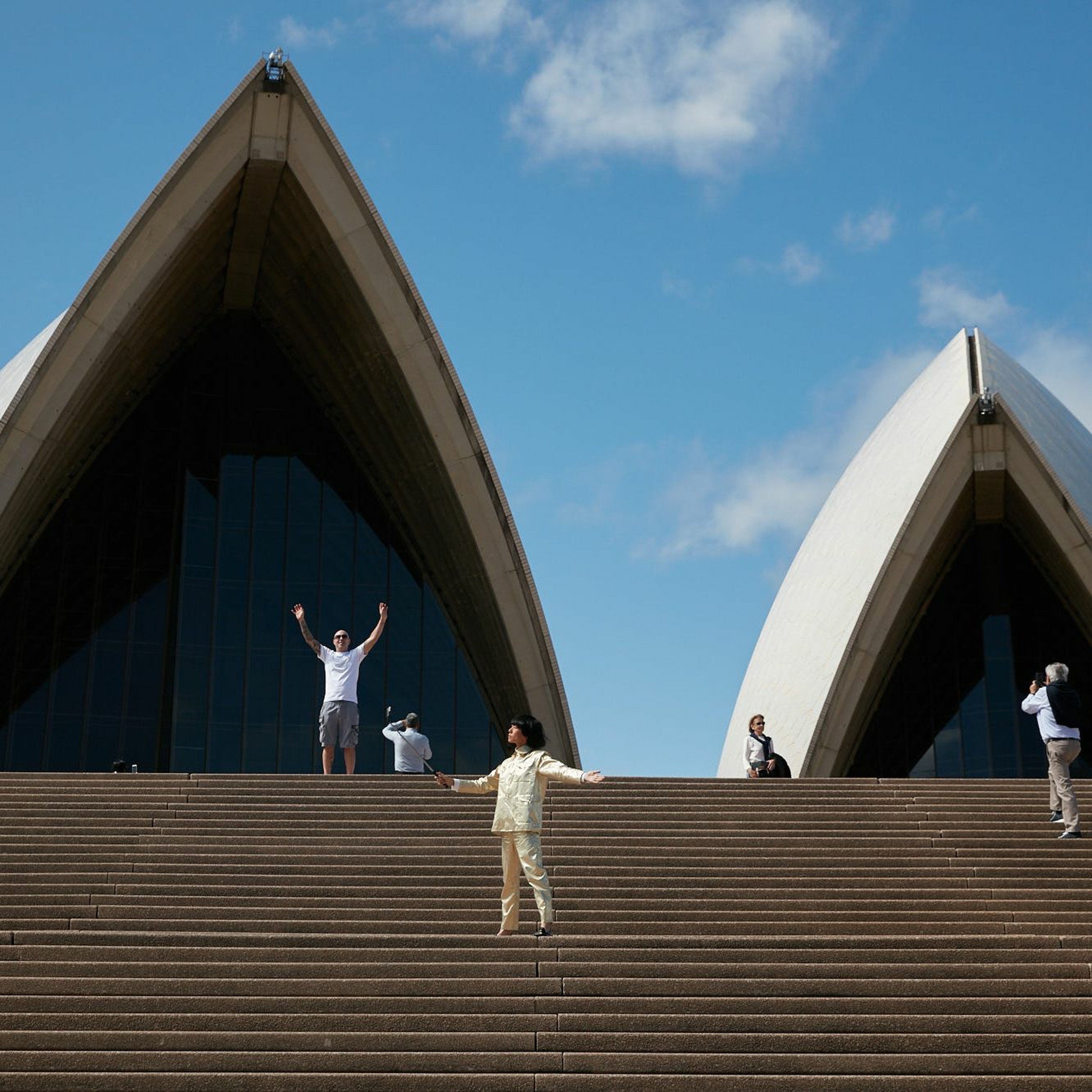
Eugenia squeezes the ideas of national and personal identity through video performance and installation. And if I get any of this wrong, as I said before, please interject and let me know. The stretched out contemplative time of her works is an antidote to the fast-paced globalism that she critiques. She playfully tugs at stereotypes and questions how architecture, borders and the built environment may alienate or include. Eugenia has performed the identities of a Japanese hikikomori, a bowie-eyed rock star, the cannibal Issei Sagawa, a suburban beautician Miranda from Picnic at Hanging Rock and currently a gold male-suited ambassador. Eugenia co-directed the inaugural Channels Video Art Festival. She's a board member at Next Wave and she's the founding editor of Assemble Papers. So please welcome Hannah and Eugenia.
Did you want to, is it just one slide, your inspiration? Yeah, I don't know. Let's see what comes up next. Let's give it a whirl. Oh, you go. Yeah, okay. All right, so it's over to me. So I think we're just going to set the scene and talk about the work of an artist who has kind of inspired our own practice. And I wanted to start with the work of an artist called Zheng Guangzhi, who was a Hong Kong Canadian artist who passed away in 1990. And I guess my work always kind of, it roofs off what has gone before. So I often kind of look to artists who...
Yeah, I've kind of been trailblazers of a sort and I kind of build on their work. So this man, Tung Gung Tzu, was a kind of, yeah, foreigner in New York. He moved to New York in, I think, the late 70s and fell in with like Andy Warhol and the cool crowd, I think. And he sort of became the downtown documentarian. So he'd take pictures at all of the parties and of Keith Haring's work. But at the same time, he developed his own performative practice. So he...
Yeah, he kind of was hanging out in New York quite impoverished, and his parents came to visit from Hong Kong. And they took him and his sister out to dinner at a place called Windows on the World. And Zhang Gongzhe didn't have any sort of fancy costuming. He just had this Mao suit, which he put on for the dinner. And he was amazed to find that when he went to dinner, all of the waitstaff treated him like a foreign dignitary. They treated him like this kind of UN ambassador.
And he really loved that, and it became actually his modus operandi to try and kind of break down these stereotypes of the way that we see the other and the way, I guess, that kind of Asian people are kind of viewed in the West. So he put on this Mao suit, and you can't actually see the image on his kind of lanyard thing, but it actually reads slut for art on it, but no one ever looked closely enough to actually see that, that he was taking the piss. So they just treated him like this amazing Chinese dignitary, and he was given full access wherever he went. And he made this body of work called East Meets West. was taken, I think, late 70s to late 80s, and he travelled around to all of the kind of tourist monuments of America and also kind of Western Europe as well, the kind of classics. In a way, the spaces where Chinese grand bus tours will go now. He was a bit of a forerunner and kind of went there and activated these spaces. And I guess I'm interested in his practice in an ongoing way because of this idea of self-portraiture, of kind of taking one's own image and kind of taking the ownership and the agency of representation back. So, yeah, I guess I kind of, I don't know, I've been looking at his work for...
I think, over a decade now and I keep returning to it. And I guess when we look at work further on, you'll sort of see how, yeah, his kind of legacy plays out, but for me in a very different context as a woman in Australia as well. Yeah. Do you reckon another slide is there for you? I think so. Yes. Yeah, thanks. I don't need to hold that though, hey? Yeah, I'll just... Great. So, hi, everybody. So this is by Caroline Mims-Lawrence.
It was in 1972, and it's called Black Children Keep Your Spirit Free. I saw this when I was, I think I was eight, roughly. A friend of mine, her mum was really wild and painted every day, and she painted, like, all around the house. And I remember being really fascinated. I don't think I really liked my friend at the time as much as I liked her mother, because she was so interesting, and all of her kids just didn't give a shit about how interesting their mum was. And I just remember feeling like...
Just it didn't matter what I was kind of imagining or what I wanted to talk about. She had like an artist or a reference or someone or have you heard of this person's work? And so I really loved going over there. But she showed me this artwork when I was starting to paint. I think we were doing painting over there one day. Yeah, and then she just asked, have you ever seen this artist? And I remember I just, I don't know what happened. I feel like I got so obsessed with it. And I started feeling like it was the first time I'd kind of seen someone make work that...
was how I thought or how I felt like all of those kind of like words and images and all of that collides together for me constantly. It was the best time I saw it visually, really, ever. And all of her body of work then when I started getting older and understanding it, I think it was also because there was lots of play on voodoo, like she grew up in the South and there was kind of a really interesting about the spirituality that she felt had been taken and I guess it was kind of a lot of ideas of reclamation, of traditional imagery mixed with... like street art and what was going on. And also even she always talked about that there's like layers underneath this of the bright, there's layers of fighting or the anger that was around her. So all the layers underneath are like dark navies and blacks. And so I love the idea that it's like 15 layers of words underneath all of her images, which I feel like I don't, yeah, it sort of has always been how I begin any artwork that I make as well. It always begins with language and it builds and every kind of word has, I feel like I'm going to like knock this microphone out. Yeah, I don't know. I just feel like words and imagery aren't separate for me. They're very interlinked. And this was the first time that I ever really saw it.
And I guess, yeah, like, that it represented, like, what I felt like I was in as well. But it was from so long ago. It was before I was even born. And then it kind of changed even where I was thinking, like, are we in the same cycles? And, like, why is this still relevant? Yeah. But that was kind of the first one that made me start thinking about all of that and how to express myself better. Yeah. Let's move straight on to your work then. And I think we can segue into looking at what you make. It's great to see how, like, you can link in. Got it.
Sorry, I cut you off. No, go for it. Okay. This is a still from my video work that was made last year called Amistang, molten at 6,000 degrees. That video work was the second kind of big video work I've made and it was commissioned for Channels Festival.
yeah yeah and it's amazing thanks um this one started with um again like words and facts and i often feel like science is really um like even me but we always talk about the universe and how it kind of just is like crippling how incredible all the things that go on around are and sometimes it's always frustrating that you can say a fact to someone they don't get it in the way that you kind of just like how are we even like doing this right now i feel like i constantly feel like that so i'm really interested in facts I really like scientific facts. And I read this article that the core of the Earth's temperature is the same temperature as the surface of the sun. And I started thinking about this idea of ancestors and the idea of, like, all our old people kind of going back into this ecosystem that we're ruining. And, like, what would that look like? Or would that be, like, would she be angry? Or how would she feel? Would she be sad? Like, what would all the kind of...
personification like of the earth because I feel like that is how we see it and I sometimes have found that hard to express but yeah I remember when I read that fact it kind of was the first time I could link something that was like a factual scientific thing that made sense yeah in terms of starting the work so I made this video I think it's about three and a bit minutes long there's a tiny clip of it the sound that you can hear in it but it pretty much starts with rap like that's also um a huge part of my work I think there's another still yeah so um I asked a lot of friends to perform in the video work and they all um mouth different verses to it and all the images in the back The images from, there's like war zones, but predominantly it's images that are kind of the really beautiful but really awful effects of climate change and what's happening. So there's these really, it's kind of incredible, it looks like an alien landscape, but it's going to affect, you know, it's like poison landscapes and they look incredibly stunning and it's really hard to wrap your head around that this is kind of the whole earth is like starting to like implode and this is what like the visual outcomes are, which I found really interesting. But this whole artwork was if Mother Earth like was a rapper and like what would that be like?
which yeah i don't know if i like nailed it but that was what the idea i think you nailed it oh my god you love it um this was my first ever big video and i was talking um just before because i guess i've always has i've always wanted to make video works and i have made video works but um i guess also though i was working um like with um tony albert for a while i was assisting him and then started assisting for richard bell after i finished uni and i kind of felt like unless i was gonna like really crank it like unless anybody needs to really see this maybe i don't need to make something until i can get that exactly how I want it to be because I felt like I got lots of offers after uni but it wasn't great funding or it was kind of rushed and I just this idea had been in my mind since I was really little I needed to have the opportunity to nail it so this idea was about based on again like words but like with Maya Angelou's Still I Rise poem which was really important when I was younger and growing up I found that really interesting and necessary as a young black woman it's so incredible so it started with that and then I kind of had also the idea of what would Australia or this like new world look like if the parliament was run by indigenous women and women of colour.
And what would that world look like? So I made a hip-hop video based on that. Yeah, and that was, like, the whole cast. And the costuming, I based off lots of different eras of political, like, dictators. I looked at a lot of that kind of stuff. But then I put my ovaries and my oestrogen, I mixed it with camo. So then I made that into the textile. And I was really interested in that idea of this kind of growth, of, like, what this world would look like if it grew over it, I guess.
Can I just ask a technical question? How did you mix your ovaries with camo? No, I actually had a lot of troubles, like ovarian troubles and it was during uni and I felt like all of my friends were partying and having this like epic time and I was just going to the hospital and I had kidney troubles and ovary troubles and I felt so frustrated and I was so fucking bored, like in hospital. It is so boring. one day the guy was like showing me a scan of my ovaries and at the time I'd just been drawing and I had been drawing like kind of camo-y prints yeah and that was already when I'd already been thinking about so I'd been thinking about this video for a long time before it happened and I remember he showed me I'm being so angry and like militant that I was like never gonna be there again and that kind of and also he was kind of like oh you know like don't worry like um he made some joke it was some like really flippant joke about like you know at least you've got like one good ovary or like some shit like that something just really just fucked yeah and I remember being like I could just like annihilate you instead I'm gonna draw my ovaries yeah so I asked for the prints of my ovaries and then I remember just making this like idea of like all these chicks like in like camo like ovarian militant gear being like but that was kind of like when I just got so pissed yeah yeah because I just felt like it was this really I don't know condescending when I was really fragile and so I feel like that was kind of like the tough um tough girl like outcome that I made from it but yeah that video for a long long time I wanted to make but I didn't want to make it half ass I didn't want to do it on a low budget I really wanted to do it properly yeah yeah great um I feel like that's like talking for a long time I'm like no it's good oh okay thanks um these images yeah can you see me
Four more minutes ago. Great, okay. This image, this is Gracie Ether. She posed for me a while ago. We had this really big chat, and this was kind of the beginning research images for the video that I made, Uma's Tongue, and then they kind of turned into their own world. It was meant to just be research and kind of basing what that video was going to look like. And we had, she and her family have been part of a really huge movement against fracking in the Northern Territory, and there's a really great doco called Stingray Sisters, which you should watch, and they're in it. But they've also suffered a lot of tragedy and, like, heart.
ache and we talked a lot about this kind of idea of like what the earth would feel like with all this loss and anger and like even the fact that people are even contemplating like drilling and ruining it more so it was really special that when we made these images yeah I feel like we were having really interesting and huge conversations so that was kind of research before it and then I changed these and they've kind of turned into banners now as well so moving again like back I guess I don't know I guess the idea of protest banners and that kind of thing I don't know if words are always the most striking or something. I don't know if that's always the best way to get it out. So, yeah, I kind of started playing with images like this on banners. Yeah. Yeah, and that's, like, another one. Yeah. That's her Baba Heneni. Oh, don't. Will you take me further? Yeah, and so the balaclavas also got... They've got my hair and synthetic hair woven onto them, and that was also an idea I was playing with with Amma's tongue, but I don't... I guess with Still Arise, I was kind of still interested in the idea of Indigenous or First Nation, like, mutant militia in this kind of apocalyptic world.
Like what would that look like? And I think once I tried it, I feel like the still image, as soon as she spoke, we tried to do it with recording. It lost all the power because it kind of turned into really threatening and it wasn't as, I guess there's this kind of this calm, yeah, strength with the still image that didn't translate as well into video. So that was really good when I was doing all the research images, like figuring that out and finding like ways, like I think I'll come back to that. Yeah, but I feel like it's all, I feel like all my work is all stuff that I've thought of since I was little. It's just like figuring out how to like get the best way to put it out there. Yeah.
And then that's a banner that was installed in, I think that was in Auckland, that one. But yeah, I think that was also just kind of the same idea. It's on velvet and the font is actually from the band Iron Maiden. I don't know if you guys know them. But I just really like that kind of idea of like heavy metal, like really intense and then being like screamo band, like saying welcome to the matriarchy. I just really like that vibe. So that was a huge banner, but it's actually really big. That window's huge. It's three and a half metres long. So even cutting it was really intense. Like I felt like it was, I had to have a lot of love for the process. Yeah, yeah.
I'd love to see that at the beginning of a protest procession. Yeah. Yeah. I feel like I'd wig out for how long it took me. Maybe a photo of it I'd be around with. And that's the last one, I think, this one. There's so many. That's from my gig poster, the most recent one. That was on Friday night, which was Fempris, which is the event, like a hip-hop night that I run. And it's specifically all femme and women identifying women of colour predominantly.
like rap and dj night yeah because i just it was so exhausting especially specifically in brisbane there was not one lineup where there wasn't yeah it was always like one token girl and that was it or none or you'd rock up to do a dj set and all the boys would be like oh you're both both girlfriend or they'd be like can i get a beer like and you're taking over from them and it just drove me yeah so crazy so i made an event um and this is the most recent one i did which are visuals for they're actually visuals for precog which was um a next wave event um and i was looking at jill scott heron and um I was also looking at, at the time, I've been looking, I'm really interested in like scans as well, like brain scans and MRI scans and any kind of like bodily scans as the patterning is incredible. So underneath that, psychics were put under MRI and when they were seen to be having a psychic vision or when trance state, sorry, it was psychics and dancers, they were put in a test and it was meant to show what their brainwaves look like during a trance. And so, yeah, the image is underneath of that. And then the quotes are from Jill Scott Heron. And I was just really interested because there's a lot of things if you listen, because some of it, he goes like hella off, like the Richter. And I feel like he gets really away from the point.
There's these moments where it's so clear and so incredible and really special. And I'd love that he was doing that in the club. And he was, like, even, yeah, like, asking people when he started, especially when he was doing some of the early sets, like, people were like, you're depressing. Like, you're not on when I could put you on the set. And when you listen back to it, it's kind of hit because he was still the one reflecting what was happening outside the club and everyone else was pretending that wasn't going on, so the club was an escape. And I found that really interesting in terms of, like, club politics. That's really interesting. But, yeah, so that's the visuals that were playing during a DJ set. Yeah. And I love this one. Like, she was black before it was fashionable to be black sisters.
Best. Yeah. But that was his quote. Yeah. And that was kind of my favorite one. That's it. I'm definitely done.
Thanks, Hannah. Let's go straight on to you, Eugenia. Okay, I've got to remember what I was going to show. You've got a video first, I think, of Yellow Peril. So I'm going to show a three-minute excerpt from a work that I made in 2015 called Yellow Peril. And as the name suggests, it's a work that, I guess, looks at the kind of Asian experience in Australia. It came from actually an image of my parents standing in front of the vault, which is a sculpture by Ron Robertson Swan, which is now done by ACCA. You've probably seen it, Big Yellow Thing, which was also dubbed the Yellow Peril. And I guess for me, I'm interested in how...
i guess um i don't know you know kind of the built environment or icons or artworks can become symbols for uh i guess the entwined nature of i guess migration racism australian history and contemporary kind of uh changes in the way that we see ourselves as australians so yeah so you'll see like a short snippet from this which um it's like an 18-minute work and maybe i'll talk about it more after if this works So the work was shot at Sovereign Hill, which some of you might have been to as like a nine-year-old if you grew up in Victoria. It's basically a kind of historical theme park that is modelled on a gold mining town, but it's totally a fiction, like it never was one to begin with. And when I was researching this work, I was looking for sites that I guess are kind of, you know, they're sites that are sort of around the gold mining, golden triangle of Victoria. I was researching gold as a very kind of loaded symbol, something that I guess, you know, sure it represents wealth and fortune, but also, you know, the gold fields were...
inherently racist and there was great genocide you know of indigenous people and chinese people as well um so thinking about this idea this kind of like you know this like gold fever that we continue to have um but also the kind of double-edged meaning of what that is um and continues to represent so yeah i guess i wanted to find a site that um did that and sovereign hill was really interesting because it's a ready-made film set like it's it's kind of totally set up um and i love going there because it was so performative like everyone that's kind of walking around is already I guess acting or like playing some kind of colonial role. So when I went there as the ambassador in my kind of sci-fi get up, I was able to be quite invisible in that context, which I really enjoyed.
And that's what I'm interested in, I guess, this kind of idea of hiding in plain sight or kind of provoking or changing the status quo, but in a way that people don't quite, I mean, I don't know, can't quite like recognise or like you can kind of slip under the radar sometimes doing that. So that's that work. And then the next one is totally bombastic in tone. So it kind of takes, it's the same costume. You can see it's in Guangzhou's Mao suit rendered again in gold. And I've been using the suit for many years. It might almost be time to hang it up. What's that? No batch. No slap for art, just the suit.
But this work, the ambassador rises again, but in this context, she is a kind of factory boss. So I was researching Foxconn, the makers of Apple products, who kind of, yeah, have the lion's share of, you know, I guess, yeah, the fortune in terms of like technological production. We, you know, the iPhone is a symbol that I guess in the West, you know, we use, we fetishise, but it's also just ubiquitous. We kind of don't think about... what actually goes into how it's produced and the human labour and suffering that's kind of inbuilt into these devices. And I mean, it's not like I was making this in some kind of, I don't know, self-righteous way because I'm totally part of this system. Like I use Apple products, I have a phone. I guess for me, often with my works, I'm trying to understand my place in these kind of cycles or systems that I find really fucked and how to kind of, I don't know, yeah, sort of interrogate them and, yeah, understand that...
It's still in artwork, so it's kind of not something that's necessarily going to revolutionise the world, but it's a way for me to understand how to deal with being complicit or how to be less complicit in these systems. So I set up a factory space. This work is called the People's Currency, and the work takes its title from the Chinese currency, which is renminbi, which means People's Currency in Chinese. And we set up this factory space just next door to here, so out on Flinders Street. It was really important to me that this work was cited in the public space.
kind of like you Hannah like this work had been bubbling away for a long time and I wanted it to be something that was super high impact like I didn't want it to be in a white cube where it would just be the regular kind of art crowd who are kind of you know yeah already kind of leaning towards these things I guess I wanted to get out there to have it seen as maybe not an artwork like kind of get it out into a realm where people are used to watching the tennis when it's the Australian Open or they're used to having like a Haagen-Dazs pop-up selling them stuff I like this idea that you can take art into a space where it's unknown like is it kind of is it selling me something is it protest people were quite uncertain and I like that so in this space we had daily calisthenics sessions so sort of modelled on the Chinese sort of calisthenics that kids do in school every day like thousands of kids will do these moves and I worked with a choreographer to kind of make these movements that could be repeated and the general public could come and do as well so the idea was that I was the sort of Foxconn factory overlord boss and the general public were welcome to come into this space and sign up for short-term employment contracts in my factory and
I made maybe 300 porcelain iPhones, and they were actually, they're moulded, well, they're kind of like cast from my own iPhone 5, I think. So I kind of had to learn quickly how to make ceramics, so they're not very well done. But the idea was that everyone who worked in my factory would have to turn these iDevices to gold, so they'd be given the tools in the factory to kind of do this. And I got to make my own currency, which is really fun. It's pretty great being a dictator. You can kind of see why there's so much appeal to it. It's like your head is on everything. It's amazing. So I was printing currency the whole time and gilding that as well. And it was a very non-transparent process. So people would gild their phones and then come up to the boss and I would inspect them to see how good the handiwork was. And it didn't necessarily equate to good handiwork, that they would get more money or sometimes they would get a phone as well. But it was very nepotistic and very much like a dictatorship. So it just depended if I knew you or not, I think.
So these are people signing up to be good workers in the factory. And so, yeah, we had the workers would be in these PVC aprons and some of them would get co-opted into doing calisthenics as well, which was pretty fun. And that's the factory space. So the idea was that the kind of public face was very bombastic and open and colourful. And then the actual factory where you go and do your shift is totally isolated. I guess I was really, I was researching the conditions of the production line where our phones are made and they're pretty fucked. Like, you know, a 12-hour shift would be a short day. So my factory was open for 12 hours over a week. But over in China, it's like that would be a short shift.
It's a really dehumanising kind of context. And I was trying to set up a condition where, sure, it's an aesthetic experience. You're in this mirrored space and, you know, I wanted something quite, yeah, I guess aesthetic in that way, but still linking back to that idea that, yeah, it's a very dehumanising kind of context. So that was sort of the set up. And, yeah, I've got to say it was amazing to have a work in a space where people would come into it on their way to the football or grandparents would be there with their grandkids and be like, what is this? Are you selling iPhone covers? Like, can I charge my phone?
But they'd have no idea what they were doing, but something would kind of link them in so that they would come into this work and then, yeah, we had conversations about it. I feel like, yeah, that was all I was trying to do was just get people thinking about this thing that they hold every day. Just to let you know you've got 13 minutes. Oh, my God, I'm totally over time. It's OK. We're going to hear the last one. All right, I'll just quickly cycle through. So I'm deep in the edit of a new work called The Australian Ugliness, and the ambassador rides again, so you'll see some more images of this work. It'll be shown in July at Melbourne School of Design as part of Open House Melbourne, and it's a work that I guess is really looking at Australian identity. So I guess a lot of my work really tries to unpack what the hell Australian identity is. So the ambassador's travelled through...
30 different locations in Australia. And I guess I'm really kind of working with icons of Australian architecture, some well-known, some private like this, which is a private home called Gottlieb House. And I guess for me, I'm really trying to insert people that you maybe don't normally think of when you think of design for the built environment. Like I guess architecture is still quite a white male dominated industry, like most things. And also when we're thinking about architecture, I suppose we're not really thinking about, I feel like cultural diversity is not really.
a thing that's sort of considered. So in this work, I guess I'm trying to show Australia, I hope, in all of its kind of cacophonous multiplicity. So inserting this strange character into these locations and also kind of othering architecture by bringing these buildings to life as well. So it's still very... I'm still very much in it, so I can't really talk objectively about it, but this is just a few of the production stores from the work. Looks great. I can't wait to see it. Excellent. Over to you. Oh, thank you. So I'll talk a bit about my work. Thank you.
I'll talk a bit about my work and then we'll open it up for questions and questions amongst us as well. So I used to make work a long time ago that tried to find absurd solutions to personal problems. So relationship contracts conveniently filed in alphabetical order. Bed-body sculptures, electrically heated and moulded in perfect sleeping positions for when I was lonely at night. A catalogue of ideas of artworks that I would never make. I embraced pointless and absurd tasks. I experimented with bringing warmth into the sterile gallery space.
And slowly my work began to look outwards. I made lavish meals set up from dumpster food and left to sit in the gallery to rot as it would have in the landfill. I interviewed children about the meaning of life. I encountered the failures and successes of trying to squeeze socially engaged practice into institutional space and time. And in 2013, I think I left the gallery.
I made a three-team footy game in collaboration with the local football clubs and townspeople of the Wimmera region. A six-month project centred around a delicate dance of cajoling, performing and insisting, eventuated in the world's first three-team Aussie rules football game between Taylors Lake Football Club, Narajira Kwantong and Horsham United. I wanted to go to the conservative heart of Victoria to see what it would take to break down the binary mentality that dominates much of our systems of thought, not just in team sports, but across politics, gender and conflict in general. After that, I was preparing for the biggest opportunity of my career so far, I guess the AFL grand final of the art world, the Sydney Biennale. My strategic and well-publicised withdrawal from that exhibition, because of its implications with the detention industry through its sponsorship from Transfield, left me realising that sometimes art functions to distract or conceal from what's going on elsewhere, to add value to unethical companies doing unconscionable things, to grant them a social licence to operate while we, artists, are thinking that we're independent agents, free working on a higher purpose.
In this case, I desperately wanted to, but I was unable to find a way in which making artwork from within the sanctioned space of the Biennale would be an appropriate response to this problem, to actually have an equally disruptive effect on the supply chain of the detention industry, as a boycott did. From this moment on, I was no longer satisfied with making poetic musings or humorous jibes of the human condition. I felt the complicity of just carrying on as normal. And I guess over three years, I worked to try and figure out how I would deal with this turning point in my practice. And in 2007, I began to make collaborative embodied work that played a much more direct role in the issues with which it was dealing. Ever since, it became a challenge for me to be able to make interventions that were at once a logical evolution of my creative practice and a stark departure from the kind of impartial ambiguities of art.
to create actions that were not just reflecting or representing the world and its politics, but actively shaping the way that we deal with humanitarian and environmental crises of our time. I wanted to test the power and the limitations of the body in resistance, as well as creation. I wanted to make art that functions to serve society, but not in the way that we might expect. Art that's as much about problem-causing as it is about problem-solving. Art that can confuse and divide as much as it can reassure and unite. And art that can work against injustice and imagine its alternatives. In 2007, I co-founded the Artists' Committee, which makes public artwork at the intersection of money, ethics and culture.
We were in the middle of 2007 in the midst of examining how the mining giant Rio Tinto's relationship with the Melbourne Museum might skew the institution's ability to represent the facts about climate change when we were informed that the National Gallery of Victoria was about to start a new contract with Wilson Security, a company known to have committed and attempted to cover up numerous violent human rights abuses against men, women and children in Australia's offshore detention centres on Manus Island and Nauru. We pursued this through the normal channels. We wrote a petition, opened letters, arranged meetings with governance, and we received nothing but vague condescendence for our concerns. And so the artist committee decided to intervene in the gallery in a way that the gallery and its public and the media couldn't ignore. We looked first at the collection and found... Where's my clicker? And we found... Oh, I won't show you that.
We found an uncomfortable paradox in that Picasso's Weeping Woman, which is a painting intended as a universal image of human suffering as a woman mourns the loss of her family, was being watched over by the same eyes, the same company that was inflicting this same kind of suffering on children, men and women in offshore detention in our name. We also know that this work is a prized piece in the collection, one of the gallery's most expensive and well-loved paintings. So in reference to the cover-ups of human abuse, we decided to cover up the painting.
Very quickly the galleries were shut off. The director came to see what was going on. The whole security force was mobilised. Media turned up and we guarded the beeping woman until each of our aims had been reached. As a group of professional artists and mostly inexperienced activists, the artist committee designs each of our actions with the same conceptual, formal and aesthetic considerations that we have for our artworks. Each piece is choreographed, rehearsed, stage designed. It has props and costumes.
We've gone to equally long lengths to learn from the activist handbooks with roles and procedures that reflect the risk of what we're doing. The risk to property, the risk to personal safety, the risk to reputation and the risk of being arrested. We understand these risks as entirely necessary to our active participation in a just society. And we also understand the role that our privilege in many ways plays into our ability to take those risks. Our second intervention targeted the public face of the gallery and its iconic water features. The famous water wall and moat turned blood red and huge Wilson's logos were affixed to the glass entrance.
And finally, our third intervention blocked the entrance to the gallery, preventing people from entering at its peak period over the weekend. 300 people stood in a circle around a solo cellist, holding red ribbons extending from under her chair. She played a song composed by Beruz Bouchani, an Iranian journalist and filmmaker imprisoned on Manus Island. Intermittently, we used the people's microphone technique to convey our intentions and our demands.
While the NGV was relatively silent and evasive during the protests, in March this year we received an email from them informing us that Wilson's security would no longer be contracted with the gallery. And we also know that the effect of this has had a resounding effect within the cultural institutions in Australia and that multiple organisations have followed suit and informed us that they will also no longer be using Wilson's security. And while it's a small victory and we have a long way to go, it's worth celebrating those victories. Where the boundary, or whether there is even a boundary between art and activism, whether there's even one, is something that we're testing as we go. We see our current political situation as so dire that we're willing to make mistakes at an attempt at shifting something. That's all from me. So we'll open it up for questions now, and if anyone has some questions that they would like to ask...
right now then we're happy for it to kind of be uh organic between us and and the audience members to ask questions so if you do have a question just raise your hand and there are some roving mics and if you could just wait until the microphone gets to you that would be great because it is being live recorded um does anyone have anything they'd like to open up the questions with what's your next work about I can't talk about it otherwise someone will steal it. No one will do it like you will. I want to make a video work. I feel like I'd make video works like I could make one a week if someone could just bankroll me. So I'm looking for that. It's going to be another video. That's all I've done. I think that's definitely enough. Anyone else?
Hi, that was really great. Thank you. Gabrielle, you mentioned at the end of yours that you're happy to make, you know, it's okay to make mistakes in the event that you might change or shift something. Is that you sort of feeling like you've made some errors or what was that? Oh, that's a good question. I'm trying to think back to when I wrote that.
I think it could have been around the kind of uncertain tension between how to shift over to a practice that's more based in activism than in art and that does away with a lot of the necessary ambiguities of art, that kind of beautiful uncertainty and lack of stated aim that art has, whereas activism has such a kind of, you know what your aim is and you know whether you've achieved it or not. And so the kind of feeling uncomfortable about how... those two can coexist, and to realise that in some situations we might need to make decisions that deny our artistic...
intentions or what we know to be right artistically in order to achieve certain aims so for example I didn't include one of the interventions that we did which was the fourth intervention because it was a very quick decision to blockade the entrance to the triennial exhibition and to me that was less of an artistic intervention and more of a decision that we made as activists because it was much less well considered it wasn't about necessarily creating an image or conveying a message but actually just getting in the way and being really hard to ignore nuisance so that was more like and as artists we felt really really uncomfortable doing that but we felt like there was a kind of a pool there to actually step it up so yeah just to kind of like figure out those boundaries I know that you actually have those perhaps not in the same way but questions about the tension between art and activism yeah I do like I think it's something that I grapple with in an ongoing way and I think I was interested yeah I'm interested to kind of hear from both of you as well on that note I think when I
I guess I've been involved in kind of collaborative art for a long time. And then when I sort of considered, like, what am I going to do long term? Like, do I really want to do this art thing that doesn't necessarily make much of a difference? And I kind of was questioning, like, whether to keep going with it. And I think I've kind of, yeah, I've dabbled in various kind of, not as much as I'd like to, but kind of activist acts that are kind of activism, like being involved in the Pram Jam and kind of various things. And I think I still, I think I will always have that quandary and maybe that's...
that kind of weird unresolved tension goes into the work um it doesn't I think I acknowledge now that it isn't yeah it isn't activism because if it was I would be an activist like I'd be doing that but um I think I wanted to talk with you more about that idea that um I guess both realms can learn from each other like I'm very interested in this idea that um activism can learn a lot of the kind of tools and theatricality and staging and aesthetics from art um and also artists like can be held accountable as well for kind of being part of these systems and defaulting to that kind of um yeah you sort of like opaque uh non-committal sort of position on things which i think is also very problematic um so i don't know like i think i'll never quite work it out but i'm very i guess i'm very drawn to work by other artists that like is really overt and kind of takes a stance because i don't know that i maybe have the guts to do that or like i kind of like it's sort of in there but there's so many layers to it that um it's not as kind of obvious as as you know sometimes would be good but um yeah
Yeah, did you want to pitch in before I... I guess I feel like when you are Indigenous in this country, it's just like you're born politicised. So there's not like a... I don't know. I feel like I don't have that spark moment. That's just it. You grow up going to rallies. You grow up seeing people get arrested. You grow up seeing all these injustices. You're affected by policies. I don't think there's like a...
you know like a step where I was just like yeah like yeah I'm gonna lead the rally like I don't know like it just I don't know I feel like I just had to make a choice whether I was like there's a lot of pressure as well to be like and I don't even I don't even know about the word activist like I don't I don't even I don't feel like that I don't feel close to that word like I understand it but the people that I know that I believe that have done that work or do that work it's a lifetime and it's like a like you embody that like that's just not something you switch on switch off like you live that so for me I don't yeah I don't know I feel like I can't it's like you either just like you know you're out I don't know if I have like the yeah I think there's also the perception that you have to be one kind of activist and I think that there are these when we talk about the activist handbook, they're actually handbooks that kind of tell you how to do things and theorise about it as well. And I think that they can be really applied to art making and they can also make us see that there are nuances between the types of activists and there is kind of a really well-defined visible activism and then there is kind of this activism that maybe you may or may not live just by virtue of what you've grown up into.
Gene Sharp, he's a political social theorist and he divides the role of activist into four different roles and they all kind of work at different times during movements, whether those movements are kind of like fast movements that are very specific or over a long period of time, but there is the role of the change agent and the role of the reformer and the role of the citizen and the role of the rebel. And I think that what we see as activists is the rebel, but there are all these other kind of participants in change and perhaps we could see ourselves as artists in terms of those roles as well and see that there are so many ways that have... that topics have to be approached in order to affect change. Yeah. Eugenie, you said it's just an artwork, so it's not going to revolutionise the world. And my heart broke a little bit. Because I do think that art can change things. I think, I mean, of course, I think it can, because I wouldn't do it otherwise. Like, of course, there's got to be kind of some reckless optimism in this, because, yeah, like, why make anything if you don't have that idea that you can shift things? I think I mean in terms of scale, like...
I think, I mean, art's like my temple, it's like my religion, I guess. So, of course, I kind of, I believe in it and I'm sort of like a card-carrying, you know, art person. But I guess on a wider level, and I guess that's why I'm interested to take art beyond the gallery, which you spoke about as well, getting it into spaces. And you talk about the club as well, and I feel like actually some of the most exciting artists that I love are kind of working in that space where they're taking... I guess the politics of the club like out into art land and kind of like really shaking things up because I think art is so the art world can be so conservative and kind of perpetuate these structures that we really are trying to break down in society which is curious because you think that would be the place where revolutions happen but it doesn't feel that way so I think that for me the kind of solution or the way that I feel like I can make small revolutions is in taking art into the public space or with you know with this work the Australian ugliness taking art and architecture out to like the general public so taking you know kind of latching onto a festival where um you know joe blogs goes to check out a building because they're interested in that stuff and they might just see my work and kind of think about um what it means to be australian as well like so i think um yeah you know of course i don't have any um i guess
delusions about this you know the idea that I could create a revolution with the work but if I can kind of shift um yeah I guess stereotypes in the way that we see ourselves and other people as well um yeah that's a small win so I guess that it's a scale thing I think but yeah yeah where's where's the context where's your ideal context for your work Hannah like who do you imagine seeing your work in what context is it the gallery or the club definitely not the gallery I don't know but I don't think that like the gallery is where I've seen the most amazing things like I've done I feel like there's lots of artists I know that make incredible work but the energy and all that comes from like a yarn they had with like their uncle like walking somewhere or like it's not like it's these bits and then hearing about that and then seeing them in the process of making it like once it gets to the gallery I feel like all that energy and everything it's so hard because you have to put it into this big like container and it just feels really unnatural on how you make the work or how it even got there and it's all that kind of stuff that i find really odd where yeah i don't know like i didn't feel comfortable in galleries when i was younger at all and art openings i hated i never invited my family to them like i they're just so stiff and like if you don't have the right language or the right jargon or all that shit or if you didn't go to uni you're like like it's just like a never-ending like whirlpool of like but did you do you know this reference or like
all that so I feel like there's so much in that that needs to be like moved away from and like shaken up because there's this kind of talk of like wanting these revolutionary ideas or people but they're not welcome like they're not welcome in those spaces I can't imagine lots of people that are very deeply inspiring or even like uh revered artists now when they were alive I'm sure they weren't welcome in their galleries then like it's this kind of thing like it just needs to catch up it just feels like it's never on the same time scale as what's happening so I guess like that's why the club is exciting for me like that would be probably one of the best places but then there's a problem of like it's over 18 I really like especially like young women like young girls like that's really special like this is inside I've done a lot of work with um with young girls that are in foster care because of having parents that are both parents incarcerated or one parent incarcerated and the art that they make and sitting with them like I would do that 20 times over than having an art opening like any day a week like it's but that to me feels like this is where that energy is and I don't feel like yeah it's like it gets dried out a lot of the way or something yeah but yeah any day like a school art room even isn't quite the vibe like outside I always try to like get them outside like that for under 18s and then a club for 18s would be like the ultimate screening room for me anyway yeah
Hi. I was wondering, is there any advice you could give to someone starting in combining art and politics and protest? Mine's really quick. Do you have something in mind? No, not off the bat. Okay. Collectivise. It's not something that's easy to do by yourself. So try and seek out those conversations with people.
When you find you have good energy with someone, latch onto it and keep it going. And be intentional about it. It won't happen by itself. Be intentional about fostering those connections with other people and doing it with other people because that's where the magic happens, I think. It takes a long time. Well, it can happen instantaneously, actually. But to kind of do it really intentionally in a way that's sustainable, it can be a lot of work, but it's worth it.
And some of the artists can be here tonight because I'm really happy about that. But they represent to me this five years of trying to figure out how to do it and then the constellation coming together of all these people with all these different ideas and ways of doing things and skills. If you sit down in a group of people, if we did this right now and we put down a sheet of paper on the ground and we said, what skills have we got in this room? What could we mobilise together? And someone would have a ute and someone would have a camera and someone would have a...
dad with money and someone would have you know and we would and we would actually be able to do amazing stuff and so like to just kind of yeah pull resources and enthusiasm and um ideas is so valuable and so find those people yeah yeah i don't have much to add i think it's just about collaboration and kind of knowing that um yeah whatever you do as a group is more than anything you could achieve on your own and not feeling isolated. I think before I started kind of making my own work I was in collectives for like yeah over a decade and I still have various ones and that's the kind of it's a really fertile ground because as Gabrielle said you can pull resources and test things and be challenged as well because I think that's really critical when you're doing anything like this like you need to be challenged yourself and kind of have your own sort of politics and values and ethics.
yeah tested um especially if you're going to be communicating anything more widely which i guess we're all trying to do um yeah so just try and find those people and they're out there like they may be here tonight um yeah i guess i would ask yourself why like why are you interested in politics and art and like is it necessary and what is it like i would interrogate the shit out of yourself before you start do you know what i mean like Before any artwork ever gets put up or like, I'm like so bad with like this big mic. But before I ever put anything up into the world, like, is there any fucking point? Does anybody need to see this? Like, is this necessary? Like, I really feel like that's important because it's kind of like, well, then what are you doing? Like, could you be doing something else? Or could you be helping someone else who may have less opportunity? Or, you know, like maybe just kind of like wade through. And some bits is awkward. I've had times where I'm like, this is not necessary. But, you know, like it's good to think that way. And I think it's important to get through that on your own. Then you'll attract people that have also gotten through that. So you're already starting on like a much better base level rather than kind of being like, I'm vaguely interested in this.
like and then you have to kind of both like waft through this shit together like you know what I mean like just kind of get down to it and then you'll find those people because they'll also be on that level so I reckon it's just like find out who pushes you find out why like all that kind of stuff like who's the artist that like makes you want to make work and that kind of and then why is that you know I think that's helpful yeah I guess Hi all. Thank you for your art and the conversation. So I'm a scientist by profession, so I actually like coming to this event because I can understand from the artist's point of view. So my question is when you were talking about art and activism, and Hannah used scientific basis and facts in your work as well.
So if I take an example of climate change, I know that a lot of scientists have had a hard time convincing politicians or trying to bring that real change that this is a real problem. And you mentioned climate change in your work as well. So do you think artists and scientists can kind of work together to create something that can lead to more activism? And I personally don't know any artists. Do you think artists would be keen to kind of collaborate with scientists and kind of find a new avenue to...
you know, move forward and create change. Absolutely. Do either of you have a... I just, yeah, I just agree. I think any way that we can work across disciplines and together and kind of get out of our silos as well is critical. And I think, I guess, you know, one thing that it has going for it is this ability to communicate and kind of, yeah, on different levels kind of be accessible or speak the language or have that kind of image impact or like aesthetics. And I think, yeah, there has been a lot of kind of collaborations and continues to be with scientists, which is so beneficial, I think, for artists as well to kind of be confronted with the facts and to kind of...
make work that is grounded in true crisis, things that really need to shift. So definitely, I think, I don't know about you guys, but I welcome, I love working with people that aren't artists as well. Absolutely, yeah, yeah. And I don't know if you've heard of Climart. They're an organisation that specifically brings around a biannual exhibition of art around the idea of climate change. And they facilitate a lot of collaboration between scientists and artists. And in fact, I participated for the first time in it as an artist. I was invited to do a...
create a poster for their poster series. And one of the first things they did, which was something that's never been done before when I've been commissioned to do something, is that they brought all the artists together and we sat for a lecture by a climate scientist about the facts so that there was a real engagement with the science, not just this kind of like nebulous idea of climate disaster. Yeah, so if you're interested in participating in that, Climart is definitely a good organisation to get in contact with. So any more questions from the audience? We have seven more minutes, so I would say one more question. Can I ask one? Is that all right? I just wanted to ask about that. Any questions from the projectionist? Just about the fracking work you were talking about before, the stories you were listening to. I might have been ducking out, letting people in, so I might have missed it. But what was the collaboration like working to create? So her family, their community was directly being affected by fracking. But also we're friends, so I feel like it's a never-ending collaboration. But during that time, I think it was more...
I don't know I guess we both were having a hard time with dealing with both of the kind of things we were yeah I was trying to like create this work I had all these ideas that I didn't know about like well how I was going to execute it and like then I feel like the reality of like this personification it really also was great to talk to get away from kind of like the how horrific the fracking is so I guess moving both of our emotions out of it making it like personified onto I guess the idea of the earth having her own opinions and I guess it kind of allowed us both to express things that maybe we were nervous to talk about together because of like how either of us would read it of one another like that was really great but also yeah I think that it's you have to be very very careful with those situations as well when people are like actually um like they're physically affected and it's there like yeah if it's not directly you personally I think there's a lot you have to consider before that yeah it becomes a collaboration before you even step into that room like you need to know a lot about like what you're getting yourself into so it was great but I definitely think, yeah, it's still hard. Like, it's a hard subject, yeah. I don't even know if I answered. Cool. I'm going to ask one last question, if there are no more from the audience. It's a pretty big one, so be prepared. What do you think the moving image can offer us in this world in crisis? He's a big one. Because, I mean, I was saying, explaining to you before that...
I have a lot to say about the role of art and activism in change. And then to narrow it down to the moving image, I see that as a tool. But I want to know where you think that really active moment is, whether moving image can incite change or can disseminate ideas. Where do you think its power lies? I think its power lies in the fact that...
it is the medium of our time like it is this ubiquitous medium and it keeps mutating and shifting and we now stream it and we kind of we make and view it in a way that five years ago like i probably could hardly imagine and it keeps shifting and i think working in this medium is so fascinating to me because i feel like i think hitosh doyle said this as well um it's so she works with um you know kind of the latest sort of populist technology and i feel like for her she says um these things as kind of like the barometer of their time so they sort of say a lot about um i guess you know like i guess what's and like kind of social sort of situations and power dynamics and economy and all of these things are kind of embedded in this medium. And that's very exciting to me. I feel that, you know, it's a kind of rich realm because, you know, moving image on the one hand, it can be film, it can be like TV. It's very sort of populist forms that we know and we sort of watch, we're quite familiar with. And that gives us a lot of material to kind of debunk and I guess subvert. And I really like that we've got even, you know, we haven't really talked about the Soda Jerk work, but I feel like that is the ultimate in this sort of...
debunking of like national mythology and identity and kind of like rewriting all of the like fucked up kind of racist, sexist stuff that we've been fed through film and TV and popular culture. That's really exciting to think that, you know, you can kind of take existing language and existing kind of imagery and rewrite it and reinvent it. So I feel like it can be really political and I suppose that's why I continue to work with it. Yeah, yeah. So yeah, it's a moment where the technological moment has converged with the drive to...
to use that technology and... But I think we need to be really critical about it. Like, I think that's why it's great to be talking about these things because I think we kind of use them in a very just sort of accepting like way, like apathetic way. We just kind of stream things and send each other stuff and we're on social media and it's all, it's so kind of embedded in our lives. But we, yeah, I think we can definitely interrogate that a bit more. Yeah.
it's like one minute like now um i guess just the main thing that like you know like people lie in bed and they watch this stuff and i guess so immediately when you're when i'm working with video i'm really interested in hip hop videos really shouldn't like mtv and like channel me and like rage and like all of those things that um people are just immediately disarmed they see a video they're comfortable that's really natural there isn't that feeling of you know like so so so many people if you said come would you come to this like painting with me they'd be like nah I think I might be busy like you know but then a lot of people if you go like you want to come see this video they'll be like sure like it's a lot more accepted people are way more comfortable with that medium so I feel like that's kind of a really interesting avenue to then like like hug and then punch. Like it's like a really like easy way to kind of like also just like translate so much information so quickly and then let it sit. And I feel like that's something that we're bombarded with so much mindless shit all the time that then when you say something that maybe is important or you're trying to be important, trying to like reflect these things, I don't know, you do hope that people then at some part still switches in because you are comfortable, you immediately are kind of open to this medium. So I find that really interesting. Like I love the idea of like one of my videos like popping up on Rage or like I want to make one that's just like a banger so that people want to play it on Rage or like MTV. It would be so great. Do you make your music or do you collaborate with sound?
Oh, no, I'm not that talented. No, my partner helped me. She's a rapper and she did the voiceover because, like, I wrote all the raps and then just trying to coordinate, like, eight people who have never rapped to rap is really hard. Yeah. But even that as well, though, like, you know, but then even you think that may be hard, but then also because we've watched music videos for so long, people are really comfortable to lip sync and, like, you know, we do that stuff all the time. And so there's still all these things that then when you're asking people to perform, like, they are comfortable. Like, there's just so many levels to why. I feel like that medium makes sense for me. Yeah. Great. Are there any more questions? I'm sure we could.
if there's anything else likely lost this is a question for the women of color on the panel i guess like the art world is a very like um white focused and white like um centered place and like you honey you were talking about like the politicization of like um your indigeneity in the art world and like how or like in the world in general especially in a colonial australian context and i was wondering like how you protest that politicization or whether you try to or like yeah i guess that's my question is that clear enough Yeah, sure. I don't think it's like a conscious, this is what I was trying to say before, I don't know if I articulated it right, but I think it's just being. Like that's a political act in itself, like getting up every day, doing this, being out in the world. Like, you know, sometimes there's the small things that are actually more revolutionary for me than the big things of like doing this big video or big events. Like sometimes little things like just getting through and being a really great.
you know, like, like sister or friend or like those things I actually think can be more powerful and important in terms of revolutionary acts for yourself. But I guess in terms of like within this big gallery space, just calling it out, like actually not being afraid to, like, I don't think you have to be aggressive to be, I don't think that, I think sometimes that's what is frustrating is that if you're assertive, that is that, you know, that immediate assumption of that you're aggressive, but it's not. Sometimes you are literally just defending yourself as anyone else would and protecting yourself about your needs and how hard you're working and, you know, certain things like opportunities or payment or where you're staying. Sometimes I'll put you in places where I've been like, fuck that. Like I want to go out and I'm not going to walk home by myself to that place. So like, can I have cab charges? And then there's kind of like, I think you're pushing it. And it's like, well, you know, like there's all of these things that can be really stressful. But I think sometimes it's those little things of just being like, this is what I need to be safe in the world and come and do your job. So, you know, and then also kind of being like, take it or leave it. Sometimes that's really hard. And that kind of comes from another multi-sissy of mine, Cracker Solid, who's like the bomb. If you haven't like ever heard of her, you should look her up. She's got amazing podcasts on a lot of this as well. But one thing she says, like there's scarcity thinking and there's kind of like plentiful thinking. And so the idea of like scarcity thinking is actually really cool.
colonial plentiful thing is actually a very indigenous idea because there is seasonal so you're not taking too much there will always be enough so like I'm trying I'm just like learning how to do it but trying to think about that in a gallery sense like if you can't meet that and you can't look after me in this way then like that's okay like learning do you know what I mean like it's seasonal and maybe they're not right for you in this season or whatever but like that's kind of the small wins I guess like that feels like the best way I can put it I guess yeah yeah that makes sense um I think yeah I think it's maybe through the making of the work as well um and as well as what Hannah said like just not kind of bending oneself to like these existing structures that are inherently like super racist and kind of sexist as well. I don't know, I think for me as, I don't know, as a mum as well, I guess I like to make visible, I guess, the kind of the complexity and the difficulty of like just even showing up to something, like even, you know, like all the shit that you have to go through just to show up somewhere, let alone like, are you going to pay me or what, you know, like I think, I mean, yeah, it's obviously a different situation to Hannah, but I feel like as a person of colour, like...
I guess I'm so aware, I can see everything through this lens. So getting better at calling it out and recognising when things aren't right and you're being exploited or people assume that you'll do something just because it's a great opportunity and you should because it'll be great for you and saying, no, that's not right. Why should I need to self-exploit to get ahead or do stuff? So I think it comes with time. I've been doing this for a long time now and I probably wasn't very good at knowing when to say no earlier on, but I think as time goes on, yeah, it's just so small victories and having...
Yeah, like a sense of self-worth or something about what you do. I think that just about wraps it up. Thank you so much, both of you, for your inspiring, very wise and exciting and inspiring insights. Yeah, so thank you so much. And I hope that you all got something out of it and feel excited and inspired as I do. And please stick around and have a chat afterwards. Thanks very much for coming, everyone.
Hello. I'd just like to thank on behalf of me, Hannah Eugenia and Gabrielle again. I'd also like to thank our AV and front of house teams and you, the audience, in here and at home. Please keep an eye on our website. We're having these conversations every Tuesday night. Our next one has a long title, so I have to read it. Electric Girlhoods and Alice's Past and Future. That's an exploration of conceptions of femininity through the lens of Alice in Wonderland, kind of through all the different representations that story has had, which is a tie-in with our major exhibition downstairs. So please come to that one or come to a future event. And thank you again. Thank you.
an ACMI Conversations podcast. Visit acmi.net.au for information about upcoming events, exhibitions and film screenings.