
EPISODE · Jan 4, 2026 · 15 MIN
Adapting fast and slow: transportable circuits for few shot learning
from Best AI papers explained · host Enoch H. Kang
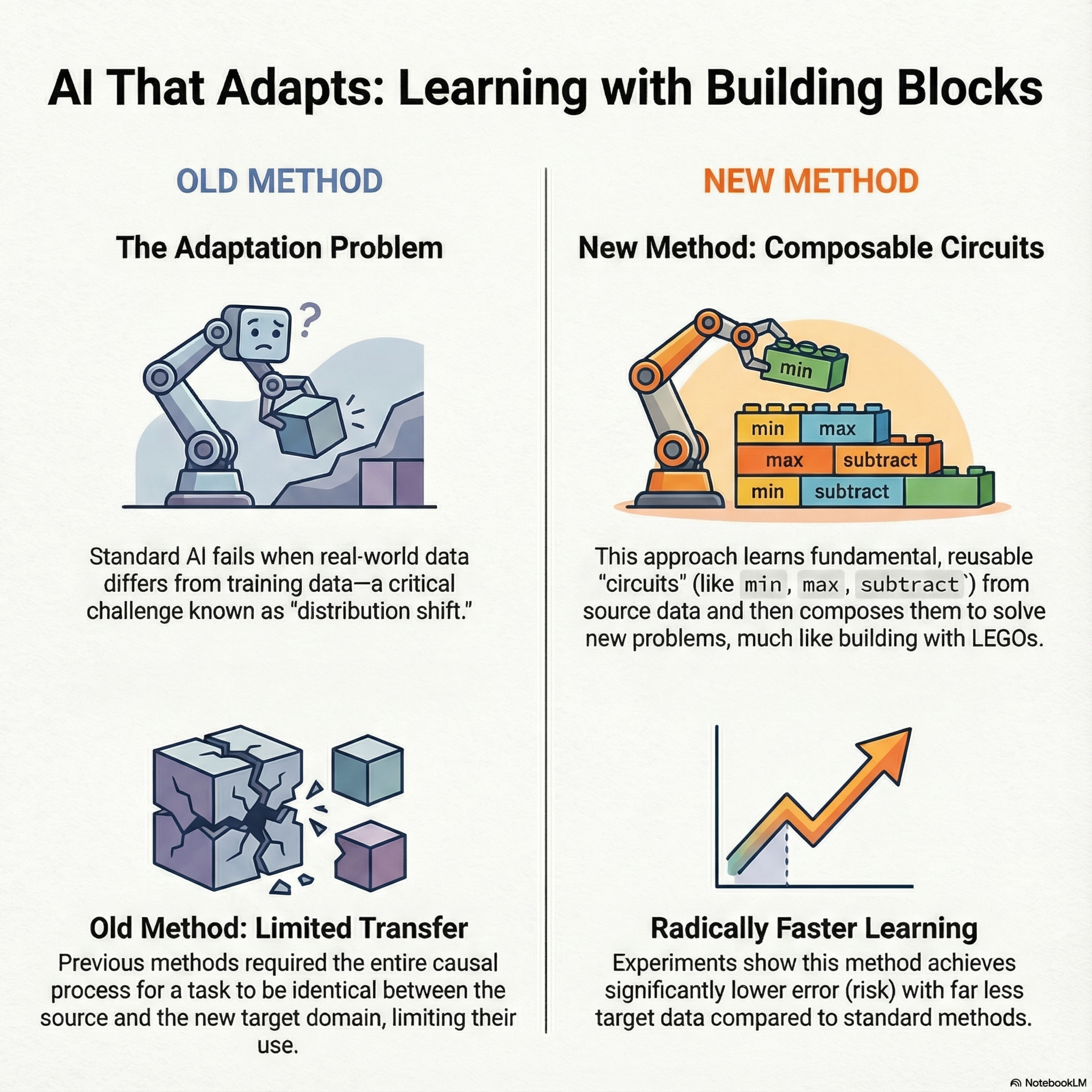
This paper introduces a novel causal framework designed to improve machine learning generalization across different data domains. It specifically presents Circuit-TR and Circuit-AD, two algorithms that leverage causal transportability theory to enable zero-shot or few-shot learning by identifying shared "modules" or mechanisms between source and target environments. While traditional methods rely on statistical invariance, this research focuses on compositional structure, allowing the system to build complex prediction rules in a new domain by combining known components from others. The authors establish a theoretical link between adaptation efficiency and circuit size complexity, showing that "fast" adaptation is possible when the underlying causal structure is small and transportable. Finally, the paper validates these concepts through synthetic simulations, demonstrating that their approach outperforms standard empirical risk minimization when structural domain knowledge is available or can be inferred.
Embed this episode
NOW PLAYING
Adapting fast and slow: transportable circuits for few shot learning
No transcript for this episode yet
Similar Episodes
No similar episodes found.