
EPISODE · Apr 17, 2025 · 45 MIN
ADHD Coach Explains: How to Stop Getting Distracted & Actually Get Things Done
from Lens of Hopefulness · host John Passadino
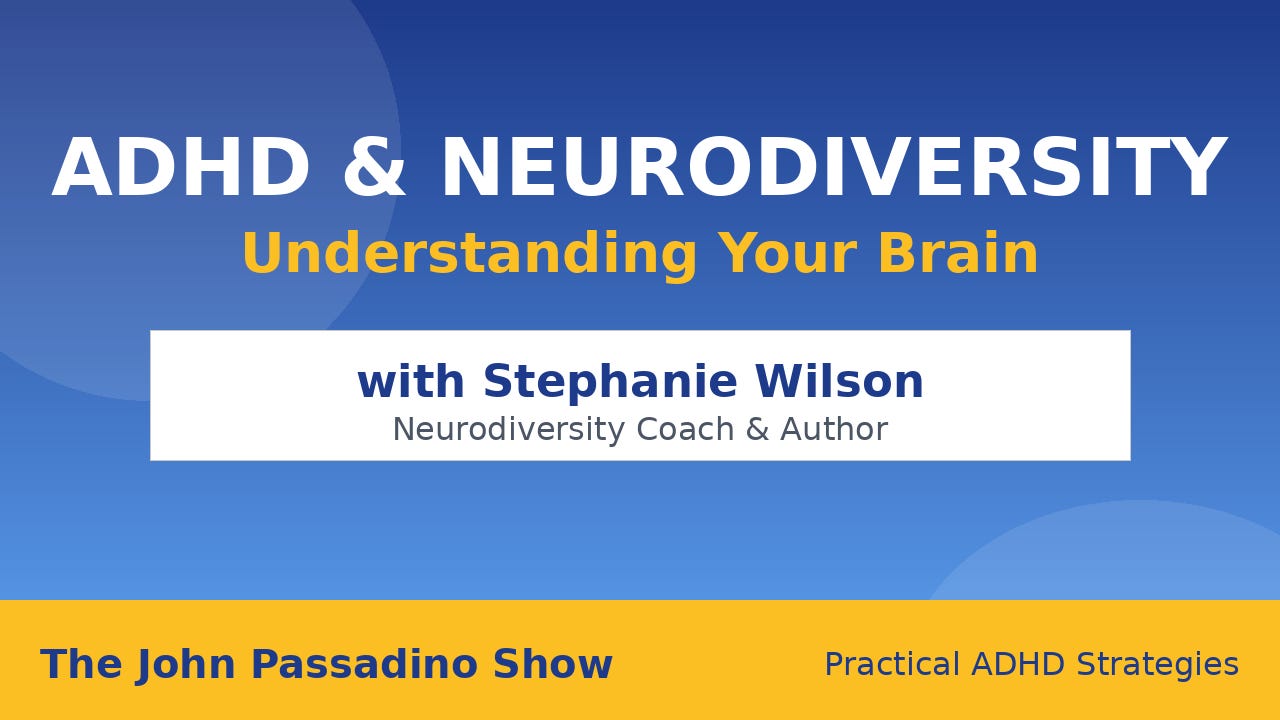
I conducted a podcast interview with neurodiversity coach Stephanie Wilson in April 2025. This is a summary of the interview.When I first discovered her on Medium.com, I was drawn to her unique combination of comedy writing, self-awareness articles, and her delightful cartoons that accompany each piece. What I didn’t know then was that this talented writer and artist was also a certified neurodiversity coach—and that learning about her work would lead me to some profound realizations about myself.Artistic talentStephanie’s journey is as multifaceted as her talents. With an MFA in painting and visual arts from Hunter College, she initially set out to become an artist. While fame may have eluded her, her artistic background has enriched everything she does. As she beautifully explained during our conversation, “writing is sculpting with words.” That perspective—treating language as a material to be shaped, refined, and crafted—infuses both her coaching practice and her creative work.For nearly five years now, Stephanie has maintained a blog on her website, posting every Wednesday without fail. She’s also an editor on Medium.com, where her supportive and constructive feedback has made her a valued member of the writing community. But it’s her work as a neurodiversity coach that has become her personal mission.What Is Neurodiversity?When I first came across the term “neurodiversity coach,” I’ll admit I was not familiar with the term. Was she a neurologist? Some kind of brain specialist? As Stephanie explained, neurodiversity refers to brains that diverge enough from typical brain structure and patterning that they cross what she calls a “clinical line”—resulting in diagnoses like ADHD, autism, and various learning disorders.What struck me most was how she describes the high comorbidity—the frequent co-occurrence—of these conditions. Many people don’t fit neatly into one diagnostic box. They might have ADHD and anxiety, or autism and ADHD together. In fact, Stephanie recently presented on the combination of autism and ADHD, which isn’t yet a formal diagnosis in the DSM (Diagnostic and Statistical Manual) but is increasingly recognized as a common experience.As we talked, I thought, “This sounds familiar.” The ADHD, the fidgeting, the anxiety—bells were going off in my head. I shared with Stephanie how a neurologist once told me during a difficult period of panic attacks: “It’s the way you are wired.” Those words lifted a tremendous burden from my shoulders. I had been chasing diagnoses, beating myself up, wondering what was wrong with me. Hearing that this was simply how my brain works—not a moral failing, not something I could just “fix” through willpower—changed everything.What is coaching versus psychotherapy?One question I had to ask: What’s the difference between neurodiversity coaching and psychotherapy? Both seem to involve talking through problems, understanding yourself better, and working toward change.Stephanie’s answer painted an understandable picture. While coaching certainly deals with emotions (because “emotion drives everything”), the focus is fundamentally different. Therapy often looks backward, examining your past and working through it. Coaching looks forward, focusing on experimentation and action.Here’s how a typical coaching session works: You have a conversation that leads to an “aha moment”—some shift in perspective or awareness. Then, instead of just talking about it, you leverage that moment by trying something new. It’s an experiment. Between sessions, you go out into the world and test this fresh approach. When you return, you report back—and here’s the key part—whether you succeeded or failed doesn’t matter. All outcomes are equally valuable data.As Stephanie put it, you might have done exactly what you intended, or done it twice as much, or halfway, or avoided it entirely, or completely forgotten about it. Each scenario offers insights for building self-awareness and developing skills. “We are scientists collecting data,” she explained.This action-oriented approach makes sense when you consider the ADHD field’s mantra: “Pills don’t teach skills.” Medication might give you a tiny pause between impulses, but you need to develop the skills to use that pause effectively.I made myself a real-world exampleI shared a daily struggle of mine with Stephanie—something I think many of you can relate to. I sit down to pay the electric bill, and suddenly I notice an open browser tab. I click on it, see an email that needs forwarding, remember something for the theater board, check social media for responses, and then an hour passes without me paying the bill.Stephanie’s response showed her coaching approach clearly. She identified two scenarios:First, there’s the anxiety-driven distraction. We know from experience that we might forget things, so when we see that open tab or get a notification, anxiety kicks in. “What if I forget this?” The fear propels us to click, to address it immediately, to juggle everything at once.Her solution? Externalize the brain. Write things down on Post-it notes as they come up. The physical act of recording the task on paper (or in a reminder app) calms the anxiety because now your “external brain” is remembering for you. Knowing the other tasks are captured and waiting allows you to focus on paying that bill.The second scenario is pure rabbit-hole diving—the dopamine hit of clicking on something interesting, getting that notification, seeing who gave me a like on a social media app. For this, Stephanie suggests environmental controls: turning off notifications during focus time, and creating a cozy, dedicated workspace.Building new habitsWhat I love about Stephanie’s approach is its structure and practicality. She talks about making “deals with yourself”—carving out a specific time in a cozy environment (for her, it’s early morning at the kitchen table with coffee) for dedicated focus. The more you follow through on these deals, the more you build the skill. The next day, you’re more likely to do it again because you remember how good it felt to succeed.Stephanie’s advice reminded me of advice from the bestselling book, Atomic Habits.She also shared a powerful insight from the book “Four Thousand Weeks”—we try to cram so much into our days that we create anxiety and stress, which only increases our distractibility and need for those dopamine hits. Instead of planning to accomplish ten things, plan for two or three. Give yourself space. Have a “vacation” between tasks as a reward.Finding your tribeOne of the most moving moments in our conversation came when Stephanie described attending her first CHADD conference (Children and Adults with ADHD). CHADD is the main educational and research organization around ADHD in the United States, and their annual professional conferences bring together researchers, psychologists, psychiatrists, and coaches.“I cried,” Stephanie said, “because here is my tribe and the people that are up there that are lifetime achievement award big researchers, psychologists, psychiatrists presenting in these massive presentation halls have ADHD.”That moment of recognition—seeing successful people who share your neurodivergence, realizing you’re not alone, that it’s okay—is transformative. It shifts the narrative from “What’s wrong with me?” to “Now what can I do to make life better?”My experience from the dark ages of educationAs we talked, I found myself reflecting on my own journey. I grew up in the 1960s and 70s, attending strict Catholic schools that punished, not accommodated, differences. If you fell behind in math, you could incur a physical penalty. There was no help, no understanding, just the expectation that you’d keep up or suffer the consequences.I contrasted this with my son’s experience. He had speech therapy, occupational therapy, and physical therapy starting at age three or four. He went through inclusion programs throughout school, and despite people warning us that he’d never function if we kept him in “special ed,” he graduated college. The difference? He had support. He had people who made him feel okay, who built his confidence, who understood that his brain worked differently.Talking with Stephanie helped me realize how fortunate we were—and how different my own childhood might have been with similar support. I firmly believe I would have been less anxious and would have suffered less. And as I told Stephanie, if her coaching helps people not feel terrible, even at a minimum, she’s a saint.Stephanie’s coachingStephanie’s work focuses on high school, college, and post-college age clients. Her mission is to help them see themselves in a positive light and leverage their strengths sooner rather than later. As she put it, “I feel like my work is done here” if she can achieve that.Her website offers a wealth of resources, including ADHD resources, coaching information, testimonials, and the option to request a free consultation. She also writes for ADDitude Magazine and maintains her popular Medium presence where she publishes both comedy and self-awareness articles, each illustrated with her unique cartoons.What makes Stephanie special isn’t just her credentials (though her training through the Neurodiversity Coaching Institute, membership in the International Coaching Federation, and her work with CHADD are impressive). It’s her genuine care for her clients. “I love my clients,” she told me. “Every single one of them. I’ll say that every day.”ReflectionsStephanie and I ended our conversation reflecting on something beautiful: the ongoing journey of self-awareness. Throughout our lives, we have moments of greater self-awareness, moments when things click into place, when we understand ourselves a little better. That’s what our conversation was really about.For me, discovering Stephanie’s work and learning about neurodiversity coaching has been one of those moments. It’s helped me understand my own wiring, revisit my son’s journey with new appreciation, and recognize how close I’ve been to these issues throughout my life without fully seeing them.That’s the power of awareness—and the power of having someone like Stephanie Wilson to guide the journey toward something better.To learn more about Stephanie Wilson’s neurodiversity coaching, visit For Something Better. You can also find her articles and cartoons on Medium.com, where she writes about self-awareness, personal growth, and the occasional comedic take on life’s absurdities. Listen to the full interview on The John Passadino Show, available on Spotify, Apple Podcasts, Amazon Music, Audible, and YouTube.Spotify:Apple:AmazonAudibleYouTube:Article and podcast copyright 2025 Passadino Publishing LLC All rights reserved This is a public episode. If you would like to discuss this with other subscribers or get access to bonus episodes, visit lensofhopefulness.substack.com
Embed this episode
Ready to play
ADHD Coach Explains: How to Stop Getting Distracted & Actually Get Things Done
No transcript for this episode yet
Similar Episodes
No similar episodes found.
Similar Podcasts
No similar podcasts found.