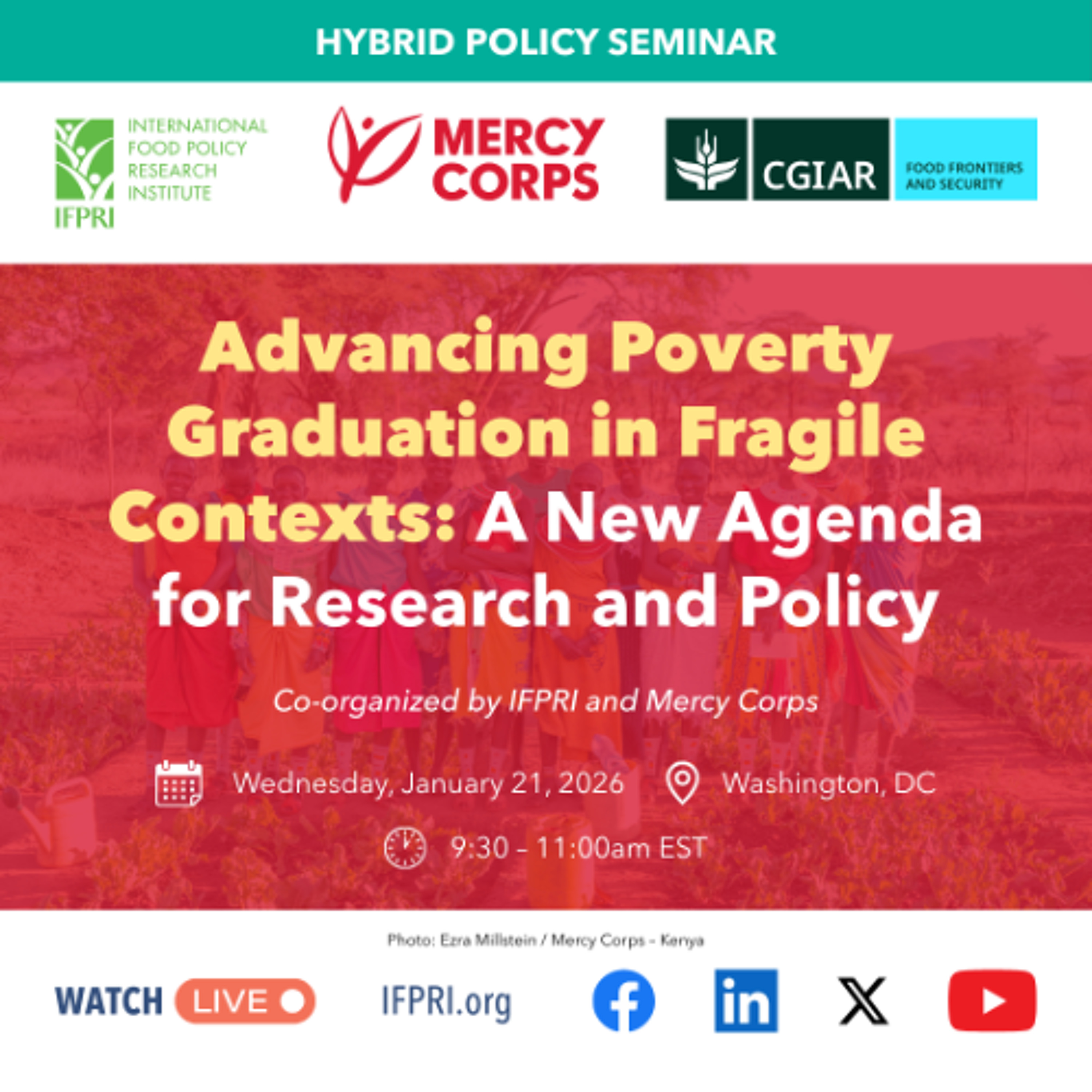
Advancing Poverty Graduation in Fragile Contexts: A New Agenda for Research and Policy episode artwork

EPISODE · Jan 21, 2026 · 1H 30M

Advancing Poverty Graduation in Fragile Contexts: A New Agenda for Research and Policy

from IFPRI Podcast · host International Food Policy Research Institute

Policy Seminar | IFPRI Policy Seminar Advancing Poverty Graduation in Fragile Contexts: A New Agenda for Research and Policy Co-organized by IFPRI and Mercy Corps January 21, 2026 Multifaceted livelihoods interventions that target households in extreme poverty are extremely effective in reducing extreme poverty, with consistent gains in income, consumption, savings, and psychosocial well-being. These interventions, often called graduation models, have been widely evaluated, but most evidence comes from stable rural settings. In fragile and conflict-affected environments where poverty is increasingly concentrated, household-level interventions may not be sufficient to drive sustained poverty reduction. In today’s climate of constrained funding and compounding crises, there is a pressing need to understand how to adapt, scale, and sustain graduation models to deliver more cost-effective, resilient, and inclusive outcomes in contexts marked by fragility, displacement, and recurrent climate- and conflict-related shocks. Convened by Mercy Corps and IFPRI, this seminar will present new research, emerging program insights, and opportunities for continued learning to make graduation model interventions more impactful, inclusive, and resilient in fragile settings. The discussion will build on Mercy Corps’ recent report, Closing the Gap: Adapting Poverty Graduation for Fragile Contexts, which highlights evidence-based opportunities to adapt graduation design and delivery. The seminar will convene leading researchers, donors, policymakers, and implementing partners to showcase emerging evidence from IFPRI, Mercy Corps, and other partners. Together, participants will distill lessons from diverse experiences, explore frontiers for innovation and learning, and chart a forward-looking agenda to strengthen the impact, scalability, and resilience of poverty graduation in fragile contexts—laying the groundwork for deeper collaboration across the research and implementation community. Introduction and Opening Remarks Jeeyon Kim, Director of Research, Food Security, Mercy Corps Highlights from Recent Findings - The Impact of a Nutrition-Sensitive Graduation Model Program on Child Nutrition: Experimental Evidence from Ethiopia: Kalle Hirvonen, Senior Research Fellow, IFPRI - Displacement and Development: Evidence from a Graduation Program for Somalia’s Ultra-Poor: Jessica Leight, Senior Research Fellow, IFPRI - The impact of connecting poverty graduation and market systems development in refugee contexts: evidence from DREAMS Uganda: Daniel Hudner, Senior Researcher, Resilience and Market Systems, Mercy Corps Panel Discussion Chaired by: Kibrom Abay, Senior Research Fellow, IFPRI Radu Ban, Senior Program Officer, Women’s Economic Empowerment, Gates Foundation Wendy Chamberlin, Senior Technical Advisor, Resilience, Trickle Up Julie Kedroske, Director, Social Protection Program, Innovations for Poverty Action (IPA) Kibrom Tafere, Economist, Development Research Group, World Bank Closing Remarks Daniel Gilligan, Director, Poverty, Gender, and Inclusion Unit, IFPRI More about this Event: https://www.ifpri.org/event/advancing-poverty-graduation-in-fragile-contexts-a-new-agenda-for-research-and-policy/ Subscribe IFPRI Insights newsletter and event announcements at www.ifpri.org/content/newsletter-subscription

Policy Seminar | IFPRI Policy Seminar Advancing Poverty Graduation in Fragile Contexts: A New Agenda for Research and Policy Co-organized by IFPRI and Mercy Corps January 21, 2026 Multifaceted livelihoods interventions that target households in extreme poverty are extremely effective in reducing extreme poverty, with consistent gains in income, consumption, savings, and psychosocial well-being. These interventions, often called graduation models, have been widely evaluated, but most evidence comes from stable rural settings. In fragile and conflict-affected environments where poverty is increasingly concentrated, household-level interventions may not be sufficient to drive sustained poverty reduction. In today’s climate of constrained funding and compounding crises, there is a pressing need to understand how to adapt, scale, and sustain graduation models to deliver more cost-effective, resilient, and inclusive outcomes in contexts marked by fragility, displacement, and recurrent climate- and conflict-related shocks. Convened by Mercy Corps and IFPRI, this seminar will present new research, emerging program insights, and opportunities for continued learning to make graduation model interventions more impactful, inclusive, and resilient in fragile settings. The discussion will build on Mercy Corps’ recent report, Closing the Gap: Adapting Poverty Graduation for Fragile Contexts, which highlights evidence-based opportunities to adapt graduation design and delivery. The seminar will convene leading researchers, donors, policymakers, and implementing partners to showcase emerging evidence from IFPRI, Mercy Corps, and other partners. Together, participants will distill lessons from diverse experiences, explore frontiers for innovation and learning, and chart a forward-looking agenda to strengthen the impact, scalability, and resilience of poverty graduation in fragile contexts—laying the groundwork for deeper collaboration across the research and implementation community. Introduction and Opening Remarks Jeeyon Kim, Director of Research, Food Security, Mercy Corps Highlights from Recent Findings - The Impact of a Nutrition-Sensitive Graduation Model Program on Child Nutrition: Experimental Evidence from Ethiopia: Kalle Hirvonen, Senior Research Fellow, IFPRI - Displacement and Development: Evidence from a Graduation Program for Somalia’s Ultra-Poor: Jessica Leight, Senior Research Fellow, IFPRI - The impact of connecting poverty graduation and market systems development in refugee contexts: evidence from DREAMS Uganda: Daniel Hudner, Senior Researcher, Resilience and Market Systems, Mercy Corps Panel Discussion Chaired by: Kibrom Abay, Senior Research Fellow, IFPRI Radu Ban, Senior Program Officer, Women’s Economic Empowerment, Gates Foundation Wendy Chamberlin, Senior Technical Advisor, Resilience, Trickle Up Julie Kedroske, Director, Social Protection Program, Innovations for Poverty Action (IPA) Kibrom Tafere, Economist, Development Research Group, World Bank Closing Remarks Daniel Gilligan, Director, Poverty, Gender, and Inclusion Unit, IFPRI More about this Event: https://www.ifpri.org/event/advancing-poverty-graduation-in-fragile-contexts-a-new-agenda-for-research-and-policy/ Subscribe IFPRI Insights newsletter and event announcements at www.ifpri.org/content/newsletter-subscription

NOW PLAYING

Advancing Poverty Graduation in Fragile Contexts: A New Agenda for Research and Policy

0:00 1:30:55

No transcript for this episode yet

We transcribe on demand. Request one and we'll notify you when it's ready — usually under 10 minutes.

That Hoarder: Overcome Compulsive Hoarding That Hoarder Hoarding disorder is stigmatised and people who hoard feel vast amounts of shame. This podcast began life as an audio diary, an anonymous outlet for somebody with this weird condition. That Hoarder speaks about her experiences living with compulsive hoarding, she interviews therapists, academics, researchers, children of hoarders, professional organisers and influencers, and she shares insight and tips for others with the problem. Listened to by people who hoard as well as those who love them and those who work with them, Overcome Compulsive Hoarding with That Hoarder aims to shatter the stigma, share the truth and speak openly and honestly to improve lives. The Small Business Startup School – Business Notes | Financial Literacy | Retail Psychology – For Professionals & Entrepreneurs The Small Business Startup School Inc. Starting or buying a small business? While personal circumstances may vary, business patterns remain timeless. On The Small Business Startup School, we explore strategies, insights, and practical solutions to help entrepreneurs confidently navigate their journey.Hosted by Ola Williams—a retail entrepreneur, fintech founder, and financial coach with over two decades of experience—this podcast marries financial awareness and retail psychology with optimism to deliver actionable takeaways.Join us to learn, grow, and connect as we uncover the keys to business success.Let’s continue to learn together and be encouraged to keep on connecting! DIOSA. Carolina Sanper This podcast is a sacred space created by Carolina Sanper where you connect with your inner wisdom and embody your magnetic feminine power.It is the realization that the mystical realm is where you plant the seeds of your desired reality.It is a portal to your true essence: awareness, presence, and receiving with ease. Welcome home, DIOSA. 🖤 XXX Tech by SOVRYN Dr. Brian Sovryn The crossroads between technology, sensuality, and metaphysics - and the longest running anarchist podcast in the world! Brought to you by Dr. Brian Sovryn.

Frequently Asked Questions

How long is this episode of IFPRI Podcast?

This episode is 1 hour and 30 minutes long.

When was this IFPRI Podcast episode published?

This episode was published on January 21, 2026.

What is this episode about?

Policy Seminar | IFPRI Policy Seminar Advancing Poverty Graduation in Fragile Contexts: A New Agenda for Research and Policy Co-organized by IFPRI and Mercy Corps January 21, 2026 Multifaceted livelihoods interventions that target households in...

Can I download this IFPRI Podcast episode?

Yes, you can download this episode by clicking the download button on the episode player, or subscribe to the podcast in your preferred podcast app for automatic downloads.
URL copied to clipboard!