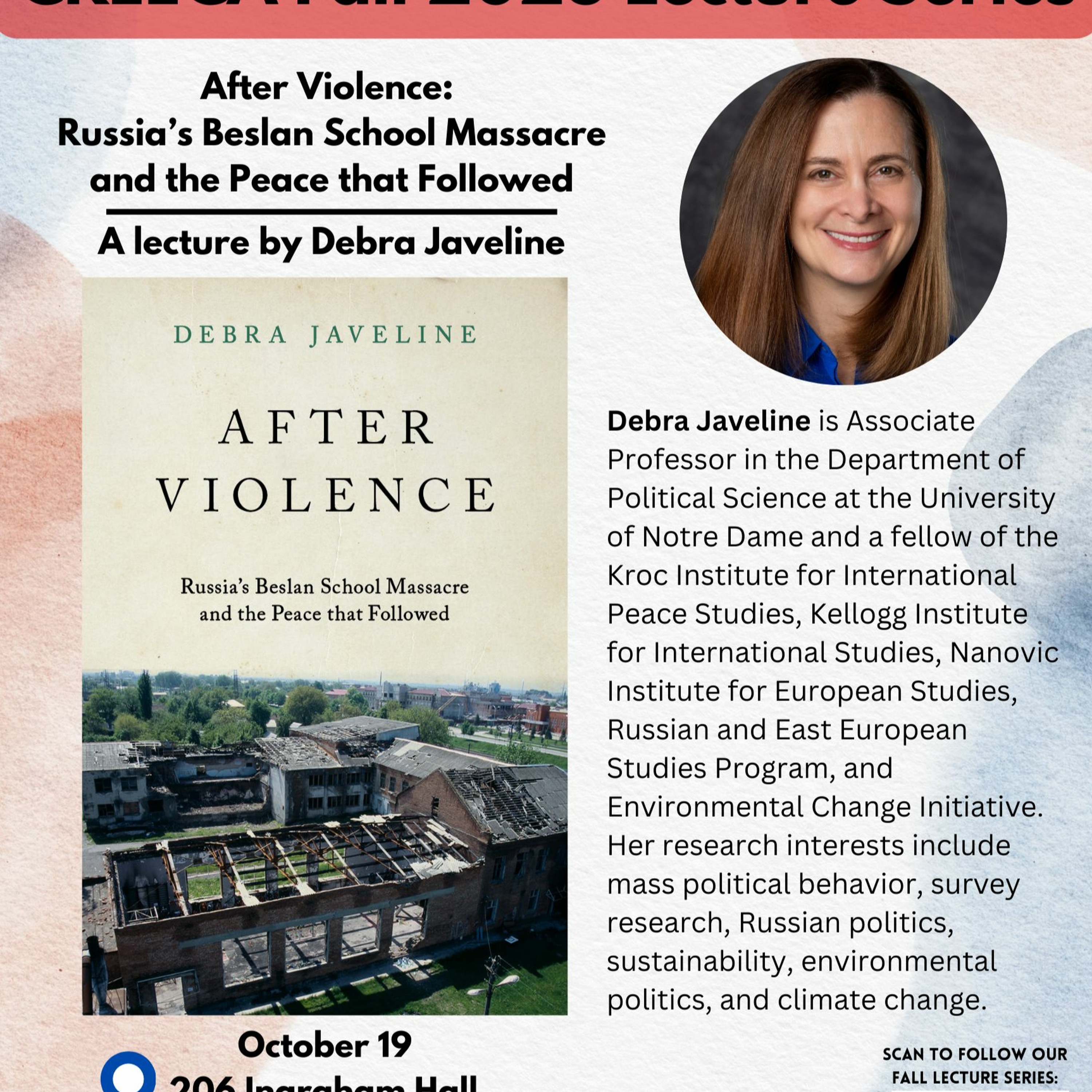
After Violence: Russia’s Beslan School Massacre And The Peace That Followed episode artwork

EPISODE · Oct 24, 2023 · 45 MIN

After Violence: Russia’s Beslan School Massacre And The Peace That Followed

from CREECA Lecture Series Podcast · host Center for Russia, East Europe, and Central Asia at the University of Wisconsin, Madison

Debra Javeline (Associate Professor in the Department of Political Science at the University of Notre Dame) will present on her book, After Violence: Russia’s Beslan School Massacre and the Peace that Followed (Oxford University Press, 2023). Free and open to the public. About the lecture: Starting on September 1, 2004, and ending 53 hours later, Russia experienced its most appalling act of terrorism in history, the seizure of School No. 1 in Beslan, North Ossetia. Approximately 1,200 children, parents, and teachers were taken hostage, and over 330 —nearly one of every hundred Beslan residents— were killed, hundreds more seriously wounded, and all severely traumatized. After Violence is the first book to analyze the aftermath of such large-scale violence with evidence from almost all direct victims. It explores the motivations behind individual responses to violence. When does violence fuel greater acceptance of retaliatory violence, and when does violence fuel nonviolent participation in politics? The mass hostage taking was widely predicted to provoke a spiral of retaliatory ethnic violence in the North Caucasus, where the act of terror was embedded in a larger context of ongoing conflict between Ossetians, Ingush, and Chechens. Politicians, journalists, victims, and other local residents asserted that vengeance would come. Instead, the hostage taking triggered unprecedented peaceful political activism on a scale seen nowhere else in Russia. Beslan activists challenged authorities, endured official harassment, and won a historic victory against the Russian state in the European Court of Human Rights. After Violence provides insights into this unexpected but preferable outcome. Using systematic surveys of 1,098 victims (82%) and 2,043 nearby residents, in-depth focus groups, journalistic accounts, investigative reports, NGO reports, and prior scholarly research, After Violence offers novel findings about the influence of anger, prejudice, alienation, efficacy, and other variables on post-violence behavior. About the speaker: Debra Javeline is Associate Professor in the Department of Political Science at the University of Notre Dame and a fellow of the Kroc Institute for International Peace Studies, Kellogg Institute for International Studies, Nanovic Institute for European Studies, Russian and East European Studies Program, and Environmental Change Initiative. Her research interests include mass political behavior, survey research, Russian politics, sustainability, environmental politics, and climate change. She focuses on the decisions of ordinary citizens, whether in response to violence or climate impacts, and she is currently exploring coastal homeowner motivations to take action to reduce their risk from rising seas, hurricanes, and other hazards.

Debra Javeline (Associate Professor in the Department of Political Science at the University of Notre Dame) will present on her book, After Violence: Russia’s Beslan School Massacre and the Peace that Followed (Oxford University Press, 2023). Free and open to the public. About the lecture: Starting on September 1, 2004, and ending 53 hours later, Russia experienced its most appalling act of terrorism in history, the seizure of School No. 1 in Beslan, North Ossetia. Approximately 1,200 children, parents, and teachers were taken hostage, and over 330 —nearly one of every hundred Beslan residents— were killed, hundreds more seriously wounded, and all severely traumatized. After Violence is the first book to analyze the aftermath of such large-scale violence with evidence from almost all direct victims. It explores the motivations behind individual responses to violence. When does violence fuel greater acceptance of retaliatory violence, and when does violence fuel nonviolent participation in politics? The mass hostage taking was widely predicted to provoke a spiral of retaliatory ethnic violence in the North Caucasus, where the act of terror was embedded in a larger context of ongoing conflict between Ossetians, Ingush, and Chechens. Politicians, journalists, victims, and other local residents asserted that vengeance would come. Instead, the hostage taking triggered unprecedented peaceful political activism on a scale seen nowhere else in Russia. Beslan activists challenged authorities, endured official harassment, and won a historic victory against the Russian state in the European Court of Human Rights. After Violence provides insights into this unexpected but preferable outcome. Using systematic surveys of 1,098 victims (82%) and 2,043 nearby residents, in-depth focus groups, journalistic accounts, investigative reports, NGO reports, and prior scholarly research, After Violence offers novel findings about the influence of anger, prejudice, alienation, efficacy, and other variables on post-violence behavior. About the speaker: Debra Javeline is Associate Professor in the Department of Political Science at the University of Notre Dame and a fellow of the Kroc Institute for International Peace Studies, Kellogg Institute for International Studies, Nanovic Institute for European Studies, Russian and East European Studies Program, and Environmental Change Initiative. Her research interests include mass political behavior, survey research, Russian politics, sustainability, environmental politics, and climate change. She focuses on the decisions of ordinary citizens, whether in response to violence or climate impacts, and she is currently exploring coastal homeowner motivations to take action to reduce their risk from rising seas, hurricanes, and other hazards.

NOW PLAYING

After Violence: Russia’s Beslan School Massacre And The Peace That Followed

0:00 45:47

No transcript for this episode yet

We transcribe on demand. Request one and we'll notify you when it's ready — usually under 10 minutes.

French Your Way Jessica: Native French teacher founder of French Your Way Boost your French listening skills and test your comprehension with this one of a kind series of podcasts. Get the chance to listen to a real conversation between native speakers talking at normal speed AND customise your learning experience through carefully designed sets of questions (2 levels of difficulty) available for download at www.frenchvoicespodcast.com. All interviews also come with the transcript. French teacher Jessica interviews native speakers of French from around the world who share a bit of their life and passion. Where else would you meet in one same place a French yoga teacher based in Melbourne, a soap manufacturer from Provence, or a couple cycling around the world? That Hoarder: Overcome Compulsive Hoarding That Hoarder Hoarding disorder is stigmatised and people who hoard feel vast amounts of shame. This podcast began life as an audio diary, an anonymous outlet for somebody with this weird condition. That Hoarder speaks about her experiences living with compulsive hoarding, she interviews therapists, academics, researchers, children of hoarders, professional organisers and influencers, and she shares insight and tips for others with the problem. Listened to by people who hoard as well as those who love them and those who work with them, Overcome Compulsive Hoarding with That Hoarder aims to shatter the stigma, share the truth and speak openly and honestly to improve lives. The Small Business Startup School – Business Notes | Financial Literacy | Retail Psychology – For Professionals & Entrepreneurs The Small Business Startup School Inc. Starting or buying a small business? While personal circumstances may vary, business patterns remain timeless. On The Small Business Startup School, we explore strategies, insights, and practical solutions to help entrepreneurs confidently navigate their journey.Hosted by Ola Williams—a retail entrepreneur, fintech founder, and financial coach with over two decades of experience—this podcast marries financial awareness and retail psychology with optimism to deliver actionable takeaways.Join us to learn, grow, and connect as we uncover the keys to business success.Let’s continue to learn together and be encouraged to keep on connecting! DIOSA. Carolina Sanper This podcast is a sacred space created by Carolina Sanper where you connect with your inner wisdom and embody your magnetic feminine power.It is the realization that the mystical realm is where you plant the seeds of your desired reality.It is a portal to your true essence: awareness, presence, and receiving with ease. Welcome home, DIOSA. 🖤

Frequently Asked Questions

How long is this episode of CREECA Lecture Series Podcast?

This episode is 45 minutes long.

When was this CREECA Lecture Series Podcast episode published?

This episode was published on October 24, 2023.

What is this episode about?

Debra Javeline (Associate Professor in the Department of Political Science at the University of Notre Dame) will present on her book, After Violence: Russia’s Beslan School Massacre and the Peace that Followed (Oxford University Press, 2023). Free...

Can I download this CREECA Lecture Series Podcast episode?

Yes, you can download this episode by clicking the download button on the episode player, or subscribe to the podcast in your preferred podcast app for automatic downloads.
URL copied to clipboard!