Black Bear Population Research in the Southern Appalachians. I'm Kristi Kiel Blackman. This is AgCast, brought to you by the University of Tennessee Institute of Agriculture. Today I have Jake Homme with me and he is a researcher associate with our department and he's also a project lead for the Southern Appalachian Cooperative Bear Study.
Welcome, Jake. Hi, well thank you. Thank you for having me today. So why don't you start off by telling us what this project is.
It has a long name, Southern Appalachian Cooperative Bear Study. What does this entail? So it is a rather large cumbersome study as the name implies. We are a collaborative research effort put together by four different state management agencies and in partnership with various federal and private organizations.
This study is a 14 million acre population estimate of the American Black Bear in the Southern Appalachians that spans across North Carolina, South Carolina, Georgia, and Tennessee. What is the data you're gathering? What is the actual data that you want to see? So well, let me start off with a little bit about the methods.
We use spatially explicit capture recapture to estimate population demographics, specifically abundance and density for Black Bear populations. And what that entails is collecting bare hair from individuals in the wild and then using that hair to put together a genetic capture recapture history. Using that capture recapture history, we then use that to figure out what our capture rate is for the entire population and we use those data also to put together a spatial distribution for the animals that we have captured and for any animals that could have been captured on our trapping grid. So we put all that data together into a program called spatial explicit capture recapture seeker in the open source programming suite R and then we use that to put together an estimate of abundance and an estimate of density for populations in Southern Appalachians.
So we're talking about collecting hair from an animal that is in excess 300 pounds. How do you actually go about getting that hair from bears? That's a good question. So traditionally in previous Markary capture studies, what you had to do was mark the individual somehow, which usually entailed some sort of live capture.
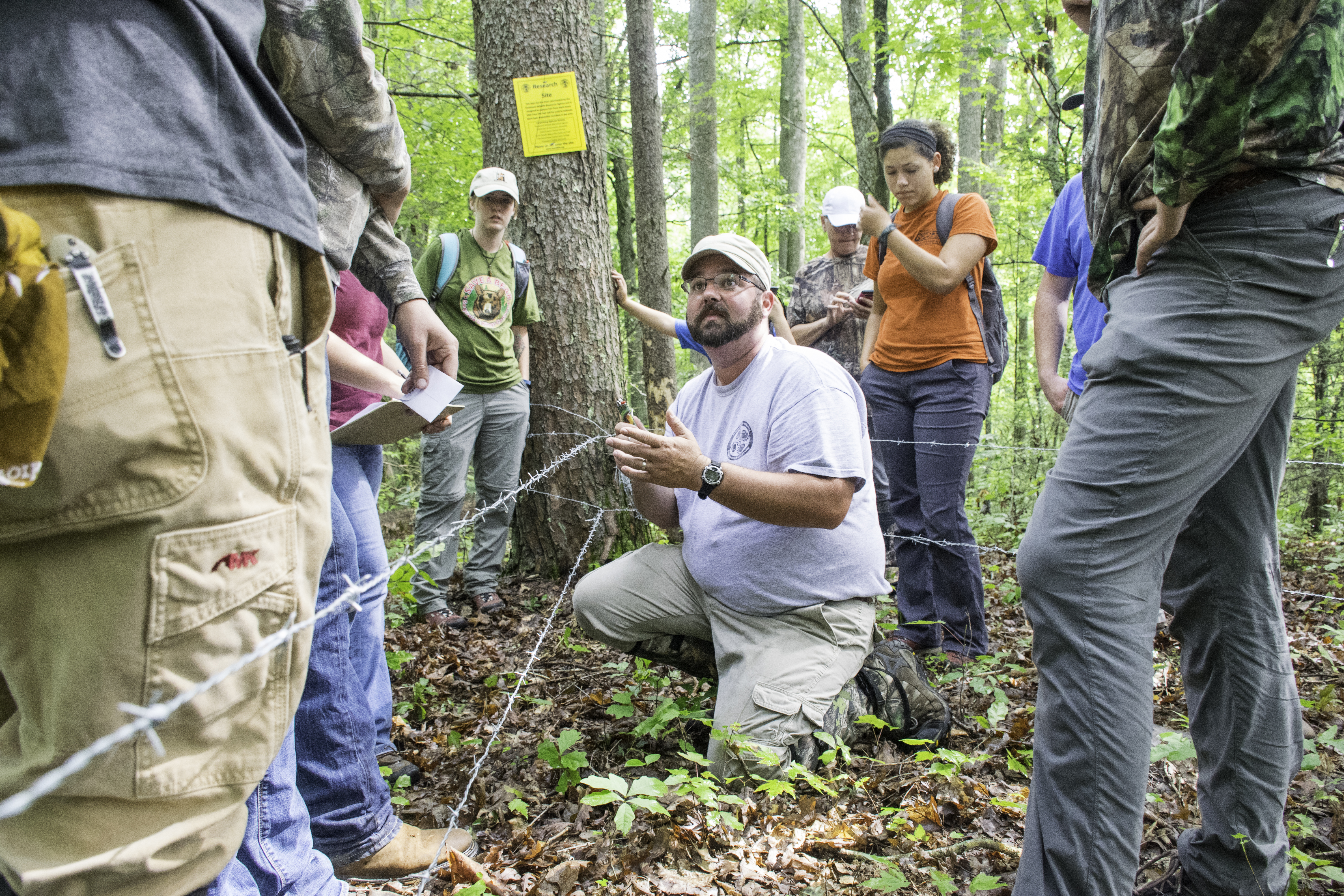
So you'd dart an animal while the free range or in a trap, anesthetize the animal and then put a tattoo or an ear tag or something, some unique identifier on the animal that allowed you to recapture it and say we have recaptured this bear. So that obviously takes a lot more time and effort and drug certifications and all sorts of paperwork to get that ball rolling. And what we use is a series of barbed wire hair snare. It's basically a a passive hair collection system.
The idea is a strand of barbed wire, well two strands of barbed wire that are wrapped around a series of three to five trees with a hanging food reward in the center of the trap. And if the animal is interested enough in going to the center of the trap that they have to go over across the barbed wire, sometimes the barbs will snag a little bit of hair. And we use that hair, we genotype the hair sample to figure out what bear has access to what trap. So we are using a genetic marker instead of an ear tag to put together our capture history.
And so is this more cost efficient and less stressful for the animal? Oh, extremely. I mean, it's very cost efficient on a large scale. That's one of the reasons why we were able to get the study off the ground.
For smaller scale population studies, sometimes live capture is still a viable option. But for 14 million acre population studies where we're covering the majority of the southern Appalachians, we need something that's a little more cost efficient and barbed wire is a lot cheaper than using live capture and and esthetization drugs and all that good stuff. As far as stress on the animal, yes, the overall experience is not nearly as stressful. Live capturing an animal, obviously you have to use drugs to anesthetize them so that they will not feel the theoretically invasive procedures that we use clipping any of your tags is a painful thing.
So you have to use anesthesia and recovering from those drugs can be kind of a rough process. And the bear is usually ending up in a trap. And in the whole thing is much more stressful for the animal than being out in the woods alone, coming across a little bit of barbed wire and going across it. So you say this covers 14 million acres?
All said and done, we are trying to cover an area that spans about 14 million acres. Now, what we do part of our part of the process of estimating the population using spatially explicit capture recapture entails putting a viable buffer zone around your trapping grid. So we use a 16 kilometer buffer around our grids. And with that included 16 kilometer buffer, the combined total area is around 14 million acres.
So why would you say this project is important? Now the blackberries, of course, a symbol of our region and it's an animal to everyone, I think has a good bit of affection or respect and or respect for. Why is this important? Why do we need to be concerned about black bear populations?
So traditional hunters in the Appalachians have relied heavily upon black bears as a source of food, as a source of hide for clothing, jewelry through their teeth. And today's modern hunting populations still do take a lot of pleasure in the sport of hunting black bear. That's another reason why we actively conserve the species because it is a viable game species. A lot of people don't see them as that, but I don't take that far out.
But anyway, and then the third reason that I like to harp on as far as the importance of conserving bear populations is because they make an excellent umbrella species. Bears require a lot of habitat in order to maintain viable population numbers. And if you conserve those animals, you're also conserving the habitat in which they live. And that habitat is vital to a number of different other species, especially in the Southern Appalachians.
So how many individual bears have you actually identified with this project? So we've actually not identified any individuals yet. Part of the genetic component of our research is actually handled by Wildlife Genetics International. They are a well-known, well-established genetics company based out of Alberta, Canada.
And we've collected about 4,500 individual hair samples just this season. And that's our first half of the study. So we really don't have the resources to process all those samples ourselves, which is why we send those out to WGI. Those guys also have one of the most extensive micro satellite libraries for black bears in North America of any laboratory in the world.
And their quality control process is really great to top-notch. So we send that out to them. They genotype the samples. It generally takes anywhere between five and nine months for them to get our genetic capture history back to us at which point we'll start our analysis.
We are halfway through the data collection phase of the projects. So we covered the eastern face of Tennessee, a large portion of the northern area of Georgia, and then basically the northwestern corner of South Carolina this year. Next year's data collection goals include, well, it's all going to be North Carolina next year, but basically we have another seven million acre chunk of the Appalachians that goes through North Carolina. That's why we split it up the way that we did, because their study area is more or less equivalent to all three other state study areas combined.
How long do you expect the final analysis to take? Well, that depends on how much we can get done in the interim with year one's data. Our method is suited to large scale population research. And a study in studies of this kind have not really been done much in the past on this scale.
So each state management agency has been doing some population research in the past on local bear populations in their respective states. However, previous techniques have limited the size of the studies that they could conduct. And so with this study, we're able to make a combined effort for the entire region as opposed to smaller populations such as in the Smokies or in Big South Fork or something like that. With this study, we can cover the entire Southern Appalachians all at once and get a snapshot of bear population demographics for the entire region.
So with this methodology, is this a game changer for animal data collection moving forward? I would say yes. I would say it is. I mean, the combination of using genetic marker recapture as opposed to live capture techniques and the added advantage of clustered sampling design, which is specific to spatially explicit capture recapture allows us to cover a much wider range than we would normally be able to with traditional marker capture.
And thus, we are able to put together large scale population estimates that have never been done before. Any project of this scale takes a collaborative effort from various agencies. And we wouldn't be able to do this without the help of the private and public agencies that have funded this project and who have allowed us access to their property in order to conduct our research. Jake, thanks so much.
Once again, this is Kristy Hill-Blackman with the Department of Forestry, Wildlife and Fisheries at the University of Tennessee Institute of Agriculture. Thanks for listening. For more real life solutions provided by the UT Institute of Agriculture, go to our website at ag.tenacy.edu.