Farmers in Tennessee and across the southeastern U.S. are hearing about crop damage caused by the herbicide Dicamba. UT's Institute of Agriculture is working with producers to educate them about Dicamba and perhaps limit any harmful impact. But can we successfully eliminate weeds from fields and still protect crops?
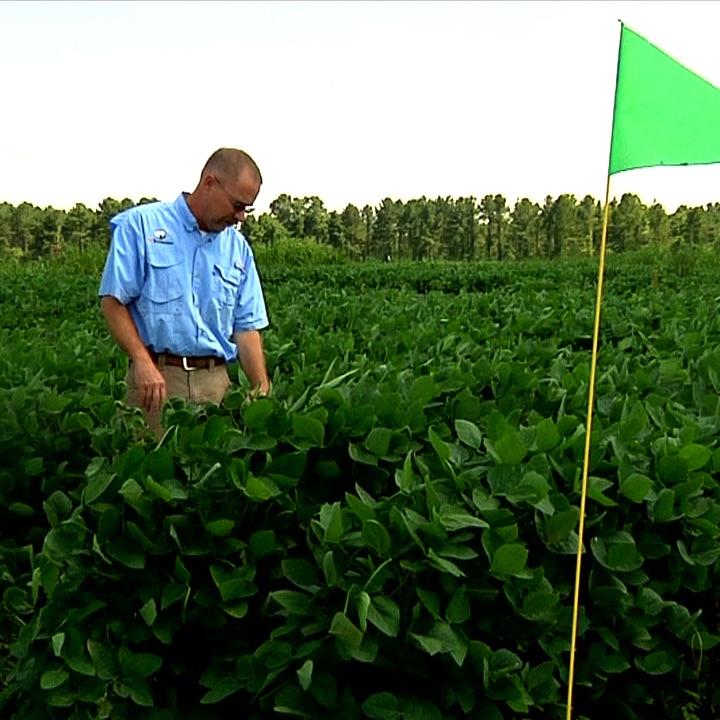
Hello, I'm Charles Denny. This is AgCast, brought to you by the University of Tennessee Institute of Agriculture. Dr. Larry Steckle examines a soybean field that appears to be coming along nicely, but a closer look shows leaves curling up.
And that's a real characteristic you'll see, especially on the new growth. It really affects the new growth, not so much the old growth. These plants at UT's West Tennessee Research and Education Center in Jackson were harmed by Dicamba. The herbicide has been around half a century and a necessary tool in preventing weeds.
Before this year, Dicamba was usually sprayed in cold weather, prepping fields for row crop planting to come later. But with new Dicamba-tolerant crops and lower volatile Dicamba formulations, this herbicide is being applied in warmer temperatures. And Steckle says that's created some challenges. When we spray it under hot conditions, it has a tendency to move out of the field and then start harming crops nearby the dark color.
Steckle, a UT Institute of Agriculture weed specialist, says Dicamba starts out as a liquid but can turn into a gas. It drifts from field to field by wind and sometimes fog. Steckle is researching the issue and trying to help farmers. UT Extension, UT Research, we are educators, we are not regulators.
And so when we get called in, we're not going to help place blame on who did what. What we're going in to do is help these growers assess what problem they have. And it happens to be Dicamba drift, which oftentimes across the state it is this year. How did it happen?
Was it drift through the field? Sometimes it's not drift. Sometimes the farmer did it himself by mistake or accident. What's helped the situation in Tennessee?
A good growing season. There's been plenty of rain this summer in the Jackson area, and that actually allows a crop to grow away from the injured area. The Dicamba damage might have been worse in a drought year. Still, half a million acres of soybeans could be affected as well as cotton, though we won't know yield impacts for a while.
And from now until harvest, the situation will be watched closely. Tracy Sullivan is with UT Extension. As complaints come in, we're trying to work with other government agencies, Tennessee Department of Agriculture, to make sure that homeowners and landowners know who to contact when they have drift issues. But also make sure that we know that farmers know how to use the product properly.
Agricultural leaders in Arkansas recently voted to ban the use of Dicamba. That's not the case here, but the Tennessee Department of Agriculture recently initiated new guidelines for Dicamba use. Dr. Bob Hayes, superintendent of the West Tennessee Ag Research Center, says it's critical for UTIA to help spread correct information about proper Dicamba use.
We're still working on it and trying to come up and educate people. We had a big effort this year on trying to educate all those users. But we know we didn't reach every user. And, you know, some choose not to come to be educated and receive that technology.
We hope we can try to reach all of them and do a great job because it's important for agriculture that we steward all of our technologies properly. Dicamba isn't just impacting row crops. The herbicide can also damage trees. UTIA experts say this summer of Dicamba damage is a learning process.
Farmers must fight weeds in order to grow crops. While Dicamba had its impact in 2017, the key goal is to prevent damage in the future. Thanks for listening. I'm Charles Denny.
For more real-life solutions provided by the UT Institute of Agriculture, go to our website at ag.phennessee.edu. For more real-life solutions provided by the UT Institute of Agriculture,