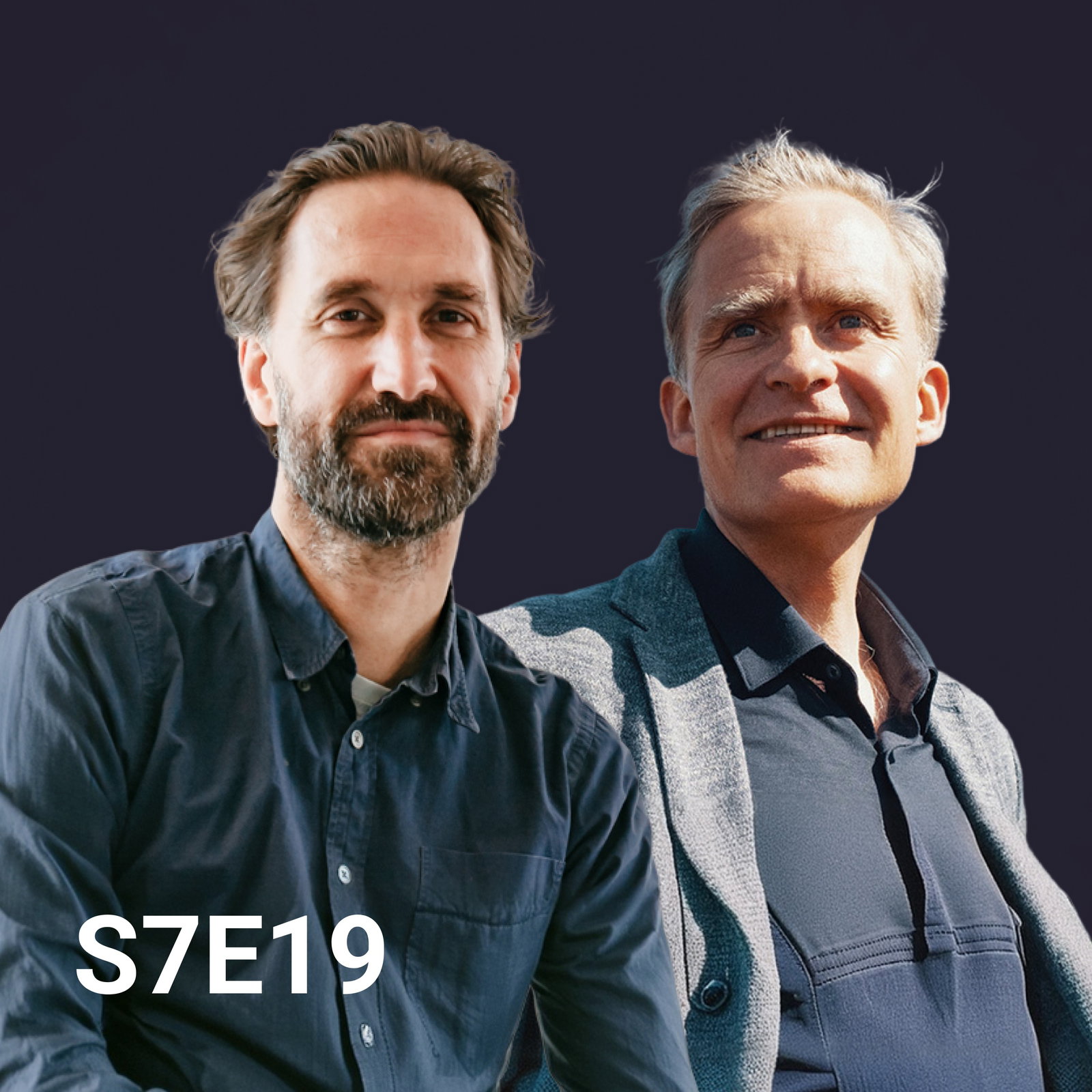
Service design has always had a problem. The service blueprints showing how products, customers, employees, and technology connect are often too complex for an organization to act on. Today, we're talking about how AI changes that, with two of the people who created the discipline, Ben Reason and Lavrun's Lovely. Welcome back to Invisible Machines. I'm Josh Tyson, joined as always by Rob Wilson, co-founder and CEO of OneReach. Rob and I are co-authors of Age of Invisible Machines, the first best-selling book about agentic orchestration, and this is the podcast where we explore the future of intelligence through conversations with the people shaping it.
Last episode, Seth Godin argued that AI will do what you said, not what you meant. The question he left open, what do you hand the machine so it knows what the work is for? Ben and Lovrens have been building that handoff since 2001, when they joined with Chris Downs to start the world's first service design agency, LiveWork. A service is not a thing you can point at. It's everything before, during, and after the product. How you compare it, how you contract, how you use it, and how you leave. The asset that makes that designable is the service blueprint, and as you'll hear Rob explain, that blueprint now has to exist in two fidelities. A compression that humans can sign,
and a hydration that agents can run. In essence, this allows the blueprint to become the organization's flight plan. We also get into vanity token burning, why seamless is the wrong goal, and a digital twin of Norway's alcohol rules where removing the paperwork spent the savings on police and healthcare. Let's hear more from Ben Reason and Lovren's Lovely. I'm really excited for today's conversation. I think it probably makes the most sense to start sort of at square one for our listeners. I know you guys have probably answered this question before, but what is service design and why do we need it? And Ben, you're on a boat right now, aren't you? I am on a boat, yes. We've been on the boat for five, six weeks. Amazing. We're stepping up our level of commitment to living on the boat. So next year, hopefully, we're learning as we go how to live on the boat.
I've been on it. We crossed the English Channel together earlier this summer. Yeah, we can amend the question. What is service design? Why do people need it? And how does it change when you're on a boat? We could jump to the start. I think according to Wikipedia, Ben and I and Chris Downs started the world's first service design agency, LiveWork, back in 2001. And we did spend quite a lot of time.
try to define, so what would service design be? We came from product design, physical product, and then we came from UX. And what we could see very clearly was that design need to be applied to organizations. So a service, meaning you don't just need a banking app, you need a system that allows you to have a relationship with your bank through call centers, apps, websites, retail environments, everything. So we thought it might be a good idea to formulate what it means to actually design a service as opposed to a product. So that's how it started back about 25 years ago.
We used to have a bit of a shorthand, which was, you know, everybody knows what design of a product means. We used to say, well, you know, a lot of people love their BMW, but not many people love their bank. So we want to bring the design quality that is the BMW employee to the experience you have of your bank or your hospital or your mortgage provider, whoever. It's probably an endless mission. But I think things have changed over the last 20-something years. And in some ways, it's like you're helping people build experiences for other people in a simple way that other people will want. Like, we're going to help you build experiences for the people they'll want versus...
versus complaining about. We have worked with tax as well. It might not be a service that people want, but it's a service you have to have. Good few years into working with the Dutch prison service as well, which is definitely not a service that people aspire for. Yeah, that's an interesting point. So yeah, there's some thread the needle here that's better than the current service. And I think that brings up a really good point because, you know, in past episodes, we've sort of talked about how to pick the right problem to solve using AI. And you guys are like...
Okay, now how to plan and solve that problem the right way? And what form should that take? And what should you do before you burn a single token? And I think that's what's really important here is people are burning tokens. They're wasting money. They're building software no one's going to use or nobody wants to use. It's fun to build software. So the person burning the tokens is having fun, but they're burning tokens, writing, whether it's writing software, writing articles, writing books that no one's going to read. I call it vanity token burning, right? And it's dopaminergic. So we're like addicted to this and companies are paying the bill. And you guys have all along, in my opinion, had the solution to this, but the solution's never been more urgent.
than it is today. There's one interesting dynamic that I think might be playing out here. So we've had this orchestration of services perspective. There was a sort of convinced that we do need a high quality experience for our customers. We do need a good app for the bank. It's almost like the issue became, but we can't build that fast enough. And the backlog became a kind of a restrictive thing for a lot of organizations, especially in a kind of legacy organization. How do we make that shift to that kind of modern experience that people start to expect because they see it from a startup? You go to a hospital, it's even worse. We've worked with health systems where you know you want to integrate data from primary care to secondary care, but you go to talk to IT and they'll tell you, get to the back of the queue. It'd be interesting to know if this is true in what you see, but it feels like in a way, AI starts to kind of take away the backlog and then the issue might...
it's almost like the bottleneck or the problem moves to something else. So it feels to us like the world has been very focused on digital product and that service design has kind of taken a secondary seat. We can do our work and then there's a huge amount of work created for production of software and digital. But if that shifts and more people can create software, you know, because they don't all need to be engineers, what changes and what's, you know, what's our role in that future? There was a throttle effect. People were not doing it in a way that frustrated other people because they wanted to or thought it was a good idea. It's because they had constraints, as Seth Godin would say, and these constraints...
created these bad experiences. AI is now breaking those constraints. But people are realizing, well, we don't have the tools to plan now properly because it wasn't necessary because we had these constraints. And now they can, but they don't know how to because they haven't read your book. They probably are just learning these two words for the first time, service design. And they're like, what the heck is that? And now they need it more than ever.
So Rob, if I could go back to your question or your comment about burning tokens, I think it's super relevant. When we started out, we spent a lot of time trying to define what's it like to design a service. And we had to understand what a service actually is. You know, it's intangible and it happens over time. And there are different business models for it. But one of the bits that were central was this idea of sustainability in delivering service. And Ben was doing his master's degree on sustainable business development at the time. That was baked into the concept of service design as we saw it. And we had a bit of a naive idea. We thought if we design services, they're so brilliant.
that people spend their time on money on intangible consumption rather than buying and throwing away stuff, then we have contributed a little bit through design. I think, unfortunately, that's not what's really happened, but I think it's extremely relevant now with AI. And when you start building services that are dependent on burning lots of tokens, you really have to think about the sustainability of the service from an economic point of view, from an energy point of view, even from a climate point of view. So I think that core idea around how do you deliver services that are sustainable and will last over time is more relevant now. with AI than it used to be. I think of it as an aim ready fire is what it should be. And it's fire ready aim. And what is the aim ready? That's service design. And it's a very specific form. We're not talking about something highly, like you can show a service design document. It's a template. There's a specific asset and it takes a specific shape and form. And it's a compression of what needs to be done so that every human in the company can read and approve and agree with the objective of what that AI project is supposed to accomplish. And this creates measurement and this creates budget.
creates responsible use of AI, responsible monetarily, as you pointed out, but also to the environment. Like why not both, right? Like we can care about both. You mentioned product design, Ben. What's interesting is we'll soon be in a world where people are only going to interact with software.
through an agent, maybe their own agent that's sort of customized to what they want to accomplish. And so digital product design, you tend to think of a UI and the constraints of a UI that often contributes to bad experiences, but also sort of flips to a new problem, right? Where there aren't as many constraints and sometimes constraints can be helpful. So now you have this blank canvas. And again, I think this is where service design is a great asset because with a blank canvas, it's hard to know what you should be doing. And service design really helps you figure out what it is, what kind of problems you should be solving and then looking for ways to solve them.
It might be good to give you a little bit more of a technical description of service design from that perspective. We think about a service as having a life cycle. We've talked a lot about banks. You have a life cycle where you understand, explore, contract with, and then use a financial service. Often the banks will talk about a product. Let's say a mortgage or a loan is a product. The service is everything that happens before, during, and after you engage with that product. It incorporates the marketing. How do you compare a loan in the market?
what's it like to contract with that bank and in a way the product is a contract isn't it it's just that we promise to lend you this money you promise to pay it back like this i sort of sometimes describe as you need to you know you kind of need to get to the product and you need help to use it and you and then you need help to move out the other side when you're done with it and make sure you're finished and hopefully for the back point of view you come back for something else and these we sometimes break down that like quite long cycle of interactions into journeys which are you know somebody has a need and that need can be resolved as an outcome and you might say okay i know i need a loan now i need to compare loans in the market and the outcome is i can make a an informed decision that I'm happy with. And if you look, if you're on the bank side, you know, they need to sell loans and their outcome is that they've got another prospective customer ready to sign a deal. And we look to align those two because often, you know, if I give an example from one bank, we found that a new account opening for a customer was when they get the credit card or that, you know, it was a...
a kind of a fancy bank so it was like i'm really after this but for the bank is when you put money in and these two things were not matching up and it meant that things weren't resolved and there was a misalignment and experiences weren't what they could be so we can actually design break things down into these journeys that have needs and outcomes so we can measure those to the point of of the kind of the token to come back to the token and what you might be accounting for what are we spending to achieve this outcome what's the outcome worth to the organization just to be a little bit more technical about how you how you think about the service and how you might approach it in different ways because if you try and you know eat the whole elephant you're going to make a mess but if you can say okay well look for this business our our issue is actually you know it's not about signing new customers we have a decent pipeline but the cost to serve things because people are coming in and then the loan isn't what they thought it was or whatever so you can say okay well we're going to look at that that part of the experience and an outcome there is a customer who is clear about how things work and able to manage it themselves so we can be quite specific about what we can measure from an experience point of view but we can align that to what we can measure from a business value point of view and the cost point of view. I've been a fan of ServiceZen for a long time and you guys, and I've always felt like it's missing, but I do understand companies' constraints. One thing that's interesting is I think in our world, there's a big push for these forward-led engineers that they're dropping into companies, and they think that companies' failure of AI is a technical failure, when in reality it's a design failure. And what I love about service design is people are talking about knowing what problem you're solving, and there's all this sort of common rhetoric around how to solve this problem, how to think and be responsible.
Um, but, but no one's like physically presenting an asset, you know, something that's like tangible that says, and this, this is exactly how you do this. You know, it's like a Ted talk. It sounds great. You feel like your life changed and then you wake up the next morning and do the exact same thing you did the day before. And what service design is, is like, yeah, you can hear all this advice, but this is the thing you can wake up and say, okay, now let's create a service design for.
For our team, because it's not just about figuring out, as you said, the outcome and the benefit to the business and the cost to get the outcome. It's also to get everyone on the same page and to get approved. It's how finance approves the token burn. It's how business approves the token burn. And the labor cost of sitting in front of watching tokens burn. And that is how you measure it afterwards. Yeah. I like that, Rob. It's useful because you're right. I think what's particular to design is you have the insight into the experience, where that experience might be failing. You have the insight into what that means for the business from a cost point of view or a lost opportunity point of view.
But that has to then inform a design, which is a concept for how to do it better, which you can then measure. That is what design is, like understanding the issue and feeding that into a problem solving solution that you can then test and prove. I've seen a lot of folks just popping up as like the expert on AI. And having done this 20 years when no one wanted to talk to me, I was the boring guy at the party and I had to remember, don't mention AI. Like my wife would be like, don't mention AI. And now everyone's talking about it, but it's so surface level because unless you've actually done this, then the practical thing is the service design. And it's one thing to say, you know, better planning on your AI. Like, okay, got it. Like who's...
Who didn't know that already? But what does that plan need to look like specifically? Like, show me an example of what a good AI plan looks like. I'll show you a service design. It sounds like you're saying that the machine can't design a service. I think a machine can design a service if it's black and white, but a human can design one that delights another human. Like, should we just check the box on service design? Or is the goal to automate things and create experiences better than how you do them now and better than how your competition does it? Well, I think this is one of the fears we've talked about with AI is that the check the box thing will become very tempting.
And then everyone will end up with the same thing. And the AYI will reference all the other models. There will be no differentiation. There may be no delight in it. There will definitely be no kind of idiosyncrasies and quirkinesses, which are actually what make us engage with the world. It's that thing that we've seen with digital already is people start buying vinyl again because it's got soul. And it's actually been a thing that we've talked about since the beginning. It's not just about something being seamless. All these words that you hear in digital, in UX, people don't want seamless. They want the right kind of friction that helps them feel something or get something done or learn something or enrich their life. Otherwise, we just have a bunch of agents which kind of...
take care of stuff for us and we're wondering what to do. Yeah, nobody wants the perfect looking actor. They want the actor that's just flat enough to relate to. I don't know if you agree, but I think I see a tendency of services becoming more and more similar, particularly given the way AI is building them. What we've talked about as the vanilla issue.
Everybody likes ice cream for everyone. Oh, it's seamless. Great. But I'm thinking it must turn into a huge problem for business because you can't really differentiate your brand. You can't put the personality in that makes you choose that provider over the other provider, et cetera. So how you actually build your brand and your values and your behaviors into it seems to be a bit under threat by the machines we use to build the services. I think that's been interesting. And I do quite a lot of work with public services, but there it might be the opposite. I'm thinking, okay, so if it's for citizens.
Maybe it's good that all public services behave in the same way. I'm not sure. The vanilla problem, it's great for public service and it's a nightmare for business. That's interesting. Yeah, in a competitive environment versus one where consistency rules. And this kind of transitions to the second half of this episode, which is service design in an agentic world isn't the same as service design as it was. And part of that is like, when is AI right for designing your service? And when is it wrong? And what should you be designing in the first place? And what is fixing something that isn't broken? This one, Artifactive Service Design, that I know you've been really...
interested in, Rob. We call the service blueprint, which is an artifact that tries to put everything into one big picture. Now, what do we want to do with the service? What are the values, the brands, the purpose? What kind of users and customers are involved? What about the staff? Which systems? Which products? So it's this huge map that tries to describe the entire service and how it should behave. And we've done so many of these. And we thought for a while, if we just get into enough detail, the world will be perfect.
And we made these incredibly complex service blueprints describing everything. And what we learned was that organizations just couldn't use them. It was just too much information. The good thing was that it gave people an overview. You can see how all the bits fit together. But trying to do it becomes too difficult. You know, we have to focus on that bit first, and we'll do that bit in two years, and that bit in four years, etc. So that's kind of been the challenge with taking the blueprint to its extremes. And like we've talked about, it's the compressed version that's for humans to sign off on. And then there's probably the much more complex versions.
That actually described the service. And that kind of learned from you, Rob. It's incredibly interesting where we stand now with AI. Yeah, it's the thing we've sort of been working on together, which is the AI can handle the detail. It can read fast. It can digest more. Now a service blueprint is like a multi-part message. It's the compression for the user to sign off on. And then it's the detail for the agent to execute on. And this is an interesting point because I think a lot of people try to blend it into two. The right fidelity for both is the wrong fidelity for either, right?
We've been experimenting with this. It's almost like, how much do you zoom in or zoom out? Do you just show a storyboard that would help someone understand it? And what we find is it depends on the audience and what they're worried about. So we created a service blueprint once for JP Morgan, which didn't really get much traction until we put the IT costs onto it. And we said, okay, this is where you're spending this much this year, this is where you're spending this much, this is where you're spending this much. And then we had a director who was like, this is what I need. I need to control that beast, the IT organization.
I need to know what they're actually delivering for the business and our customers. And it was the first time she'd had anything like that. So sometimes it's that. Sometimes, you know, people just want to know where is their regulatory and compliance obligation and how is that kind of being ticked off? So I think one of the things with my experiments with sort of putting a kind of blueprint with AI is you can create these different views very quickly as well. So you can cut it the way you need it to answer a question. You can run a hypothesis and say, okay, well, look, how would this impact on?
regulatory and compliance or how would it help me meet those obligations or what would the costs look like? It's like a prism. Now you can create versions for each persona or for each role and they can see instead of everyone trying to extract from one. Yeah, that makes a lot of sense. And just AI itself having its own lens that's highly detailed, not because it needs it, because we need to communicate that detail. It's irresponsible to let it make those decisions. I mean, just anecdotally, we had a project where it became a joke that someone would say, well, could you make a version of this for Jonathan?
because he needs a certain angle on it. So then you'd have one of the design teams spend a couple of days recutting, and then you end up with the version nightmare of your documentation. Yeah, it's fascinating. That's great. It's helping us do this. One thing I find fascinating about your journey and makes so much sense to me is that as an organization, you've sort of explained that you've...
You sort of begin your journey with, we'll do service design for you. And then organizations very quickly see, how did we not do this? Now we need to know how to do it. And it shifts from like, we'll do it for you. And they're like, great, to no, no, no, no, we need to know how to do this. Teach us how to do this. Yeah, I can't believe I'm talking about banks all the time, but I did speak to a colleague from one of the UK banks and they are managing all of their digital estate through a kind of service blueprints journey approach and have a good kind of team of 100 service designers who are...
who are doing that. So like you say, Rob, I think we almost saw this at the beginning, Lawrence. Remember, you need to be really close to the service to be able to design it in an ongoing way, you know, because it's being delivered every day and, you know, things change frequently. So being the guys who wrote the book, that's encouraging to see that kind of come to pass to say, OK, organizations are realizing that they need this. You got a friend who works in Alberta with the government and they, you know, again, they have this big team, which is keeping the lights on. Yeah, this is like, I'm seeing this everywhere. It's engineers essentially creating whatever their version of a service design is, which is usually very bad, trying to learn how to become an accountant in a couple of weeks so they can automate accounting.
gee, I wonder why this isn't working, right? Is it because AI is broken? Yeah, that must be it. It's just that AI is broken, right? It's not that it actually took them a long time to learn this. And like, who should be designing this versus, is this a build problem? It's a design problem. And then, yeah, what is the common federated asset that everyone creates that's familiar, not everyone creating their own version of, you know, how to define the outcomes, but saying like, as an organization, we should all agree on a format for communicating this so that we all recognize it.
And it has all the things in it that we need to make a decision on whether this is the right tokens to burn. We have seen many a project where they've said, we have X number of ways of describing the service that we do. You know, people who've adopted Journey, but we have, you know, multiple different templates. So let's start off with just a kind of amnesty on these things. And let's agree one way that we document so that we're able to work across teams and things like that. So I wonder what some of the challenges.
that we see to do that is about human adoption, you know, it's about organizational adoption. But I think one thing that AI will help us with is just being able to manage the data so you don't have to have people whose job it is to kind of update things and keep them current and stuff like that. I think that's another big barrier is just the labor cost of keeping things documented so you can carry on working this way. It's easier to just have it all kind of lying around. and do your best. Yeah, I wonder if like your head of AI should be an expert on how to ingest and train an LLM or if they should be an expert on service design. I think you know where I stand, like service design. Then you've got a lot of people to teach out there. I think that idea that we've been discussing about service design or a kind of a service blueprint as the system prompt has really got me thinking. If there's a design job and a build job, the idea of being able to design the service, something that's delightful, useful, exciting.
And that's built in a systematic way, hopefully with some decent human input. That becomes a much stronger rule set, particularly if the machines are building the service. Do you agree, Rob? Yeah, I definitely agree. I think a lot of people talk about AI taking jobs and what are the new jobs AI is going to create. And then they immediately go to the people who are going to fix the AI machine.
who are going to keep it running. And they forget that, no, the new job is going to be service designers. And this is why we're working together on what is an education curriculum that says, what is service design in a genetic world? Like there's a lot of people now that need to be trained, but not trained on how to use AI, trained on how to do service design. What are some of those like early things that need to happen? I'm kind of wondering like what kind of conditions exist in a company that can really do well with service design? Because it's easy to look at the services you provide and throw AI at them.
and watch that fail. But it seems like the greater challenge is sort of figuring out how we can design a better service than what we already have. Seth Godin kind of breaks it down into problems and constraints. You know, if your problem is you want to get into orbit, your constraint is gravity. And then within most organizations, he describes them as entanglements, where it's all these systems that are kind of interlocked. And, you know, sometimes you can find a pin that you can pull out and the knot comes undone. But are there organizations that are better at this than others? I think some organizations understand that they provide a service.
and others don't others think that they provide products and that you know and they're not interested and that would be that's a kind of a pretty major blocker just to illustrate we worked with a telco in europe once where we demonstrated that most people came into the store for service like they were customers they needed to change a tariff or add something to it or something like that but the sales director of the company wouldn't accept this data because you know it kind of in his whole makeup as a salesperson he was about product and sales and that was also where the whole incentive structure was even though we can say 60 of your footfall is service requests you know and if you don't meet those you may lose revenue or lose customers but the mindset was was not there for some people. So I think that becomes kind of an interesting barrier. And I don't know if that will shift with AI. But in some ways, it's easier to work with public services because they're called public services. So people are kind of, you know, we know we're providing a service. It's generally intangible. It's often not paid for. So that becomes easier. I mean, constraints are a convenient way to be lazy and not care about service. And I think a lot of people are like, it's hard. You have to care about other people. You have to do extra work. And oh, these constraints can be convenient excuses to not care. I think this is effectively, if you wanted to boil Apple down to like...
What was their mentality? You're talking about an organization that understood what you just said. They're not a product company. They're an experience company. And that's what makes them stand out. And just inherently, they got this, right? And they know every product is an experience. They know it's not a product. And look how successful they are because they got this early. And that's their culture. And they have so much pressure, you know, from PEs or whatever to save money because what do you do? You buy the company, you reduce the quality of service and raise the price, right? And is that business model really going to hold unless you have a monopoly in the future where...
To your point, if AI lets you create better experiences because those constraints are no longer a convenient excuse, then consumers are going to choose the experience. As we see with Apple, they're going to choose the better experience. So now you can't afford to. I hadn't thought about it like that. The constraints come away, so therefore your excuses go away. So then what happens? The excuse is, well, this is a cost sensor, so we don't want to deal with it. I think what makes sense about that is that I think usually when we speak to top management, like CEO level, they get it because they own the totality of the organization that have interfaces with customers. Then the challenge is they've organized everyone below them to be like, you take care of product, you take care of IT, you take care of marketing, you take care of retail. So the silos underneath are more difficult to convince. And I think that's more just because it's so difficult. Yeah, I'm going to say it because you're not going to say it, but I think...
service design is the way they can cascade that downwards because words and speeches aren't going to do it. Inspirational TED Talks on their internal quarterly employee meetings, that's not going to do it. You need a tangible item that creates culture. You need this plan that forces people to think in a certain way, like checklist manifesto. You need this checklist that says, have you thought about this? Have you thought about this? What is your answer to this? You need something real to cascade down. Two thoughts on that. The first is that we had a director once who said, if you can connect the fluffy stuff, meaning all the experience stuff, all the human kind of.
insight that they got through research. If you can connect that to the machine, then I'm interested. If you can make the machine behave in ways that kind of responds to what we learn about humans, that's the trick that I don't have to answer to. And then the other one is, I don't know whether this is true in the AI world, but I sort of sometimes get the sense that the CEOs are kind of saying to the organization, okay, AI, go figure it out and make it happen because I don't want to be left behind. But they don't see it as their responsibility. But what you just said, Rob, is almost like, this is the CEO's toolkit. It's like, I can now. And we have had some clients, some CEOs who have literally taken a service blueprint, printed it onto an A3 and kept it in their briefcase.
I was like, this is the way I keep tabs on everyone. I had a friend who worked at Airbnb and she got a call one day from Brian Jeske's office saying, I don't know how this organization works anymore because we've built bits of digital on top of bits of digital. And, you know, how does it all work? And she created the service blueprint that he has outside his office so that he knows how does that experience relate to these products, to these policies? And I hadn't thought about that until now, but it's sort of, hey, dear CEO, you need to be the service designer. You know, my background was on the Dreamliner and it was automating, you know, that and a big part of that was the flight planning. And you know who did the flight planning? The pilot. And a flight plan is critical.
You don't fly without a flight plan. To me, Service Blueprint is the flight plan. And everyone's just getting in an airplane, loading it up with people, getting up to 30,000 feet, and then going like, okay, where do you guys want to go? And then everybody's saying a different place. And they're like, oh, why does AI fail? Why are these projects failing? It's a really exciting idea, though. And I haven't thought about it like this until now either. But let's say a service design or a blueprint of this total description is owned by the CEO. And you think about it in a genetic AI way, use that as a prompt for everybody when they're going to build something in there.
silo in the business, here's the system prompt that we all work from. And it will tell your machines how to build things in a way that matches the other bits. I think that's a really exciting concept. Yeah. And I think his or her job is not just to prove and review the blueprint. Their job is to make sure that the passengers get to where they're trying to go, which is the employees and the customers, right? Somebody has to make a decision on where to go. You can't just let them decide because no one will decide because they really want to go somewhere else. But also to ensure that they're doing it in a way.
It's to ensure that they're thinking through it properly. And that's what service design forces. It forces organizations to get on the same page. It's the asset that everybody can read, understand, know what the objective is, and approve before a token gets burned. And that's why I'm so excited. But I want to...
I want to make sure we don't over-index on customers because happy employees equals happy customers, right? If you want to start with service design, this is my opinion. You start with your employees because the best way to make customers happy is make your employees happy because they're the front line. I'm talking front line employees here, right? A friend of ours said, we all experience SAP. Employees, customers, everyone. We all experience it because it dictates the experience. I think you're spot on. I mean, I was thinking in healthcare.
Mostly we design for doctors and nurses, mostly nurses, because they're the ones on that front line who create the experience that people have. I think we have a whole stack of projects where people came to us and asked, how can we improve the customer experience? And it just ended up with working with their staff, because that's the best way to change it. And I think that's interesting again with AI, because I think also now when you design a service, you have to also incorporate these thoughts about all the people that need to change their jobs and how they do them, et cetera. And I think those transitions also need to be designed into how we...
actually implement services that are more driven by the machine. Yeah, and Joshua Ganz, it was like, AI will help the frontline worker provide better human-to-human experiences if you're using it well, right? And service design therefore becomes more relevant because now to help you deliver a human-to-human experience better, it needs to know what that human experience is supposed to look like. Ben, I think you said it. You would spend time with organizations and create a service design blueprint that was magnificent, but it was like too much to bite into, right? Like they didn't really know where to start. So is that almost like where AI becomes an asset? Because if you're trying to move from that blueprint to then...
a service design document for a single service or a single experience. If you have this service design blueprint, especially this hydrated version we've been talking about that an AI can look at, you know, the AI can help you work through some of that complexity, right? If you have that blueprint and then also a really clear idea of a service that you want to provide or design, does that help close that gap? Being able to bring AI into the process and say like, we want to accomplish this. How do we move that through our system, through our service design blueprint? Yeah, I think in some ways in very practical terms, and it's interesting with the, what will it do to Jobs thing from a designer point of view? Because what I've seen is, oh, there's a whole lot of work that no one pays for that we could now do.
which is about pulling data together that will enable support decision-making or evaluation or something like that. I mean, I've just done this as a test where I created a dummy healthcare service and then said, okay, here's an idea. how does that stack up against the whole outcomes model that we've got in here? And that kind of work would take going out, reading all these academic papers, pulling all that stuff. The quality of the work can be a lot higher. And I think something I'd really like to talk about is we've always had a bit of a challenge around the proof point, whether it's financial or the value case. You can very easily say, look, here's some humans and they're having a poor experience and we can improve that. But what's it worth and does it make a difference for a business point of view is quite hard or can take years to kind of filter through. But I think we'll be able to...
provide that kind of evaluation much faster, at least at a sort of fairly robust data analysis point of view, and then check it. I think that's really important, like for people to understand that service design is not about delivering a service that puts you out of business, but delights everybody else. It's about delivering the best service you can while optimizing and staying in business, right? Its whole point is trying to find exactly the perfect balance between these two things, because that's where all the money is, right? That's where all the profit is.
It's striking the perfect balance between how much service versus like what that costs you. And really like that's about knowing that before you start building anything. Another challenge we often have is, you know, you have to wait to see. So if you hire service design, you know, we might go and do field research with customers. And there's a kind of a gap in just in time before you start to see, oh, this is what it means to me. And I think the big difference that we can make now is we can, as Lavin says, we can kind of build the service, design the service before designing the service.
and show what we're after. Say, okay, we want to intervene here at this point because we can see X as an upside to that and we can then track whether that happens. This has been a bit of a holy grail for us for some time that closed the gap, the value gap in that way and reassure people, you know, this is what we're after here and it's only going to cost you X tokens to the burning question. And to build on that, what's incredibly important and what we have been missing is the opportunity to simulate properly on a system level. In the olden days, we'd sit down, speak to some customers, design something and make a small prototype and test it with a few people and try to build it. But what we can do now is to...
design the whole service and then we can start running simulations which is amazing and we can simulate on scale and we can simulate on system level so it's like oh the root cause to the problem is way over there or it's way down there and here's some completely unintended effects that we see in the system and that's something that the human brain just isn't constructed to do properly AI in its systemic nature is incredibly good at it I think this is an extremely exciting area right now and Now, we've been discussing in many ways so far in this conversation, how can we do things that have been done before better? But I think the most exciting thing is how can we do things that we haven't done before using AI? And I think this whole simulation bit is where it really comes in. And you can do the economic simulations, include the tokens. You can start looking at...
what's the human and economic cost of replacing this customer interaction with a machine? Yeah, and challenge those assumptions in your service design. Like, oh, will this make them happy? Will this go the way we think? Because service design is a lot of assumptions, right? That then if any of those are false, now you can stimulate those assumptions. Not perfectly, right? But much better. And then you're like, okay, test the outcomes. So now it's not just here's what we think it will save, but we've also simulated it. And that's about companies like now being able to have more data. The more service designs you do, the better your simulations are.
I think what's cool about that blueprint idea too is the beefier your blueprint, the better your simulations are. And then also if that blueprint is part of a knowledge model that is constantly taking snapshots as things move through the organization, it can track patterns as well. And then that also just becomes more data so that you can run better simulations and ultimately burn less tokens in your services. We're doing a piece of work now, which I think is one of those where we're trying to do things that humans haven't been able to do. So we're working with a regulatory system for alcohol in Norway.
And in Norway, where I live, there's lots of very strict regulations about alcohol. So there's a wine monopoly. Only the state can sell alcohol, for instance. Now, these regulations are relatively straightforward until you get into practice because there's a layer cake of different sets of regulations. So if you're an apple farmer and you want to produce alcoholic cider, you have to make some applications. And then you want to serve it to some guests on your farm, another set. And then you want to host a wedding at your farm and serve it, and there's a whole different set. So when the layer cake of regulations slap on top of each other, it becomes almost impossible, both for those who give permits and those who apply for permits. So what we're doing now, we're building a digital twin of the whole regulatory system.
We're dumping all the regulations in and we're building agents for all the actors in the system. So, oh, you're an apple farmer or you have a wine bar or you're working in a council, you're giving permits. And we built really rich agents with qualitative data, with what's in the job description, et cetera. And now we're simulating the effects of regulatory change. So, OK, we'll remove paragraph 17B from the law, try to apply for serving alcohol. And the whole system starts and all the actors come up. And it's been amazing in terms of seeing unintended consequences and also seeing where you can.
make regulatory changes that make everything easier across the layer cake. So in one case, we worked with the council. They said, well, what if we just remove the whole application? We will save thousands of hours handling these permits and businesses will be so happy. So we ran the simulation and said, yeah, fine, we'll save loads of money. However, you will need to put more money into the police because there's going to be in the streets and you'll need to put more money into healthcare because of more accidents and ill health due to alcohol, et cetera. So, and these were things that, you know, you possibly...
It would be so hard for a human to see the systemic consequences of it. And I think using agentic AI on a service level simulation is something new and incredibly exciting. Yeah, the service design as an asset, as a common template, let's call it, for communicating the objective of any project that is going to burn tokens and create something relative to the art of it is fairly straightforward. And anyone can be taught that as long as it's built on experience and the template's the right template. But the hard part is, you know, you're on a boat sailing.
A lot of people think like good experience equals comfortable experience, right? But if you just wanted to make it easy and comfortable, the last thing you would do is try to put all your stuff in storage and sail around the world on a boat. So good experience doesn't equal easy or comfortable all the time. Like the right experience is an art, right? And it's an art of balancing the right kind of challenge, the right kind of friction. And I think if AI is designing the easiest experience, it can do that. If you're trying to design...
the right kind of experience with the right kind of frustration and pain now it becomes that art a nice illustration of that not work that we did but we worked with the um the student loan company in the uk and there was a team working on the application process and at some point someone in that team said hang on a minute someone you know who was talking to the young people and making the applications they said you know we all need to realize that these are 17 18 year olds and this is the first time they've really borrowed money and we're talking about thousands of pounds that they're borrowing here so if we make this fast they're making a decision without really consciously knowing what they're doing so they they built into the design these kind of speed bumps which were little educational moments where it's like This is how interest works. This is how repayments work, you know, and they had to kind of answer a little quiz about them or something like that in order to progress through. And then, you know, Lawrence knows all about this more than me, but behavioral economics, these are kind of rational overrides that help you engage your slow brain and make sure that you kind of consciously know what you're doing. There's a kind of ethics to it as well. I have a good friction story from an insurance company we worked with. They really simplified the digital reporting of claims. So my suitcase was stolen.
And of course, the product is a simple rule set. If you're traveling and your suitcase is gone, then we'll pay you. But then there's this whole text field, tell us what happened. And an insurance company, they said, you know, we will just drop the text field. It's a rule set. We don't need it. Turned out customers lost trust in the insurance company. They had such a human need to tell the story about what happened and for the insurance company to really understand what happened and to trust that they would get the right payment. So that kind of friction needed to be in there. And then we learned something else interesting from behavioral economics.
It turns out the more words people use, the more likely they are to lie. In the end, the machine didn't really read what they said. They counted the words. I think that's true for LLMs as well, to be honest. The more words they use, the more they're lying. Well, that's because they've learned from humans. And I think that's mathematically proven. Actually, I can show you papers that actually show you that. And also on the input, ironically, the prompt window. The more tokens beyond 700, the more likely it is to hallucinate on a curve. Interesting that, yeah, it is mimicking us in every way and all of our bad habits. Yeah.
The philosopher John Gray, he sort of said that would happen. You know, these things will just have our neuroses and our ideologies kind of built in. Well, too bad it doesn't have service design built in because not enough people were doing it and now they need to. I really, truly believe this will be one of the most... the highest growth job areas, I think, whether it's a job or whether it's just a part of everybody's job, I probably think it will begin as a job and then it will grow into, like, the computer department. You know, people who worked on a computer worked in the computer department. Now we're all in the computer department. I feel like this will go the same way. And I'm excited to work with you guys to help get this out there in the agentic version, you know, because I think it's needed right now for all the reasons we said, economics being huge, but also just environmentally. So this was great, guys.
I really appreciate this and hopefully more conversations to come and more stuff. Fantastic. Thank you so much for prompting us so well. It's been great talking to you and I've learned a lot. Me too. Us too. Hopefully our listeners.
Conversation with Ben and Lavrons is the launching point for an upcoming course in service design for AI. The easiest way to find out more about that course is to become a member at uxmag.com. It's free, and you get access to member-exclusive articles and newsletters, as well as advance notice when registration for the course opens. Many thanks to the team at UX Magazine and everyone who works behind the scenes to make this podcast what it is. We could not do it without your help. Until next time, Owagi.