
EPISODE · Apr 20, 2026 · 22 MIN
AI-Driven Metagenomics and the Future of Plastic Bioremediation
from Biomanufacturing & Fermentation Technology · host prasad ernala
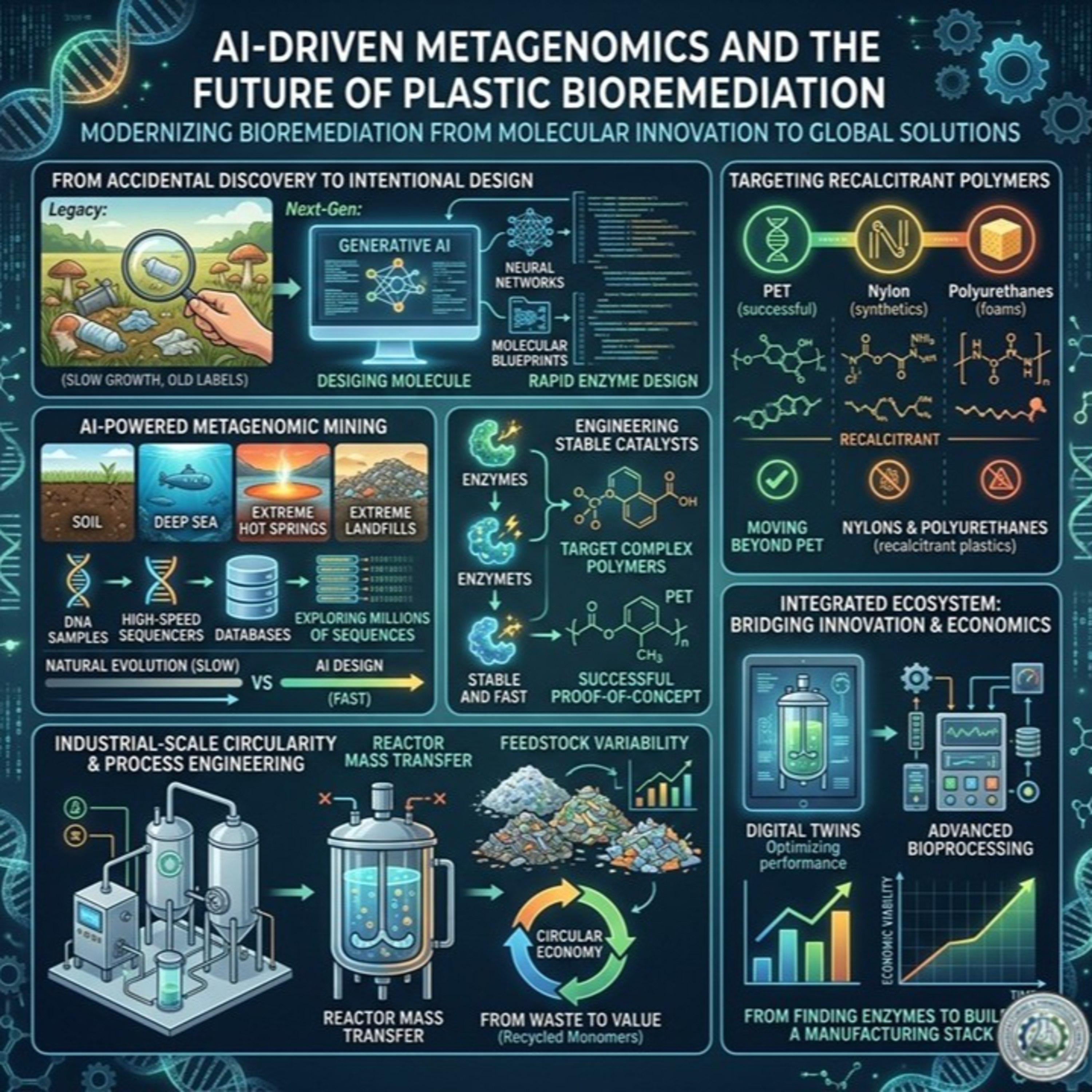
This discussion explores the modernization of plastic bioremediation, detailing a shift from accidental discovery to the intentional design of enzymes. By leveraging generative AI and metagenomic mining, researchers can now engineer stable catalysts that target complex polymers much faster than natural evolution. The sources emphasize that while PET depolymerization serves as a successful proof of concept, the future lies in tackling more recalcitrant plastics like nylons and polyurethanes. Achieving industrial-scale circularity requires moving beyond laboratory successes to address process engineering challenges, such as reactor mass transfer and feedstock variability. Ultimately, the field is evolving into an integrated ecosystem where digital twins and advanced bioprocessing bridge the gap between molecular innovation and economic viability. This transition marks a critical move from simply finding enzymes to building a comprehensive manufacturing stack for global waste management.#Bioprocess #ScaleUp and #TechTransfer,#Industrial #Microbiology,#MetabolicEngineering and #SystemsBiology,#Bioprocessing,#MicrobialFermentation,#Bio-manufacturing,#Industrial #Biotechnology,#Fermentation Engineering,#ProcessDevelopment,#Microbiology,#Biochemistry,#Biochemical Engineering, #Applied #MicrobialPhysiology, #Microbial #ProcessEngineering, #Upstream #BioprocessDevelopment, #Downstream Processing and #Purification,#CellCulture and #MicrobialSystems Engineering, #Bioreaction #Enzymes, #Biocatalyst #scientific #Scientist #Research
What this episode covers
This discussion explores the modernization of plastic bioremediation, detailing a shift from accidental discovery to the intentional design of enzymes. By leveraging generative AI and metagenomic mining, researchers can now engineer stable catalysts that target complex polymers much faster than natural evolution. The sources emphasize that while PET depolymerization serves as a successful proof of concept, the future lies in tackling more recalcitrant plastics like nylons and polyurethanes. Achieving industrial-scale circularity requires moving beyond laboratory successes to address process engineering challenges, such as reactor mass transfer and feedstock variability. Ultimately, the field is evolving into an integrated ecosystem where digital twins and advanced bioprocessing bridge the gap between molecular innovation and economic viability. This transition marks a critical move from simply finding enzymes to building a comprehensive manufacturing stack for global waste management.#Bioprocess #ScaleUp and #TechTransfer,#Industrial #Microbiology,#MetabolicEngineering and #SystemsBiology,#Bioprocessing,#MicrobialFermentation,#Bio-manufacturing,#Industrial #Biotechnology,#Fermentation Engineering,#ProcessDevelopment,#Microbiology,#Biochemistry,#Biochemical Engineering, #Applied #MicrobialPhysiology, #Microbial #ProcessEngineering, #Upstream #BioprocessDevelopment, #Downstream Processing and #Purification,#CellCulture and #MicrobialSystems Engineering, #Bioreaction #Enzymes, #Biocatalyst #scientific #Scientist #Research
NOW PLAYING
AI-Driven Metagenomics and the Future of Plastic Bioremediation
No transcript for this episode yet
Similar Episodes
Apr 21, 2026 ·13m
Apr 19, 2026 ·16m
Apr 17, 2026 ·13m
Apr 13, 2026 ·11m
Apr 11, 2026 ·16m