
EPISODE · May 22, 2026 · 1H
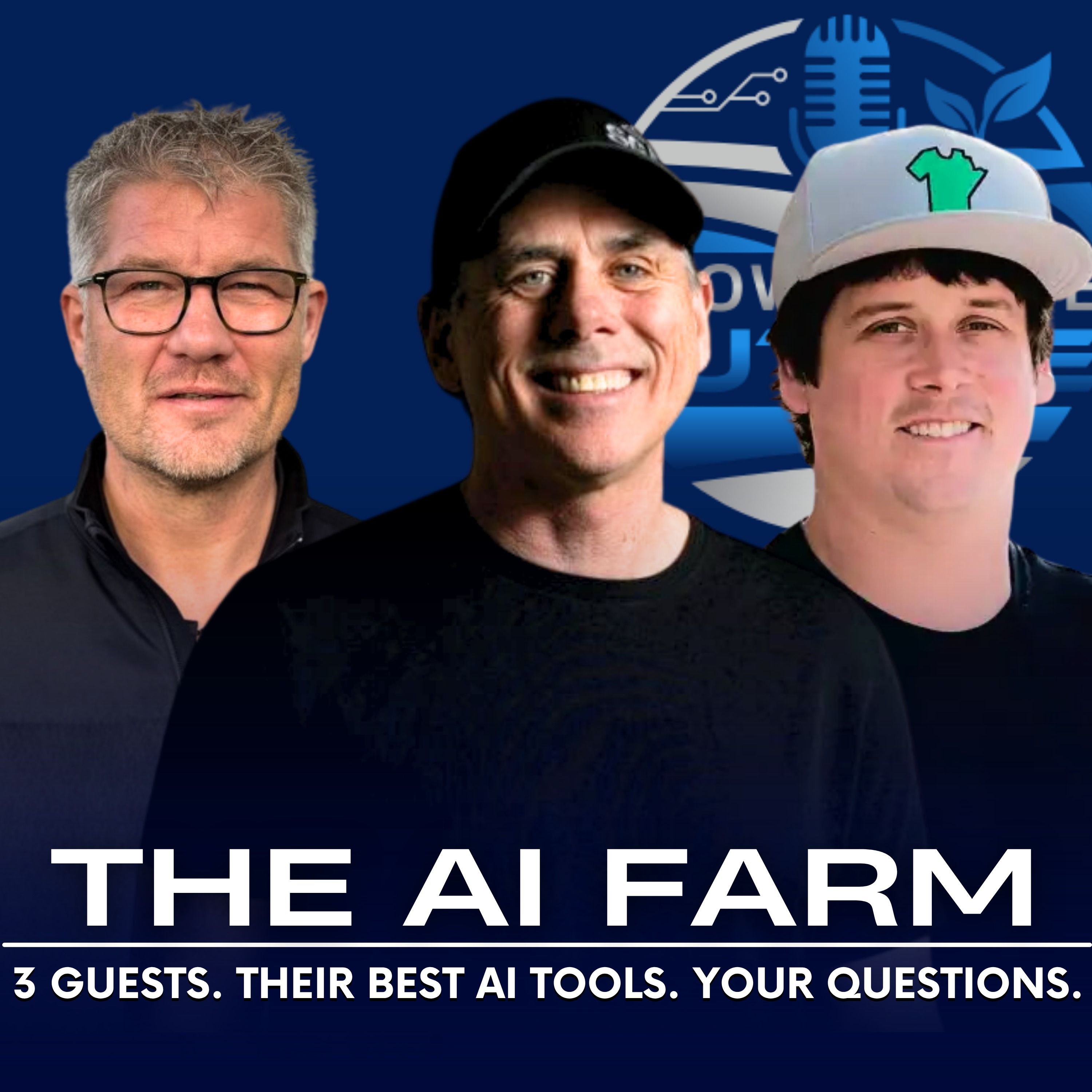
AI Farm Episode 2
from Growing the Future · host Trevor Muir - Leadership Coach, Red Neck Tech (formerly CEO, SurePoint Technologies) Steve Langston - Founder, Dirty T-Shirt Productions; Author, Small Town Big Dream Chris Unrau - CEO, Precision Land Solutions; Serial Entrepreneur, Winkler, Manitoba Tracey Wiedmeyer - CEO, Gripp (co-host and guest judge)
The format is a pitch competition. Three operators come in cold, each shows the room exactly what they have built, and the audience votes. No PowerPoints about what AI could do. No vendor demos. Just a farmer, a coach, and an entrepreneur holding up real work. Trevor Muir went first. After leaving SurePoint Technologies - which he scaled from $4 million to over $120 million in revenue before buying it back from U.S. private equity and handing it to the employees who built it - he found himself without a team and without a system. He built one. He started by asking AI to construct a board of directors for his goals, then turned each board position into a persistent custom persona. The result is Serena - a named AI executive assistant and strategic thinking partner Trevor has used for more than a thousand hours, exclusively by voice. He has never typed into a chat window on a computer except twice, for demos. On the call, he introduced Serena live; she spoke, answered Dan's questions about hallucination and memory, and explained her own purpose more clearly than Trevor could. He has since deployed the board-of-directors framework inside ten companies and has a course in development, not yet public. His warning to the room: AI will validate you when it should push back, and information overload - not a lack of data - is the actual problem most operators face. Steve Langston pitched AI literacy, not AI tools. A Manitoba entrepreneur and video producer who has renovated 25-30 rural properties, cycled 35,000 kilometres, and written a book on rural community revival, Steve spent the first 45 minutes of an 8-hour AI consulting engagement delivering everything the client needed - then had to rethink what consulting even means. His practical framework: block an hour to be curious, not productive. Stop using AI like a search engine. Create an AI brief - a persistent context document about your business and yourself - so the tool knows who it is talking to. The example that resonated: instead of asking for a shareholder's agreement, ask AI to surface the 10 questions it needs to build one properly. On rural communities and AI displacement, his position was calm and direct: if it is a repeatable task, it is at risk. But rural communities have trades, proximity, affordability, and quality of life that no algorithm replaces. He sees rural Canada as structurally insulated and, if anything, better positioned than the urban centres. Chris Unrau closed with the session's most surprising arc. He opened humble - told Dan he would be a disappointment - and then spent fifteen minutes describing a full vibe-coding operation built on Base44 while watching hockey games. He replaced a $10,000 custom app with a $40-a-month subscription that does more. He built a credit card receipt tracker that scans email, assigns expenses to eight companies, and generates reports. He built a crew field-tracking app with scoreboards after his team asked for one. All in evenings. He also told the room about using ChatGPT to handle Manitoba Health's roastery licensing questions 100% by AI - and getting approved - and about using AI to navigate the adoption and care of three boys with trauma backgrounds. His therapist endorsed it. His takeaway for the room: if you have an idea for an app, tell the tool what you want and it will make it. His next hire will likely be an AI specialist to maintain the growing ecosystem he cannot document fast enough. Tracey Wiedmeyer gave Chris the edge for demonstrating AI's widest surface area in a single operation - business, personal, relational, and creative all at once. Key Topics Trevor Muir's Serena: how to build a custom AI board of directors and executive assistant using only voice, over time The board-of-directors framework: identifying the advisory roles you need, then building them as persistent AI personas AI validation problem: AI will agree with you when it should push back - how the Serena system is designed to counter that Steve Langston on AI literacy: curiosity over speed, smart prompting, and the AI brief as a persistent context document The prompt is you: why context about yourself is the highest-leverage input, not the question you ask Rural communities as AI-insulated economies: trades, proximity, quality of life, and affordability as structural advantages Chris Unrau on vibe coding with Base44: building custom apps in evenings with no technical background Replace before you subscribe: why Chris is rethinking every SaaS tool his companies pay for AI for personal and relational challenges: all three operators shared non-business AI use cases Gripp June cohort: 20-producer training cohort launching in June 2026 (links shared in event chat) Resources Mentioned Serena - Trevor Muir's custom AI executive assistant / board of directors (voice-only, built in ChatGPT; course in development, not yet public) Base44 - no-code / vibe coding app builder used by Chris Unrau ($40/month subscription) Small Town Big Dream - Steve Langston's book (available on Amazon) Gripp (grip.ag) - farm operations platform for tracking equipment, tasks, maintenance, and team communication Suno - AI music generator (Chris Unrau uses for making songs about friends) Convergence Conference 2027 - February 2-4, 2027 (links shared in event chat) Connect Trevor Muir: LinkedIn (most active) Steve Langston: Dirty T-Shirt Productions; Small Town Big Dream on Amazon Chris Unrau: Precision Land Solutions Tracey Wiedmeyer: grip.ag growingthefuture.ca Register for the Convergence Conference at convergence.ag and stay updated by subscribing to the Growing the Future Podcast at growingthefuturepodcast.ca.
Embed this episode
What this episode covers
Trevor Muir (leadership coach, Red Neck Tech), Steve Langston (Dirty T-Shirt Productions), and Chris Unrau (CEO, Precision Land Solutions) each pitched the room on what they have actually built with AI - not what they plan to build, and not vendor promises. Trevor demonstrated Serena, a custom AI persona functioning as a personal board of directors and executive assistant, built over more than a thousand hours of voice conversation and now deployed inside ten companies. Steve Langston made the case for AI literacy as the entry skill - smart prompting, context documents, and curiosity over speed - and argued that rural communities are structurally insulated from AI job displacement in ways urban centres are not. Chris Unrau, a self-described non-technical entrepreneur, built three custom apps using Base44 while watching hockey games, replacing a $10,000 custom app with a $40-a-month subscription, and along the way used AI to navigate personal relationship challenges his therapist later endorsed. The audience vote tied Trevor and Chris; judge Tracey Wiedmeyer (CEO, Gripp) gave the edge to Chris for demonstrating the widest surface area of any single operator in the room.
Ready to play
AI Farm Episode 2
No transcript for this episode yet
Similar Episodes
Apr 5, 2026 ·14m
Similar Podcasts
No similar podcasts found.