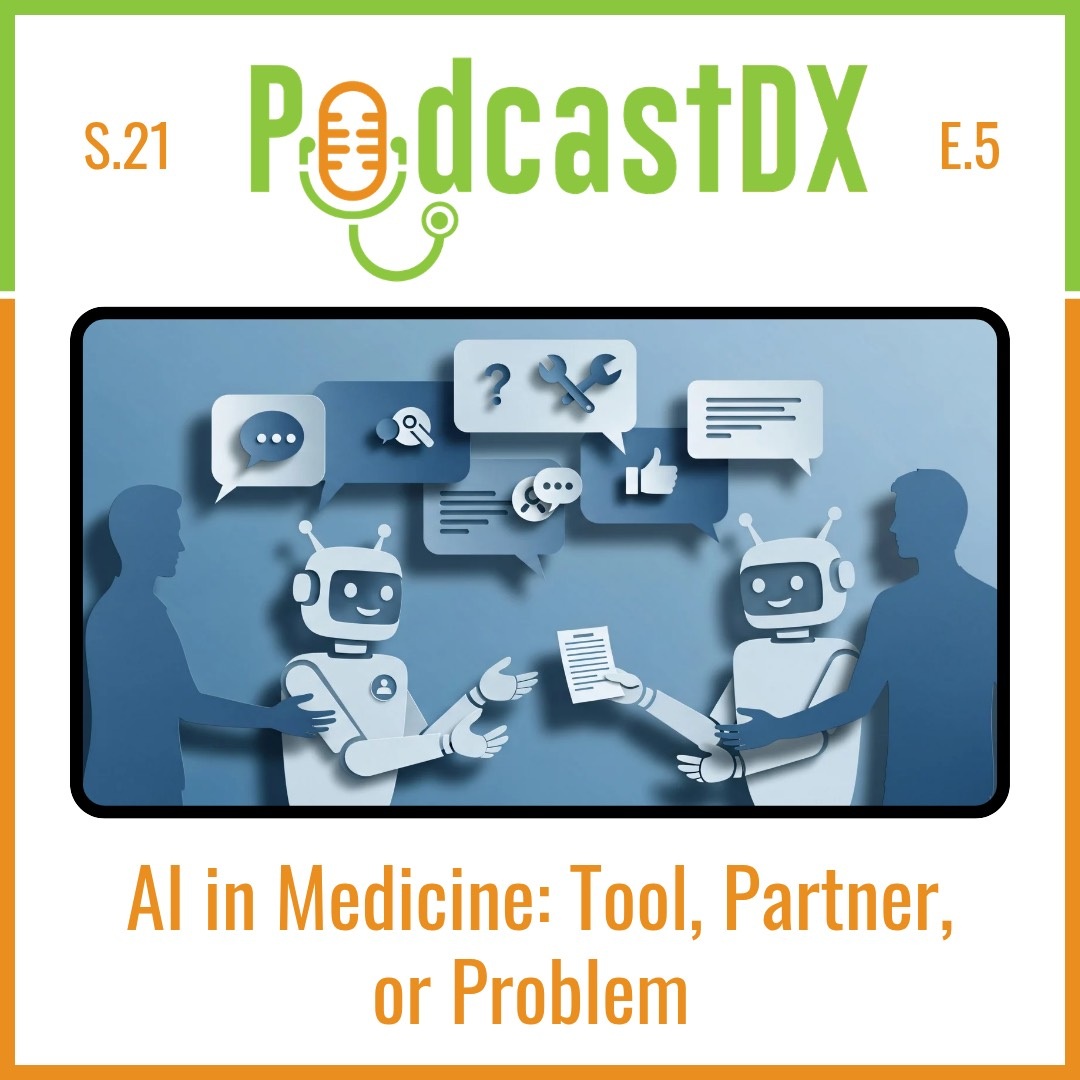
Ai in Medicine Tool Partner or Problem
from PodcastDX Hosted by PodcastDX
*:first-child]:mt-0"> AI in medicine is best understood as a powerful tool and a conditional partner that can enhance care when tightly supervised by clinicians, but it becomes a problem when used as a replacement, deployed without oversight, or embedded in biased and opaque systems. Whether it functions more as a partner or a problem depends on how health systems design, regulate, and integrate it into real clinical workflows. Where AI Works Well p]:pt-0 [&>p]:mb-2 [&>p]:my-0"> Decision support and diagnosis: AI can read imaging, ECGs, and lab patterns with very high accuracy, helping detect cancers, heart disease, and other conditions earlier and reducing some diagnostic errors. p]:pt-0 [&>p]:mb-2 [&>p]:my-0"> Workflow and documentation: Tools that draft visit notes, summarize records, and route messages can cut administrative burden and free up clinician time for patients. p]:pt-0 [&>p]:mb-2 [&>p]:my-0"> Patient monitoring and triage: Algorithms can watch vital signs or wearable data to flag deterioration, triage symptoms online, and guide patients through care pathways, which is especially valuable with clinician shortages. Risks and Problems p]:pt-0 [&>p]:mb-2 [&>p]:my-0"> Errors, over-reliance, and "automation bias": Studies show clinicians sometimes follow incorrect AI recommendations even when the errors are detectable, which can lead to worse decisions than if AI were not used. p]:pt-0 [&>p]:mb-2 [&>p]:my-0"> Bias and inequity: If training data underrepresent certain groups, AI can systematically misdiagnose or undertreat them, amplifying existing health disparities. p]:pt-0 [&>p]:mb-2 [&>p]:my-0"> Trust, explainability, and liability: Black-box systems can undermine shared decision-making when neither doctor nor patient can understand or challenge a recommendation, and they raise hard questions about who is responsible when harm occurs. Impact on the Doctor–Patient Relationship p]:pt-0 [&>p]:mb-2 [&>p]:my-0"> Potential partner: By handling routine documentation and data crunching, AI can give clinicians more time for conversation, empathy, and shared decisions, supporting more person-centered care. p]:pt-0 [&>p]:mb-2 [&>p]:my-0"> Potential barrier: If AI outputs dominate visits or generate long lists of differential diagnoses directly to patients, it can increase anxiety, fragment communication, and weaken relational trust. How To Keep AI a Partner, Not a Problem p]:pt-0 [&>p]:mb-2 [&>p]:my-0"> Keep humans in the loop: Use AI as a second reader or coach, not a final decision-maker; clinicians should retain authority to accept, modify, or reject suggestions. p]:pt-0 [&>p]:mb-2 [&>p]:my-0"> Demand transparency and evaluation: Health systems should validate tools locally, monitor performance across different populations, and disclose AI use to patients in clear language. p]:pt-0 [&>p]:mb-2 [&>p]:my-0"> Align incentives with patient interests: Regulation, reimbursement, and malpractice rules should reward safe, equitable use of AI—not just speed, volume, or commercial uptake. In practice, AI in medicine becomes a true partner when it augments human judgment, enhances relationships, and improves outcomes; it becomes a problem when it is opaque, biased, or allowed to replace clinical responsibility.
Embed this episode
No transcript yet.