
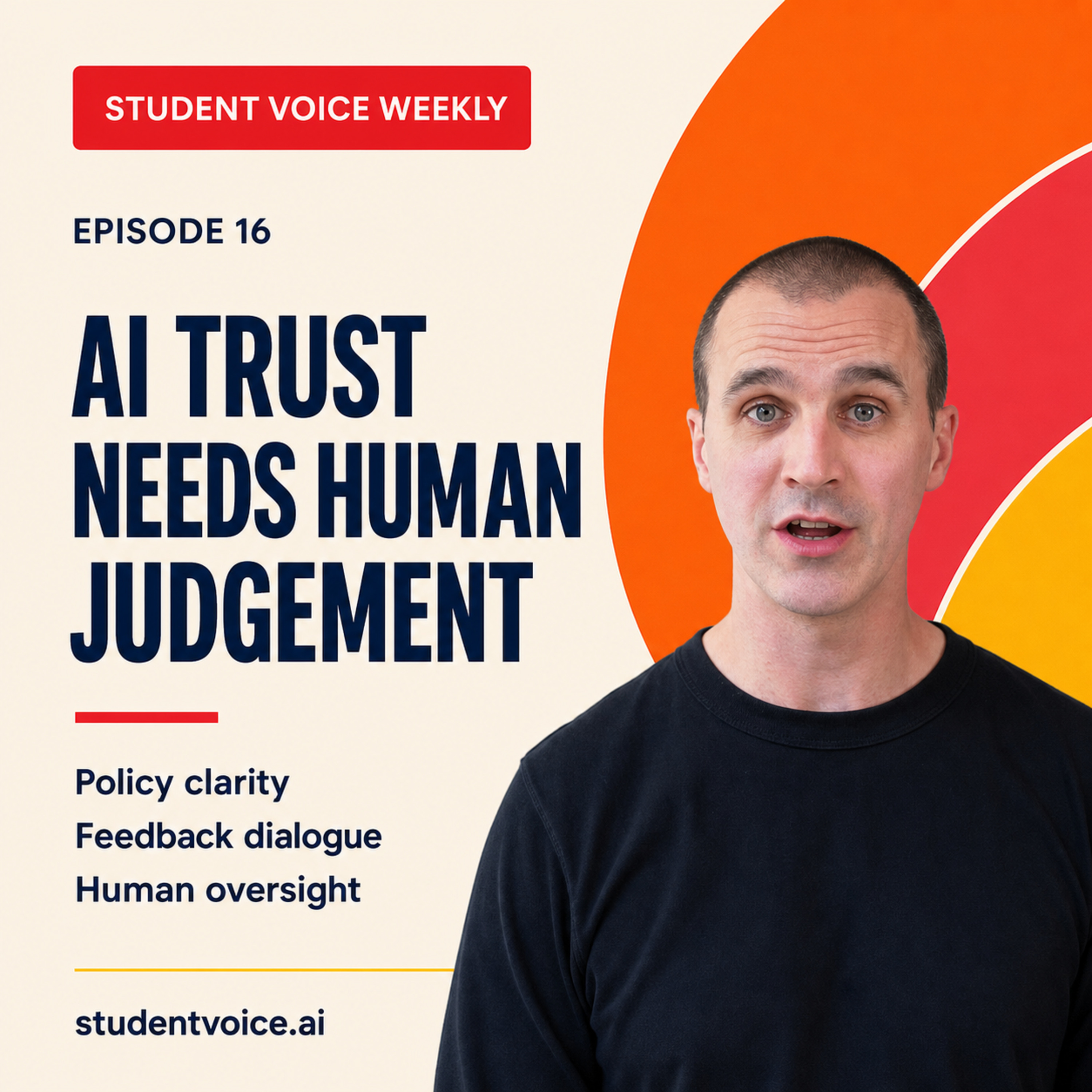
EPISODE · Jun 12, 2026 · 8 MIN
AI legitimacy: students want to see the human judgement
This week, Dr Stuart Grey discusses AI legitimacy and student voice evidence: why students judge AI through trust, anxiety, fairness, and the visibility of human judgement, not only through speed or technical performance. The episode covers student feelings about generative AI, feedback dialogue, Cambridge evidence on AI marking, Jisc's formative feedback pilot, and practical ways to separate comments about policy, assessment, belonging, and academic care. In This Episode - Why student feelings about AI are mixed, and why that matters for belonging and trust. - How feedback dialogue helps students use assessment comments rather than decode them alone. - What Cambridge's AI marking study shows about classification agreement, bias, and the need for human judgement. - Why Jisc's pilot points towards formative feedback as the right place to start. - How older student voice work on AI, co-creation, and assessment still helps frame the current debate. - A practical way to test whether students can see where human judgement sits in an AI-supported process. Student Voice Practice AI comments are rarely only about a tool. They are evidence about what students think is safe, fair, useful, and human. A comment about uncertainty may belong with academic integrity policy, assessment design, confidence, belonging, and support at the same time. The useful move is to code the practical concern beneath the word "AI", then decide which team needs to respond. Research Spotlight - Students' feelings about AI reveal trust and belonging risks universities miss: https://www.studentvoice.ai/blog/students-feelings-about-ai-reveal-trust-and-belonging-risks/ - Students use assessment feedback better when universities create space for questions: https://www.studentvoice.ai/blog/students-use-assessment-feedback-better-when-universities-create-space-for-questions/ Across the Sector - Cambridge study shows why AI marking in higher education still needs human judgement: https://www.studentvoice.ai/blog/cambridge-ai-marking-higher-education-human-judgement/ - Jisc's AI marking and feedback pilot says formative feedback is the right place to start: https://www.studentvoice.ai/blog/jisc-ai-marking-and-feedback-pilot-formative-feedback-first/ From the Archive - AI and Education - Equity Challenges and Opportunities: https://www.studentvoice.ai/blog/navigating-the-intersection-of-ai-and-education-equity-challenges-and-opportunities/ - Respect is key for successful student voice as co-creation practices: https://www.studentvoice.ai/blog/respectful-student-voice/ - Which assessment methods work best in physics?: https://www.studentvoice.ai/blog/student-perspectives-on-assessment-methods-in-physics/ Practical Takeaway Before expanding an AI feedback or marking pilot, ask students four questions: what do they think the AI is doing, where do they think human judgement sits, who can they ask when something feels wrong, and what evidence would make the process feel fair? Separate useful AI from legitimate AI before scaling it. Full Episode Page https://www.studentvoice.ai/podcast/episodes/016-ai-legitimacy-students-want-to-see-the-human-judgement/ Subscribe Subscribe to The Student Voice Weekly: https://www.studentvoice.ai/blog/newsletter/
Embed this episode
NOW PLAYING
AI legitimacy: students want to see the human judgement
No transcript for this episode yet
Similar Episodes
No similar episodes found.
Similar Podcasts
No similar podcasts found.