AI Model Retirement Migration
from The Innovation Attorney Podcast Hosted by The Innovation Attorney
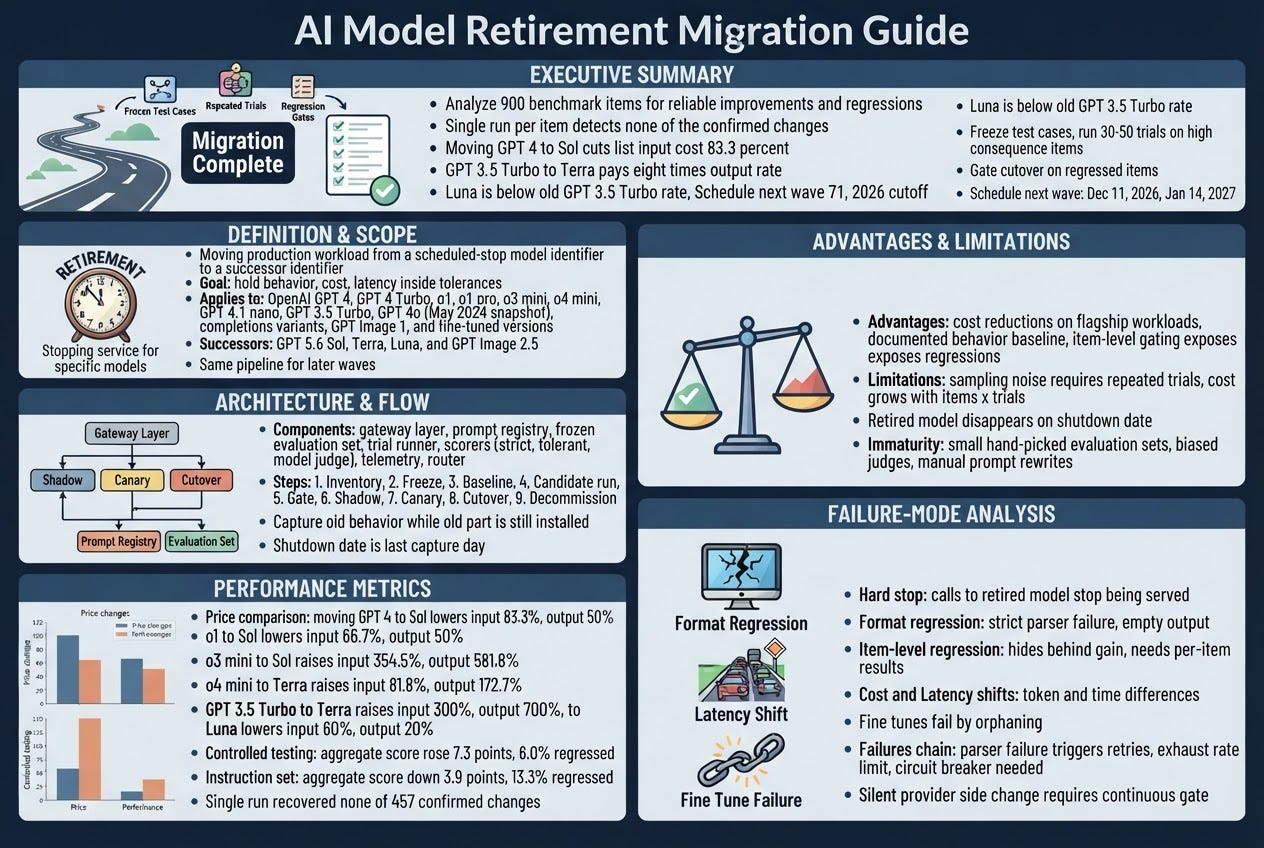
An AI model retirement migration before OpenAI’s October 23, 2026 shutdown of GPT 4 and o1 requires frozen test cases, repeated trials, and regression gates set per item. OpenAI announced the shutdown on April 22, 2026. The list covers GPT 4, GPT 4 Turbo, o1, o1 pro, o3 mini, o4 mini, GPT 4.1 nano, GPT 3.5 Turbo, a May 2024 snapshot of GPT 4o, and every fine tuned snapshot built on them, with GPT 5.6 Sol, Terra, and Luna named as successors. Google stopped serving Gemini 2.5 Pro, Flash, and Flash Lite on its Gemini Enterprise Agent Platform on October 20, 2026, and named Gemini 3.8 Flash as the replacement. A 2026 study of 900 benchmark items, each run 50 times across three consecutive GPT releases, found reliable improvements and reliable regressions inside every migration. In one comparison the aggregate score rose 7.3 points and 6.0 percent of items regressed anyway. A single run per item detected none of the 457 confirmed changes. Price adds a second variable. Moving a GPT 4 workload to Sol cuts list input cost 83.3 percent. A GPT 3.5 Turbo workload that lands on Terra pays eight times the old output rate, and Luna, at $0.20 input and $1.20 output per million tokens, sits below the old GPT 3.5 Turbo rate. Teams should freeze their own test cases from production traces, run 30 to 50 trials on high consequence items, gate cutover on the list of regressed items, and schedule the next wave: December 11, 2026 and January 14, 2027. Definition, Scope, and Technical Context What Is an AI Model Retirement Migration? An AI model retirement migration is the engineering process of moving a production workload from a hosted model identifier that a provider has scheduled to stop serving to a successor identifier, while holding behavior, cost, and latency inside tolerances the team defines in advance. It belongs to software change management, and the dependency being changed is a probabilistic function whose internals the deployer cannot inspect. Deprecation is the announcement, retirement is the date the identifier stops answering requests, and drift is a behavior change that arrives with no announcement at all. The October 23, 2026 cutoff comes from OpenAI’s April 22, 2026 notice. The identifiers include GPT 4 (the 0613 snapshot), GPT 4 Turbo (the April 9, 2024 snapshot), a GPT 4 1106 preview, a GPT 4o snapshot dated May 13, 2024, GPT 4.1 nano, o1, o1 pro, o3 mini, o4 mini, GPT 3.5 Turbo, the completions variants of several of these, GPT Image 1, and the fine tuned versions built on GPT 3.5 Turbo, GPT 4, GPT 4.1 nano, and o4 mini. OpenAI named GPT 5.6 Sol as the successor for GPT 4, GPT 4 Turbo, o1, o3 mini, and the older GPT 4o snapshot, GPT 5.6 Terra for o4 mini and GPT 3.5 Turbo, GPT 5.6 Luna for GPT 4.1 nano, and a GPT Image 2.5 model for GPT Image 1. Today is October 22, 2026, so a team reading this has one day left. Calls to a retired identifier stop being served after the cutoff, which converts every unfinished migration into a production incident. The work described below fits a one day sprint for a small inventory and a multi week program for a large one, and the same pipeline serves the later waves. Which Providers Retire Models Between October 19 and October 23, 2026? Four providers retire models inside that window. Google ended calls to Gemini 2.5 Pro, Gemini 2.5 Flash, and Gemini 2.5 Flash Lite on its Gemini Enterprise Agent Platform, formerly Vertex AI, on October 20, 2026, while the Gemini API keeps serving those models with no shutdown date. Google shuts down Gemini Omni Flash Preview and three Veo 3.1 preview models on October 22, 2026, with Gemini Omni 1.1 Flash as the replacement, and retires a deep research preview agent on October 23, 2026. Together AI ends serverless access to Llama 3.3 70B Instruct Turbo and DeepSeek V4 Flash 0731 on October 22, 2026. NVIDIA stopped supporting Nemotron 3 Super on its free NIM endpoints after October 19, 2026. How Much Notice Do Providers Give Before Retiring a Model? OpenAI publishes a minimum of six months of notice for generally available models, three months for specialized variants such as chat, Codex, and deep research models, and as little as two weeks for preview models. The April 22, 2026 announcement preceded the October 23, 2026 shutdown by six months and one day. Fine tuned models follow the schedule of their base model, and the List models and Retrieve a model endpoints return a shutdown_date field that a script can read. Google labels the dates on its Gemini API deprecation page as the earliest possible shutdown dates and sets no minimum notice period. Anthropic commits to preserve the weights of every publicly released Claude model for at least the lifetime of the company, and the same commitment page states that preserved weights do not guarantee continued availability for inference. The analysis here covers hosted model APIs and excludes consumer chat products and self hosted open weight models. Underlying Scientific and Engineering Principles Why Does Changing the Model Change Application Behavior? Changing the model changes application behavior because a hosted model acts as a function of its weights, the prompt, the decoding settings, and the serving stack, and a retirement replaces the weights and usually the serving stack with them. Prompts written against one set of weights absorb that model’s habits: its tolerance for ambiguous instructions, its default verbosity, its willingness to hold a format. A December 2025 paper calls the resulting loss Model Drifting and reports that a prompt written for one model usually performs worse on another than a prompt tuned for the target. Sampling adds noise on top. The same prompt yields different outputs on repeated calls, so one run per test item mixes real change with chance. With 50 trials and a true pass rate near 50 percent, the standard error is about 7.1 points and a 95 percent interval spans roughly 14 points either side (a calculation from the binomial formula). A single trial per item has no interval at all. Which Constraints Are Fundamental and Which Are Contingent? Three constraints are fundamental. Sampled generation is stochastic. The retired model cannot be queried after shutdown, so the baseline has to be captured before the date. Provider internals stay opaque, so the deployer sees behavior and never the cause. Anthropic’s preservation of weights illustrates the second constraint: keeping weights on disk does not keep a model answering requests. Four constraints are contingent and open to engineering: prompt portability across models, the coverage of the evaluation set, the cost of repeated trials, and the price of the successor. Money and discipline move each of these four. How Large Is Behavioral Drift in Practice? A July 2023 study found that GPT 4 accuracy on a prime number identification task fell from 84 percent in March 2023 to 51 percent in June 2023 under the same model name, and a 2026 analysis of the hosted model supply chain cites a fall in directly executable generated code from 52 percent to 10 percent over the same interval. The 2026 study of three consecutive GPT releases found a quieter form of the same effect. On an instruction following benchmark the gap between loose and strict scoring widened to 9.0 points on Sol, with the strict score down 3.9 points and the loose score nearly flat, which points to a formatting regression and leaves reasoning ability intact. System Architecture and Process Flow What Components Does a Migration Pipeline Need? A migration pipeline needs seven components. A gateway layer holds model identifiers in configuration so that application code never names a model. A prompt registry versions every prompt. A frozen evaluation set is drawn from production traces. A trial runner repeats each item many times. Scorers include a strict parser, a tolerant parser, and optionally a model based judge. Telemetry records tokens, latency, and cost for every call. A router sends shadow and canary traffic and supports ro… This is a public episode. If you'd like to discuss this with other subscribers or get access to bonus episodes, visit theinnovationattorney.substack.com/subscribe
Embed this episode
No transcript yet.