
EPISODE · May 3, 2026 · 8 MIN
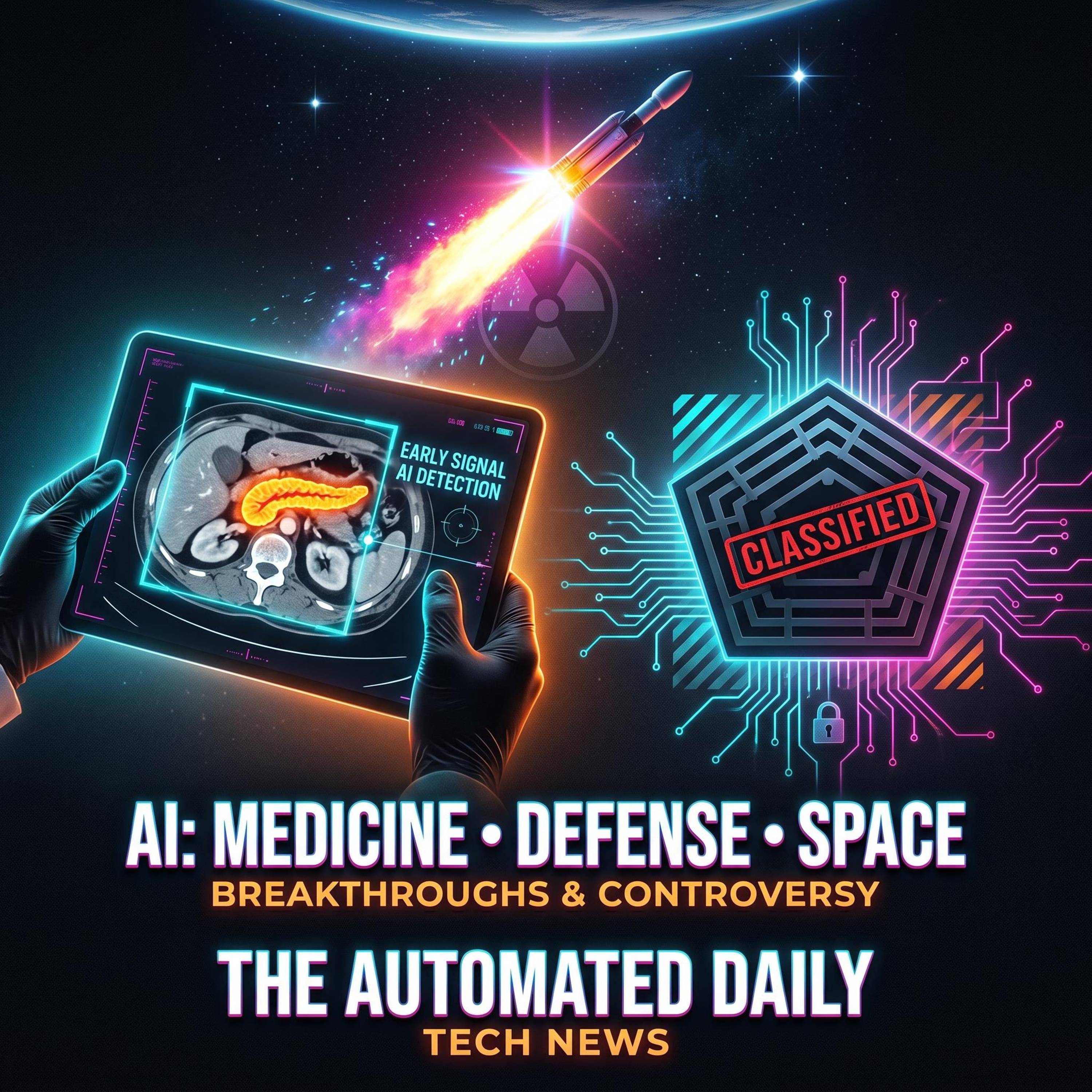
AI spots pancreatic cancer earlier & Pentagon brings AI into classified systems - Tech News (May 3, 2026)
from The Automated Daily - Tech News Edition · host TrendTeller
Please support this podcast by checking out our sponsors: - SurveyMonkey, Using AI to surface insights faster and reduce manual analysis time - https://get.surveymonkey.com/tad - KrispCall: Agentic Cloud Telephony - https://try.krispcall.com/tad - Discover the Future of AI Audio with ElevenLabs - https://try.elevenlabs.io/tad Support The Automated Daily directly: Buy me a coffee: https://buymeacoffee.com/theautomateddaily Today's topics: AI spots pancreatic cancer earlier - Researchers at Mayo Clinic and UT MD Anderson reported REDMOD, an AI model that can flag early pancreatic cancer signals in CT scans well before diagnosis, raising hopes for earlier treatment despite false-positive concerns. Pentagon brings AI into classified systems - The U.S. Defense Department announced partnerships with Google, Microsoft, AWS, Nvidia, OpenAI, Reflection, and SpaceX to bring AI tools into classified environments, intensifying debate over safeguards and oversight. Musk’s OpenAI lawsuit testimony - Elon Musk testified in a California trial tied to his lawsuit against OpenAI, Sam Altman, and Greg Brockman, arguing OpenAI abandoned its nonprofit mission and calling Microsoft’s involvement a major turning point. Lean startups in the AI era - Sam Altman said AI is enabling much smaller startup teams to build and scale faster, potentially reshaping venture funding dynamics, competition, and how work is distributed across companies. Meta faces public nuisance trial - A New Mexico trial will examine whether Meta’s Facebook, Instagram, and WhatsApp constitute a public nuisance by allegedly addicting minors and failing to protect children, with potential remedies like age checks and product design changes. China court rejects AI-layoff claim - A Hangzhou court ruled a company unlawfully fired a supervisor after claiming AI replaced his role, signaling that "AI adoption" alone may not meet legal standards for termination in China. Dark Eagle hypersonic missile request - U.S. Central Command has requested permission to deploy the Army’s Dark Eagle hypersonic missile system to the Middle East, highlighting concerns about Iran’s mobile launchers and the race to field longer-range strike options. New Earth-observation satellite milestone - Space startup GalaxEye launched the Drishti Earth-observation satellite on a SpaceX Falcon 9, aiming for more reliable imaging through clouds and at night—useful for disaster response and infrastructure monitoring. NASA nuclear electric spacecraft plan - NASA unveiled the SR-1 Freedom concept for nuclear electric propulsion to support deep-space travel and a Mars mission timeline, while critics point to schedule, budget, and safety risks. Episode Transcript AI spots pancreatic cancer earlier Let’s start with the medical story that’s turning heads. Researchers at the Mayo Clinic and UT MD Anderson Cancer Center have published results on an AI tool called REDMOD that looks for faint, early changes tied to pancreatic cancer in CT scans. The striking part is the timing: in testing, the system often flagged risk well before a formal diagnosis—sometimes by more than a year, and in some cases reaching back much further. This matters because pancreatic cancer is frequently found late, when options shrink fast. The catch, though, is equally important: the model also raised a meaningful number of false alarms, which could lead to extra follow-up scans and anxiety. The takeaway is promising, but it’s not a drop-in clinical solution yet—bigger, broader trials will decide how useful it is in real hospitals. Pentagon brings AI into classified systems From saving lives to planning wars: the Pentagon says it’s expanding AI use in classified military systems through new partnerships with seven major tech players—Google, Microsoft, Amazon Web Services, Nvidia, OpenAI, Reflection, and SpaceX. Defense officials describe the goal as decision support for troops in complex environments, plus faster planning and logistics. In plain terms, they want AI to help sort overwhelming information, speed up workflows, and reduce friction in everything from maintenance to supply chains. What makes this notable is less the ambition—this has been building for years—and more the vendor approach. The department is clearly leaning into a multi-provider model as it scales up. That’s a signal that AI in national security is shifting from experiments into a broader, more permanent procurement posture. Musk’s OpenAI lawsuit testimony But the Pentagon’s AI push is landing in the middle of an already heated safeguards debate. One flashpoint: a dispute involving Anthropic and contract terms around limits related to autonomous weapons and domestic surveillance. That disagreement escalated into court after the Trump administration moved to block federal use of Anthropic’s Claude and even weighed labeling the company a supply-chain risk. Whether or not those steps hold up, the broader question is now unavoidable: as the government adopts more AI, what guardrails are enforceable, who sets them, and what happens when a vendor refuses the terms? Lean startups in the AI era That theme of mission versus money also showed up in court with Elon Musk. Musk testified for hours in a California trial tied to his lawsuit against OpenAI, Sam Altman, and Greg Brockman. He argued OpenAI drifted away from its original nonprofit purpose, repeatedly framing it as a “charity” that, in his view, was meant to benefit humanity rather than private interests. He also emphasized his early role—funding, recruiting, and connecting OpenAI to key relationships—and described later moves, including Microsoft’s involvement, as a fundamental shift. The reason this matters beyond the personalities is that it’s becoming a proxy fight over governance: who controls powerful AI systems, what promises made early on still apply, and how much transparency the public should expect when the stakes are so high. Meta faces public nuisance trial In a much calmer, but still consequential, thread: Sam Altman says AI is changing what a startup even looks like. In a recent podcast appearance, he argued that new companies can be built and scaled with far smaller teams—sometimes just a founder—because AI tools can absorb work that used to require whole departments. It’s an idea that’s gaining traction in Silicon Valley: fewer hires, more compute, faster iteration. If that trend holds, it could reshape venture funding and competition. Investors may back more “micro-teams,” while workers may see job ladders compress in certain roles. The big question is whether this creates more opportunity overall—or concentrates power among those who can best access talent, data, and computing. China court rejects AI-layoff claim Now to platform accountability. A trial starting in Santa Fe is set to test whether Meta’s Facebook, Instagram, and WhatsApp constitute a “public nuisance” in New Mexico. The claim is that product design has contributed to youth addiction and failed to protect children from sexual exploitation. This is the second phase of the state’s broader action, after a jury previously found Meta violated consumer protection rules and awarded substantial damages. Why the “public nuisance” angle matters is the remedy. If the judge agrees with the theory, it could open the door to court-ordered product changes—things like stronger age checks or altering certain engagement features for minors. Meta argues it’s already improved safety and says some proposed mandates would be unworkable. Either way, the case is being watched closely because it could become a blueprint for other states, cities, and school districts looking to force social platforms to redesign around child safety. Dark Eagle hypersonic missile request On the labor side of AI adoption, a court in Hangzhou, China, ruled that a tech company unlawfully dismissed a senior quality assurance supervisor after claiming his role was replaced by AI. The worker was offered a lower-level job with a major pay cut, refused it, and was then terminated under the banner of AI-driven restructuring. The court wasn’t persuaded, finding that “we’re using AI now” didn’t automatically meet legal standards for ending the contract, and that the alternative role was not a reasonable substitute. This is a small case with a big signal: as companies try to justify cost cutting with AI, courts may demand proof of legitimate downsizing—and may push back on attempts to make workers personally absorb the cost of “transformation.” New Earth-observation satellite milestone Shifting to defense hardware: U.S. Central Command has requested permission to deploy the Army’s Dark Eagle hypersonic missile system to the Middle East for potential use against Iran, according to reporting based on a source familiar with the request. The argument is straightforward—Iran has moved some mobile ballistic-missile launchers farther inland, beyond the reach of certain existing U.S. strike options. Dark Eagle would offer longer range and faster reach, aimed at holding those launchers at risk. What’s striking is the timing. Dark Eagle has faced delays and hasn’t been broadly declared fully operational, yet the request suggests real urgency. It also underscores how hypersonics have become a status marker in great-power competition, with Russia and China already fielding similar categories of weapons. NASA nuclear electric spacecraft plan And finally, a couple of space updates—one commercial, one government. First, a space startup called GalaxEye launched an Earth-observation satellite named Drishti on a SpaceX Falcon 9 from California. The pitch is practical: more reliable imaging even when clouds or darkness would normally limit what satellites can see. That kind of capability is useful for disaster response, agriculture monitoring, infrastructure checks, and security-related surveillance. The broader angle is strategic resilience—countries and companies want dependable Earth imagery without being vulnerable to sudden access limits during crises. Second, NASA unveiled plans around a spacecraft concept it calls SR-1 Freedom, built around nuclear electric propulsion for deep-space travel. NASA says it’s meant to overcome the limits of solar power as missions go farther from Earth, and the agency is targeting a Mars-related mission timeline later in the decade. The proposal is ambitious—and it’s meeting skepticism around schedule pressure, budgets, and safety planning. Still, it’s a clear sign NASA wants to move beyond incremental upgrades and push into propulsion that could meaningfully expand where, and how fast, missions can go. Subscribe to edition specific feeds: - Space news * Apple Podcast English * Spotify English * RSS English Spanish French - Top news * Apple Podcast English Spanish French * Spotify English Spanish French * RSS English Spanish French - Tech news * Apple Podcast English Spanish French * Spotify English Spanish Spanish * RSS English Spanish French - Hacker news * Apple Podcast English Spanish French * Spotify English Spanish French * RSS English Spanish French - AI news * Apple Podcast English Spanish French * Spotify English Spanish French * RSS English Spanish French Visit our website at https://theautomateddaily.com/ Send feedback to [email protected] Youtube LinkedIn X (Twitter)
Embed this episode
What this episode covers
Please support this podcast by checking out our sponsors: - SurveyMonkey, Using AI to surface insights faster and reduce manual analysis time - https://get.surveymonkey.com/tad - KrispCall: Agentic Cloud Telephony - https://try.krispcall.com/tad - Discover the Future of AI Audio with ElevenLabs - https://try.elevenlabs.io/tad Support The Automated Daily directly: Buy me a coffee: https://buymeacoffee.com/theautomateddaily Today's topics: AI spots pancreatic cancer earlier - Researchers at Mayo Clinic and UT MD Anderson reported REDMOD, an AI model that can flag early pancreatic cancer signals in CT scans well before diagnosis, raising hopes for earlier treatment despite false-positive concerns. Pentagon brings AI into classified systems - The U.S. Defense Department announced partnerships with Google, Microsoft, AWS, Nvidia, OpenAI, Reflection, and SpaceX to bring AI tools into classified environments, intensifying debate over safeguards and oversight. Musk’s OpenAI lawsuit testimony - Elon Musk testified in a California trial tied to his lawsuit against OpenAI, Sam Altman, and Greg Brockman, arguing OpenAI abandoned its nonprofit mission and calling Microsoft’s involvement a major turning point. Lean startups in the AI era - Sam Altman said AI is enabling much smaller startup teams to build and scale faster, potentially reshaping venture funding dynamics, competition, and how work is distributed across companies. Meta faces public nuisance trial - A New Mexico trial will examine whether Meta’s Facebook, Instagram, and WhatsApp constitute a public nuisance by allegedly addicting minors and failing to protect children, with potential remedies like age checks and product design changes. China court rejects AI-layoff claim - A Hangzhou court ruled a company unlawfully fired a supervisor after claiming AI replaced his role, signaling that "AI adoption" alone may not meet legal standards for termination in China. Dark Eagle hypersonic missile request - U.S. Central Command has requested permission to deploy the Army’s Dark Eagle hypersonic missile system to the Middle East, highlighting concerns about Iran’s mobile launchers and the race to field longer-range strike options. New Earth-observation satellite milestone - Space startup GalaxEye launched the Drishti Earth-observation satellite on a SpaceX Falcon 9, aiming for more reliable imaging through clouds and at night—useful for disaster response and infrastructure monitoring. NASA nuclear electric spacecraft plan - NASA unveiled the SR-1 Freedom concept for nuclear electric propulsion to support deep-space travel and a Mars mission timeline, while critics point to schedule, budget, and safety risks. Episode Transcript AI spots pancreatic cancer earlier Let’s start with the medical story that’s turning heads. Researchers at the Mayo Clinic and UT MD Anderson Cancer Center have published results on an AI tool called REDMOD that looks for faint, early changes tied to pancreatic cancer in CT scans. The striking part is the timing: in testing, the system often flagged risk well before a formal diagnosis—sometimes by more than a year, and in some cases reaching back much further. This matters because pancreatic cancer is frequently found late, when options shrink fast. The catch, though, is equally important: the model also raised a meaningful number of false alarms, which could lead to extra follow-up scans and anxiety. The takeaway is promising, but it’s not a drop-in clinical solution yet—bigger, broader trials will decide how useful it is in real hospitals. Pentagon brings AI into classified systems From saving lives to planning wars: the Pentagon says it’s expanding AI use in classified military systems through new partnerships with seven major tech players—Google, Microsoft, Amaz...
Ready to play
AI spots pancreatic cancer earlier & Pentagon brings AI into classified systems - Tech News (May 3, 2026)
No transcript for this episode yet
Similar Episodes
No similar episodes found.
Similar Podcasts
No similar podcasts found.