
EPISODE · May 6, 2025 · 10 MIN
Al-Haytham Reimagined: The Father of Optics Meets the Age of Augmented Reality
from The Cogitating Ceviché Podcast · host Conrad T Hannon
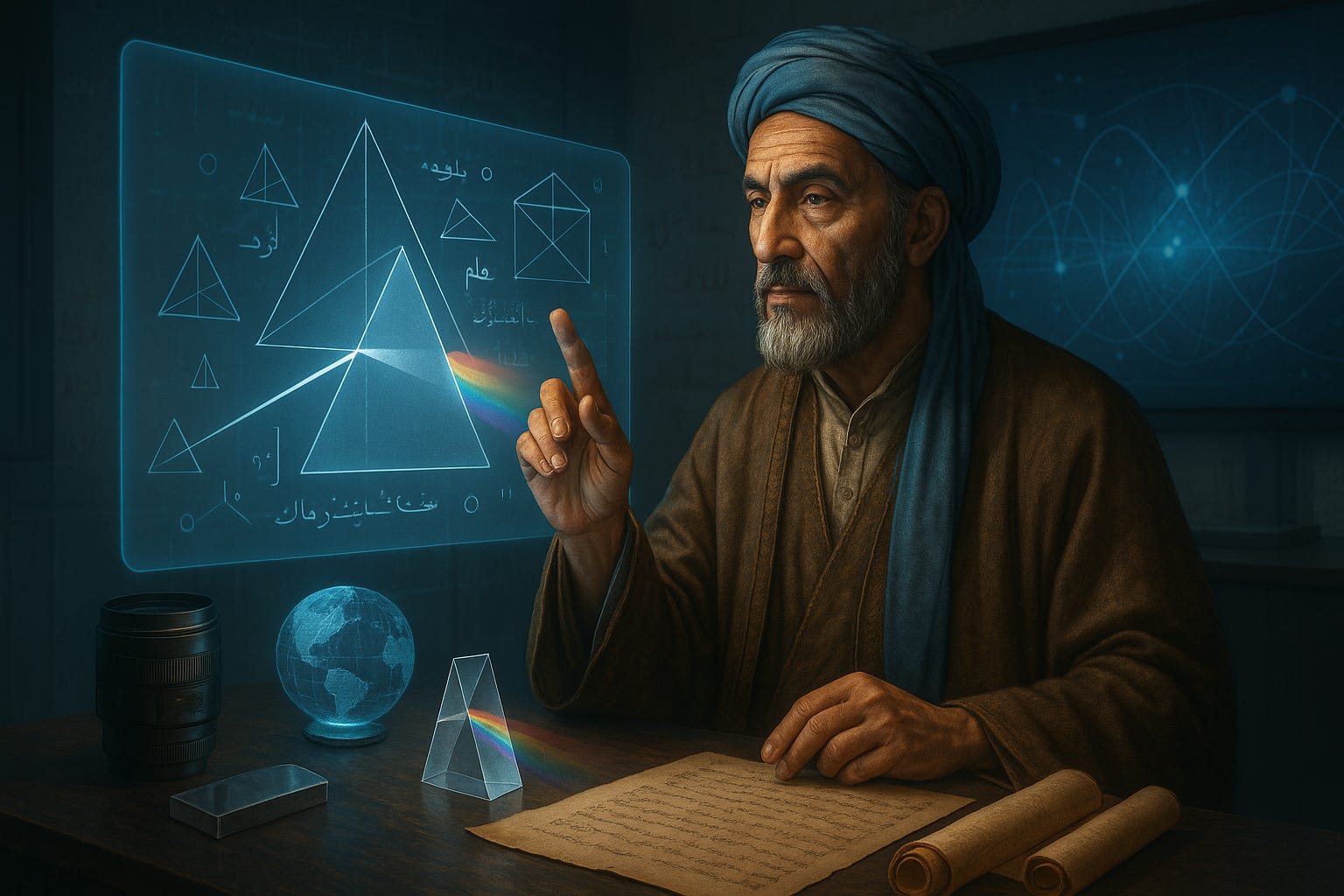
The Cogitating CevichePresentsAl-Haytham Reimagined: The Father of Optics Meets the Age of Augmented RealityPast Forward: Historical Icons in the Digital Frontier #59By Conrad HannonNarration by Amazon PollyPrefaceFew names in science echo across centuries with the clarity of Al-Haytham, known in the West as Alhazen. A polymath of the Islamic Golden Age, he is widely considered the father of modern optics and an early pioneer of the scientific method. His masterwork, the Book of Optics, transformed how we understand light, vision, and empirical inquiry—centuries before the European Renaissance began to reawaken to scientific rigor.But what if Al-Haytham were transported to our time—a world where light is not just studied but bent, filtered, and simulated by cameras, lasers, lenses, and augmented reality headsets? How would he interpret fiber-optic networks, photonic computers, and the digital manipulation of images that travel across continents in nanoseconds?This entry in Past Forward explores the journey of a medieval scholar through the lens of modern physics, photography, and AR, inviting us to imagine how his disciplined mind would not just adapt to today’s world—but shape it.IntroductionA sudden burst of light. Not the flame of a candle or the shimmer of sunlight through palm leaves—but an electric gleam, cold and clear, flooding sterile white walls. Al-Haytham blinks, eyes adjusting with the instinct of a man who has spent his life observing light. A ceiling panel glows overhead without heat. The window glass is too smooth, too perfect. Screens flicker with images of faces, landscapes, and data—emitted light, not reflected. He reaches for his ink-stained sleeve, then stops, realizing it is now clean, unfamiliar fabric.He is in a laboratory. Machines hum. A camera lens adjusts silently, tracking his movement. Across the room, a young woman in a lab coat watches him, then gestures to her headset.“Dr. Al-Haytham,” she says carefully, “you’re safe. We have much to show you.”He doesn’t speak right away. He walks to a polished surface and stares—not at his reflection, but at the ring of sensors embedded in the mirror. Light without a source. Images without substance. Vision without direct sight. “Where,” he finally asks, “does all this light come from?”His question marks the beginning of a new journey—not into the nature of vision, but into the very architecture of modern perception.Scholar of Light: Historical Foundations, Enduring InfluenceBorn around 965 CE in Basra, in what is now Iraq, Al-Haytham lived during a peak of Islamic intellectual flourishing. Drawing on Greek, Persian, and Indian knowledge, he moved far beyond them. In Kitab al-Manazir (The Book of Optics), written between 1011 and 1021 CE, he refuted long-standing theories from Ptolemy and Aristotle that vision originated from rays emitted by the eye. Instead, he correctly theorized that light reflects from objects and enters the eye—a radical claim grounded in rigorous experimentation.His method of inquiry was equally groundbreaking. Al-Haytham emphasized hypothesis testing, repeatable experiments, and careful observation. He outlined the basics of what we now call the scientific method, centuries before Bacon, Galileo, or Descartes.His experiments with pinhole cameras, lenses, and mirrors created a foundation for understanding refraction and reflection. He was the first to describe the camera obscura in detail, laying the groundwork for both photography and the design of early telescopes. His work influenced European thinkers such as Roger Bacon, Kepler, and even Newton.Today, physics and optics courses still reference his findings. But were he alive now, he wouldn’t just be cited—he would be building the next generation of tools that shape how we see the world.Interacting with Modern Innovations: From Lenses to LightfieldsThe lab technician hands Al-Haytham a modern lens—compact, precisely curved, coated with anti-reflective film. He studies it, then asks for a flame. When handed a lighter, he smiles wryly at the button ignition and turns to examine the interplay of flame and lens.Soon, they show him a camera’s internal structure. “It uses a CMOS sensor,” the technician explains, projecting microscopic images of the sensor's photodiodes. Al-Haytham’s eyes light up. “This is the retina,” he murmurs, “but externalized... recorded light instead of merely seen.”Next, they introduce him to LiDAR and photonic computing. At first puzzled, he leans in as they demonstrate a drone mapping a 3D space using invisible beams. “Invisible light to detect visible space,” he muses. “An echo of light rather than sound.”But it is the AR headset that stops him cold.Wearing a Hololens, Al-Haytham sees layered digital projections over real-world structures. Annotated diagrams float in air. A simulated sunbeam splits into rainbow spectra as he adjusts a slider.“This,” he says, awed, “is not just observing light—it is commanding it.”He tests color overlays and object recognition algorithms. “Do you call this 'seeing'?” he asks. “Or has seeing become creation?”Later, he explores quantum photonics—single-photon emitters, entangled states, beam splitters. Some concepts make him pause; others ignite familiar lines of thought. “We speak now of particles and waves,” he reflects. “But I wonder—are they not two metaphors for a truth we still only approximate?”The past scholar now stands shoulder to shoulder with physicists, bridging eras with shared curiosity.The Ethics of Sight: Surveillance, Manipulation, and IllusionAl-Haytham’s joy turns to unease when shown the darker side of optics in the modern world. “Here,” says a software engineer, “are deepfakes—synthetic images created to deceive.”He watches a video of a world leader saying words they never spoke. The likeness is perfect. “So a shadow now speaks with stolen light,” he murmurs. “A reflection becomes a lie.”They show him facial recognition databases, where millions of images are tracked, labeled, and stored without consent. They explain how surveillance systems in some states monitor citizens by sight alone.Al-Haytham recalls the moral concerns in his own work—warnings against the misuse of knowledge. He speaks of niyyah—intention—and insists that tools which augment vision must be governed by ethics just as much as accuracy.“In my time,” he says, “to see falsely was to err. Today, it is to deceive.”He joins ethicists, privacy advocates, and AI researchers in roundtable discussions. He urges transparency in algorithm design and strict boundaries between enhancement and intrusion.He is particularly struck by the use of synthetic imagery in war—drones identifying targets, smart weapons using heat and light for precision strikes. “To see is now to kill,” he says. “This is not the science I dreamt of.”From Scholar to Collaborator: Guiding the Next Generation of VisionariesDespite the ethical dilemmas, Al-Haytham embraces his role as mentor and innovator. He works with physicists at MIT to reimagine lens designs using metasurfaces—flat materials that bend light in unnatural ways. He aids engineers in designing bio-inspired cameras that mimic the dynamic range of the human eye.At Stanford, he consults with AR developers to create educational overlays that simulate ancient experiments for students worldwide. “Let them see as I saw,” he insists, “and perhaps see more.”In a collaboration with artists and historians, he helps reconstruct lost optical devices from his time, using 3D printing and historical texts. These installations tour museums as both scientific marvels and cultural treasures.He writes essays—published in both academic journals and viral blogs—exploring the future of vision: not just how we see, but how we understand what is seen. He proposes a new principle: “Every tool that extends vision must also deepen understanding.”Legacy in the Light: Al-Haytham’s Enduring InfluenceAs his time in the modern world nears its end, Al-Haytham walks through a gallery of optics history. One wing displays ancient manuscripts; another, holographic projections of the universe observed through Hubble and James Webb telescopes. The arc of light stretches from his first prisms to quantum teleportation.He stops before a plaque bearing his own words: “The duty of the man who investigates the writings of scientists, if learning the truth is his goal, is to make himself an enemy of all that he reads…” and smiles. Even now, that skepticism powers discovery.A final exhibit—an interactive AR sculpture—invites visitors to manipulate light with their hands. Children laugh, refracting beams and creating colors midair. Al-Haytham watches in quiet satisfaction. “Let the next generation see light not as mystery or magic—but as invitation.”Conclusion: A Mind That Still IlluminatesAl-Haytham’s journey through the modern world reveals something profound: while our tools have changed, the questions that drive science remain timeless. What is light? What is truth? What can we know, and how can we know it?From the dusty libraries of Cairo to the luminous labs of California, his insights still shape how we see—literally and philosophically.He leaves behind new blueprints for optical design, cautionary guidance on visual ethics, and a renewed framework for inquiry rooted in intention, humility, and empirical rigor. In a world saturated with images, simulations, and digital illusions, Al-Haytham’s enduring lesson is clear: to understand light is not merely to see the world more clearly—it is to see ourselves more truthfully.As he returns to his time, light bends one final time through the lens of history—leaving us with a scholar who never stopped looking, and never stopped asking why.Thank you for your time today. Until next time, stay gruntled. This is a public episode. If you'd like to discuss this with other subscribers or get access to bonus episodes, visit thecogitatingceviche.substack.com/subscribe
Embed this episode
NOW PLAYING
Al-Haytham Reimagined: The Father of Optics Meets the Age of Augmented Reality
No transcript for this episode yet
Similar Episodes
No similar episodes found.
Similar Podcasts
No similar podcasts found.