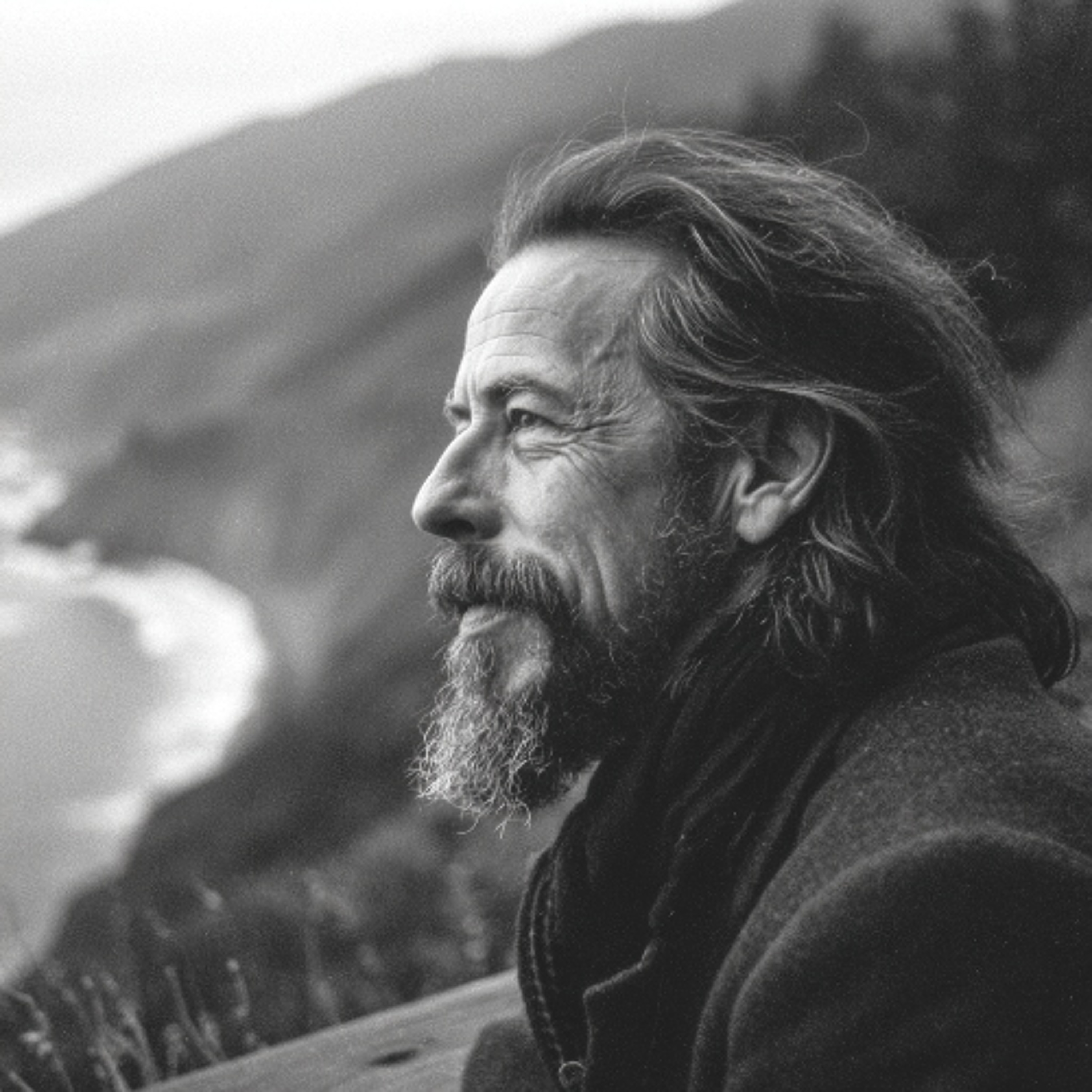
Alan Watts, interviewed by Esalen co-founder Michael Murphy (1966) - Part Two episode artwork

EPISODE · Aug 25, 2025 · 34 MIN

Alan Watts, interviewed by Esalen co-founder Michael Murphy (1966) - Part Two

from Voices of Esalen · host Esalen Institute

Today I’m super excited to present to you another episode from the Archives From this trove of 1/2 inch reel to reel tapes that we recently found mouldering in a storage facility near the Monterey Airport - a 1966 dialogue between Esalen co-founder Michael Murphy and philosopher Alan Watts and today is PART TWO— notable for being one of the only instances I've encountered of Michael Murphy conducting an interview himself. But hey, when it’s Alan Watts, all bets are off. So, first, who is Alan Watts? He’s born in England, but moved to the United States in 1938 to pursue Zen training in New York. Then he attended a Seabury-Western Theological Seminary, got a master’s degree in theology. became an Episcopal priest in 1945, left the ministry in 1950 and then he moved to California, where he joined the faculty of the American Academy of Asian Studies. It was during the 1950s that he met Dick Price and Michael Murphy - both of whom were kicking around the Bay Area after their stints at Stanford, trying to figure out what the heck they were doing with their lives. It’s widely known that Watts represents this pivotal figure in the transmission of Eastern philosophical traditions to Western intellectual discourse. By the time this conversation rolls around in 66, he had long since established himself as a rather famous interpreter of Zen Buddhism, Taoism, and Hindu metaphysics for American audiences. He’d had a rise to prominence in the 1950s which coincided with a broader cultural receptivity to Eastern philosophical frameworks. The Beats, early hippies, young people, intellectuals - they were all fascinated by Zen and the I Ching and Buddhism. At Esalen, where Alan Watts taught from the very first days in 1962 up until his death in 1973, he really found an ideal context for exploring the synthesis between Eastern contemplative traditions and this Western psychological inquiry which was coming to the forefront. And then the temporal context for this interview bears mentioning, too. This conversation occurs at a moment of considerable social upheaval: we’ve got an escalation of American involvement in Vietnam, and a pushback at home, we’ve got the emergence of several countercultural movements, including the civil rights movement and a rather new hippie/ pyschedelic culture. There’s a widespread questioning of established institutional authority. So it’s within this milieu that Watts and Murphy examine fundamental questions about human consciousness and the peculiarities of American cultural expression. And of course all delivered in that million dollar voice by Alan Watts. I mean, He could read a Denny’s menu and make it sound profound. To me, this is a treasure of a conversation - even though it’s historically situated, it addresses still-relevant questions about consciousness, about cultural development, and about humanity's place within larger systems. It also provides a lot of insight into the intellectual atmosphere that characterized Esalen's early years, when the boundaries between disciplines were very permeable and fundamental questions about human nature were approached with both rigor and imagination. Here's Alan Watts, interviewed by Michael Murphy, at Esalen Institute in 1966.

Today I’m super excited to present to you another episode from the Archives From this trove of 1/2 inch reel to reel tapes that we recently found mouldering in a storage facility near the Monterey Airport - a 1966 dialogue between Esalen co-founder Michael Murphy and philosopher Alan Watts and today is PART TWO— notable for being one of the only instances I've encountered of Michael Murphy conducting an interview himself. But hey, when it’s Alan Watts, all bets are off. So, first, who is Alan Watts? He’s born in England, but moved to the United States in 1938 to pursue Zen training in New York. Then he attended a Seabury-Western Theological Seminary, got a master’s degree in theology. became an Episcopal priest in 1945, left the ministry in 1950 and then he moved to California, where he joined the faculty of the American Academy of Asian Studies. It was during the 1950s that he met Dick Price and Michael Murphy - both of whom were kicking around the Bay Area after their stints at Stanford, trying to figure out what the heck they were doing with their lives. It’s widely known that Watts represents this pivotal figure in the transmission of Eastern philosophical traditions to Western intellectual discourse. By the time this conversation rolls around in 66, he had long since established himself as a rather famous interpreter of Zen Buddhism, Taoism, and Hindu metaphysics for American audiences. He’d had a rise to prominence in the 1950s which coincided with a broader cultural receptivity to Eastern philosophical frameworks. The Beats, early hippies, young people, intellectuals - they were all fascinated by Zen and the I Ching and Buddhism. At Esalen, where Alan Watts taught from the very first days in 1962 up until his death in 1973, he really found an ideal context for exploring the synthesis between Eastern contemplative traditions and this Western psychological inquiry which was coming to the forefront. And then the temporal context for this interview bears mentioning, too. This conversation occurs at a moment of considerable social upheaval: we’ve got an escalation of American involvement in Vietnam, and a pushback at home, we’ve got the emergence of several countercultural movements, including the civil rights movement and a rather new hippie/ pyschedelic culture. There’s a widespread questioning of established institutional authority. So it’s within this milieu that Watts and Murphy examine fundamental questions about human consciousness and the peculiarities of American cultural expression. And of course all delivered in that million dollar voice by Alan Watts. I mean, He could read a Denny’s menu and make it sound profound. To me, this is a treasure of a conversation - even though it’s historically situated, it addresses still-relevant questions about consciousness, about cultural development, and about humanity's place within larger systems. It also provides a lot of insight into the intellectual atmosphere that characterized Esalen's early years, when the boundaries between disciplines were very permeable and fundamental questions about human nature were approached with both rigor and imagination. Here's Alan Watts, interviewed by Michael Murphy, at Esalen Institute in 1966.

NOW PLAYING

Alan Watts, interviewed by Esalen co-founder Michael Murphy (1966) - Part Two

0:00 34:48

No transcript for this episode yet

We transcribe on demand. Request one and we'll notify you when it's ready — usually under 10 minutes.

Ask A Spaceman Archives - 365 Days of Astronomy Ask A Spaceman Archives - 365 Days of Astronomy Podcasting Astronomy Every Day of the Year Eat to Live Jenna Fuhrman, Dr. Fuhrman Our health is our most precious gift and smart nutrition can change your life. Each month, join Dr. Fuhrman and his daughter, Jenna Fuhrman as they discuss important topics in the world of nutrition. Eat to Live will change the way you eat and think about food. French Your Way Jessica: Native French teacher founder of French Your Way Boost your French listening skills and test your comprehension with this one of a kind series of podcasts. Get the chance to listen to a real conversation between native speakers talking at normal speed AND customise your learning experience through carefully designed sets of questions (2 levels of difficulty) available for download at www.frenchvoicespodcast.com. All interviews also come with the transcript. French teacher Jessica interviews native speakers of French from around the world who share a bit of their life and passion. Where else would you meet in one same place a French yoga teacher based in Melbourne, a soap manufacturer from Provence, or a couple cycling around the world? That Hoarder: Overcome Compulsive Hoarding That Hoarder Hoarding disorder is stigmatised and people who hoard feel vast amounts of shame. This podcast began life as an audio diary, an anonymous outlet for somebody with this weird condition. That Hoarder speaks about her experiences living with compulsive hoarding, she interviews therapists, academics, researchers, children of hoarders, professional organisers and influencers, and she shares insight and tips for others with the problem. Listened to by people who hoard as well as those who love them and those who work with them, Overcome Compulsive Hoarding with That Hoarder aims to shatter the stigma, share the truth and speak openly and honestly to improve lives.

Frequently Asked Questions

How long is this episode of Voices of Esalen?

This episode is 34 minutes long.

When was this Voices of Esalen episode published?

This episode was published on August 25, 2025.

What is this episode about?

Today I’m super excited to present to you another episode from the Archives From this trove of 1/2 inch reel to reel tapes that we recently found mouldering in a storage facility near the Monterey Airport - a 1966 dialogue between Esalen co-founder...

Can I download this Voices of Esalen episode?

Yes, you can download this episode by clicking the download button on the episode player, or subscribe to the podcast in your preferred podcast app for automatic downloads.
URL copied to clipboard!