
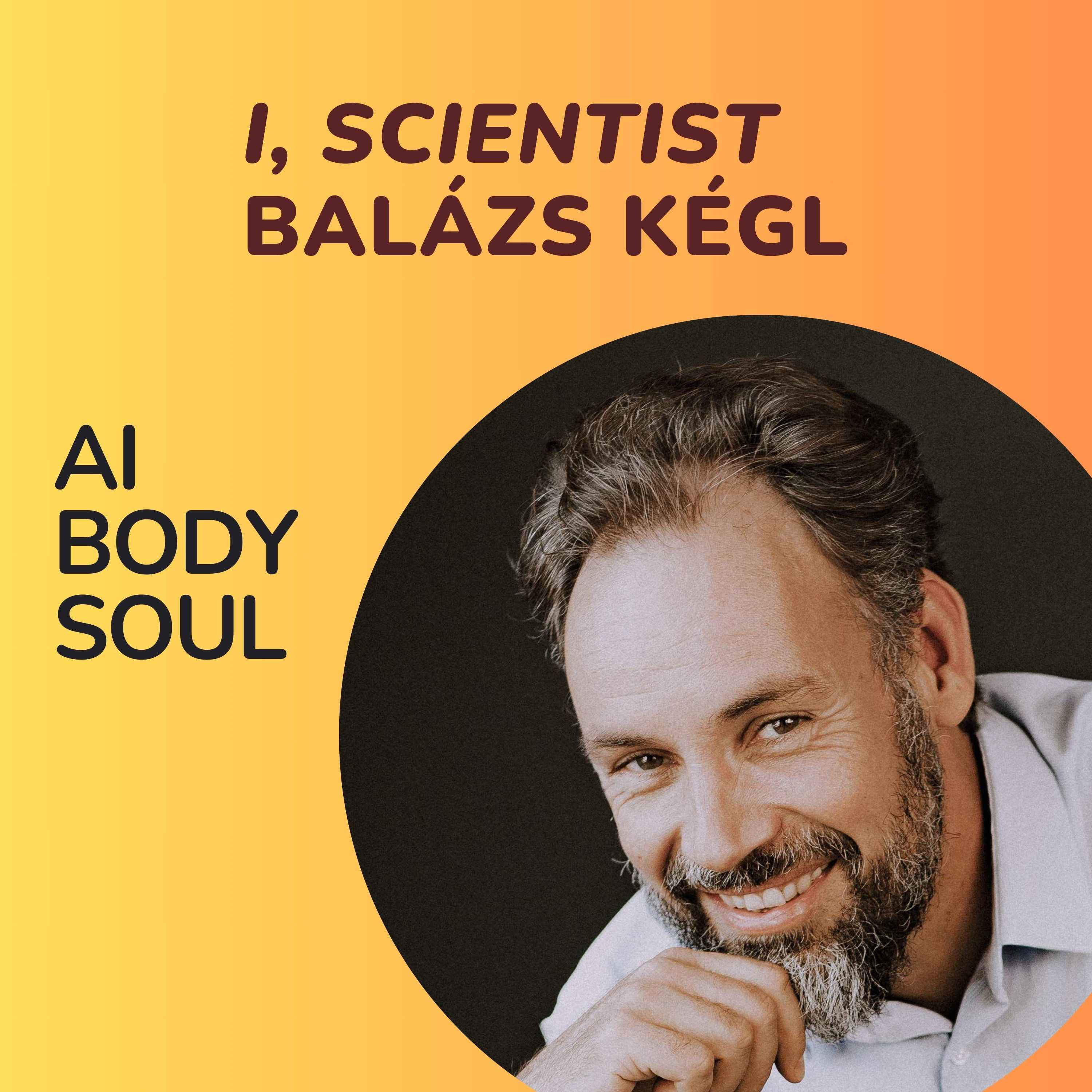
EPISODE · Nov 14, 2024 · 1H 20M
Alexander Ororbia
from I, scientist with Balazs Kegl
We get deep into identity and death. If you are fascinated by Michael Levin and Jonathan Pageau, this conversation is for you.Fascinating discussion where we go beyond the Free Energy Principle, and even Levin's cognitive cones, and postulate that crucial internal structures, a subset of me, are what define identity. If they get damaged, I lose my identity. Deep self-transformation may also rupture my continuity. When does it happen, when do I die, as opposed to my subsystems dying? Very much a sequel to my conversation with Yogi Jaeger (https://youtu.be/5UJ4y2L2qpk). The paradox of self-preservation vs self-sacrifice. Maverick computing and organoids.Alexander is an Assistant Professor of Computer Science at Rochester Institute of Technology. He directs the Neural Adaptive Computing (NAC) Laboratory where they work on developing new learning procedures and computational architectures that embody various properties of biological neurocircuitry and are guided by theories of mind and brain functionality. His research focuses on predictive processing, active inference, spiking neural networks, competitive neural learning, neural-based cognitive modeling, and metaheuristic optimization.Alexander's webpage: https://www.rit.edu/directory/agovcs-alexander-ororbiaPaper link: https://arxiv.org/abs/2311.09589Biological learning survey: https://arxiv.org/abs/2312.0925700:00:00 Intro00:01:37 Geoff Hinton's "mortal computation" idea: what if software and hardware were inseparable? Cybernetics, thermodynamics, 4e cognitive science, basal cognition.00:11:20 Hinton's energy consumption argument.00:21:01 The self-preservation directive is the source of intelligence. The free energy principle. The non-equilibrium steady state is your identity.00:32:21 The paradox of the membrane: a permeable separation of inside and outside. The nestedness of inside and outside: fractal structure. Beyond FEP: identity-defining internal structures. Subsystemic death. Bottom-up and top-down causation.00:52:12 Why mortal (as opposed to living) computation? The crucial role of finite time horizon.01:01:49 The paradox of self-preservation vs self-sacrifice. Life drive vs death drive. Is death a must? Maverick computing and organoids.01:15:38 My take on embodiment and mortality.I, scientist blog: https://balazskegl.substack.comTwitter: https://twitter.com/balazskeglArtwork: DALL-EMusic: Bea Palya https://www.youtube.com/channel/UCBDp3qcFZdU1yoWIRpMSaZw Hosted on Acast. See acast.com/privacy for more information.
Embed this episode
Ready to play
Alexander Ororbia
No transcript for this episode yet
Similar Episodes
No similar episodes found.
Similar Podcasts
No similar podcasts found.