
EPISODE · Feb 4, 2025 · 11 MIN
Alexander von Humboldt: The Original Ecologist in the Age of Climate Crisis
from The Cogitating Ceviché Podcast · host Conrad T Hannon
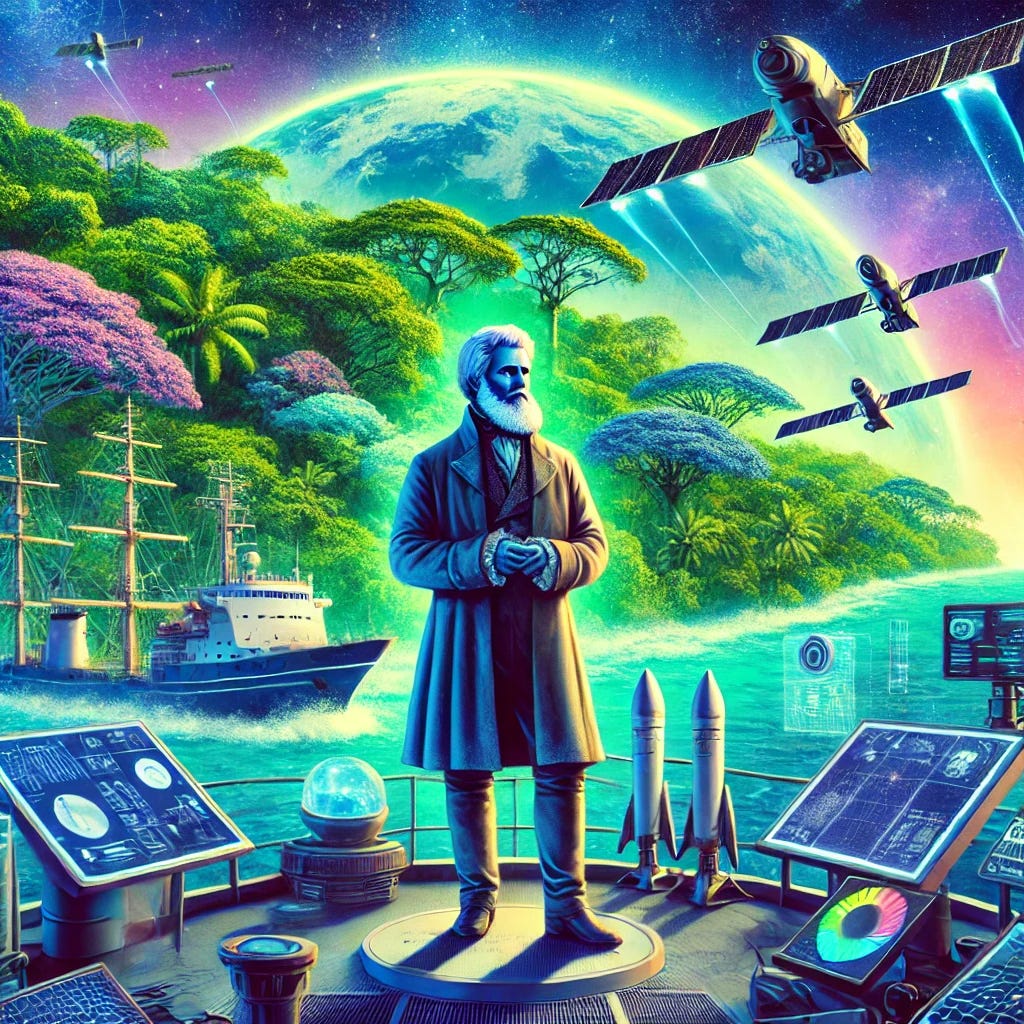
The Cogitating CevichePresentsAlexander von Humboldt: The Original Ecologist in the Age of Climate CrisisPast Forward: Historical Icons in the Digital Frontier #45By Conrad HannonNarration by Amazon PollyPrefaceWelcome to the latest installment of Past Forward: Historical Icons in the Digital Frontier. This series imagines how history’s most influential figures might engage with today’s world, drawing upon their expertise to examine contemporary challenges. In this entry, we bring back Alexander von Humboldt—the pioneering naturalist, geographer, and explorer—whose interdisciplinary approach to science laid the groundwork for modern ecology and climate studies. How would Humboldt react to the environmental crises of our time? What insights could he offer on biodiversity loss, climate change, and planetary exploration? Join us as we follow Humboldt into the heart of the 21st century.Arrival in a Changed WorldHumboldt steps onto the deck of a research vessel off the coast of the Galápagos Islands, a place Charles Darwin once explored with a copy of Humboldt’s Personal Narrative in hand. The air hums with the sound of drones surveying marine biodiversity while satellite feeds stream live data on shifting ocean temperatures. Scientists onboard discuss ocean acidification, microplastic contamination, and shifting migration patterns of marine life, their voices filled with urgency. He is both exhilarated and alarmed.The world has become a vast, interconnected web of information—just as he once envisioned. Massive digital archives track species populations in real time, AI-assisted models predict ecological shifts and remote sensors reveal changes invisible to the human eye. Yet, a deep concern settles in as he scans the digital readouts and hears of mass coral bleaching, species extinctions, and deforestation. Have we ignored nature’s delicate interdependencies for too long?Humboldt steps away from the ship’s railing, listening intently as marine biologists explain how ecosystems are at risk due to rising temperatures and pollution. He watches video footage of once-thriving coral reefs now turned to skeletal remains, fish populations dwindling as their habitats degrade. He flips through data charts, recognizing familiar geographic patterns but with stark new variables: unprecedented warming trends, intensifying weather events, and growing atmospheric carbon concentrations.Determined to witness the changes firsthand, he joins an expedition to a nearby island, walking along a shoreline littered with plastic waste. He bends down, lifting a tangled fishing net from a tide pool, its fibers entwined with remnants of marine life. He shakes his head. "Nature’s resilience is mighty, but human carelessness is mightier still," he murmurs, his mind racing with ideas on how to bridge scientific knowledge with actionable solutions.The urgency of the situation fuels him. The modern era has tools unimaginable in his time—climate modeling, global monitoring networks, and cutting-edge technology—but does it have the will to act? He resolves to immerse himself in the scientific community, convinced that solutions must be driven by a deep understanding of nature’s interconnected systems. He exhales, determined. His work is not yet done.Humboldt’s Legacy and the Modern Environmental MovementIn the early 19th century, Humboldt was one of the first to articulate nature as a unified system where climate, geography, and biology interact dynamically. His explorations across Latin America and Siberia laid the foundation for biogeography and predicted human-induced climate change long before the industrial world took heed. His writings influenced generations of scientists, from Darwin to modern ecologists, making his holistic view of nature more relevant than ever.Now, standing in front of climate activists holding signs quoting his own words—“Everything is interconnected”—Humboldt finds himself at the heart of a movement he anticipated but never lived to see. He is eager to contribute but also stunned by the scope of human impact. Industrialized agriculture has replaced vast rainforests; ice sheets he once mapped are vanishing. “We must measure, document, understand,” he insists, grabbing a digital tablet with the same enthusiasm he once reserved for his barometers and compasses. The tools have changed, but his mission remains: to observe and reveal the relationships binding all life.Exploring Modern Climate Science and ConservationHumboldt wastes no time integrating himself into the scientific community. He collaborates with climate modelers, devours satellite data on atmospheric carbon levels, and studies global conservation efforts. His insatiable curiosity drives him to remote sensing laboratories, deep-sea expeditions, and rainforest research stations.Yet, he is not merely a passive observer. As a man who risked his life climbing Andean volcanoes to prove the connection between altitude and vegetation, he is eager to be in the field. He hikes through deforested regions of the Amazon, where cattle farms have replaced once-thriving ecosystems. “This is a violation of nature’s intricate equilibrium,” he exclaims, sketching notes on his tablet as he once did in his journals.Humboldt’s insights into climate change are prophetic. In his time, he warned that deforestation and industrial emissions would alter weather patterns, an idea dismissed by many contemporaries. Today, as he examines temperature records and sea level projections, he sees the realization of his worst fears. But he also sees solutions—renewable energy, reforestation, and ecological restoration—all concepts deeply aligned with his vision of sustainable coexistence with nature.Ethics, Industry, and the Cost of ProgressHumboldt was never content with pure science; he was also a fierce advocate for social responsibility. In his travels, he condemned colonial exploitation and the environmental destruction it wrought. He directs his sharp critique at multinational corporations and policymakers prioritizing profit over planetary health. “We are stewards, not owners, of nature,” he declares at a UN climate summit, where world leaders scramble to adjust their rhetoric in response to this unexpected but commanding presence.Humboldt’s approach is not merely one of condemnation; he seeks collaboration. He engages with economists and policy experts, advocating for economic models that integrate ecosystem services into market systems. If nature’s benefits—clean air, water, biodiversity—were accounted for in financial ledgers, he argues, the incentive to protect them would be undeniable. His interdisciplinary approach, once revolutionary, now finds a receptive audience in sustainability circles and environmental think tanks.Humboldt in Space: A New FrontierHumboldt’s vision of interconnected systems extends beyond Earth. He was invited to NASA’s Jet Propulsion Laboratory and was captivated by exoplanet research and astrobiology. Scientists show him data from Mars, Venus, and distant exoplanets, explaining how planetary climates evolve. The concept of studying Earth through the lens of other worlds thrills him. “To understand our planet’s fate, we must look beyond it,” he muses, urging further exploration into planetary habitability and climate models informed by interstellar discoveries.In a conversation with a team of astrobiologists, he discusses the potential of terraforming Mars, likening it to how human activities have altered Earth's climate. “If we have the power to reshape a planet, then surely we can learn to preserve our own,” he argues. He is also fascinated by the search for extraterrestrial life, drawing connections between microbial life in Earth’s extreme environments and potential life forms on icy moons like Europa.Expanding his interest in planetary systems, he visits a cutting-edge space telescope facility, where astronomers demonstrate how advanced spectrometry techniques allow them to detect the chemical signatures of exoplanet atmospheres. He marvels at the precision of these instruments, comparing them to the rudimentary barometers and altimeters of his time. “You have turned the sky into a living map of possibilities,” he exclaims, astounded by how modern technology brings the cosmos within reach.Determined to apply this knowledge to earthly concerns, Humboldt collaborates with planetary scientists studying Earth's twin, Venus. He delves into its runaway greenhouse effect, drawing stark parallels between the planet’s thick carbon dioxide atmosphere and humanity’s escalating emissions problem. “Venus is a warning, not a mystery,” he tells the researchers. “We must heed the lessons it offers before we follow the same path.”He also takes a keen interest in efforts to establish sustainable off-world colonies, debating with space agencies about the ethics of planetary expansion. He raises questions about the environmental impact of human settlements beyond Earth. “If we cannot preserve the delicate balance of life on our own planet,” he asks, “what makes us think we can do better on another?”Inspired by these discoveries, Humboldt urges a new interdisciplinary approach to planetary sciences that sees Earth as part of a larger cosmic framework. His relentless pursuit of understanding, drive to integrate knowledge across disciplines, and unwavering belief in the interconnectedness of all things make him an indispensable voice in the growing dialogue between Earth scientists and space explorers.A Call to ActionBefore he returns to his own time, Humboldt delivers a final address to a global audience. He warns that humanity stands at a precipice, echoing the cautions of today’s climate scientists. But he also offers hope. “Knowledge is power,” he insists. “We have the tools to restore balance, but only if we act swiftly and with purpose.”As he vanishes back into history, his legacy endures, inspiring new generations of scientists to push boundaries, advocating for conservation, and expanding our understanding of the interconnected forces shaping our planet—and beyond.Thank you for your time today. Until next time, stay gruntled. This is a public episode. If you'd like to discuss this with other subscribers or get access to bonus episodes, visit thecogitatingceviche.substack.com/subscribe
Embed this episode
NOW PLAYING
Alexander von Humboldt: The Original Ecologist in the Age of Climate Crisis
No transcript for this episode yet
Similar Episodes
No similar episodes found.
Similar Podcasts
No similar podcasts found.