
EPISODE · Feb 13, 2026 · 9 MIN
Amateur Radio News and Notes 2/13/2026
from Amateur Radio News and Notes Podcast · host Ed N2EC
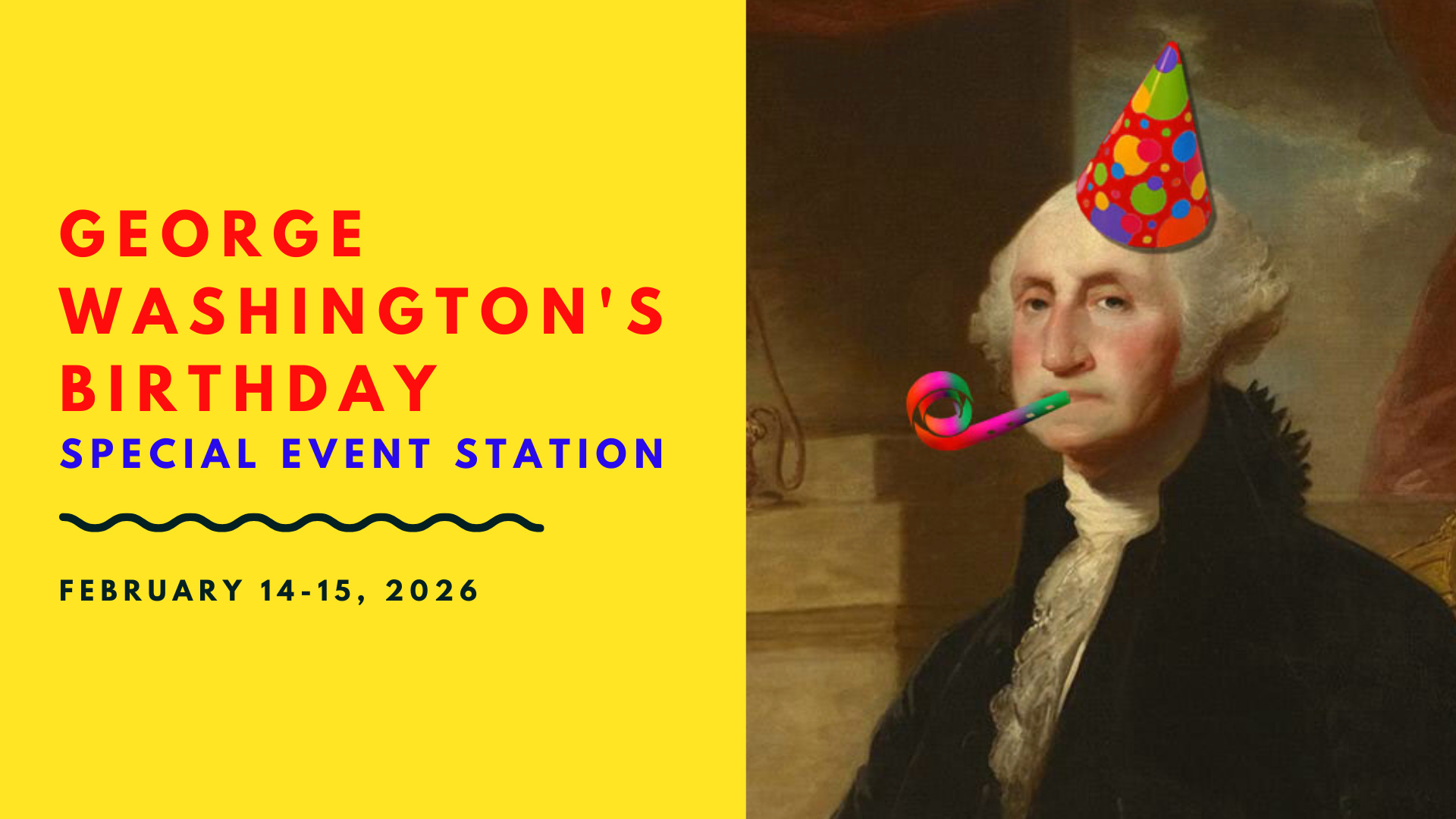
In the log this week* New U.S. 60 Meter Band Allocation Effective Today 2/13/2026* KP5/NP3VI Desecheo DXpedition To Continue Operations Until 3/3/2026* MVARC Special Event Station at George Washington’s Mount Vernon This Weekend 2/14/2026-2/15/2026* MVARC Nets on the Air* What’s happening with DX? * Solar Activity Update* Upcoming Contests* Interesting Online Radio Content As always, links to all referenced content can be found in the show notes, or at our Substack at mvarc.substack.com Thanks for reading Amateur Radio News and Notes. Subscribe for free to receive new posts and support my work.New U.S. 60 Meter Band Allocation Effective Today 2/13/2026Today marks the effective date of the new 60 Meter Band allocation in the United States. The main change relates to spectrum around the former channel at 5358.5 kHz which has been replaced by an allocation from 5351.5 kHz to 5366.5 kHz. The new allocation is limited to no more than 9.15 Watts Effective Radiated Power (ERP) which is a change from the previous limit of the channel of 100 Watts ERP. The other channels at 5332, 5348, 5373, and 5405 kHz remain as before with 100 Watts ERP. Bandwidth on the 60 meter band is limited to 2.8 kHz and amateurs are reminded that our privileges on the band are secondary to other stations authorized by the FCC and NTIA, other nations in the fixed service, and all other nations in mobile with the exception of aeronautical mobile.This is an exciting new addition on a very useful band and the low power levels will make it a great place to enjoy QRP communications. More information about the changes can be found at:* https://docs.fcc.gov/public/attachments/FCC-25-60A1.pdf* https://www.federalregister.gov/documents/2026/01/14/2026-00587/implementation-of-the-final-acts-of-the-world-radiocommunication-conference-geneva-2015-wrc-15-other* https://www.arrl.org/news/new-60-meter-frequencies-available-as-of-february-13 KP5/NP3VI Desecheo DXpedition To Continue Operations Until 3/3/2026Image Courtesy https://desecheo2026.com/kp5/ On February 10, 2026 the KP5/NP3VI team announced that the Desecheo DXpedition has been extended until March 3, 2026. The remote Radio-in-Box systems were initially slated to be retrieved on February 12, but deteriorating conditions at sea prompted the schedule to be delayed. As a result, the team will continue remote operations to get more operators in the log. As of the 10th the team reported over 66,000 QSOs with 14,771 stations, for a total of 3,674 All-Time-New-Ones (ATNOs). Your author was able to get KP5/NP3VI in the log on 30 meters CW on 2/8/2026 and the contact was confirmed on Logbook of the World and Club Log within minutes.The team also announced what they’re calling ATNO Day which is scheduled for Sunday, February 15, 2026 at 0000 UTC (Saturday Night at 7 PM ET) until Monday, February 16, 2026 at 0000 UTC (Sunday Night at 7PM ET) where the team will be focusing on operators who have never made a contact with Desecheo (so for them, it would be an ATNO). They will focus on FT8 from 1200-1400 UTC after which time they will focus on SSB with frequencies being in the U.S. General bands. They ask that ops who have them in their logs already let those who do not have them in their logs get their ATNO on this day. Operating schedules and updates can be found on their web site at https://desecheo2026.com/kp5/. Good luck!MVARC Special Event Station at George Washington’s Mount Vernon This Weekend 2/14/2026-2/15/2026This weekend the Mount Vernon Amateur Radio Club will be operating as K4US from the grounds of George Washington’s Mount Vernon Estate to celebrate his 294th birthday. The club plans to get on the air around 1500 UTC on Saturday (10 AM ET) until 2000 UTC (3 PM ET) and then again on Sunday from 1330 UTC (8:30 AM ET) until 1600 UTC (11 AM ET). Look for us on spotting networks and around centers of activity around 7.042 and 14.042 for CW and 7.242 and 14.242 for SSB. QSL cards will be available via the address on the K4US QRZ page. We look forward to celebrating on the air and hope to get you in the log. MVARC Nets on the Air* 2 Meter FM Net: Tuesdays at 7 PM [146.655/- MHz (141.3 Hz PL Tone) ] * 2 Meter Digital Net: Immediately Follows 2 Meter FM Net [146.655/- MHz C4FM] * MVARC Slow Speed CW Roundtable: Saturday and Sunday at 7:30 AM [3.565 MHz CW]* MVARC Cherry Tree Net: Saturday and Sunday at 8:30 AM [3.920 MHz LSB]What’s Happening with DXThere will be a lot of DX on the air this week. Stations on the air include Gambia (C5SP), Guinea Bissau (J52EC, J51A), Desecheo Island (KP5/NP3VI), Greenland (OX7A, OX7AM, OX7AKT, OX3LG, OX3LX), Mali (TZ1CE), Cambodia (XU7O), Belize (V3O, V31KO), Solomon Islands (H44MS), Colombia (HK3JCL), and Antarctica (DP0GVN, FT4YM).A calendar of DXpeditions can be found at https://dxnews.com/calendar/ Solar Activity UpdateAs we go to press the Solar Flux Index (SFI) was 129 and the estimated sunspot number was 82 with 7 numbered sunspot regions visible from Earth. Over the last week the SFI has decreased. Solar activity has been at moderate levels in the last 24 hours. The geomagnetic field has been at quiet to active levels and the Kp index reached 3 yesterday. The solar wind peaked at 461 km/s. Solar activity is predicted to be at low levels with a slight chance of M-class flares today through Sunday. The geomagnetic field is forecast to be at quiet levels today, at quiet to unsettled levels on Saturday, and at quiet to minor storm levels on Sunday. The chance of solar radiation storms at the S1 or greater level is at 1% today through Sunday. R1 to R2 radio blackouts are unlikely in the near term with a predicted probability of 10% today through Sunday. R3 or greater blackouts are unlikely with a 5% chance predicted today through Sunday. There is a chance of 6 meter propagation so keep an eye on the band and spotting clusters to be ready for the next time the magic band does its thing. It remains a fantastic time for amateurs to get on the air and work the world. Good sources of real-time solar information include https://www.spaceweatherlive.com/ and https://solarham.com/. A good overview of conditions can be found at https://dx.qsl.net/propagation/. To see D-layer absorption data and associated radio blackouts, visit https://www.swpc.noaa.gov/products/d-region-absorption-predictions-d-rap. To see real-time Maximum Usable Frequency (MUF) and Critical Frequency (foF2) information from radiosonde data, visit https://prop.kc2g.com/. Upcoming ContestsThis weekend brings the YLRL YL-OM Contest, the CQ World Wide RTTY WPX Contest, the PODXS 070 Club Valentine Sprint, the Asia-Pacific Spring Sprint on CW, the SKCC Weekend Sprintathon, the KCJ Topband Contest, the Dutch PACC Contest, the OMISS QSO Party, the WAB 1.8 MHz Phone Contest, the RSGB 1.8 MHz Contest, the Balkan HF Contest, and the Run for the Bacon QRP Contest. As always the K1USN SSTs, MSTs, and CWTs will also be on the air. The full contest calendar with events and exchanges can be found at https://www.contestcalendar.com/weeklycont.phpInteresting Online Radio ContentMatt M0DQW takes a look at the Anytone AT-D890UV DMR and NXDN HT - Mike K8MRD fixes his base station antenna installation and sings the praises of TennTennas - Dr. Tamitha Skov WX6SWW takes a look at some space weather conditions from earlier this week - Half as Interesting talks about an experiment to enhance propagation by sending millions of needles to space - Hayden VK7HH talks about how take-off angles change with antenna elevation and how to make it work to your advantage - Walt K4OGO discusses long path and short path propagation for DX - Josh KI6NAZ talks about using Linux for amateur radio - Save it for Parts experiments with receiving satellite signals from his geodesic radar dome - Mr. Carlson’s Lab explains how to extend the life of your soldering iron tips - Geerling Engineering shows how broadcast TV sports are produced - Tim N7KOM takes a look at the quick-to-deploy BeeTenna Yagi - Dan WD4DAN looks at new features for OpenHamClock - That’s it for this week.Best 73,EdN2EC This is a public episode. If you would like to discuss this with other subscribers or get access to bonus episodes, visit mvarc.substack.com
Embed this episode
Ready to play
Amateur Radio News and Notes 2/13/2026
No transcript for this episode yet
Similar Episodes
No similar episodes found.
Similar Podcasts
No similar podcasts found.