
EPISODE · Jul 2, 2024 · 56 MIN
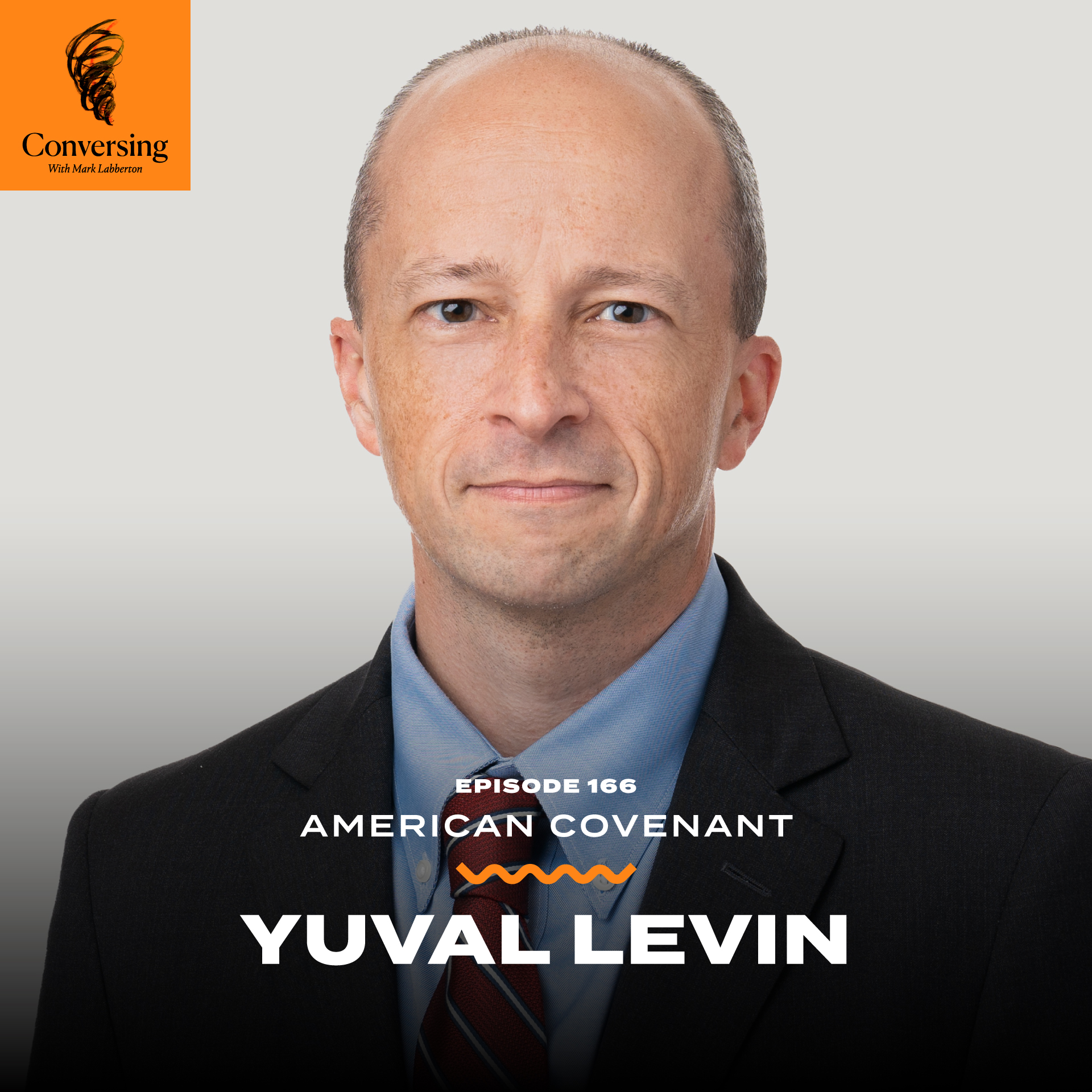
American Covenant, with Yuval Levin
from Conversing with Mark Labberton
"The Constitution is neither a left-wing or right-wing document. It is ultimately about how to hold a society together." American political life today is fractured and splintered, but many still yearn for unity. How can we find social cohesion amid sharply felt differences? Political scientist Yuval Levin wants to bring us back to our founding document: the American Constitution. After all, the Preamble identifies as its primary purposes to "form a more perfect union" and "establish justice." Yuval Levin is the director of Social, Cultural, and Constitutional Studies at the American Enterprise Institute, where he also holds the Beth and Ravenel Currie Chair in Public Policy. His latest book is American Covenant: How the Constitution Unified Our Nation—and Could Again. He's founder of National Affairs, senior editor at The New Atlantis, a contributing editor of National Review, and contributing opinion writer at the New York Times. Levin joins Mark Labberton to discuss the US Constitution's purpose in fostering social cohesion and unity; the malfunction of Congress to build coalitions across disagreement; the values of social order and social justice; the fragility of democracy; the difference between a contract and a covenant; and the American aspiration to live up to the covenantal relationship and mutual belonging implied in "We the people." About Yuval Levin Yuval Levin is the director of Social, Cultural, and Constitutional Studies at the American Enterprise Institute (AEI), where he also holds the Beth and Ravenel Curry Chair in Public Policy. The founder and editor of National Affairs, he is also a senior editor at The New Atlantis, a contributing editor at National Review, and a contributing opinion writer at the New York Times. At AEI, Levin and scholars in the Social, Cultural, and Constitutional Studies research division study the foundations of self-government and the future of law, regulation, and constitutionalism. They also explore the state of American social, political, and civic life, focusing on the preconditions necessary for family, community, and country to flourish. Levin served as a member of the White House domestic policy staff under President George W. Bush. He was also executive director of the President's Council on Bioethics and a congressional staffer at the member, committee, and leadership levels. In addition to being interviewed frequently on radio and television, Levin has published essays and articles in numerous publications, including Wall Street Journal, Washington Post, The Atlantic, and Commentary. He is the author of several books on political theory and public policy, most recently American Covenant: How the Constitution Unified Our Nation – and Could Again (Basic Books, 2024). He holds an MA and PhD from the Committee on Social Thought at the University of Chicago. Show Notes Get your copy of Yuval Levin's American Covenant: How the Constitution Unified Our Nation—and Could Again Yuval Levin's background as a Jewish American and his childhood immigration to the United States from Israel. Yuval has "the kind of vision that sometimes immigrants have, which combines a really deep gratitude for this country with a sense of what's unique about it, and what's wonderfully strange about it." Yuval's religious practice at a Conservative Jewish synagogue in Washington, DC. How Torah has shaped Yuval Levin's life and thought. Torah is Hebrew for "law." Annual cycle of reading and immersing oneself in a text. "The American Constitution is not divine. It's the work of a patchwork of compromises, it has a lot of problems, by no means do I think that it's analogous to the Hebrew Bible." Why write a book about the American Constitution? How to understand the constitution as a framework for social cohesion and unity. "Even in the private lives of a lot of Americans, I think the sense of isolation, of alienation, breakdown of social cohesion is very powerful in the lives of a lot of people." Constitution is intended to unify, but it's been used to divide. James Madison as a primary figure in Yuval's new book. "Americans tend to approach politics by thinking of other Americans as the problem to be solved." "In any free society, there are always going to be divisions." James Madison in Federalist 10: "He just says, simply: As long as the reason of man continues fallible, and he's at liberty to exercise it, different opinions will be formed. The fact that we disagree is not a failure. It is a reality. And yet, that doesn't mean that we can't be unified." Unity doesn't mean thinking alike, it means acting together. "The Constitution compels us into building coalitions with precisely the people we disagree with." Yuval Levin explains the premises behind his book The Great Debate: Edmund Burke, Thomas Paine, and the Birth of Right and Left Social order versus social justice "There are, as a general matter, more or less two ways of thinking about the purpose of a free society like ours. There is a way of seeing it as intended to address the challenge of chaos and disorder, and there is a way of seeing it as intended to address the challenge of inequality and injustice." "… the premise of human fallenness, which says that we begin unready for freedom. And we need to be formed and shaped to be capable of freedom." "I think it's worth our seeing the Constitution is neither a left-wing or right-wing document. It is ultimately about how to hold a society together, which has these two sides to it. And so it has a lot to offer us." Social order as "patient to a fault" and "prejudicial toward white or elite culture." Ideological extremism. "The most dangerous kinds of abuses of the weak happen at the hands of majorities. And therefore, democracy itself has to be constrained by principles of justice that are kept beyond the reach of majorities." The question of "simple majority rule." Populism. Two minority parties, rather than a majority party. Coalition building is just not being allowed to play out. Shared action versus shared ideas. Congress is about acting together when you don't think alike. "Clearly there is something broken about Congress… Everybody agrees the institution is dysfunctional. I don't think everybody agrees about what function it isn't performing." "Their job is actually to negotiate with the other party." "I think that's fed a kind of attitude among a lot of prominent politicians in America that says, fighting for my constituents means yelling at the other party, and refusing to give ground, refusing to give an inch. That's actually not what fighting looks like in our kind of democracy. That's what losing looks like. Fighting looks like effectively bargaining and negotiating so as to achieve something of what your voters want or need. Partisanship, reactionary politics, and cynicism "I've come to think that cynicism about politics is actually very naive." "The people you're dealing with are not cynical Machiavellians. They really believe they're doing good here, and there actually is room to have an argument." How does justice operate in the political approach Yuval Levin advocates? The first two purposes of the Constitution: form a more perfect union, and establish justice. Who gets to decide what is just? Human equality and dignity as the premises for justice Why wasn't slavery abolished in the Constitution itself? Native Americans and the abuse of human dignity Analogy: relating to our political or religious tradition as analogous to the child–parent relationship Seeking a mature relationship with our traditions Yuval Levin on the fragility of democracy: "Our democracy is often at risk." Contract (an agreement that can be broken) vs. Covenant (a relationship of belonging) "'We the people of the United States.' That "we" is an aspiration." Yuval Levin's perspective on the American Church, and how it contributes to the current social crisis American evangelicals coming to identify as an "embattled minority" or a "moral minority" Judging the success of a religious community by their influence as a political block "The particularly Madisonian logic of the Constitution is that everyone is a minority. … And that is not a position of weakness, necessarily, in this society. This is a society that is unusually solicitous of minorities. And when it's at its best, it is especially solicitous of minorities." Production Credits Conversing is produced and distributed in partnership with Comment magazine and Fuller Seminary.
NOW PLAYING
American Covenant, with Yuval Levin
No transcript for this episode yet
Similar Episodes
Mar 26, 2026 ·1m
Jan 2, 2026 ·47m
Dec 21, 2025 ·46m