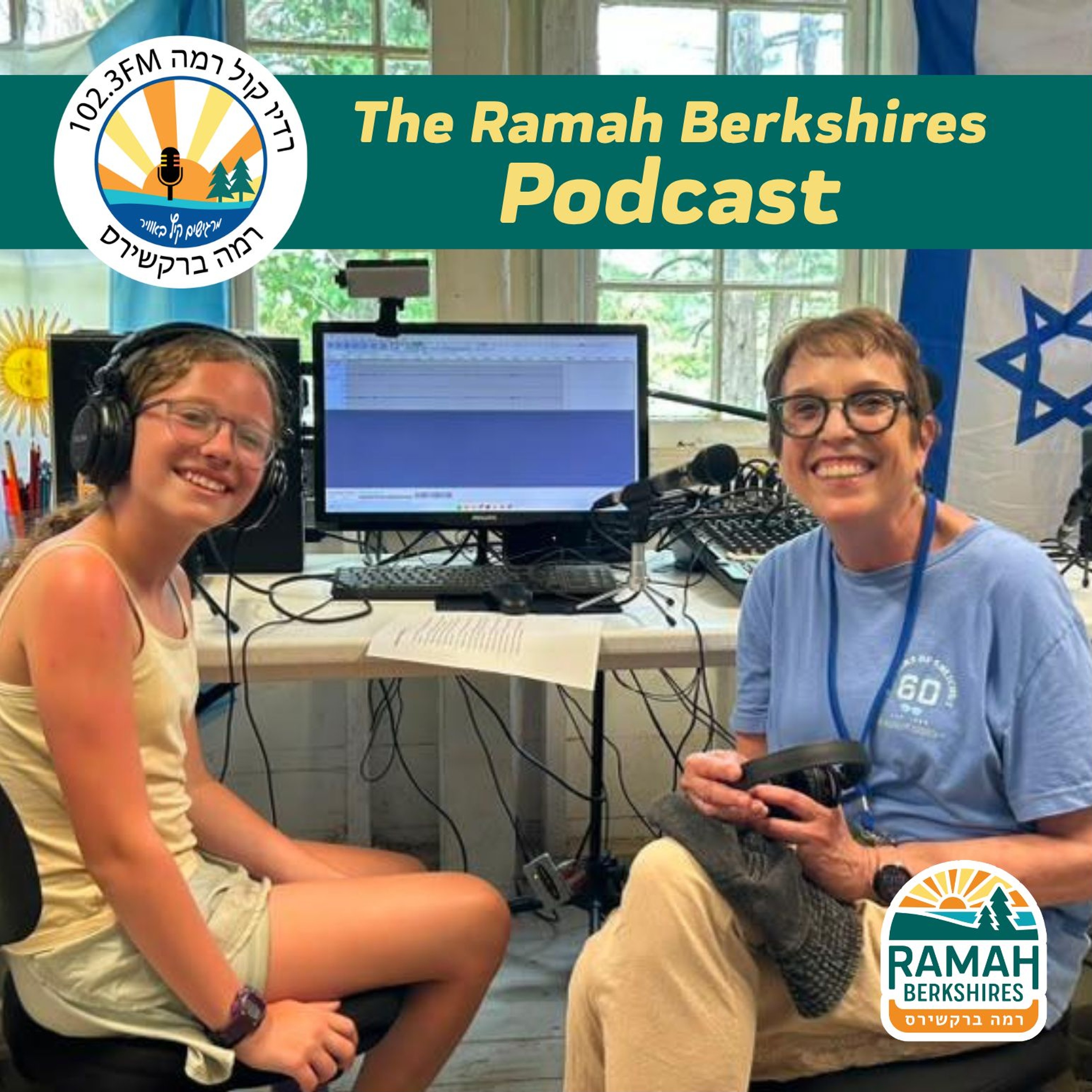
Hello, I'm Tess Kenther, and I'm in Sayurim at Ramah Berkshires. I'm Amy, and I'm sitting with Tess for, I think it's going to be a great interview. So I came to camp in Ta'am. It was really fun. Ta'am is only for a week, but I decided that I wanted to come every year after that because I loved it so much. Tess, how many years have you been here for? This is my fifth year. So you're going to be here. You're already five years in. You have a bunch more years as a camper. Then hopefully you're going to go on Ramah Israel Seminar.
And then do you already see yourself coming back on staff? Yes. I really want to be a counselor here. That's great. Amazing. Do you want to be a Roche Dau one day? Yes. It seems so fun to be a Roche Dau. It really is. It's a lot of hard work, but it's really, it's an amazing opportunity. So stick with Ramah. That's great. So how did you first get involved with Ramah and what led you to your current role? That's great. So my name is Amy Scott Cooper and I'm the CEO of the camping movement. So we have a lot of camps. We have nine overnight camps and we have five day camps in North America. And then we have all of our programs in Israel. And you and I already spoke about when you're going to go on seminar one day.
I wish I had gone on Tom when I was your age, but I actually started Ramah when I was in high school. I was going into 12th grade and was looking for a job, my first job. And I was at a conference for teens and it was a sign, anyone who wants to work at Camp Ramah, come downstairs. And I said, sure. And I went downstairs, really not knowing that much about Ramah. And I went to Camp Ramah, New England. It just happened to be the staff, the camp that was advertising. And here's the amazing thing. I think like you, though I was older, as soon as I went into Camp Ramah that summer, within a few days, I felt like...
I found my people. I found my friends. I really love the community. And I knew, just like you did from Tom on, I'm going to stick with Ramah for a long time. And it's been a really, really long time. I've worked for Ramah. I directed one of our camps for 20 years. But I've worked for Ramah now for over 30 years full time and 40 summers. 40 Ramah summers. I really feel good about that. That is so cool that you've been here for such a long time. Maybe one day you will have the same story to tell. And you stuck with it. What do you think is most important about the Ramah movement?
There are a lot of things that are really, really important about the Ramah movement. The first is you just have an opportunity to be you. There's a certain freedom that camp gives you with an amazing, happy Jewish community where you just are surrounded by people that love being Jewish just like you do, that love Israel like I hope you do, that can celebrate Shabbat and spend the whole week thinking about Shabbat will be here soon, and I can't wait for Shabbat to happen again. There are people of all ages, which I think is a really cool thing. What you don't know yet, but you will as you get a little bit older, is you're part of a movement of 12,000 people all over the place that also have their Ramah stories to tell. So you have your first story here, but as you get older, and I know it feels like it's a really long way from now, but after seminar and you go to college, you're going to be meeting other Ramahics from all over the place, and you have a shared background. That is so amazing. I'm so excited for that. Good. What do you think makes Ramah unique, and why has it had such a long-lasting impact that you've stayed here for such a long time? Yeah, so Ramah is a lot older than I am. Ramah is going to be 80 years old.
I know. Isn't that amazing? Not this camp, but their first camp at Camp Ramah, Wisconsin. It's going to be celebrating its 80th birthday. I think there are a few things that make Ramah unique. First, that I know this is like a fancy word, but the mission, like the goals of Ramah have really stuck and they continue to make sense to every new generation, to the people that founded Ramah, to you guys. And everyone will still think, always thinks about that Shabbat or that Rikudiyah or that Zimriyah, like year after year. So I think that's amazing. I think the other thing that's really...
super important about Ramah is every year there are people that think about, all right, what new ideas are we bringing into Ramah? How are we going to make Ramah relevant and meaningful and super fun for the next group of kids and the next group of staff? And so the Ramah that I started out shouldn't be the same Ramah that you're at right now. It should continue to evolve. And along with it, the world has changed. In some ways, the world has changed for better.
And in some ways, the world has been challenged. You're living in an era like after October 7th. That's a hard era to be living in. You went to school with yellow chairs all over and stickers and signs, and you saw them here. That's a very sad world to be living in. And I think the amazing thing about Ramaz is that we were able to respond to that and make them feel welcome, that they had a home and a place to explain things and a place where you could just talk about these types of things.
Yeah, that's very, very special. Is there a particular camper or staff story that captures what Irma is all about, like what you were saying, that there are so many special, specific moments that you'll always remember? So I'll name two. One goes back to October 7th, and it's not one particular story because each one of our camps has these stories, but each one of our camps, especially theme, have come to camp and said, I am going to keep someone's name alive. Someone that maybe should have been here and is no longer, but it is my mission in life to make sure that that person's name is kept alive. That's a really big thing. There's also something that...
I go from camp to camp. I will visit every camp during the course of the summer. In fact, at this point, I have visited 12 of our camps since camp started. I love camps where campers come up and welcome me and ask who I am or ask if I need help getting to the next place if I don't know where it is or open a door because it is a sign of true hachna sator chim, of welcoming in guests and doing it with graciousness. And it just makes me feel really good that at each of our camps, I find people, chani chim, that take that initiative to do it. I love that about Ramat too.
So you had the opportunity to work with so many other Ramah camps. Like you said, you've already visited 12 this summer. So how is Ramah Berkshire similar to other camps, and what makes it distinctive? Oh, that's a really good one. Well, first of all, I can walk into any Ramah camp and feel like I'm at a Ramah camp. I will see a Madricha, and I will see a Roshedah, and I will hear the same music, and even a lot of the same Tfilot, and that's really, really cool. Having said that, each camp has a little bit of its own culture, and that too is amazing. You have a culture that, at first, I wasn't sure if I was going to love or not, and then I spent a good part of a summer here and learned to really love it.
There is a Shabbat Shira culture here that is like really, really loud and a lot of fun. And at first I wondered, is this too loud? Can kids hear? Is there too much banging? And then I realized like everyone loves this culture. And so did I as I as I got used to it.
Yeah, Shirat is one of my favorite parts of camp. Are you a screamer? Yeah. Are you on the benches and everything? Yeah, I bang on the table. Yeah, you did. Okay, good. Don't break the tables. So the Ramon experience is so meaningful, and there's so many things that you can take away from the Ramon experience. But what do you hope that today's campers and staff will take away from their Ramon experience? I really want you to be the following. I want you to love being Jewish. I want you to love Israel.
I want you to be surrounded by people like you and feel like you always have an amazing community of friends here. And that as new kids come into the community, that you welcome them and make them feel welcome just the way you were. I really want you to find opportunities to ask questions and to learn as much as you can. I want you to feel confident as a human being, as a young Jew. I want you to feel that happiness and confidence and belief in your future. And finally, in the years to come, I want you to feel like I am going to, as you become a teenager, I'm going to be leading this community. I'm going to keep on accepting more and more leadership opportunities for me because the world needs me as a leader. That's what I want Ramon to be able to do.
Yeah, that's kind of like how you're a leader at Ramal when you first came, and now you're the CEO, and that's so amazing. So looking ahead, what excites you the most about the future of the Ramal movement? That our camps are really vibrant places. We have the numbers of kids and staff that we want. People eagerly wait for Ramal year after year that I see in each one of our camps, like tremendous initiatives and a lot of goodwill. And looking ahead, I want more Ramal.
Yeah, it is. It's so exciting. I remember it was 100 days till camp, and I was like, yes, 100 days till camp. It's just so exciting to look forward to. And you know what I would say to you? Are you here for one session? I'm here for both sessions. That's all good for you. At one point in the middle, it feels a little long. Don't let it feel that way. Take advantage of every second of every day of being here. Because what I always tell people, kids and staff, you shouldn't have would-hows and should-hows at the end. Had I known I would have done X, Y, and Z, seize the moment and do it. Because it really goes fast. Yeah.
It does. It's so crazy that it's almost the end of the first session. Yeah, it really is crazy. So if you could share one message with the Vermont Berkshires community, what would it be? Continue to build this amazing, spirited, wonderful community. Be kind to each other. Look at moments where you can lead.
Look for moments where you are taking care of each other, campers taking care of staff and staff taking care of campers. Celebrate together. And what I said before, take advantage of everything this amazing community has to offer you because it really is beautiful. Yeah, Ramon is so beautiful. That is so amazing. Thank you so much. So nice to meet you. Nice to meet you too. Take care.