An Authentic Woman
from P. A. Ritzer Hosted by P. A. Ritzer
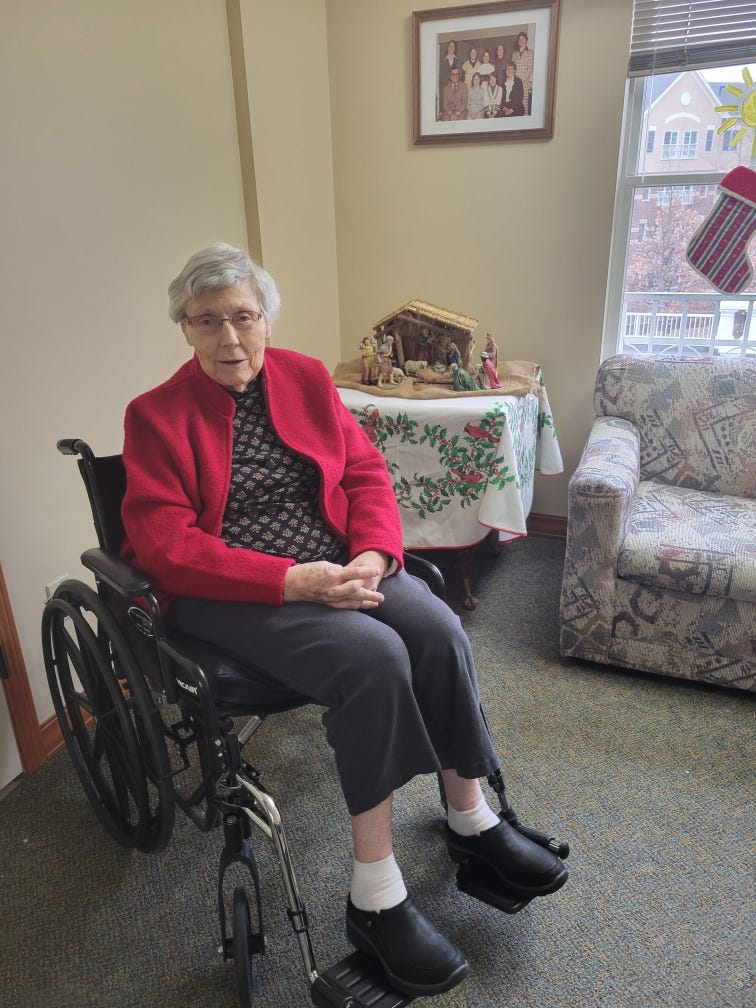
(This is the longer, revised edition, 12 January 2026.) I have been captivated by the thoughtful, insightful, and often brilliant writing on what I will call authentic womanhood versus feminism by such Substack contributors as Elisabeth Stone and Abigail Austin. In fact, after reading Elisabeth Stone’s “Born to Be a Feminist,” especially the part about her grandmother’s “bitterness and poison” about not doing “her own thing” and instead settling down into marriage and family life, I could not help but see the sharp contrast between such a perspective on life compared to that of my mother, whom we only recently buried after she passed away at ninety-six-years of age. I thought it might be profitable to share a smidgeon of my mother’s story. And so I do so on the anniversary of the day she gave birth to me, 12 November 1960, sixty-five years ago. (See “An Authentic Woman II.”) Margaret Mary Costello was born in 1929 in Weaver, Minnesota. Her father, Patrick Edward Costello (Ed) was a hard-working, educated, intelligent, dignified, and devout Irish Catholic, who attended Mass on Sunday and holy days, prayed his rosary daily, and did not drink because he did not like beer and he feared that he might like whiskey too much. Her mother, Vera (nee Odell) was an intelligent, educated, kind, complicated woman, a convert to the Catholic Faith, whose past included some traumatic events that may have contributed to some level of neurosis. Margaret grew up with one sibling, her beloved sister, Pat, (who would also attend the College of St. Catherine on scholarship, become a librarian, and who, though two years younger, would marry three years earlier and also have four daughters and three sons, more about her here). At a young age, Margaret’s teacher walked her home to tell her parents that she should move up a grade. At seventeen she attended a leading Catholic women’s college on an academic scholarship. She graduated with a degree in library science and English and embarked on an eight-year odyssey of work, service, and adventure that many a feminist might have envied. And yet, she never considered herself a feminist. Photographs of Margaret before she became Mom made us wonder at her pitching hay, riding a horse, wearing an Inuit parka in Alaska, standing atop the continental divide, holding a shotgun in one hand and a bird she had bagged in the other. We remember paraphernalia from her former life: a view finder with slide reels of her travels in the west, Mickey Mouse ear hats, an Inuit cup-and-ball game. It was not to prove something that she excelled in academics, edited the newspaper, served as senior class president, enjoyed football, ventured out to the Iron Range, Green Bay, California, and Alaska. She never renounced men, or marriage, or children. She just lived her life with intrepidness, wonder, and faith, hope, and love. In fact, she once told me that she never had any desire to be a feminist because the men in her life had treated her so well. Of course, her unwavering commitment to the Catholic Faith influenced her experience and outlook. She just lived her life with intrepidness, wonder, and faith, hope, and love. At twenty-eight, she settled in Stillwater, Minnesota, where she met Jim Ritzer, also a devout Catholic, whom she married and with whom she raised seven children. What she thought of marriage and family might well be summed up by a conversation I had with her one day upon returning home from kindergarten after I had for the first time met someone—call him Billy—whose parents were divorced. “Billy’s parents are divorced.” “Oh, that’s very sad.” “Would you and Dad ever get divorced?” “No.” “How do you know?” “We took vows.” “Billy’s parents took vows too.” “We meant them.” Any doubts I may have had about the earthly permanence of my parents’ sacramental union were thus dispelled (see also “One Big Family”). Another memory was aroused when my sainted sister Mary was trying to coordinate a day for Mom’s funeral that would accommodate all seven of us siblings and families, especially a sister in Montana who had only recently undergone serious surgery. Mary was concerned about whether there could be an open-casket wake over a month after Mom had died. I said to Mary, “Well, you know Mom’s opinion on the subject.” Mary said, “No, what was it?” So I recounted what my mother (at least half Irish) had opined on the subject when she and I were going to attend a funeral for a relative some forty years or so before: Oh, the Irish and their wakes. They have the casket open and everyone comes up and says, “Doesn’t she look wonderful?” No, she looks dead. Put me in a pine box. Cover it with the lid. Hold the funeral. Put me in the ground and throw dirt over me. This put Mary at ease, though we did hold an open-casket wake and, ironically, Mom did look so wonderful that I and several other people remarked that we thought she would at any moment open her eyes, sit up, and speak to us. Full though her life was, with plenty of joys and wonders, it also involved challenges, sufferings, and heartaches. She had several health challenges and surgeries, including a perforated ulcer that was misdiagnosed for several years as “change of life” that destroyed her duodenum and involved chronic intense pain that took its toll on her and the family until finally discovered and corrected by surgery. (One doctor had said to her, “I don’t know what your problem is; I met your husband and he seems like a nice guy.” She said that if she had not been doubled over, she would have hit him.) She relied on her intrinsic Catholic faith to forge her way through all of it. Margaret was not perfect, as she was well aware. Like the saints, she knew she was a sinner. Margaret was not perfect, as she was well aware. Like the saints, she knew she was a sinner. But she had the courage to give herself in love to God and His Church and, through its Sacrament of Matrimony, to her husband and the family she formed with him (see also “Making Room and the Courage to Love”). Her self-awareness surfaced once, back in the 90s, when I told her about a television program I had seen about the common characteristics of those who live long lives. When I mentioned that one of them was the ability to let things roll off one’s back, she laughed and said something like, “Then, I’m sunk.” And yet she learned well enough to do so that she lived to be ninety-six. Of course, that laugh exposed one of the other longevity traits in which she proved enduringly proficient, exercising a sense of humor. Then there was the matter of patience. Margaret would say of her sister about her dealings with their mother, “Pat has the patience of Job.” Margaret did not, and yet, as Christ, “learned obedience through what he suffered,” she developed great patience in serving husband, children, grandchildren, and friends, which was never more evident than in her caring for her husband, Jim, into her nineties, as he slid ever deeper into the grip of Alzheimer’s disease. A note about the obituary: it mentions that “working full time” was something Margaret did as “an expert multi-tasker.” Of course, she did work full time, but for years that was at home as wife, mother, and homemaker. In addition to that full-time work, she would at times add more work to help make ends meet. Hence, she put her sewing machine to good use altering clothing for a local men’s store. She also sewed many a garment for the family, including not only bridesmaids’ dresses for her daughters but even one daughter’s designer wedding dress based solely upon photos in a magazine. That project caused her enough psychological distress that a son and son-in-law, fresh from (and in the clothing and condition of) a full day of physical labor, in response to the emergency, were reduced to discussing the various body shapes of the daughters with a clerk at a sewing store in the process of buying Margaret, on behalf of all her children, a dress form that would fully meet her stitching needs. As for work… Get full access to P. A. Ritzer at paritzer.substack.com/subscribe
Embed this episode
No transcript yet.