An Authentic Woman II
from P. A. Ritzer Hosted by P. A. Ritzer
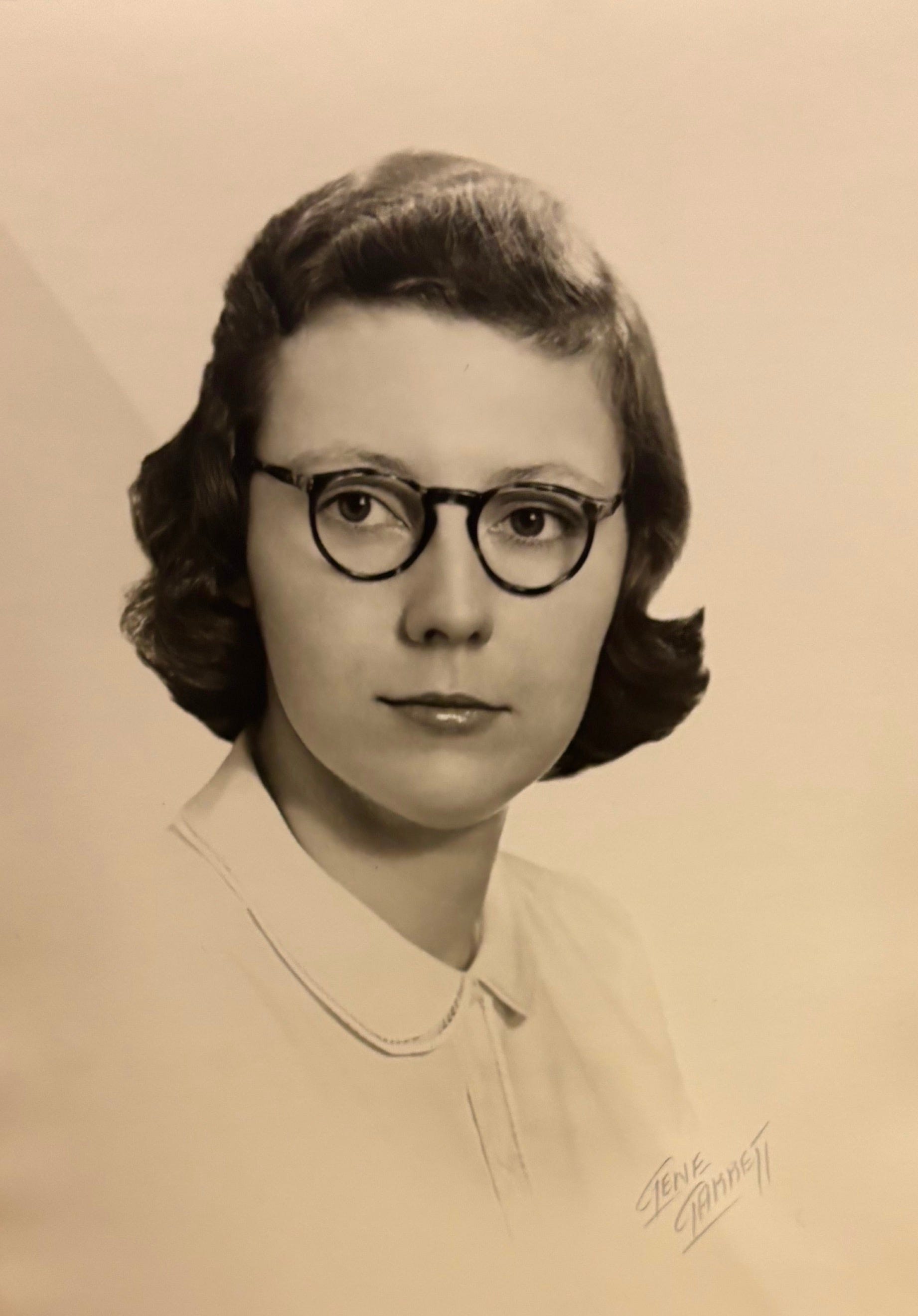
The article “An Authentic Woman,” about my mother, Margaret Mary Costello Ritzer, was so well received that I thought I would share more information about Margaret from photos and articles, displayed at her wake, that my sister had found in a box. Learning things about Mom at her death, in our older ages, that we never knew, gives us an even greater appreciation for her life. Facing the Future All that would be Mom would emerge from the young woman pictured in the splendid black-and-white, college-senior photograph above. Next to the photo in the College of St. Catherine’s 1950 yearbook appeared the following: “As president of the senior class, Margaret is kept busy planning and working. She is on the Executive Board, schedules senior activities, and is a ‘jack-of-all-trades.’ Margaret spends her spare time sewing and avoiding cooking.” That gives rise to a certain fascination. The photo is so singular. It is just her, just Margaret. All alone she gazes into the unknown at the end of her college education, in the process of leaving home and family years before she would join Jim Ritzer in creating their own. Latent lie her intrepid early working years, her marriage, motherhood, grandmotherhood, old age, and passing. Latent too, in a down-to-earth example of marital dying to self, lies the cooking she avoided in her single life, perpetual cooking, of good meals, for a family that would grow to nine people, day in and day out, through a course of decades: no small sacrifice there. All that was to fill, mold, develop, and shape her, and those whose lives she would touch over seventy-six more years on earth, are to the photo’s subject and the surrounding world unknown. Known now to us we can look on that face and wonder. All that was to fill, mold, develop, and shape her, and those whose lives she would touch over seventy-six more years on earth, are to the photo’s subject and the surrounding world unknown. Known now to us we can look on that face and wonder. “What a Gal” It is fascinating to find out from her St. Paul, Minnesota, Harding High School newspaper, the Beacon, article “What a Gal,” of 6 June 1946, how Margaret was viewed by her peers at that time with words like: “modest,” “a tall Irish brownette with a ready smile and quick wit,” “has endeared herself to everyone,” “admirable,” “efficient and charming,” “dependability,” “winning personality,” “intelligence,” “a little shy,” and “a good leader.” We, her children, did not know that Margaret had been named Outstanding Senior Girl (which thrilled her) and Most Likely to Succeed in high school. I was surprised to see how involved she was: “president of the Scribbler’s Club, secretary of the National Honor Society, and editor of the Beacon” (“the greatest thrill in my life”). (That requires a correction to her obituary: the weekly high-school newspaper, of which she was editor in chief, was the Beacon, not Saga. Saga was the yearbook, but she also served on the art and editorial staff of it. Paul Haller—the fellow who possessed the qualities she admired in a boy “a sense of humor, and a nice personality”—was one of the three editors of Saga.) And she was “also a member of the Spanish Club.” We never knew Mom studied Spanish, Latin yes, but not Spanish. Was that to accommodate plans for travel abroad? We do not know. We also did not know that “girl smokers” were “her pet peeve,” especially since she was smoking up to three packs a day (as I remember it) some eleven years later when she quit cold turkey, throwing her cigarettes into the fireplace, at a party at my father’s house, before they were married. She had related many years ago that the girls of her age thought Peter Lawford pretty special. I seem to remember that my dad, more a Jimmy Stewart fan, did not have much time for him. And who was the “big, handsome football player” from Grand Meadow who drew sighs and a smile? Was he the fellow to whom Margaret was engaged to be married when she was seventeen? Was he the “Ralph” whose photograph was in an old locket and who appeared with her in photographs of a formal in her college freshman yearbook? Apparently so. I learned of this earlier engagement decades ago, when she told me that she had been engaged when she was seventeen and had considered relinquishing her scholarship and dropping out of college to get married. She was grateful that her father had discouraged the plan by saying that he thought an education was so important. She added about her father’s advice and her taking it, “Thank God.” This prompted me to ask about her prior fiancé, “Why, was he a bad guy?” “No,” she made clear, “he was a very good man, but he wasn’t your father.” Though thus summarized unceremoniously decades later, the breaking of an engagement could not have been at the time easy, trivial, or devoid of emotion. My father, Jim Ritzer, Margaret would not meet until she was twenty-eight and marry when she was twenty-nine, a fairly advanced age for marriage at that time. Did she ever wonder if she had made the right decision about breaking up her earlier engagement during the intervening single years? She told me once that a priest she had consulted during those years had said that the single life was itself a vocation, which suggested that she had considered that she might never meet the right man to marry. But, of course, she did meet Dad and they were married at St. Michael’s church in Stillwater, Minnesota on 27 December 1958. And because she would marry in Minnesota in December (partly to take advantage of all the beautiful flowers and decorations ornamenting the church during Christmas) she sewed her wedding dress, and her bridesmaids sewed their dresses (green while they held bouquets of red), out of corduroy, providing another example of how, fundamentally traditional though she was, she was never one to be constrained by convention when common sense or practicality recommended a better way. Though thus summarized unceremoniously decades later, the breaking of an engagement could not have been at the time easy, trivial, or devoid of emotion. Patrick Edward (Ed) Costello (born 1889), Margaret’s father who had encouraged her to finish her education rather than drop out and get married, had himself dropped out of the College of Saint Thomas in the early 1900s to start a newspaper, had later received a field commission to lieutenant during World War I, and had been saved from participating in that war when it ended before he shipped out. The crucifix he carried in his rucksack hangs on the wall in the room in which I write this. He had been the “Irish son” (my mother’s term) who had returned to run the family farm for his widowed mother, until she passed away, and then courted and married my grandmother, Vera Odell, when he was thirty-eight in 1927. Vera (born 1895), whose ancestry Margaret traced back to a Matthew Camfield (somewhere down the lineage it was changed to Canfield) in Massachusetts in 1631, had known her share of tragedy. Her father, Herbert (Bert) Odell, a Methodist (if I remember right), had been a professional hypnotist. (His father was Francis Marion Odell, apparently named after the Revolutionary War hero Francis Marion of South Carolina, which I find intriguing considering that I remember some tradition about the Odells coming up from Tennessee at some time, though I know of no record of it.) Bert had also been an alcoholic who had taken “the cure,” which would make one seriously unwell (physically and mentally, as I understood it) should he ever take another drink. Someone encouraged Bert to take that next drink at an Independence Day celebration in 1899, and he went home and shot himself in the head. (I suspect that both Bert and Vera may have been afflicted with Obsessive Compulsive Disorder, unknown at the time. Please pray for his soul.) Vera, not yet four years old, was in the house at the time, and no one k… Get full access to P. A. Ritzer at paritzer.substack.com/subscribe
Embed this episode
No transcript yet.