
Wait, wait, wait, wait. You're listening to Radio Lab. Radio Lab. Sure.
From WNYC. And NPR. Hello there, this is Jim Dickson speaking. Hello, Dr.
Dickson, my name is Soren. I'm the producer for Today. You'll actually be talking to our host, Jad. He's on his way over to the studios right now.
So that's good. Alright, so let's just start the story here. This is a bit of tape we've had for a while. It's just kind of fun.
It'll lead into the story. Hello, Dr. Dickson. Hello there, Jad.
Hi, how are you? I'm very well. Thank you. I'm always pleased to talk about my delightful obsession.
I'm very glad you're here. Hello, Jad. Hi, how are you? I'm very well.
Thank you. I'm always pleased to talk about my delightful obsession. I've had for more than 10 years. I'm led to my marriage to a French lady.
I'm not joking. How does the marriage to the French lady factor in? Ah, well, we met on email. Huh?
A bit like you've got mail, you know. The Hollywood film? Well, I mean my wife was sitting beside me. And she's making signals.
What is it you're saying to you? Can I ask her? Is there any chance we could talk to your wife? Yes.
If you say to my next therapist. Yes. I want to talk to you. Hello.
Hi. Sorry, I am French and my English is not very excellent. Well, you're fantastic. Bonjour.
Bonjour. He mentioned that Utsi was what brought you together. Yes, it's true. I was a teacher, a primary school teacher.
She emailed me some questions about Utsi. Yes. And I answered them to the best of my ability. And shortly after, we were married.
Yes. No kidding. So Utsi is my benefactor, my friend. Okay, so we should introduce ourselves with us.
I'm Jad. I am Robert. This is RadioLab. The podcast.
And so that guy, Jim Dixon, leaves a botanist, called him four years ago to talk about this fellow Utsi. We're going to tell Utsi story in completely in just a second. But there's something in the whole interaction between him and his wife there that just kind of captures how everybody gets when they get into Utsi. They get married, they get obsessed.
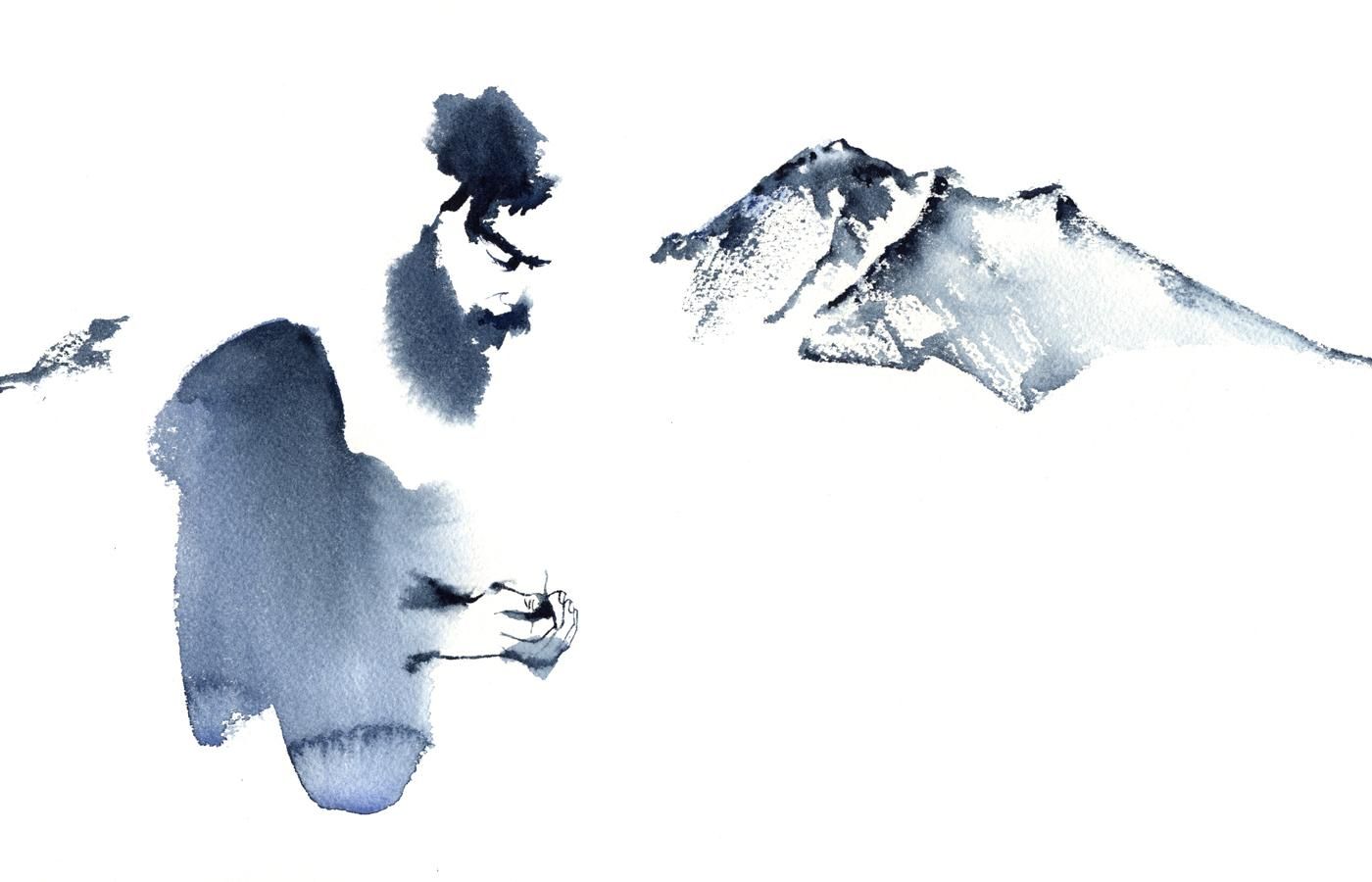
Yeah, but it wasn't until very recently. I produced an animal that I happened to talk to this graphic artist named Aaron Burke, who is also totally obsessed with this guy. Yes. Yeah.
I think there's this hunger on the part of the reason. That's when we really understood what this story is all about. Yeah. At least for me, that's where it all started.
And since Andy's been reporting this piece, why don't Andy, you just take the ball from here. Okay. Do it, Andy. So story starts 1991 way up in the Alps.
This is a frozen glacial spot. And up there walking around. Two hillwalkers. Two hillwalkers hikers.
Hikers. It was a German couple, a man and wife. It was early in the afternoon. And at some point, they take a notion to head off trail.
And there were only 400 yards off the beaten track. And after just a few minutes, they round a little rock. And that's when they were stopped at their tracks. By what?
By a corpse. This corpse sticking out of the ice. He was lying on his stomach. Faced down in the ice.
He was going to drape to her big boulder. His legs are buried under the ice up to his hips. And his top half is just sticking out. His left arm is kind of under his forehead.
Almost like a school boy falling asleep in class on his arm. So these two hikers, they see this and they run off for help. The hot footage to the nearby mountain hut is thinking it was our mountaineering accident. A recent one.
They called the police. They said, hey, somebody, a tourist or a climber had some sort of accident. And so the cops showed up with drills and ice picks and started to chip away at the ice, trying to get the body out. But then they started noticing some things.
Like this guy had all these tattoos. On his back and behind his knees. And then they started noticing all this stuff buried with him. He's got some kind of moccasin, looks like ox skin.
He had a bare skin. Cap. Unusual stuff. He had a copper headed U-half did.
Axe. A what? A small pouch filled with medicinal tree fungus. A beautiful of arrows.
A long bow. He had grass socks. Grass socks. Woven grass.
A dagger that has been chipped out of stone. And so these cops realized. This is not a 20th century tourist who wandered off trail. This was something extraordinary.
This is old. Like Renaissance or old Middle Ages or old? Well, wouldn't we like to know? And what did the police do?
Well, the police reported to the forensic authorities in the University of Enz group. Basically they took it to a team of local scientists who sent samples out to a bunch of labs and eventually confirmed that, yeah, this is old. But not just old. This was really old.
This body is 5,300 years old. Wow. Yes. That's way before Jesus.
Way before most of you would use a historic mark point, let's say, the pyramids of Egypt. This would be 700 years prior to the construction of the pyramid in Giza. It was beyond archaeologists wildest dreams. A 5,200 year old perfectly preserved cops.
We're talking about a man with all his skin, with his eyeballs, his teeth, his tongue, his groin, his organs, his guts. Everything's in there. Everything is almost perfectly freeze-dried. There he is.
So what does it look like? Oh, well. He was bearded. He's 45 years old, which I think for 3,000 BC is pretty darn old.
And he was a small guy. He was only about 5 foot 2 in height. But his calf muscles, his thigh muscles are incredibly developed. Yeah.
So this would suggest that he's a hunter or a shepherd of some kind who walks these mountains. His physique is comparable to modern Olympian wrestler. He was very obviously a human being. Very, very obviously an able to put all the hopes and fears of you and I.
They even gave him a name. Uzzi. Edsy. Uzzi.
Even though some of us can't really pronounce that name. Uzzi. Oh, with two dots on top. Scientists call him Uzzi.
There's all kinds of drama. There's Austria competing with Italy. He's Armami. Oh, he's Armami.
He's on the border. Who's Mummy is eventually the Italian Scotty. Because he said to be 92 meters inside Italy. A whole museum is built around him.
An entire facility is built to freeze him. There's teams of researchers. There's competing universities. You have documentaries.
You have books and articles about this incredible mummy who was walking in the icy fell. Isn't that fascinating? You know, Brad Pitt? Yeah.
He got a tattoo of Uzzi on his arm. Really? But what everyone really wanted to know was... Who was this prehistoric person?
Who was this guy? Where did he come from? Was he a scout? Was he a traveler?
Oh, he died. Was it a storm that took him? I wonder what he's doing so high in the mountains. Yeah.
But when we found him, there really wasn't any way to answer these kinds of questions. All you got was wild speculation. But this is where it becomes more than a story about an ancient dead guy. Over the past 22 years since he's been found, all these researchers keep coming back to Uzzi.
And they've gathered just enough little pieces of evidence that when you put it all together, what you get is this surprisingly intimate look at this one real person, like this one real dude who lived 5,300 years ago. And for our purposes, the first piece of the puzzle falls into place on a summer's day in 2001 when a radiologist named Dr. Paul Gossner is staring at a CT scan. Basically a 3D X-ray of Ozzi's chest.
Maybe for the umpteenth time, for the thousandth time. When suddenly... He notices something unusual. Right up by Ozzi's shoulder blade.
In the left scapula. What does he notice? He finds an arrowhead lodged in the shoulder blade. And I think it was hard to see because it's stone, not metal.
If it was metal, they would have picked it up right away. So is this mean that this is like a possible murder? That's right. The whole thing blows up to a full-scale murder mystery.
From that moment on, we knew that he was shot with an arrow and then it all started the research about it. That's Albert Zincke. He's actually the top scientist in charge of Ozzi these days. What we do is like doing a crime scene investigation.
We try to put together... Not too long after Gossner spotted that arrowhead. Zincke and his team, they take Ozzi. They actually put him into an ambulance.
Russian assess, they can to a hospital, trying to make sure that he doesn't thaw. And they put him into a higher resolution, full-body CT scan. And the plot thickens further. We find severe abdominal wounds and rib fractures.
Things that before may have come across as 5,000 year old wear and tear. There's an orbital fracture of the cranium. Now it's like we're seeing them with new eyes. His head is busted.
And not only that. His right palm is very badly cut. It's very deep. How deep?
It's so deep that there's cuts in the underlying bones. Oh, and some pathologists say it's a defensive wound. A wound that comes from a fight to the head is right hand up and he got slashed on his right palm. And in trying to piece together what happened, one of the questions that scientists like Albert Zincke asked was like, this cut on his hand.
Was it a... Fresh wound of this was already a healing wound. Like how much time it passed between when he got the cut and when he died. Well, we took a little tissue piece out of the wound.
They dehydrated it. They sliced it up with lasers. We made little slices and we have a look at them in the microscope. And they could see evidence that when he died, the blood from this wound was just starting to clot.
But that had not yet formed a scab when he died, which told them that this attack... This must be a wound that happened already three or four days before he died. Which had another question to the list. Like what happened in those last three or four days between the time he got cut and the time he died?
Well, I mean, I think this is the most fascinating thing of all about Uzi. Jim told us luckily for scientists. His intestines are all there. And to the trained eye.
Your intestines. It's like a map. And a diary. A diary.
Yeah, a diary. In what way? If there's any food in your stomach, it's less than four hours old. Which would probably be your last meal.
And the stuff in an intermediate position, like the colon, is between a few hours old and a few days old. Your last few meals. So if you get samples from all these and look at the content, you can digis all sorts of things. Um, but one small problem.
If you've got a 5,000 year old mummy on your hands, you can't exactly just cut him open. So Jim and his team, what they did is they snaked some fancy equipment up his butt and started rooting around. I mean, I didn't do that, you appreciate it. I'm a botanist, I'm not a mate.
Someone else from his team did that. In any case, they got up in there and first of all they couldn't find the stomach. But they did pull out samples from the rest of his guts. And they found...
Pollen. Pollen. Pollen. Actually two kinds of pollen.
One from the fresh flowers of the hot horn bean. Yes. A tree that blooms down in the valley. And conifer pollen.
A second kind of pollen from high altitude evergreen trees. So you've got the high mountain furs. And the deciduous trees of the valley of the low places you've got the horn bean. Both of these kinds of pollen were found in Ozi's gut.
Probably because he drank some water which contained the pollen. And then the horn bean was the king. The pollen from the valley. It's sandwiched in between these two layers of mountain pollen.
And that implies an order. Ozi must have first ingested the pine pollen. Then the horns bean. And then the pine pollen again.
And that suggests. About two days or so before he died. He was high up in the hong. Drinking pollen-lated water.
High above. And then he was very low down below the tree line. Drinking pollen-lated water down below. And then he came back up again.
To meet his end. And so taking all that and a couple other pieces of research. Here is what we think happened to Ozi in his last days. We know that it would have been summertime.
Probably. Probably June. Because that horn bean pollen in his death. Only blooms in the early summertime in June.
And for whatever reason. Maybe he's hunting, maybe he's looking for copper. We don't know. He's high up in the mountains right?
Well above the tree line. And then he goes back down to his village. Which we believe was south of the mountain. Because certain chemicals in the local water were also found in Ozi's teeth and bones.
Anyway, it was not a short walk home. It's all the way down. It's five, six thousand feet we're talking about. Then we know that within the span of about 24 hours.
Something happens in his village. Something violent. Maybe his people were fighting with other people where he got. The details are a little blurry.
But it is clear that he was attacked. That he put his right hand up to defend himself. And that he gets that cut. It's very deep.
It's very bloody. It's very painful. And I'm shortly after that event. He bends down and picks up a clump of vogmos.
Jim actually found that vogmos on Ozi. And he says that it's. It's mildly antiseptic. Anyway, Ozi.
He heads back at the mountain. He goes back up again. Perhaps pursued by somebody or people plural. We think that maybe he was in a hurry.
Because of the 14 arrows. That he was carrying. Only two had flint tips and ferres and the other 12 were useless. Which suggests a frantic state.
I mean you've got a guy who's running, bleeding and he's busily carving his arrows. Carving as he runs in for about a day. Or maybe a day and a half. He's running a lot like he's running a lot like he runs over 12 miles.
That he gets up above 10,000 feet above sea level. Managing to evade whoever it is that's coming after him. But then. The fatal arrow shot.
This is the official report from the South Hyrule Museum of Archaeology. We can see that the point of the arrow to our hole in the artery beneath his left collar bone. Which led to a massive hematoma. It's blood into the thorax cavity.
Which in turn caused cardiac arrest and sudden death. He bled to death. He would have died in less than half an hour. Really he would have died in 20 minutes perhaps.
And according to a lot of researchers. Whoever killed Boatsy. Came over. Pulled the arrow shaft.
Out of Boatsy's back. Picked up a big stone. And bashed his head in. And then.
Within. About an hour. Maybe two. His body would have been completely covered in snow.
And within a month or so that snow would have become ice. And then. When the next summer came around that ice would have thought out just enough to allow a little sunlight to come through. The next winter he would have froze again.
Following summer. Thawed. A little bit. And then froze again.
And then thawed. And here's why that's important. Bodies that are completely frozen. Ditirate.
Those periods of thaw kept him from deteriorating. So he had this perfect mixture throughout all these years. A season of snow. A season of ice.
And then a thaw. And then a snow. And then a nice. And then a thaw.
I mean just think about it. Year in and year out. Throughout the building of the pyramids. The rise and fall of Rome.
The enlightenment. The industrial revolution. All of this time. Not so he was there.
And that spot just a few feet away from where he was murdered. Until 1991. When a couple of German hikers. Decided to.
Head off trail. We have forensic proof of his suffering. We have forensic proof of his hunger. We have forensic evidence that he was cold.
We have all of this undeniable irrefutable forensic evidence that this man was a living human being who was tormented. And was enduring. With incredible tenacity. And in the last few years scientists have still been at it.
They've still been poking it out. See trying to figure out who was this guy. Not just who might have been but who was he really. I think there's a hope that something will be found which will say yes he was a hero.
Yes he was a king. Yes he was a father. I think there's this hunger on the part of the researchers to find something beyond the biology. Beyond the molecular chemistry to find some sense of the humanity.
And in the years since we spoke with Jim Dixon scientists. Did find something. Which for Aaron at least does give him that sense. In 2010.
They found OTC's stomach. Which Jim and his team they couldn't find because it was tucked deep up under his rib cage pressed up against his heart. They find the stomach. And inside.
One and a half pounds of undigested goat meat and bread in his belly. His last meal. This was eaten on the day of his death. Maybe just an hour before he died.
It was a huge feast. And for Aaron imagining OTC sitting at that fire right before he died. That's what did it. Oh I can see it.
He cooked his food. We have proof. He cooked the meat and he sat down. It must have taken time.
It took at least an hour or two. Like I can feel it. I'm in the cave. I'm by the fire.
That's what brought him back. So you're saying then that some hours before he had somehow the time to build a fire. Catch or acquire or carry a fairly substantial meal and sit and eat it. Somewhat at rest.
So he must not have known what was coming. Well he might maybe he knew. Maybe he had found some kind of resolution around it. But we have forensic proof.
That for this brief moment in time. The Alpine Iceman felt safe. He was a very good person. And we have forensic proof.
That for this brief moment in time. The Alpine Iceman felt safe enough to just do his meat and his bread and sit by the fire and eat his dinner. Before we go to brief notes first Robert and Jad will be back from our live show tour by our next podcast and if you want to see them this week in either Portland or Seattle go to our website radiolab.org. Second a friend of the show a novelist named Stefan Bloch he heard about this guy OTC got obsessed.
But unlike Brad Pitt instead of getting a tattoo he wrote a fictional piece that tries to answer some of those remaining questions like why was OTC pursued? Who was after him? We'll soon be able to find that piece along with a lot of other great stuff on our website radiolab.org and of course thanks for listening. This is Bonnie Colley from Boston Massachusetts.
Radio Lab is supported in part by the National Science Foundation and by the Alfred P. Sloan Foundation, enhancing public understanding of science and technology in the modern world. More information about Sloan at www.sloane.org.