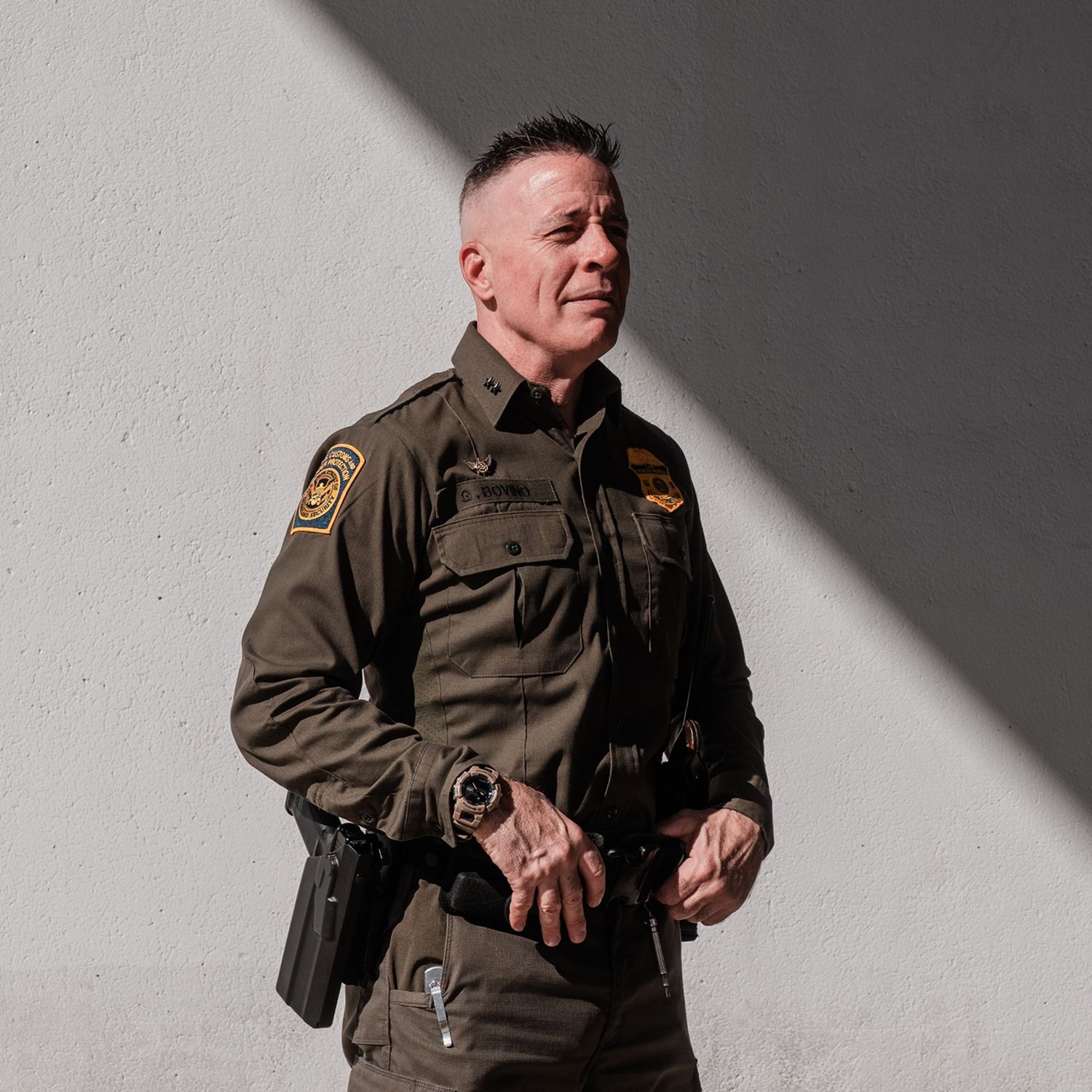
From the New York Times, I'm Natalie Kittroweff. This is The Daily. What is he being pulled over for? There's a child! As the Trump administration ramps up its crackdown on illegal immigration, it's turned to one agency and one man officials believe can help them dramatically increase deportations. Border Patrol Chief Greg Bovino. Arrest as many people that touch you as you want to. Those are the general orders. He's the law enforcement figure who's now at the center of the most aggressive raids and tactics being employed in American cities. Why are your officers asking me where I'm from? I thought you were doing targeted arrests. Today, my colleague Hamed Ali Aziz speaks to Bovino and explains why his militaristic approach may be here to stay.
It's Wednesday, November 12th. Hamid, we're now almost 10 months into the Trump administration's crackdown on immigration. And over the course of that period, you've come on the show at several points. And you've told us that despite all of the videos that we're seeing of these ICE raids and these arrests and these very aggressive enforcement tactics, the administration is actually frustrated internally with the pace, the slow pace they see of deportations. And you've been reporting recently on the changes that they are making to try to address that. So let's start there. Walk me through that.
Yeah, the Trump administration, when they came in, they promised mass deportations. And as part of that, there was this massive push earlier this year to arrest 3,000 people a day. That was the goal. And ICE has gone nowhere near that goal. Across the country, typically, ICE on a weekday is averaging around 1,300 arrests. And because of the inability to get these numbers, there have been constant changes at ICE. And not just recently, but throughout the year. They've replaced their director. They've replaced multiple senior officials.
And a couple weeks ago, they got rid of almost half of the senior leaders across the country. Just to drill down here for a second, what is it that the administration is actually taking issue with? What are these leaders doing wrong, according to the administration? I think one of the main issues here is that the way ICE has historically conducted immigration enforcement is really time intensive. What ICE does, they spend a long time surveilling a single individual. They send out several people to go arrest that person. Sometimes that person's not there.
So there's so many resources. There's so much time just to get a small number of people. And right now, the administration and DHS and ICE is running into really kind of an inherent issue with the way ICE does its work. It sounds like you're saying they see ICE as actually too methodical, which honestly is sort of hard to square with the images that we've seen of these agents tackling people, slamming people to the ground, breaking families up. But then again, we did talk to you a couple months ago about an ICE raid that you and one of our producers went on. And that was this big day-long raid where they only detained three people.
Yeah, I mean, there have been countless videos. You see ICE smashing windows to get people. We've seen officer-involved shootings involving ICE. There are these really dramatic videos of ICE conducting immigration sweeps in the country. But for ICE, that's the type of drama that they want to avoid. Typically, what they want to do is they want to secure the scene. They want to get in and out. And they take a lot of pride in conducting their immigration enforcement in this manner. But, of course, to pull off a smooth raid, it takes time and planning, and the agents have to be meticulous in the lead-up.
And as far as the administration is concerned, time is something that ICE just doesn't have. So they've looked to another agency, and that's Border Patrol. Border Patrol typically operates near the southern border. They are in charge of stopping people who cross into the country illegally. And they're more willing to be in your face, to be more militaristic in many ways. And they're very aggressive in their approach. And they've been really behind.
Some of the videos that have gone viral, including, you know, people being chased at Home Depots, raids on apartment buildings, people being arrested at car washes. These are Border Patrol, not ICE. And now the administration wants them to do more and to be really at the forefront of immigration enforcement in the United States. And the guy that's overseeing all of this, the person who is the commander of this operation, is a guy named Greg Bivino. Hey, Chief, how are you? I'm doing good. How are you doing? I'm doing well. So I recently spoke with him to understand his career.
where he came from, and why he's been empowered by the Trump administration. And when you hear his story, it's pretty clear that his whole career has been leading up to this point. And where does that story start for him? Well, really at a young age, he's somebody who was drawn to the agency through books, through film. I'm not going to be telling you anything you don't know.
The game's a little different around here. In fact, he had a distant relative. He calls him an uncle, who was a producer in Hollywood. Never knew him, but he produced a movie called The Border with Jack Nicholson. The Border. It divided the land. It divided the man.
And I remember, I believe I was approximately eight, nine years old. And my parents took me to see that movie because Uncle Neil produced it. It was kind of a big deal from back in rural North Carolina to see something like that. You're killing drivers. Don't tell me I don't know what I'm talking about. I don't know what I'm talking about. Where's the driver you took in there today? So we went and watched it. See this line? This line right here I don't cross. This line right here.
It got me interested in the Border Patrol from an early age. And I juxtaposed that against the many authors from the 70s and 80s that were from the Border Patrol. I think he was inspired by an agency in which people are overseeing these vast swaths of land. They're by themselves. The extreme amount of violence that those Border Patrol agents, or they were called inspectors back then, were up against. And it struck me, wow, that was a pretty tough organization to be out there alone with no backup. And I began to realize that that thing called the U.S. Border Patrol was probably something pretty special. So I kept it in mind through the years and when I had the opportunity.
I put my application in and was accepted, and the rest is history. And he joins the agency in 1996, and he starts at the El Centro sector, this area near the southern border in California. You know, when I started there in El Centro, it was just open desert between the United States and Mexico. And I remember the amount of what we would call a drive-through. That's when someone takes a vehicle and drives across the border, whether it's with a load of illegal aliens or a load of narcotics. That was quite rampant back in the day there 30 years ago.
And pretty quickly, he's almost put into the scenario that he imagined as a young man, you know, this area that's vast swaths of land. There's not a lot of agents out there. It's oftentimes agents by themselves. And so he's out there doing the work that he romanticized as a young man, arresting human smugglers, arresting migrants crossing the country illegally, and really being thrust into these intense scenarios that just years before he was reading in books. And from there, he was able to rise up in the agency, take on leadership roles across the country, including in New Orleans. And ultimately, in 2020, toward the end of the first Trump administration, he returns to El Centro, and he takes over as Border Patrol agent in charge. Well, being able to return where I started, that was pretty special. So there was one area at the border that I thought I knew quite well. And once I got down there, I couldn't even recognize it. It was almost unrecognizable. So I noticed there was a lot more infrastructure. President Trump had put the new wall in, the 30-foot wall. There's now a wall. There are roads.
the technology, the improvements that were made there under President Trump's administration. So that's something I noticed is a much more secure border. And perhaps most consequentially, the policies are much different. The Trump administration at this time in 2020 has enacted a sweeping border policy that allows agents to quickly turn back people, deport them without any process or access to asylum. We finally got what we were asking for. It's like they finally listened to the Border Patrol. And of course, this was in the administration's reasoning.
as a result of protecting the American public from the spread of COVID. Right. This was Title 42, the measure that allowed them to immediately deport people who tried to cross the border because of the public health emergency. Exactly. So it sounds like Bovino is excited by the Trump administration's full-throated approach to enforcement. How does he experience Biden coming to office? He was not a fan. It was like turning a light switch on and off. In this case, it was like turning the light switch off.
We went back to the dark ages. So during the Biden administration, it's important to note that the Biden administration continued to use Title 42 during the early years. But one thing that happened was I remember the order was given there from that leadership in D.C. It was about throughput and decompression. There were so many people crossing the border that one of the strategies the administration took was to, quote unquote, decompress their border facilities. In other words, to release people into the country with immigration court hearings or with notices to go see ICE.
And so during that process, many people, hundreds of thousands of people, were allowed into the country after they had just crossed illegally. And it's just a massive onrush of millions of illegal aliens. You realize that, you know, a policy like that, how damaging that can be and how much work it could undo. It undid a lot of work, decades of work, all in a 24-hour period, basically. And that's all it took. And for Border Patrol, that was really demoralizing and upsetting. And Greg Bovino really kind of embodies that. Right. We both actually covered this at the time, Hamid. I was covering this from the Mexican side of the border as a foreign correspondent. You were in the U.S. Bovino describes what he calls a totally open border.
That is an oversimplification. But it's true that we saw a more porous border under Biden. And there was this huge influx of people. And rather than turning all of them away, there was this release into the country of many of these people. Yeah, I think that's right. I mean, I think during the Biden years, there was not an open border. There were certainly people who were crossing illegally and being turned back.
During that time, there were so many people crossing that many people got through. And for other migrants, there was this kind of idea, there was a message being sent that the Biden administration wasn't going to go to the lengths that the Trump administration was willing to go to. To stop them from entering. Exactly. And as a result of that, you started to see hundreds of thousands of people crossing and willing to take the risk of potentially being deported because they knew there was a good chance that they wouldn't be and they would be allowed into the United States.
So here's Bovino. He's on the forefront of this in many ways. He's right on the border. And he's saying the Biden administration is asking his agency to do the opposite of its mission. So how does he respond to that? Yeah, for him, he feels like he's not going to go along with what's happening in other parts of the border. He's going to try his own approach in his area. One of the things we did in El Centro sector is we didn't do throughput and decompression. We continue to give consequences to those who have come across the border. And one of the interesting things is when you do provide a consequence to an illegal alien that comes across the border, guess what?
They don't want to cross the border where you're providing consequences. So despite what he sees as the Biden administration's stance of releasing migrants into the United States, he says that in his sector, they kept on turning back migrants at the border and deporting them. And toward the end of that time, as he's getting more and more frustrated with the Biden administration's policies alongside other Border Patrol agents who felt the same, he decides to amp things up even more. What does he do? In January of this year, in the final weeks of the Biden presidency, he conducts this sweeping operation in the Central Valley of California. Operation Return to Sender. So Return to Sender was there in Bakersfield. CBP stationed over 60 agents in and around Kern County. This is an area that is really vibrant with farm workers, many people from Latino backgrounds. And so he decides to send his Border Patrol agents there.
Arresting 78 people whom they said were illegally in the U.S. from Peru. And pretty quickly, there are these scenes that immigrant advocates at the ACLU are reporting back. You know, farm workers were in vans, driving to work, pulled over, stopped and arrested. The alleged crimes spanned from child molestation to drugs and narcotic seizures to DUI convictions, vandalism, burglary and domestic violence. People at Home Depot stopped and arrested. I went out yesterday to two stores in Arvin and they were all...
People who have status of some sort, including U.S. citizens, briefly detained. What we're hearing is that the CVP pulling cars over and profiling folks. And we went to Bakersfield because of what we had seen there coming from the border, where it was going to, where these smuggling networks were smuggling. And it certainly opened our eyes to the need for interior enforcement, whether it's attacking the smuggling networks going to and through Bakersfield or...
There are a couple of things that are worth pausing to talk about here. First of all, the tactics that he's using in this operation. Pulling people over on their drives to work, sweeping up some American citizens in the process. That's a real escalation from what we were seeing at the time. But maybe just as important is where this operation is happening. It's not at the border. He's going into the interior of the country. And I'm wondering if you see this as a test where Bovino is starting to expand the idea of where the Border Patrol does its work.
Yes, definitely. I think for them, it's the idea here is border enforcement doesn't stop at the border. People who cross illegally into this country, we're going to find them wherever they are. How unusual is that, Hamid? Because I've only interacted with Border Patrol at the border. Is it something they've done before to go into the interior and do their work that way? Yeah, I mean, there have been arrests of human smugglers, you know, one-off events. Border Patrol has helped in the past. But this type of operation in which they are acting as...
essentially ICE officers. That type of thing is very unusual. That is something that I have not seen in my years of covering immigration. And so what's the reaction? Like, is there fallout? What happens? Yeah, definitely. You know, community members are upset. Immigrant advocates and lawyers are upset. And pretty quickly, the ACLU files a lawsuit calling out the work of Greg Bivino and his agents, basically saying that...
They were stopping people at random and arresting them without the level of reasonable suspicion that is needed to talk to them and to ultimately later to arrest them. They believe that this was a sweeping operation targeting farm workers based on their appearance. And a federal court judge found that Border Patrol and Greg Bovino had actually violated the law and the way they operated in California's Central Valley. But despite that, Bovino sees that operation as a clear success. And it was a kind of test case.
for what it would look like if Border Patrol agents actually went into the interior of the United States and arrested immigrants. Do you think at the time, despite the questions over the legality of the operation, Bovino might have seen Return to Sender as a model for the incoming Trump administration for how they might want to carry out enforcement? We don't know exactly, but it's pretty clear that Bovino feels like this is the right way to handle immigration enforcement. This kind of no apologies, going into communities, rounding up people, and operating really aggressively in public spaces is exactly the kind of thing that really President Trump promised. in his campaign. And this summer, as they're really trying to pick up their mass deportation effort, they turn to Greg Bovino and appoint him as tactical commander. We already had the model down. We already knew what we were doing. And once we started, that good work spoke for itself. And essentially unleash him on American cities. We'll be right back.
Today, Harvey, the AI platform for legal work, is writing the next chapter. More than 200,000 lawyers are building with Harvey, accelerating review, sharpening negotiations, and more. This is how the future of agreements is being crafted now. Harvey. Learn more at Harvey.ai.
Harvey does not provide legal advice. Users should always independently review and verify any output from Harvey. Hey, it's Anna Martin from the New York Times. Wherever you get your podcasts. You've heard that line before, right? Wherever you get your podcasts. Wherever you get your podcasts. Of course you have. But what if I told you you never have to hear that line ever again?
You know what? You caught me. I actually can't tell you that. But I can tell you somewhere I think you might want to go. It's the show's tab in the New York Times app. You can find full episodes of The Ezra Klein Show, The Interview, Modern Love, The Daily, new and classic episodes from Serial, and so much more. So much to listen to and watch. I think that's really special. I did this interview once on Modern Love with the actor Andrew Garfield. He was reading an essay and suddenly he was moved to tears. And when you watch the video, you feel like a part of it. The show's tab. Find it wherever you get your... Just kidding. It's in the New York Times app. Explore the show's tab and follow a show today.
You said the administration turned to Bovino as it was ramping up its immigration enforcement. What did it look like? Yeah, it starts in L.A. If you recall, in early June, ICE does this operation in downtown Los Angeles. You start to see people being chased by Border Patrol agents in the parking lots of Home Depots. Car washes are another main area for Border Patrol agents to arrest immigrants. You see food stands on the street.
Suddenly, there are all these videos coming out of Los Angeles. Showing a really almost chaotic immigration sweep. It unleashes mass protests. President Trump sends a National Guard. It's this really intense period where the administration is saying, we're not going to back off. We're going to do immigration enforcement anywhere.
And by we, it really means Greg Bovino, who's overseeing the operation. What did the secretary tell you when she appointed you to this job? What did she tell you about what she expected? We want you to make a difference. We want you to attack those smuggling routes and remove some of these really bad people and bad things from Los Angeles. Go. This is the Trump administration saying, do this every single day in one of the biggest cities in America.
And what does Bovino say about the huge outcry that these tactics elicited? I mean, we remember the backlash, the protests, the anger, and the sense that a lot of people had that these raids just didn't have a lot of order to them, that they're these sweeping operations kind of targeting people seemingly at random. You know, for him, there is no equivocation. Can you walk me through how you do it, how you pick your targets, how you go about arresting people? Because I think the criticism is that it appears kind of random. Can you talk through how you go about picking up people at Home Depot?
Sure. Hamad, I'm not going to go too much into the tactics, but even before we go to a city, we gather intelligence from many different means. Let's just say that. So we already know that there are bad people, bad things in certain locations. We're going there. We gather intelligence. Bovino says that they are operating on intelligence, that they are targeting people based on their own surveillance. And as far as whether or not it's random. Now, if there are other individuals there, they're going to get arrested also. If you're an illegal alien, you're going to get arrested. He says that if there are other people in the area that we believe are undocumented, they will be arrested as well.
This is what is often referred to as collaterals, right? Exactly. These are people who are around targets of an immigration operation. And when you go to a Home Depot, when you go to a public place where there are a lot of people, the prospect of getting more collateral arrests goes way up. And as part of that, you're going to have the potential to get more numbers, to arrest more people, and go towards that goal that the administration has strived toward, which is 3,000 arrests a day. Right.
For the Trump administration, it's kind of easy to see the appeal of Bovino's approach, especially compared to ICE's more directed version of enforcement. By going into big public areas instead of a single person's home, it's more likely that you're going to detain a bunch of people. Maybe they're people that you weren't originally looking for, but that might help the administration meet its goal of working to deport as many people as possible. So my question is, how exactly does Border Patrol decide who to stop when they're there? What's the criteria they use? Well, the way he describes it to me is a process.
called reasonable suspicion. That reasonable suspicion is below probable cause. Many of your viewers probably understand what probable cause is. Reasonable suspicion is an even lower standard. So to get that reasonable suspicion, we look at things called articulable facts. And someone's ethnicity is naturally an articulable fact as well. It could be, but that's a case-by-case basis, Hamad. There's not a blanket articulable fact sheet that we're going to look and say, well, you know what? That guy's got all these or that girl's got all these and go get them. Basically, immigration officers must have a reasonable suspicion that somebody's in the country illegally to be able to stop them and question them.
about their status. But it's the basis for that reasonable suspicion that has led to allegations that Border Patrol agents in Los Angeles have racially profiled people. That's something that Greg Bovino and the U.S. Border Patrol disputed. We're not looking at any one thing. We like the compendium of facts. We like a lot of different facts put together, the outward-facing characteristics of an individual. Do they turn and run? Is that an articulable fact? So let's say you're at a Home Depot and you've got the criminals that you've targeted, you're arresting, and then next to them are people who apparently appear to be Latino, they speak Spanish. Would that be enough to kind of start questioning and figuring out?
whether or not to arrest them? Yeah. I talked to, and our agents talked to people that are, as you say, Latino or speak Spanish every day. And a lot of those folks are legal permanent residents. They have legal documents. It happens all the time. Not a big deal to us if someone speaks Spanish. I speak Spanish, not the greatest. His contention, his main thing to push back on that is this idea that the idea of just speaking Spanish is not enough for them to arrest somebody. He points to, hey, we've arrested people from Europe, including from Poland. So we're not racially profiling in the way that people are saying that we do. I can't speak Polish, but guess what I can do?
I can gather those needed legal articulable facts to put together that that individual is an illegal alien from Poland. What do you make of that response, Hamid? Because when you hear that Border Patrol agents are showing up at a Home Depot and picking people up because they look Latino, it's hard to see how that isn't profiling. And of course, we're hearing that the people they're picking up are often Latino citizens of the United States. Yeah, I mean, the reality is that in the arrests that we've seen in Los Angeles and elsewhere, they are picking up people oftentimes who are Latino. And these core questions of when and where Border Patrol and immigration enforcement agents can make arrests went all the way to the Supreme Court. And tell us what happened there. So a federal court judge had limited the way Department of Homeland Security could operate in Los Angeles. But the Supreme Court blocked that order temporarily. And in his opinion, Justice Kavanaugh said that it wasn't the role of the federal court judge to tell.
the government, what it could and could not do when it came to immigration enforcement. And in fact, Kavanaugh said that immigration officers can use ethnicity at least as a factor in the decision to stop someone on the streets. And of course, I think this ruling really kind of emboldened the Department of Homeland Security and Greg Bovino to continue with their actions in Los Angeles and elsewhere. This is Kavanaugh basically agreeing with Bovino's argument that ethnicity is a legitimate factor that can be used as agents are out there deciding who to question on the streets. So...
Bovino gets this legal validation from the highest court, at least temporarily. He's got the administration's backing. What does he do with that? Well, of course, they continue going hard in Los Angeles, hitting home depots and car washes. But the Trump administration decides it's time for Bovino and his agents to go from Los Angeles to Chicago, where they take things up a level.
It's hard to see, but there's a helicopter right there on this building. Early on in their time in Chicago in September, they do this operation unlike anything I've ever seen before. And that helicopter has just inserted snipers for the protection of all these federal agents you can see entering the building. Hundreds of agents surround an apartment complex. They film a video showing agents rappelling down from a helicopter, you know, bright spotlights. It really looks like an action movie, something like a Michael Bay film. This is Bovino having his Hollywood moment. Exactly.
But that operation engenders a huge response as well, right? I mean, this was something people saw as particularly cruel. I remember the images. There were people, children, pulled out of their homes in the middle of the night. How does Bovino see this operation? He's very proud of it. That was a highly successful operation, Hamad. Remember, there was a lot of American citizens in that apartment building that were being preyed upon by violent gang members. So I'm very extremely proud of that large scale of an operation. He sees the operation as one in which they got rid of bad people.
And this is exactly the type of work that they should be doing. This was a success. Kudos to the agents there. They made that part of the city a safer place. And I think a lot of folks would agree there with that. And was it a success, actually? Like, what do we know about that? Yeah. So like we talked about before with collateral arrests that happened here, in some of the reporting that I've done, I found at least a few of the people who were arrested had no criminal background. There were families who were arrested as well. But the administration has not, in a month since, given us any breakdown or any details.
of what happened and the individuals who were detained. So I think this operation in many ways symbolizes the immigration debate in the country. For one portion of the country, this was an overreach. Law enforcement agents rappelling down from helicopters, arresting a bunch of people at random at times, completely inappropriate. Whereas for Bovino and supporters of the Trump administration, this is exactly what should happen. Ultimately, if you're in the country illegally and you're arrested, that's the exact thing that should happen.
Yeah, this is very much in line with the White House's policy of zero tolerance. You know, if you committed the crime of crossing the border illegally, the administration is going to go after you. And they say, look, this is what people voted for. Bovino is just following through on that. Yeah, Bavino, DHS, ICE, the administration, when they're talking about their crackdown immigration, at the forefront, they want to talk about people with criminal records. But when you point to people who don't have criminal records, they say, well, those people crossed illegally and they're in the country without any form of status. They should be arrested as well. There's no forgiveness. And what about any legal challenges to these tactics? Where are the courts on this today?
Yeah, there are lawsuits in Illinois right now over the use of force by Border Patrol agents there, which has really been a hallmark of their operation. Bivino was recently actually called to testify in that case, where a judge seems particularly skeptical that... It was necessary for agents to use force on the streets during their operations. I think by the end of the year, we should expect that the Supreme Court will weigh in one way or another on Border Patrol's tactics. And in the meantime, I think for Bovino and DHS, they believe what they're doing is completely appropriate and necessary. Do you ever worry that you're going too far, that people are saying, you know, the descriptions of the operations you're doing, some of the use of force? Do you ever worry about any excess enforcement? Does that ever come into your mind? No, it doesn't, because especially there's inner city residents here in Chicago.
who have been silenced, been silenced by the Governor Pritzers and the Mayor Johnsons, those inner city residents come out and say, please stay, please do more. So he's claimed that he's been stopped by residents in Los Angeles and Chicago who've said they support what he's doing. And he believes that the people who are opposed, who are protesting, they're actually in the minority. What we do know is that his approach is fully in line with what the Trump administration wants. The leadership at the Secretary Noem, the Trump administration, President Trump, have you heard that people are supportive and happy with the work that you're doing in the country?
Well, that leadership you're talking about, I call that the leadership dream team. That light switch that I said went off during the last administration went back on on this administration, except when it went on, it's so bright that I have to put sunglasses on just to even see now. And so I asked him, you know, is this operation, are you going to take it to other cities? That's the million dollar question here. That's the million dollar question. All I can say is stay tuned. And, you know, he was a little bit coy, but it certainly seemed like, yes. And they seem to be appreciative. We're in lockstep with Ma and Pa America, with the taxpayer. And thank you for having me here on the podcast.
Thank you so much for your time. I really appreciate it. Have a great day. Let's do it again. Thank you. OK, I hear the argument that he's making, but that does seem to be in conflict with all this public polling that we're starting to see that gets at the response to these tactics. Because while the administration has empowered Bovino, there are growing signs that many voters really don't like these methods. Yes, they might support deportations, but they're not necessarily in favor of this approach, these aggressive scenes that we're seeing play out, especially in Chicago.
And so I wonder if you think there's any risk politically here for Trump and his administration in doubling down on Bovino and his style. Yeah, I mean, we recently saw the president go on 60 Minutes and say that, in fact, agents aren't going far enough. So certainly for him, it seems like he's supportive of a more aggressive approach. But you're right. I think how this plays out with voters is going to be key. We'll probably see some of that in the midterm election next year because these images are everywhere. We're seeing them on a daily basis.
So until something changes, either in the courts or through an election, I think Bavino's style and his influence is only going to grow. And I mentioned earlier some vacancies within ICE, them replacing some senior leaders inside the agency and across the country. In fact, some of those people have been replaced with ex-CBP officials. So officials who worked at the agency that oversees the Border Patrol are now being put in a position to lead ICE. Do you, Hamid, take that as a signal that what you described as ICE's more considered approach, more methodical approach?
is on the way out. What are the implications of that? Well, it's unclear right now, but one thing I think is for sure, which is that ICE is under pressure to deliver more results. The Trump administration wants more arrests. They want more deportations. So ICE is on notice. But I think as a result, there could be increased violence and confrontation in cities between protesters and the federal government. Well, Hamid, thanks so much. Thank you for having me.
On Tuesday, The Times reported that Border Patrol officials, led by Bovino, are expected to soon leave Chicago and move their operations to Charlotte and New Orleans. We'll be right back. Hi, this is Carolyn Ryan, managing editor of The New York Times. At The Times, we strive to help everyone stay informed. And at this critical moment, we're making all of our election coverage free in our app. This election has been an expansive battleground map. States that haven't been in play before are suddenly competitive. We have more than 100 reporters out there talking to voters. I wonder if I can just call Will to get the actual numbers.
Hey, how are you? How many voter interviews do you think we've done? Our plan is to talk to 30,000 voters this year. Okay, you're awesome. Thank you very much. Thank you. Don't you love the New York Times? On election night, we are the place to go for race results. Our maps are updated minute by minute. Our data team can show you what votes have come in, what votes are yet to be counted, and how that might affect the overall results. Come experience all of our election coverage for free right now in the New York Times app. Here's what else you should know today. On Tuesday, the U.S. Navy's biggest and most advanced aircraft carrier moved into the Caribbean region.
The move represented a substantial escalation of U.S. military might as the Trump administration weighs taking military steps aimed at ousting Venezuelan President Nicolas Maduro. News of the arrival of the carrier, called the Gerald R. Ford, came a day after Defense Secretary Pete Hegseth announced that six more people had been killed in strikes on boats that he said were smuggling drugs in the eastern Pacific Ocean. Those attacks raised the death toll in the campaign to 76 people since September.
The presence of the Ford, alongside three missile-firing Navy destroyers, brings the total number of military personnel in the region to more than 15,000, making it the largest U.S. buildup in the area in decades. Today's episode was produced by Carlos Prieto, Stella Tan, and Muj Zady. It was edited by Rachel Quester, Liz O'Balen, and Michael Benoit. Research help by Susan Lee. Contains music by Dan Powell and Marion Lozano. And was engineered by Alyssa Mosley. That's it for The Daily. I'm Natalie Kittroweck. See you tomorrow.
I'm MJ Franklin, and this week on the Book Review Podcast, Switzy by Emma Klein. Hands down, the novel with the most impressive control I've read this year. Someone is losing their mind, and they're approaching their death. Completely moving, elegantly written. I just got lost in the prose of it, which sometimes feels like poetry to me. What does a life add up to? What does it all mean? Listen to the Book Review wherever you get your podcasts.