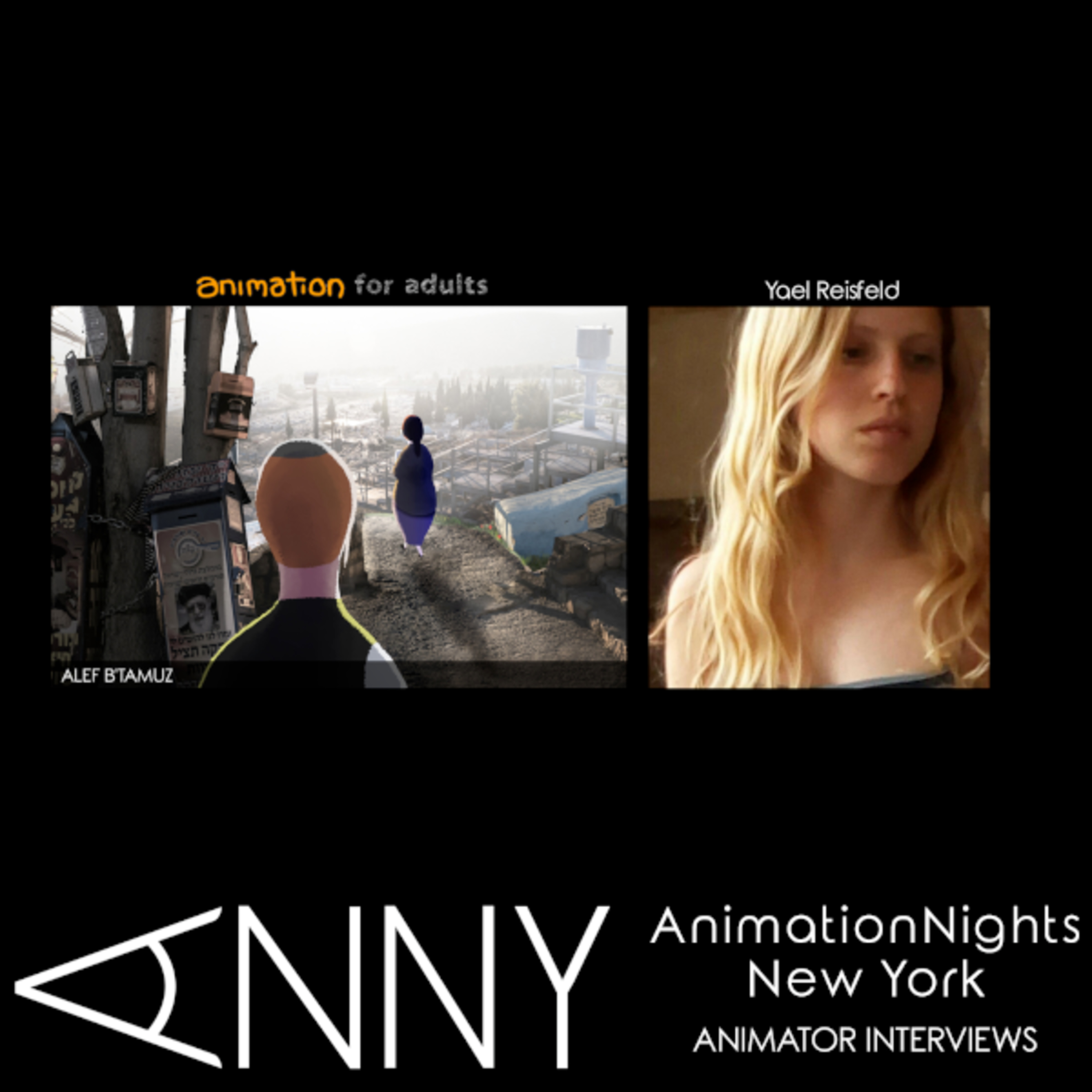
Welcome to another episode of Animator Interviews. My name is Evan Vernon. I'm a contributor at Animation for Adults, as well as Animation Nights New York, also known as Annie. For those new to Annie, we are a monthly screening event and yearly festival that celebrates the very best in animation talent. Our artists come from all across the globe, and many have had their work featured at Cannes, Annecy, and other prominent festivals. We receive hundreds of submissions each year, and each year we screen just 20 at our annual BestaFest. Today we're joined by one of those 20. Yo Reisfeld is with me now.
Yale is an Israeli director who graduated from the Bezalel Academy of Art and Design and currently works as a freelance animator. Yale's thesis film, Aleph Bitzemuz, follows three pilgrims who travel to Sfat, a Jewish cemetery renowned for its supernatural powers. The pilgrims prey on the graves of Sfat to get help with their life problems, hoping that the ghosts underneath will hear their cries. The ghosts answer, but not in a way the pilgrims expect. What follows is a night of dance, flight, and possession that will rock Sfat to the core.
Dizzying, surreal, and visually unique, A Left Beat to Moose is a proud addition to this year's Best of Fest. Today, Yale has kindly agreed to discuss this film and chat a bit about her career. Today's interview is also public and open to audience questions. We will address all of those as they come in. Yale, thanks for being here. I'll start with the same question we ask all of our artists. What got you into animation?
I guess Ren and Stimpy is the point where as a very small kid, I saw this show, Ren and Stimpy, and this disgusting thing. I was just obsessed with it so much, and this is what I want to do. So that was the key moment. Yeah, and then I started life itself and did some boring job that I wanted to die. So I just left it and went to animation. Yeah. No, thank you for giving us some context there. It's interesting you mentioned Ren and Stimpy, a very surreal program and kind of contentious given the history of its director, but memorable nonetheless. And you can kind of see that surrealist style in your own work. Was there anything specifically about animation as...
a storytelling device that kind of attracted you to that? Because there are different ways to become an artist, right? And to tell stories, you can paint, you can, you know, just draw or take photographs, but you chose to do the hardest of them all, which is animating. So why animation specifically? I think I'm also like into music. I play piano and like to improvise. There's something about the timeline, you know, like the, I'm also like visual artists. I always, you know, drew and so on, but I was always on both like music and visual arts. So I found that this is the, like.
place where they meet in the most amazing way. And yeah, just like a nerd that likes animation. You said a lot right there. The wonderful thing about animation and just filmmaking in general is that you can marry different mediums, right? And, you know, music features very prominently in your film, the one that we're discussing today, but it's not something that you can really integrate with a still drawing or photograph or painting. So well said, Yael. Thank you for kind of explaining.
You attended the Bezalel Academy of Art and Design, which is a very prestigious academic institution in Israel. We've had a lot of artists from Bezalel come through Annie's doors. Tell us a bit about this film, Alaf B. Tammuz. Where did this story come from? I understand it was a documentary. What inspired you to create this work? So, yes.
um it's not really like a documentary it's it started off as wanting to make a documentary but if like it didn't happen the things that happen in the film uh but it's based on like documentary uh shots of the place and of characters that i've seen there uh that i documented there for myself uh what inspired it it's okay i'll try to make it like okay what's why did i do this um so my family yeah i don't remember uh my family from my mother's side uh they come from this place spot which is a very very weird place it's a very old city in on a mountain in the galilee and um everybody's crazy there like it's just it's hard to explain if you haven't been there but everybody's very like in spiritual places and um also my uncle uh that passed away recently was uh schizophrenic and he used to live in my grandmother's uh like house outside there was like a room where he lived there and um as a kid i was very like it was kind of like i used to come over in the summers and help her take care of him and give him pills and like this whole atmosphere of being in the summer as a kid in this place um
was very psychedelic and it went into like my dreams i have this whole dream space that i still sometimes uh have of the city just the psychedelic uh realm of this this place um so i kind of went there because i had this obsession and i just wanted to explore what what is it about this place that always really like resonates with me and um the cemetery that is in there is um also like i've been there in all hours of the day so even if you come there in the middle of the night it's packed with people uh and there's like candles everywhere and people like praying and singing and and it's all in the middle of like this amazing nature and It goes on and on. Like I can't talk about it for hours, but yeah. So this is kind of the background of why it started. And at the same time, like emotionally for where I got to, I got really like interested in this. I'm not a religious person at all. And I I'm even pretty cynical about it, but something about seeing the people that come there to pray for their problems and, and experience this very spiritual thing made me like.
sad like in a in a complex way like sad like a beautiful kind of sadness of like the fact that um faith is tragic in a way for me. And also what things that I've been going through at the same time, like medically. And so it's kind of an issue that always I'm interested to explore that the tragicness of faith. You've said a lot right there. And for those who haven't seen the film, I'm probably not doing it justice with this description, but it seems to focus on three pilgrims who journey to this cemetery and prey on the graves of what I'm guessing are dead rabbis and hopes that their sickness will be healed, that their lives will improve. And in the process become possessed and what ensues is a wild psychedelic. You said the word of just kind of.
madness that ends at daybreak and they're kind of back where they started. I'm curious about the visual style of this film. It's very unique. I don't have as keen an eye for animation as some of our fans do and certainly not the same eye that you do as an artist, but there seem to be like 3D models, cutouts. I thought that even some of the backgrounds were in live action. So tell us a bit about your process constructing that. It looks like it took a long time and a lot of care, but what inspired you to kind of create this hybrid style?
So I started experimenting with a style on my third year film with Nofal Schweitzer, which was also in Annie's camp program. I just, I found it very joyful to not just be, you know, drawing all day on my, on my Wacom and just going outside and taking some like pictures and videos and then seeing how I can like create from all these things I collected, like this world where I kind of tear everything apart and bring it back together into something different. It's just so fun and it gets me out of my, my computer. So this is. kind of why i chose this style and yeah there's a lot of live action uh also like footage that i made into like collage like you know in after effects and also videos and 3d and many things yeah yeah i'd imagine that labor intensive but the end result is is so unique um i don't think i've ever seen an animation quite like this it sticks with you so good on you for kind of creating this um almost i don't know if you describe it as a signature style your other films might deviate from that but it's very it's very beautiful to look at as um bizarre as the subject matter
of the film can be. So thank you y'all for sharing. I know you hesitate to describe this film as a documentary, but I'd like to pick your brain a bit and get your opinion on this. The idea of animation as a storytelling device in documentary seems to be more of a thing now. You see these feature length films coming out about like different people in history, different events. Why do you think that is? Because it almost subverts the expectation that the viewer has watching a documentary. It's about the real world. So why wouldn't it be in live action? What does animation bring to the documentary genre?
I think there's a couple of things. First of all, it's very unlimited. If you want to make an entire live action documentary, then you have to actually be in all the scenes that you're trying to document and with all the equipment at the right time. And it's limiting in that way. And also in your expression, it's a bit limiting because you can only show, you're a bit more limited in what you can show and how you can deal with the subjects. On the other hand, you can also be very...
literal with animation sometimes I feel like it's as a freelance I get contacted a lot with documentary filmmakers because it's very trendy now and sometimes it's just like we have this uh this blank place where we don't know what footage to put so we'd like to put animation there which is nice for me but sometimes I tell them like I don't think it's a good idea or it doesn't always work in my opinion but it depends so it's almost more freeing because you can capture reality but you can also create something more subjective or imaginative. Is that kind of what you're saying, Yael? Yeah. Yeah. And also for me, I really want to do things that sometimes I'm very limited with the documentary subjects that I want to do because the characters don't want to be revealed. They don't want to be exposed. So animation can also deal with anonymity and that kind of problems. Very well said. I've never considered that before. If someone doesn't want to be featured because the subject matter in question is...
maybe just too sensitive, then you can work around that. Really fascinating comments you made right there. Thank you so much for sharing. I had just a couple more questions for you. I appreciate we're getting close on time. So you graduated from Bezalel, I think in 2018. So just, you know, a couple of years ago, what are you doing now? Tell us about some of your recent projects. So mostly now I do TEDx.
And I did like some work with the documentary filmmakers in Israel. And I also do editing for documentaries here. Yeah, I'm freelance, basically. Do you think that you'd consider, maybe this is a dangerous question, the life of a freelancer preferable to a studio job? Because I'd imagine, go ahead, go ahead. Yeah, for me, for me, it's better. I'm very problematic with office jobs myself. My recent very, very, very short independent film is actually about like lunch breaks.
from my experiences from being in offices and the lunch break being the only part of day that I remember from them and that I liked and was very looking forward to. So I documented many different lunch breaks from different jobs, from construction work to like teachers and so on. You probably have just a greater range of projects coming your way too. You talk about these documentaries and commissions you've done, but also these TED-Ed videos, which by the way is amazing. I mean, to work with TED-Ed is a powerful testament to your skill as an artist. Everybody watches those. So I hope you're enjoying yourself. That sounds like an exciting career path. Last question I have for you, Yael, is just...
You know, you're a young artist. You have your whole career ahead of you and have already done so much. But there are plenty of great things to come as well. So where do you see yourself 10, 20 years down the road, ideally? What would you like to be doing? Films, I guess, like independent films. I hope to have more bravery to actually do like, because now I'm very stuck creatively. Every idea that I have, it's kind of like, no, that's not good enough. Or I don't know, it's hard. I find it a bit hard to create.
um recently also because it's like society is changing in a good way i feel but it's very confusing at the same time like a lot of things that um a lot of content that uh was made like even five years ago i look at it now and it doesn't stand up to like current conversations about you know politics or social things and it's very confusing for me but yeah i hope i would be like brave enough to create uh art and commission work yeah no absolutely would this take the form of um like a feature film possibly is that what that's a very big uh aspiration. Even if it'll be short films, I'll be content because it's, yeah, just as long as I'm creating and like what's... It's the content, not the length that matters per se. Yeah. Yeah. Yeah. Well said, y'all. We do have a question from Billy's audience. I'll go ahead and read it back to you before we finish. Billy says, great film. Your use of photos and videos seem to have used more in the design of backgrounds than the character design. Is that right? Was that a conscious decision? And to what extent were characters modeled after real people, photos or videos of real people?
Yeah, the decision to do it mostly in the backgrounds is because I'm kind of more, the backgrounds were more available to me. I didn't want to use real people. And also technically, it's just... hard to animate uh yeah it was mostly i think because of technical issues but um yeah i just wanted to keep the character uh very expressive and like classical animation so i could just concentrate on the acting and the you know overall design of them and um were they based on real people not like one-to-one but a lot of observation like uh of each each character is like kind of based on someone that i saw that i have in my head yeah well and maybe the um the somewhat nondescript appearance of the characters makes them more relatable in certain ways, because it's not just three people, I guess, at the end of the day you're talking about, but many different people who have come to this great site. Maybe that's one way to look at it too, but very insightful question, Billy, and very insightful answer, Yael. Appreciate you both. That's really all I have, but Yael, we just want to thank you for sharing your talents with us. All the best to you in the future. You have a ton of talent. I know we can expect great things from you and hope to see you at Best of Best in the future as well. Thank you so much.