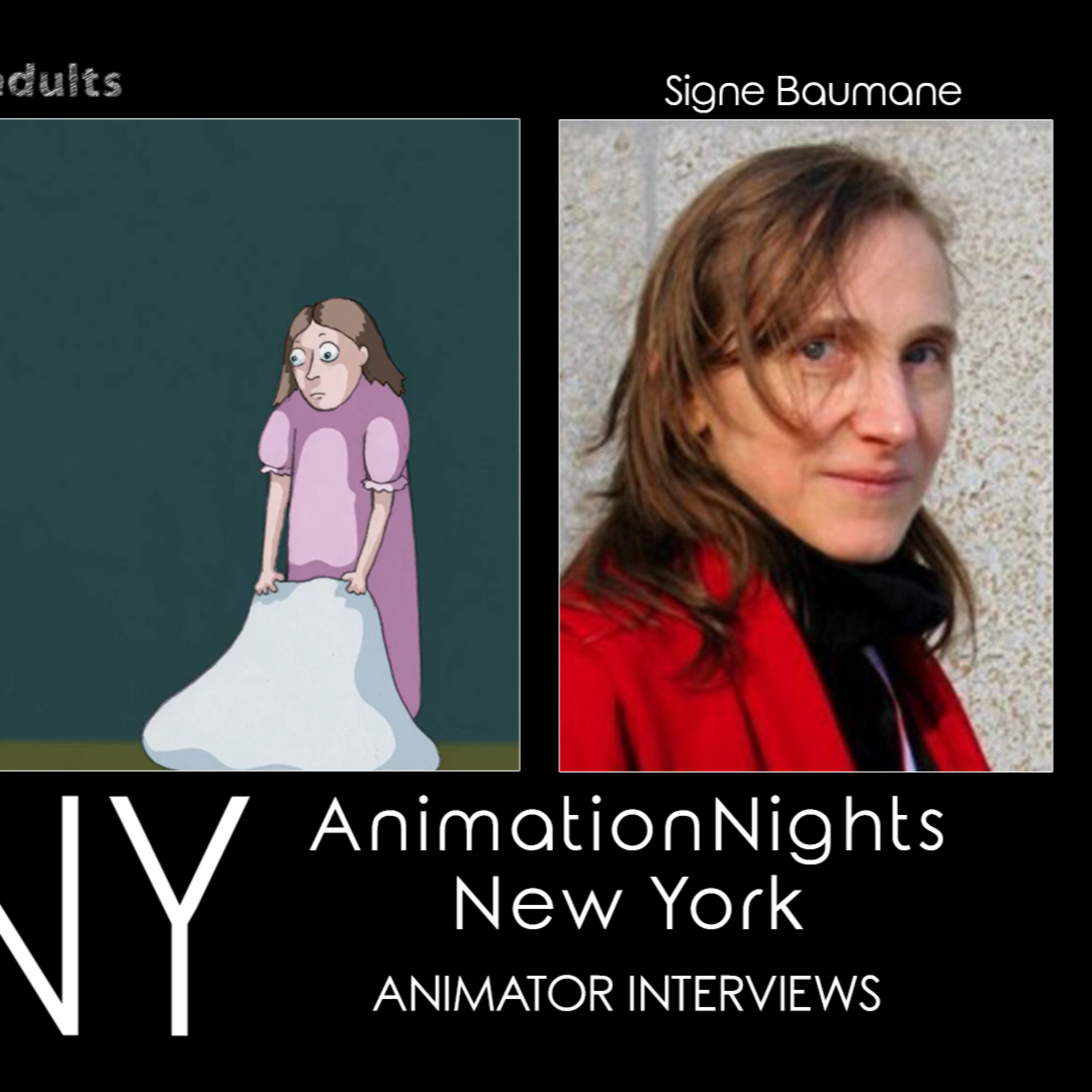
Welcome to another episode of Animator Interviews. My name is Evan Vernon. I'm a contributor at Animation for Adults, as well as Animation Nights New York, also known as Annie. For those new to Annie, we are a monthly screening event and yearly festival that celebrates the very best in animation talent. Our artists come from all across the globe, and many have had their work featured at Cannes, Annecy, and other prominent festivals. We receive hundreds of submissions each year, and each year we screen just 20 at our annual Best of Fest. Today we're joined by one of those 20...
If you're a fan of independent animation, you've probably heard of Signa Bowman. The Latvian artist is a prominent name in the field. In the span of her prolific career, Signa has directed 15 shorts, released a feature film, toured over 300 festivals, secured exclusive grants and fellowships to fund her work, and collaborated with the likes of Bill Plimpton and other industry giants. Signa's animated short Mother's Song tells the story of Zelma, a young girl who wakes one night to find blood on her bedsheets. Her first menstrual cycle has begun, and she calls to her mother for help.
Joined by a troupe of sirens, Zelma's mother proceeds to teach her daughter about love, marriage, and the rigid role of women in society. Today, Cigna has kindly agreed to discuss Mother's Song and share a bit about her career. Today's episode is also public and open to audience questions. We will address all of those as they come in. Cigna, thanks for being here. We want to talk about Mother's Song, but before we do that, take us on your journey a bit. What got you into animation? How did you enter the industry?
Yeah, that's like a long story how one starts animation. I was studying philosophy and I never intended to be an artist and I thought it was a horrible idea to be an artist but I did draw and I did do all these things but I just didn't probably didn't think I was good enough or I just didn't I was not going to pursue a career of an artist and then I studied philosophy for five years and at the end I was supposed to teach philosophy I was supposed to be a philosophy professor and it didn't really appeal to me and I had to find a job or something very quickly because in a country where I was from you had to uh after you graduated you have to get a job immediately and so i uh looked around and a friend of mine said i really like your doodles that you draw on the lectures of the philosophy and i would like to see these doodles move uh so i uh she said i would like to see them to be animated and i thought okay you know animation sounds much better than teaching philosophy so i uh so that's what happened
For me, the animation, what happened was that the focus that animation requires is just so amazing. You know, like you go in there in this other zone and you forget the outside world and outside problems. And I don't know, I just fell in love with it. Probably I was not very good when I started out. You know, I don't really find myself very talented or wonderful in many ways. But when you do something for a long time, you know, for years, then I guess at some point you, I wouldn't say you become good, but you kind of get it.
So that's what happened to me. And you're definitely a person who gets it, Cigna. For all those listening in, you're definitely underselling yourself. Your work's been critically celebrated by many different voices in the industry. So thank you so much for sharing. Before we talk about the film, I was wondering if you could tell us where your visual style came from a bit. It's very interesting. There's this almost kind of creative dissonance between the content of your work and the way it appears. It's very children's booky. I think you've actually done...
illustrations for children but um for mother song in particular that that visual aesthetic is there but the subject matter you know the actual content skews adult so tell us a little bit about that where that style come from I have never, like I said, you know, I never studied art. And so my style has never been broken. You know, like when you go to art school, they kind of break you. They tell you this is good and this is not. And this is the way you do it. This is why you don't. I was never broken as an artist. So for me, my style is my handwriting. You know, like I, it's like I write, you know, how you write and it's your particular style. And so that's just the way how.
I draw, it's the way how I write. It's kind of my voice, and it's untamed. And I mean, you know, I developed it over the years, and I want to, I get more ambitious and more sophisticated, but I just, I don't know. But with the visual approach, the visual, what interests me on how I organize the images, that I can say clearly was influenced by Eastern European poster tradition. There is a great tradition of posters. And there is one Lithuanian-Polish illustrator, Stasi Sidergiewicz, that I would say...
influenced me quite a bit yeah he's a very particular uh artist and then of course uh bill plimpton was a big influence and also uh if you remember the mtv uh spots you know the the yeah uh single films you know those are amazing and i i still uh i mean i i when when i saw them for first time it just was like i couldn't get enough of those i was jealous and envious and i wanted to do something like that So that's kind of my biggest, like in a broad strokes, you know, my biggest influences in a visual style or visual approach actually. But yeah, but I see what you're saying is that style being childish. I think that my style in that regard is a little bit deceptive because it's not exactly childish. It's simple.
You know, it's very obvious, not obvious. It's simple, you know, like you, but then there's a layer of adultness that is, you know, that you have to look at it a little bit more, a little bit more to decode it. So, but yeah, but I would say I am still a five-year-old girl trying to draw and communicate with the world in images. And also, you know how children draw and they show it to their parents and, did you like it? Do you like it? And then you want to have a reaction. And that's me and audience. You know, I always want, when audience is happy, I'm just happy. Yeah. You said some beautiful things right there. You know, never forsake your inner child, right? When people say that, I feel like they're just alluding to the creativity, the lack of inhibition that children have. And, you know, you can see that in you saying that as an artist, your work's so expressive.
You definitely have that inner child. You have to be in touch with it. I don't know how else you can be creative or free or anything. At the same time, of course, you have responsibilities of adults, which is you have to finish your work. That's one responsibility. A child doesn't have. A child impulsively can start something and drop it. And like for me, in the last six years, I've been working in this animated feature film, I Love Affairs Marriage. And, you know, like if I was just a five-year-old girl, I would just drop it a long time ago because it's just so difficult and drawn out. And it's, you know, not exactly impulsive. And, you know.
Yeah, so you have responsibilities. So, but there's another person inside me, it's a five-year-old girl, but the other one is a hundred-year-old lady. And so that is the wisdom and endurance and patience that you have to have. So as an animator, so the descent living between the two extremes of a child and an old woman. Well said. Well said. I do see that we have one question in the chat. We're going to get to that in just a moment here. But before we do, give us some background on Mother's Song, the film that we're screening, featuring right now as part of the festival. I understand this is part of a larger body of work, this feature film, My Love Affair with Marriage. But where did the idea for Mother's Song in particular come from?
Yes, so A Mother's Song is a part of a feature film, My Love of First Marriage. As I mentioned to you before, when you start a big project like that and you don't go to film festivals, people kind of forget you. You know, they're like, who is this person? Where is they coming from? Because six years is a long, long time. You know, like my allegory for an artist is like, we like dogs. We have to mark our territory. We have to piss on the corners. And then when you skip like a day, you know, some other dogs will piss on the corners. And so people would not know that it's your territory. So in some ways you have to mark your territory.
And so this mother's song seemed self-sufficient. We have 23 songs in the film, but this particular song seemed self-sufficient. It explained within itself what it was. But yeah, but you're right, there's a certain part of the song that is inspired by real events and conversations with my mother. like other women that I know who had conversations with their mothers. What does it mean when you start menstruating? You know, like what does that monthly bleeding mean? And for the first time, it's for me personally, I was 13. It was very scary. And I wanted my mother to give me consolation, you know, and advice. And I wouldn't say she had exactly the same kind of brutal conversation with me.
But in some way, she didn't assure me, you know, actually her conversations about that was kind of more and more scary, you know. And the thing was that now you're going to be a woman and you are going to have to have, you know, men are going to surround you and you have to make the right choice and stay pure and virginal until you marry. And so that was kind of the inspiration. The other musical inspiration, though, when I wrote the lyrics for the song and I asked composer Christian Sensini. to write the music for it. He said, in what direction would you like to go for this song? And I was like, well, the song is absurd. The message is absurd. And I said, I would like to have something like Oompa Loompa from Chocolate Factory. I was like, Oompa Loompa. And then Christian kind of looked around and he said, oh, I see what you mean. And so he did something entirely different. But the idea of that absurdity, I think he preserved it really well, the humor and absurdity of the piece.
Yeah. Yeah. Absurd humor. This has been said about you before, but critics have kind of praised your work for the way that it addresses difficult subject matter. If you smooth things over with comedy, even if it's dark comedy, it becomes easier to digest. That issue is now more accessible to the viewer in some way. We do have a question in the chat from Jack. I think this is about the visual style of the film in particular. Jack writes, you and your team constructed that room and mother song that the film takes place in in real life, which looks amazing. What was the idea that led to that over a drawn background?
So, yes. So the technique in the film that we used was to do three-dimensional backgrounds and build a room, Zelma's the main character's room. And so then we photograph it and then I animate on top and then we color the drawings in Photoshop and then composite them in After Effects. And so that is how it's done. And most of the, I love marriage is done in this way, but certainly mother's song, except there are like few clips of the fantasy scenes. Zelma processes in her particular way what mother is saying.
So that's how I separate the real world from the fantasy. So the idea to do three-dimensional sets, I think that's the question. Yeah, it came when I, many years ago, I was... uh some fashion designer in italy saw my work and he said i want to do you i want you to do mural for for me and i did this mural and then he said oh now i want you to do can you do like paper mache sculptures and i pay you right and i'm like okay i do anything you know for money you can do a lot of things and i was like and he said you can do anything you want but i was like it was my first time i never done paper machine you know but i was like let me try and i turned out to be so good i mean meaning i'm not good but you know like i i i created this uh sculptures about of my size you know they're huge and they're papier-mâché and it was amazing to create them and I thought it would be great to bring this kind of three-dimensional world into my animation world work but as you know if you animate papier-mâché it breaks and you know it's just not possible to animate it and I was like well how can I how can I make it work how can I make it adjustable to my animation work then I kind of had this idea about backgrounds you know all if I made these backgrounds and I photographed and then I put little characters on top and that was I did that technique for my first animated feature from
my pocket. And for the second film, we developed the scene, sorry, the technique much more. My partner, Sturgis, whom we met just before the panel, he built all the sets, you know, from wood, from scrap wood he finds in Brooklyn trash cans, you know. And then my assistants, art assistants Yasemin and Sophia, they were painting them. And so it was a very elaborate process and very elaborate sets in comparison to my previous feature film.
But yeah, I also, I would like to make, like I was kind of struggling, I was like 10 years ago, I was like, I would like to make a feature film, live action with actors, but I don't know anything about actors who are shooting live action. And in this way, when I brought in three-dimensional sets, suddenly I am working with camera, because I really like taking pictures and camera work. I really like it. And so now I'm working as a camera woman, and that is that kind of like, it's not live action, it's not stop motion, it's not exactly traditional animation, it's kind of blend of several techniques. It's Cigna Bowman animation. No, I did not invent anything. It's really, I think that this technique is as old as the world. I was told that even Disney tried in, like a long, long time ago, tried to do this technique. But of course, before digital, you couldn't do it. So they were doing it in a way how it didn't look really so great. But the combination of 3D backgrounds and 2D characters has been done before. I just made adjustments and I made it my own, you know, but to serve my style, my purposes. Yeah.
Well, again, your modesty betrays you, but I think there's a lot to be said about your skill and just how interdisciplinary you are. I think we have a, let's see if this is a question. It might be a comment. Also from Jack. Jack, thank you for your thoughtfulness. Appreciate it. Jack writes, the result is spectacular. Thank you for telling us about it. I second that, Jack. I had another question. What was the influence behind the half bird design of the chorus singers? That's interesting. Yeah. So the kind of like harpy characters. Go ahead.
yeah yeah no those are they have name actually uh which you never find out right but in the interior you know like you know what you call it in insiders kind of insight right they're called mythology sirens and sirens and they are shape-shifting characters and so they're when zelma is young they are kind of younger smaller and uh and then when i grow bigger she grows bigger than i get they could be like frightening and they could be like funny and they could be sad or mourning they kind of exaggerate uh uh kind of Zelma's perception of what she's supposed to do, you know. And so, I don't know, in a whole film, they change every, as I said, we have 23 songs with the mythology sirens. And every time when they appear, they are slightly different or like heavy different, magnificently different from whatever before. So yeah, they're these shape-shifting characters and they represent the societal expectations, like societal norms.
you know what the world expects for a girl to be or do you know and in this case the mother is the main singer the lead singer or she doesn't think she's just like who says these truths but uh but the science support her you know they're like ah you know they're harmonizing in the background so uh and and they also accent in this uh uh in this song they accent the absurdity you know uh in the other songs in the in the rest of the film and the feature film uh they can get very frightening and threatening you know when zelma loses car virginity there is like a whole fight going on so yeah Yeah, it's fascinating that, thoughtful question, thoughtful answer, first of all. It's fascinating that you're able to kind of take these different, I guess, illusions, you know, from myth or something and then kind of repurpose them and integrate them into your own work. Oh yeah, but that's animation. Animation, the possibilities are endless, you know? Yeah, well said, Signa. Well, I know we're running a bit close on time here, so I think we are going to have to start bringing things to a close. I've got one last question for you, Signa. So a lot of your work seems to underscore important social issues in one way or another. For those who've seen Rocks in My Pockets, it deals very heavily with mental health and mental illness.
mother song deals with gender. So with that in mind, Cigna, and I hope I'm not leaving the question, you've already established a very strong artistic legacy, but how would you like to be remembered as an artist? How would you like people to remember your work? What would you like them to learn from you? I don't know if I want people to learn anything from me. When I make films, I aspire to provoke people, you know, like kind of poke a little bit at the comfort, you know, like wake them up and kind of slap them around and say, hey, you know, there's this question, you know, what do you think about it? And so, and I can give answers. I mean, I'm not answer creating machine. Answers are done by activists and politicians, maybe, you know, by people who are much smarter than me. I am just an artist, you know, I see something say.
something you know i i'm i'm an artist and my my job is to make people think i also think that like really what upsets me in in the world is like people sink into this uh you know kind of passivity you know like uh complacency you know how they do as maturity does you know you know yeah sure you know like wearing masks uh yeah do as majority does i mean i wear a mask every time but i i i didn't just complacently went with maturity i said why and where and how and then i put it one and one together and i'm wearing a mask you know you know what i mean it's like uh or you know or you know in a human existence i i want to i don't know it's uh I want people to have critical thinking, you know, like employ critical thinking, be able to ask questions. And I mean, not just like stupidly saying, you know, like doubting vaccines or something like that, but just being more critical of information. And I don't know how, I mean, obviously I believe that when the moment I disappear from face of earth, people will forget me because there will be no one pissing on the corners, on my corners, right? That's, you know, like I'm not, nobody's going to claim the space that I'm taking.
But I want, I'm creating work for people today, now, you know, because there might be no tomorrow in some ways for me or for anybody. I mean, I'm not going to be so pessimistic. There is going to be a long life on earth for everybody. But I don't know. I'm too young to say, oh, I want to be remembered by this or by that. Well, it's a difficult question to ask as an artist, but you said something very beautiful, right? They're saying, I'm not going to give you the answers. I want people to think by doing that, you're allowing the art to kind of become its own organism. And now it belongs to all of us. And we have to interpret it for ourselves. The same goes for poetry, your work.
in many ways is like poetry. And it's been a real honor and thrill for us to show it here at Annie Best of Fest. So thank you so much for just giving us a sample of your talent. We wish you all the best in the future, Signa, and look forward to seeing what you do later down the line. That's all I've got. Best of luck to you in the future, Signa. You are incredibly gifted. I hope we see you next year. Thank you. Thank you so much. It was a really great honor to be part of the best of the Annie's. That's just a really great honor. Thank you. No, thank you, Signa. And we're getting a lot of thank yous from the gallery too. So you take care. Okay. Thank you. Bye.