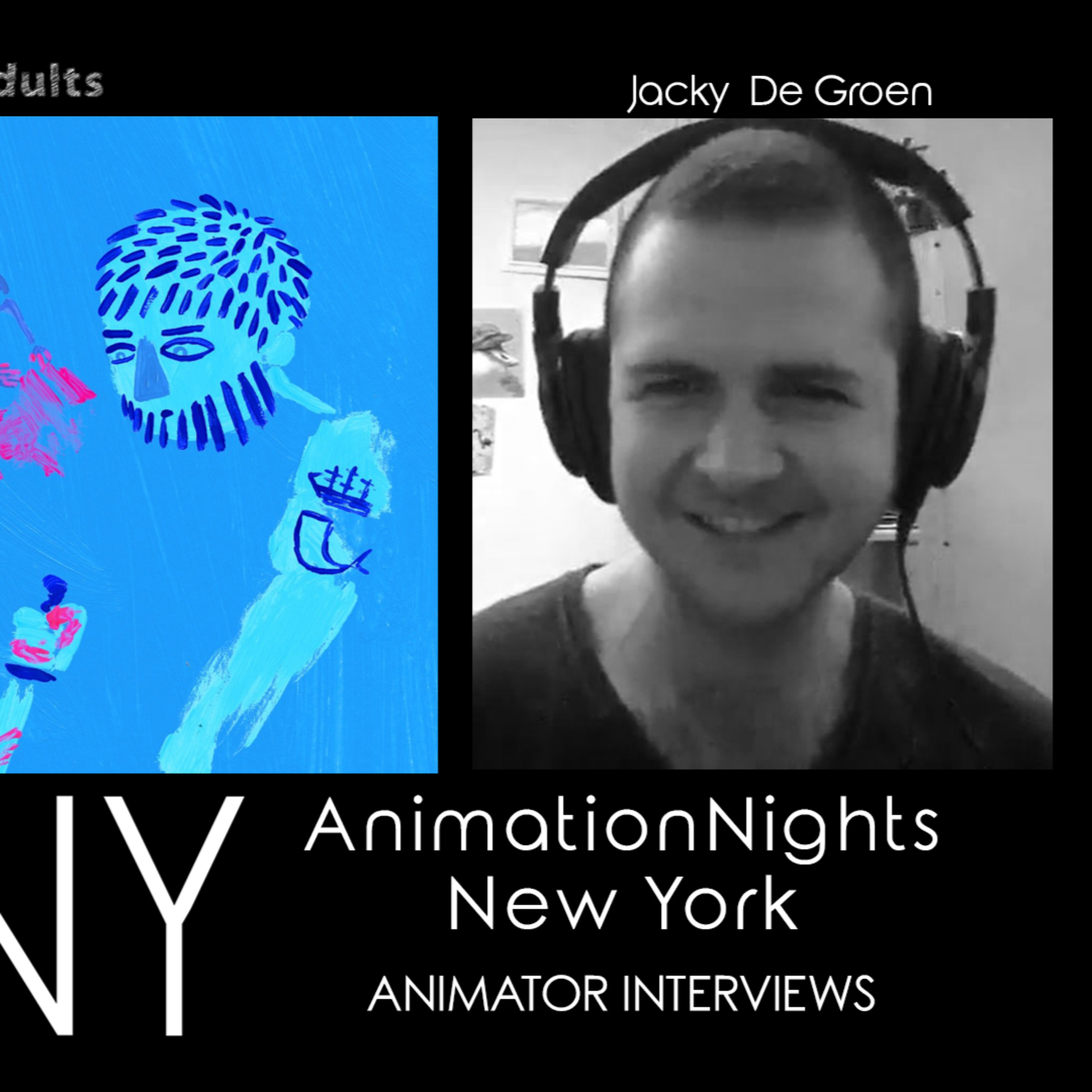
Welcome to another episode of Animator Interviews. My name is Evan Vernon. I'm a contributor at Animation for Adults, as well as Animation Nights New York, also known as Annie. For those new to Annie, we are a monthly screening event and yearly festival that celebrates the very best in animation talent. Our artists come from all across the globe, and many have had their work featured at Cannes, Annecy, and other prominent festivals. We receive thousands of submissions each year, and each year we screen just 20 at our annual Best of Fest. Today we're discussing one of those 20...
Jackie DeGroen is with me now. Jackie is a Belgian artist who specializes in painted animation and currently works as a freelance director. Jackie's critically acclaimed short, Spermaceti, was chosen by our jury as a Best of Fest winter film. Inspired by Moby Dick, the film follows a young deckhand as he joins a whaling expedition, surrounded by rough, hardened men who take no issue with their grisly trade. Lacking their enthusiasm, the boy tries to abstain from the hunt, but as days go by, the time comes when he, too, must take a life. What ensues is a surreal, hallucinogenic experience that will change the boy forever, forcing him to confront his demons as he wakes his inner self. Today, Jackie has kindly agreed to discuss this film, its unique style, and his future plans as an artist. Today's interview is also public and open to audience questions. We will address all of those as they come in.
Jackie, thanks for coming. We want to discuss the film, but brief us on your background a bit. What got you into animation? It's definitely not something that I wanted to do from a young age. Because to be honest, when I was a kid, obviously I watched a lot of animation, but I never really thought about the fact that people actually made those films. I just sort of took it for granted that these films came into existence, and I never put much thought into how they came into existence. And then later on, I was...
just trying to find my way in creative endeavors. And I ended up starting to animate because it just combines a lot of things that I was interested in, like sounds and motion and filmmaking. But prior to deciding to pursue animation, I was interested more generally in being a filmmaker and not specifically in animation. But animation ended up being a discipline that complements my personality a lot more because you can work independently alone. And I don't really have the people skills to be a director, I think. So starting to animate came quite naturally from wanting to be a filmmaker in that sense. It sounds like you wanted a medium, a way of filmmaking that was maybe a bit more personal. Do you feel that way about animation? Yeah, I mean, it's definitely...
The thing with animation in general, you can see like one frame from an animation film and it tells you a lot about the artistic sensibilities of the people behind it. Yeah, it's definitely a field with a lot of space for a personal approach. That kind of leads into my next question, if you don't mind telling us a bit about your visual style. So for those who have seen Sperm Aesthetic, it has a very, very unique, very distinct aesthetic. It appears to have been painted almost every single frame, which I'd imagine is an extremely tedious process on your end, Jackie, hand painting all of these frames. But the color palette...
even more so is incredibly impressive and unique. You use a lot of blues and greens and a few reds every now and then, very intentionally. It almost feels like a neon light show, if I can use that analogy. So tell us a little bit about that style. Where did that part of Jackie DeGroen come from? Yeah, it's definitely not something I designed really consciously. It's a style that sort of evolved from one project to the next. So a lot of it is just habits, I guess, which is maybe not a really flattering thing to say.
But I just have a way of working, and I try to refine it more with each new project or incorporate new stuff into it on every step of the way. But generally, it really grew kind of organically. And working with paint in the way I do, you say it looks like a long and tedious process, which, I mean, it's not a long and tedious process. But it also allows me to cut a few corners in a really acceptable way because the style is pretty rough. So there's a lot of details that I don't have to animate super accurately. Yeah.
I also choose really selectively in each shot or each scene what is important to show and what isn't. So there's a lot of stuff that is just abstracted or isolated, like an action with hands and you only see the hands and the rest is kind of blurry or just sort of fake shapes. So working that way with paints, it also allows me to skip some work. So it's not only piling work for myself. You've said some really interesting things there, Jackie. And we'll touch on your kind of manipulation of darkness, I guess, and obscurity in a moment, because that seems to be an important feature.
not only of spermaceti, but in your other films as well. But you were talking about how this is something that you didn't consciously hone, this visual aesthetic, it just came naturally to you. That's a very beautiful thing. You can think about how to approach something and just kill yourself until your creativity is completely dead, trying to engineer something. But sometimes channeling what comes most naturally to you ends up being or creating the best result. And this film is an excellent example of that. It's absolutely beautiful. So tell us a bit, Jackie, about the idea behind spermaceti. It's a very specific story. So what inspired that, Jackie?
It was definitely not like a sort of top-down approach in constructing the story. I was in a period where I was just drawing a lot of ocean stuff, boats and the sea and deckhands and all that stuff. So I just started wondering, who are these people that I'm drawing? And then things sort of took off from there. In the process, of course, it's pretty obvious from the film that the story of Moby Dick is never really far away in my imagination around it. So I really took those archetypes.
and relative, I think. Yeah, it's a very moving and sensory experience too. Just a moment ago, you were talking about your minimalistic approach to your subject matter at times, how you'll obscure certain parts of the body. And the way that you do that seems to be very intentional. You know, in your other films, there was one I know about a lion tamer and a lion almost becoming the same entity. And you seem to kind of do that a little bit here with a spermaceti. When the young boy is dragged down by the rope and harpoon that's inside of the sperm well and goes into the sea, we lose track of him a little bit. And when he emerges, he's...
kind of been transformed a bit into something else the whale seems to be part of him so um would you agree with that jackie are you um Are you trying to obscure the line, I guess, between man and beast? I think identities is probably an important theme in a lot of the things that I make, like the boundaries of a person and your place in the world. And I think that's something that I, looking back on this film, that I also really see that as a theme. These moments where the boundaries between a person and the rest of the world start to blur. And I guess you could call it a sort of psychedelic approach as well. That's definitely in there, yeah.
I don't really see it as specific as the boundaries between a human and a beast. I mean, for me, it's quite evident that we are animals and just one specific type of animal. That's not really like, I don't necessarily want to make a point about that or something. It's more, I guess, about being in the world and relating to the world at large. Yeah, no, absolutely. There's an interconnectedness, I guess, between the humans and the creatures in your stories. It's very evident. And how you choose to interpret that, you know, I guess it sounds like you're trying to leave that open to the viewer, possibly, Jackie, which is also a very poetic thing. I'm reminded of, you know, you kind of see it in Moby Dick. The whale is characterized as a monster. Captain Ahab, with his relentless bloodlust, is kind of a monster. You know, I think there's a scene when Ishmael is on the boat with Ahab and, you know, kind of has this internal thought that the only difference between Ahab and the sperm whale.
It's just their physiology. At the end of the day, fundamentally, they're the same entity. That's an interesting idea. And I think that really connects with what we're talking about here. Hopefully, hopefully that does you justice. But, you know, it's difficult to talk about films as moving and beautiful as your own because it feels like the viewer is always inclined to box them in. You know, what's this mean? What's the interpretation? It's never that simple, is it? No, but I think it's also, I mean, I wouldn't want to force an interpretation onto an audience because...
most of the things that happen in the film don't have a fixed meaning for me, myself, but I really love it when people have these super specific interpretations of things that happen and of the thematic elements. But for me, it's really important to allow some room for openness so people can bring their own things in their viewing and see what they need to see. Very well said, Jackie. Not every director feels that way, but you are inviting people to enjoy your work infinitely in a way that's very personal to them. That's very generous of you. Not everyone does that. So thank you. I appreciate that we're getting a bit close on time. So I had just a couple more questions for you. You're a young artist. You've already made some very beautiful films on top of Spermaceti, but where do you see yourself in the future? In an ideal universe, what is Jackie DeGroen doing?
10, 20, 30 years down the road. I don't know. I sometimes feel like I have everything that I want already. I mean, I'm not an ambitious person in a career sense. Like, just being left alone to make my stuff is really okay for me. As long as you can keep doing your craft, right? Right, yeah. And I mean, of course, I have to do some stuff in the meanwhile to pay rent and pay the bills and stuff. But as long as the external factors and practical factors of life don't get in the way of painting and making stuff too much, then I'm just kind of content where I am, I think.
So I don't try to think so much about 10 years in the future or 20 years. I would imagine that I'm pretty much doing the same thing as now in 20 years. We hope you do. We hope you do. We hope there's much more, much more tomography like this. It really is a beautiful work of art. And again, we just want to thank you so much for sharing it with us, Jackie. Last question I have for you. Can you tell us about any projects you might be working on now or thinking about? Right now I'm working on something about...
stones and rocks, it's still kind of taking shape in my head. So I can't really talk coherently about it, I think, because it's still really in an early stage. I'm not animating yet. And hopefully I can launch it into the world in a couple of months would be optimistic, let's say years. Sure. Well, we look forward to it, Jackie. Really appreciate your time today. You've been an absolute delight. All the best to you in the future. And we hope to see you at Annie Vesta Fest again. Yeah, likewise. And thank you for having me. And thanks for the interesting questions. Thank you for the very insightful responses. But it's been a pleasure, Jackie. You take care. Thank you. Take care.