
EPISODE · Apr 21, 2026 · 6 MIN
Apple CEO succession in 2026 & EU DMA interoperability vs Apple - Hacker News (Apr 21, 2026)
from The Automated Daily - Hacker News Edition · host TrendTeller
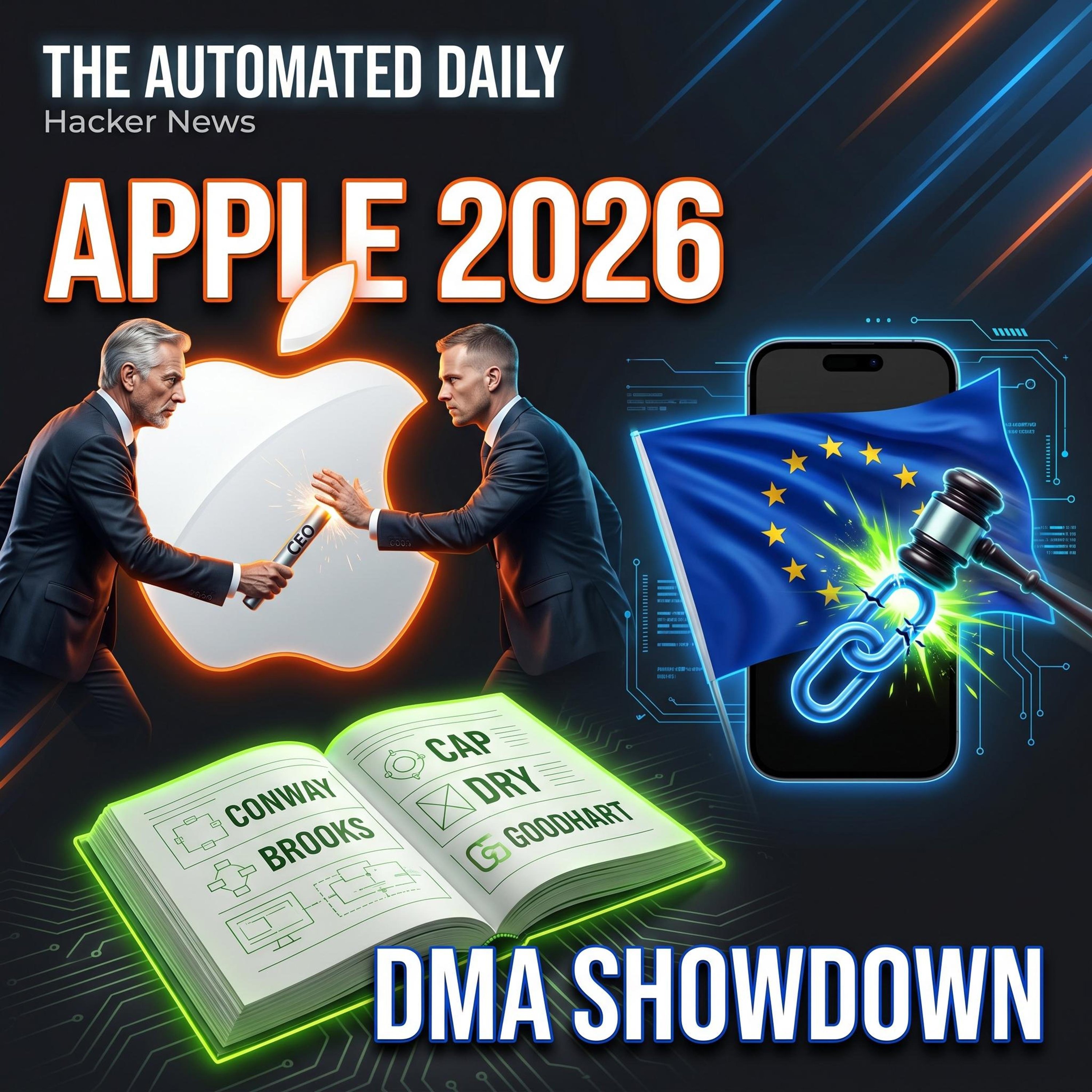
Please support this podcast by checking out our sponsors: - Discover the Future of AI Audio with ElevenLabs - https://try.elevenlabs.io/tad - SurveyMonkey, Using AI to surface insights faster and reduce manual analysis time - https://get.surveymonkey.com/tad - Lindy is your ultimate AI assistant that proactively manages your inbox - https://try.lindy.ai/tad Support The Automated Daily directly: Buy me a coffee: https://buymeacoffee.com/theautomateddaily Today's topics: Apple CEO succession in 2026 - Apple announced Tim Cook will become executive chairman on Sept. 1, 2026, with hardware chief John Ternus taking over as CEO—major continuity signals for products, services, and regulation. EU DMA interoperability vs Apple - A FSFE report says Apple’s DMA interoperability request process has produced zero concrete new access so far, raising questions about enforcement, open standards, and developer choice on iOS. Catalog of software engineering laws - A new “Laws of Software Engineering” reference curates 56 principles like Conway’s Law, Brooks’s Law, CAP, DRY, and Goodhart’s Law—useful vocabulary for trade-offs and failure modes. Living with an open-hardware laptop - A personal long-term field report on the MNT Reform open-hardware laptop highlights repairability, real-world quirks, and community-driven fixes—what ownership looks like beyond the spec sheet. Flipper research on shelf labels - TagTinker is an open-source Flipper Zero app for authorized infrared ESL protocol research, lowering the barrier for analysis and replay testing while stressing legal and ethical boundaries. Tabletop dice pioneer Louis Zocchi - Game industry figure Louis Zocchi, founder of Gamescience and an early champion of polyhedral dice, has died at 91—his standards and distribution helped shape modern tabletop gaming. - Website Catalogs 56 Core “Laws” and Principles of Software Engineering - Apple Names John Ternus CEO as Tim Cook Becomes Executive Chairman - Codemix introduces @codemix/graph with type-safe traversals, Yjs sync, and Cypher queries - OpenClaw Updates Anthropic Integration with API Key, Claude CLI Reuse, Caching, and 1M Context Options - Owner Log Details MNT Reform Open-Hardware Laptop Issues, Mods, and Linux Workarounds - TagTinker brings infrared ESL protocol research tools to Flipper Zero - FSFE Report Says Apple’s DMA Interoperability Process Has Delivered No Solutions for Developers - Louis Zocchi, Pioneering Dice Designer and Gamescience Founder, Dies at 91 Episode Transcript Apple CEO succession in 2026 Apple is planning a major leadership transition effective September 1st, 2026. Tim Cook will move from CEO to executive chairman, while John Ternus—Apple’s senior VP of Hardware Engineering—will become the next CEO. Apple is presenting this as the outcome of long-term succession planning, with Cook staying on through the summer to help with the handover. Why it matters: CEO changes at Apple are rare, and they tend to shape expectations for years—even when the company says it’s “continuity.” Putting a hardware leader in the top job is also a statement about where Apple thinks its leverage remains: devices, silicon, and the tight integration that comes with them. And with regulators increasingly scrutinizing platform control, Apple also made a point of keeping Cook involved as executive chairman, including global policy engagement. EU DMA interoperability vs Apple Staying with Apple, a new report from Free Software Foundation Europe argues that Apple’s Digital Markets Act interoperability process isn’t delivering practical results. Using Apple’s own public tracker, the report says that as of late March, none of the formal interoperability requests had produced a new solution made available to developers. Many requests, it claims, were rejected as out of scope, too technical, or already covered by existing options. Why it matters: the DMA is supposed to make gatekeepers open up key platform capabilities so smaller developers can compete and users get real choice. If the process turns into paperwork with long timelines and ambiguous rejections, the law’s intent gets diluted—without a clear “no.” This also signals where the next phase may head: fewer polite requests, more enforcement actions, and more pressure for open standards rather than case-by-case exceptions. Catalog of software engineering laws On the software engineering side, a site called “Laws of Software Engineering” is making the rounds with a curated catalog of dozens of widely cited principles—everything from Conway’s and Brooks’s Laws to ideas like the Law of Leaky Abstractions, CAP, DRY, YAGNI, and Goodhart’s Law. The pitch is simple: these patterns keep showing up in real projects, and having them in one place gives teams a shared language for trade-offs. Why it matters: most software failures aren’t caused by one bad line of code—they’re caused by mismatched incentives, hidden complexity, and planning assumptions that don’t survive contact with reality. A reference like this is useful not because it’s “law” in the physics sense, but because it helps engineers and managers name the trap they’re walking into—like over-optimizing a metric, or assuming abstraction layers won’t leak at the worst moment. Living with an open-hardware laptop If you want a grounded look at the difference between “repairable” in theory and “repairable” in daily life, there’s also a long-running personal field report on the MNT Reform—an open-hardware laptop designed and assembled in Berlin. The author documents owning multiple units over several years, swapping devices, and even turning one into a community loaner. It’s full of practical details: physical wear issues, a trackball that can mark the screen when closed, and experiments like repositioning antennas to improve Wi‑Fi. Why it matters: open hardware often sells a promise—control, longevity, and the ability to fix what breaks. Reports like this show the real cost and real payoff: you may spend more time tuning and tinkering, but you also get a path to parts, modifications, and community knowledge that’s hard to find in sealed consumer laptops. Flipper research on shelf labels In security and hardware research news, an open-source project called TagTinker has been released for the Flipper Zero. It focuses on researching infrared electronic shelf-label protocols—observing signals, analyzing them, and doing controlled replay-style experiments on hardware you own or are authorized to test. The maintainer is explicit about boundaries, repeatedly warning against using it on deployed retail systems or anything that could alter pricing or interfere with operations. Why it matters: electronic shelf labels are everywhere, and they sit at an awkward intersection of retail operations and wireless security. Tools that make research easier can help defenders, auditors, and interoperability work—provided the culture around them stays responsible. This is the same story we’ve seen with many dual-use tools: the technology isn’t going away, so the best outcome is transparency, clear ethics, and better security design upstream. Tabletop dice pioneer Louis Zocchi Finally, a notable loss from the broader tech-adjacent world of hobby gaming: Louis Zocchi—often called the “Godfather of Dice”—has died at 91. Beyond game design and publishing work, his biggest legacy came through Gamescience, where he helped popularize polyhedral dice in the U.S. and pushed unusual formats that became part of tabletop culture. Why it matters: this is a reminder that “technology culture” isn’t only servers and code. Manufacturing, distribution, and standards—even for something as humble as dice—shape whole ecosystems. Zocchi’s impact is visible every time a tabletop game pulls out a bag of polyhedrals and treats it as normal. Subscribe to edition specific feeds: - Space news * Apple Podcast English * Spotify English * RSS English Spanish French - Top news * Apple Podcast English Spanish French * Spotify English Spanish French * RSS English Spanish French - Tech news * Apple Podcast English Spanish French * Spotify English Spanish Spanish * RSS English Spanish French - Hacker news * Apple Podcast English Spanish French * Spotify English Spanish French * RSS English Spanish French - AI news * Apple Podcast English Spanish French * Spotify English Spanish French * RSS English Spanish French Visit our website at https://theautomateddaily.com/ Send feedback to [email protected] Youtube LinkedIn X (Twitter)
Embed this episode
What this episode covers
Please support this podcast by checking out our sponsors: - Discover the Future of AI Audio with ElevenLabs - https://try.elevenlabs.io/tad - SurveyMonkey, Using AI to surface insights faster and reduce manual analysis time - https://get.surveymonkey.com/tad - Lindy is your ultimate AI assistant that proactively manages your inbox - https://try.lindy.ai/tad Support The Automated Daily directly: Buy me a coffee: https://buymeacoffee.com/theautomateddaily Today's topics: Apple CEO succession in 2026 - Apple announced Tim Cook will become executive chairman on Sept. 1, 2026, with hardware chief John Ternus taking over as CEO—major continuity signals for products, services, and regulation. EU DMA interoperability vs Apple - A FSFE report says Apple’s DMA interoperability request process has produced zero concrete new access so far, raising questions about enforcement, open standards, and developer choice on iOS. Catalog of software engineering laws - A new “Laws of Software Engineering” reference curates 56 principles like Conway’s Law, Brooks’s Law, CAP, DRY, and Goodhart’s Law—useful vocabulary for trade-offs and failure modes. Living with an open-hardware laptop - A personal long-term field report on the MNT Reform open-hardware laptop highlights repairability, real-world quirks, and community-driven fixes—what ownership looks like beyond the spec sheet. Flipper research on shelf labels - TagTinker is an open-source Flipper Zero app for authorized infrared ESL protocol research, lowering the barrier for analysis and replay testing while stressing legal and ethical boundaries. Tabletop dice pioneer Louis Zocchi - Game industry figure Louis Zocchi, founder of Gamescience and an early champion of polyhedral dice, has died at 91—his standards and distribution helped shape modern tabletop gaming. - Website Catalogs 56 Core “Laws” and Principles of Software Engineering - Apple Names John Ternus CEO as Tim Cook Becomes Executive Chairman - Codemix introduces @codemix/graph with type-safe traversals, Yjs sync, and Cypher queries - OpenClaw Updates Anthropic Integration with API Key, Claude CLI Reuse, Caching, and 1M Context Options - Owner Log Details MNT Reform Open-Hardware Laptop Issues, Mods, and Linux Workarounds - TagTinker brings infrared ESL protocol research tools to Flipper Zero - FSFE Report Says Apple’s DMA Interoperability Process Has Delivered No Solutions for Developers - Louis Zocchi, Pioneering Dice Designer and Gamescience Founder, Dies at 91 Episode Transcript Apple CEO succession in 2026 Apple is planning a major leadership transition effective September 1st, 2026. Tim Cook will move from CEO to executive chairman, while John Ternus—Apple’s senior VP of Hardware Engineering—will become the next CEO. Apple is presenting this as the outcome of long-term succession planning, with Cook staying on through the summer to help with the handover. Why it matters: CEO changes at Apple are rare, and they tend to shape expectations for years—even when the company says it’s “continuity.” Putting a hardware leader in the top job is also a statement about where Apple thinks its leverage remains: devices, silicon, and the tight integration that comes with them. And with regulators increasingly scrutinizing platform control, Apple also made a point of keeping Cook involved as executive chairman, including global policy engagement. EU DMA interoperability vs Apple Staying with Apple, a new report from Free Software Foundation Europe argues that Apple’s Digital Markets Act interoperability process isn’t delivering practical results. Using Apple’s own public tracker, the report says that as of late March, none of the formal interoperability requests had produced a new solution made available to developers. Many requests, it claims, were ...
NOW PLAYING
Apple CEO succession in 2026 & EU DMA interoperability vs Apple - Hacker News (Apr 21, 2026)
No transcript for this episode yet
Similar Episodes
No similar episodes found.
Similar Podcasts
No similar podcasts found.