
EPISODE · Jun 5, 2026 · 32 MIN
Architecting the AI-Native Software Life-cycle | A Critical Analysis of the Gemini-Driven Spec-First Paradigm
from Mind Cast · host Adrian
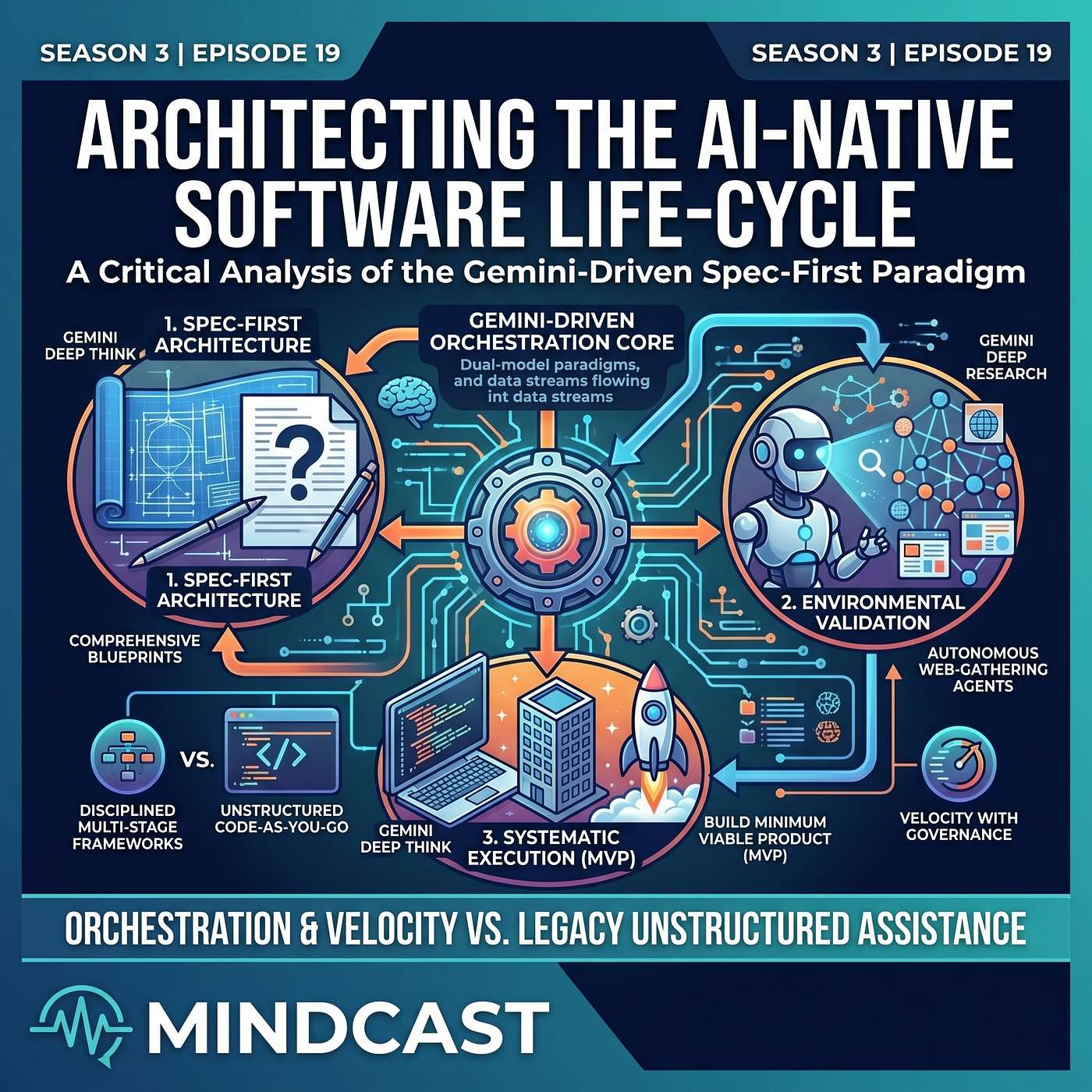
Send us Fan MailThe software engineering discipline in 2026 finds itself navigating a foundational transition. The initial wave of generative AI coding assistants, characterised by inline autocomplete functionalities and unstructured chat interfaces—has demonstrably altered the metrics of individual developer throughput. However, mounting empirical evidence indicates that without rigorous architectural governance, these ubiquitous tools introduce profound organisational bottlenecks that neutralise high-level velocity gains. In response to this systemic friction, advanced engineering practitioners are abandoning unstructured, spontaneous AI interactions in favour of highly disciplined, multi-stage orchestration frameworks.An emerging and highly potent manifestation of this shift is a purely bimodal, dual-model development paradigm that isolates the cognitive workloads of software engineering into specialised processing environments. The workflow in question—leveraging frontier reasoning models (such as Google DeepMind's Gemini Deep Think) to architect comprehensive blueprints, utilising autonomous web-gathering agents (Gemini Deep Research) to validate environmental constraints, and subsequently utilising Deep Think again as an execution engine to systematically build a Minimum Viable Product (MVP), synthesises a new operational standard.This podcast provides an exhaustive technical, economic, and architectural analysis of this specific Gemini-centric workflow. It validates the hypothesis that this methodology represents a novel development paradigm—one that resurrects legacy architectural concepts but fundamentally alters their execution velocity—and evaluates its structural superiority over both legacy AI assistance and competing terminal-native agentic tools.The Future of Software Development in 2026: AI, Vibe Coding, and the Rise of Citizen Developers | by Vishal Mysore - Medium, https://medium.com/@visrow/the-future-of-software-development-in-2026-ai-vibe-coding-and-the-rise-of-citizen-developers-d5d8a6469059 What is Vibe Coding? | IBM, https://www.ibm.com/think/topics/vibe-codingVibe Coding Explained: Tools and Guides - Google Cloud, https://cloud.google.com/discover/what-is-vibe-codingVibe coding and agentic engineering are getting closer than I'd like, https://simonwillison.net/2026/May/6/vibe-coding-and-agentic-engineering/ 'Vibe coding' may offer insight into our AI future - Harvard Gazette, https://news.harvard.edu/gazette/story/2026/04/vibe-coding-may-offer-insight-into-our-ai-future/Claude Code | Anthropic's agentic coding system, https://www.anthropic.com/product/claude-codeAn Introduction to Spec-Driven Development | GEICO, https://www.geico.com/techblog/an-introduction-to-spec-driven-development/ Spec-Driven Development: It Looks Like Waterfall (And I Feel Fine ..., https://rogerwong.me/2026/03/spec-driven-developmentWhat Is Spec-Driven Development? A Complete Guide - Augment Code, https://www.augmentcode.com/guides/what-is-spec-driven-developmentUnderstanding Spec-Driven-Development: Kiro, spec-kit, and Tessl, https://martinfowler.com/articles/exploring-gen-ai/sdd-3-tools.html
What this episode covers
Send us Fan Mail The software engineering discipline in 2026 finds itself navigating a foundational transition. The initial wave of generative AI coding assistants, characterised by inline autocomplete functionalities and unstructured chat interfaces—has demonstrably altered the metrics of individual developer throughput. However, mounting empirical evidence indicates that without rigorous architectural governance, these ubiquitous tools introduce profound organisational bottlenecks that neut...
NOW PLAYING
Architecting the AI-Native Software Life-cycle | A Critical Analysis of the Gemini-Driven Spec-First Paradigm
No transcript for this episode yet
Similar Episodes
No similar episodes found.