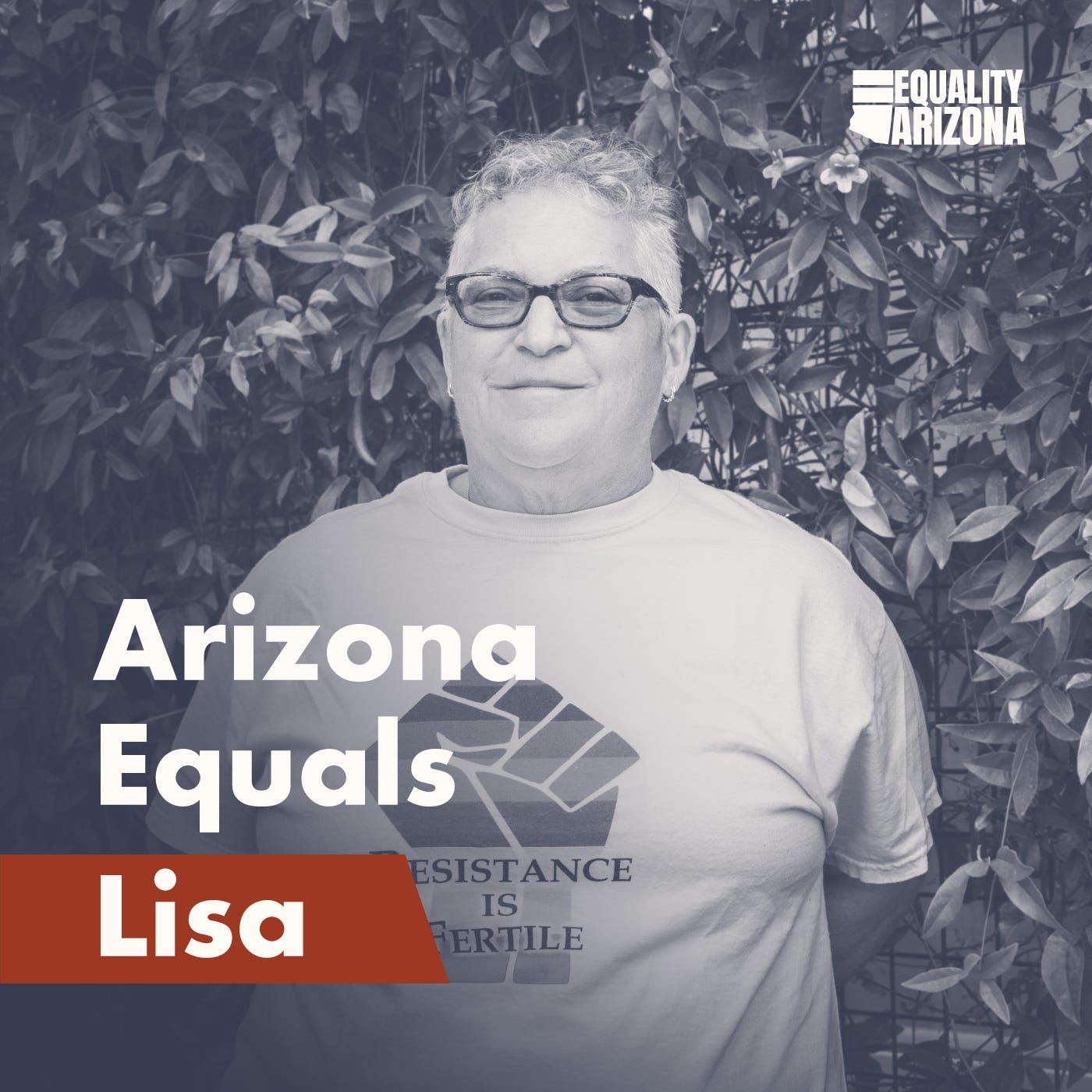
Arizona Equals Lisa
from Equality Arizona Updates Hosted by Equality Arizona
Today on the Arizona Equals Conversation, Jeanne interviews Lisa Malachowsky, a local entrepreneur and political organizer with a 20 year history in the computing industry. This episode covers a lot of ground, from technology history and workplace organizing to the struggle for marriage equality and the threat of rising antisemitism. We’ll be off next week enjoying the holidays, and will return with new stories in 2023. If you have a story to share about being queer in Arizona, get in touch! Links for Context * Dive N Ride Adventures * The History of IBM * Dykes on Bikes * Amdahl Corporation * Gene Amdahl * NCJW Arizona * Arizona Prop 102 * Wolf Girls at Vassar: Lesbian and Gay Experiences * Rising Rates of Antisemitism Full Episode Transcript [00:00:00] Jeanne From Equality, Arizona. You're listening to the Arizona Equals conversation. I'm Jeanne Woodbury. I'm the interim executive director of Equality Arizona and the host of this podcast. Today's episode is going to be our last for the year of 2022, but we'll be back next year with more stories about what it means to be queer in Arizona. Hosting this podcast has been one of the highlights of my year, and I'm excited to keep it going in 2023. But I need your help. If you have a story that you want to share or if you know someone and you think that their story needs to be heard, please get in touch. You can sign up through a form on our website, at equalityarizona.org/stories, or you can just email me. My address is [email protected]. We've got a lot of great plans for 2023, and with a new legislative session just around the corner, there's a lot of work to be done. If you're looking for a way to get involved, we have a few different volunteer teams that I'd love to invite you to join. You can find out more about those at equalityarizona.org/volunteer or in the most recent edition of our newsletter. And of course, the holidays are the traditional season forgiving so. If you want to support the work of Equality Arizona, please consider making a donation on our website, at equalityarizona.org/donate. Anything helps, and we're so grateful for all of your attention and support over the years. The conversation I got to have with Lisa Malachowsky for this episode was absolutely delightful, and I'm really glad she made the time to sit down with me. We take a lot of twist and turns, and I think it's worth just diving right into it. So let's roll the tape. [00:02:10] Lisa Hi. My name is Lisa Malachowsky. My pronouns are she/her. I live in the Ahwatukee area of Phoenix, and I've lived in Arizona since 2010. [00:02:20] Jeanne Cool, thanks for joining the podcast. Oh, I cut you off. [00:02:22] Lisa No, it's all right. Thank you. Thank you for inviting me. I appreciate the opportunity. [00:02:26] Jeanne Yeah, it's really fun. We've been doing this podcast for a little over half the year, and it's been a really cool project to see how things have developed. And the first person I spoke to is also kind of like a Chandler, Ahwatukee area person. And we talked about how if you're in Ahwatukee and then you cross over the road into Chandler and it's like, oh, this is a different world. [00:02:47] Lisa It seems to be, yeah. [00:02:48] Jeanne Do you have that experience? [00:02:50] Lisa Sometimes, but since I've lived here from 2010, I'd say that was more the case back then. Now the vibes are totally different. Ahwatukee has changed. It's not as Republican as it used to be, and Chandler's really changed. It's not as raw, I think I would say, as it used to be in 2010. There's a lot more build up downtown. The downtown has a different vibe. I call it Little Scottsdale sometimes and I just hope it doesn't turn into Scottsdale. But, yeah, I really enjoy the restaurants and just the hanging out. I mean, my wife and I are hoping we have more time to spend there. We've just been crazy for the last year coming out of COVID, everything's been just wildly busy. [00:03:30] Jeanne Yeah. Were you here in Arizona for the whole COVID situation? [00:03:34] Lisa Actually, I wasn't. We were living in North Carolina outside of Raleigh at the time, and Bev my wife's job came to an end. I'm trying to think, it was probably like a year into COVID, and then we decided we were going to move back here because we kept our house here. We have a beautiful Santa Fe style house that I never wanted to give up. I always wanted it to be home base because it felt like home to me, which I haven't really felt since I was a kid. [00:04:02] Jeanne So you kept those roots in Arizona, even when you were in North Carolina. [00:04:04] Lisa Right. I was hedging bets. I always felt we were going to move back to Arizona because I knew I wasn't gonna like North Carolina, and I didn't. I had a lot of personal problems and I had a lot of physical problems while we were living there. So I got connected to the community that I wanted to be connected to, but without that, I probably would have really struggled. [00:04:23] Jeanne What's that community like in North Carolina? [00:04:27] Lisa The community that I was involved with was really the Democrats of Wake County, so much so that I became the president of the Democrats of Wake County, mostly by attrition. Everybody kept leaving to get involved in other campaigns, so I was the only one who wasn't involved in a campaign, so I said I would stay. But where I was living was this town named Apex, and Apex used to be, in 2012 it was considered by US. News and World Report the best place to live in the country. I would say it's not. It was overgrown with housing, and it didn't keep up with the services associated with what people need to live there. So there weren't enough restaurants, there weren't enough grocery stores, there weren't enough places to get your car fixed. It just felt like it was in the middle of really bad growing pains, and I felt pretty isolated. I mean, I was in an environment where most of my neighbors were heterosexual and white and — actually, no, there was one African American family. Those were the only folks we really got to be very friendly with — and everybody kind of lived in their house and kind of if you weren't in the norm, people stayed kind of away from you, and it didn't feel overt, but you could tell there was a difference. And then I found community through the Democratic Party there, and I have some really good friends there. In fact, I met this wonderful, wonderful, wonderful African American transgender woman who I wish I could talk to every day, but she doesn't stay in touch with me. She's quite busy. But, yeah, I felt some very strong ties to the people that I met there. [00:06:04] Jeanne You mentioned in 2010, Chandler had like this raw feeling. Is that similar to what you're talking about with the kind of housing boom, but lack of services in North Carolina, or kind of different? [00:06:16] Lisa It feels different to me. It feels like Chandler, housing-wise and services-wise, planned things better and really thought through, and I don't know if this is the case or not, but it seems like they thought through what people were going to need to live there. So we moved to Arizona in 2010. My wife was working for Intel, and in those days, Intel used to say that for every Intel job that was created, there were five or six jobs created in the community. And I think Chandler really understood that and created all the services. I mean, granted, back then, in the beginning of our time here, they were very… much more conservative I think. It felt much more conservative than it does now. [00:06:58] Jeanne In Chandler? Lisa Yeah. Jeanne And Ahwatukee, definitely. [00:07:00] Lisa Yeah. In fact, this is kind of the running joke I used to have. I used to say that it was easier in Arizona, at least what my experience was back in 2010, to be gay than to be a Democrat. And I basically set out to be a part of changing that. I wanted it to be equally as free and able to be whatever you wanted to be. [00:07:20] Jeanne Do you think, you know, in … This is a public episode. If you would like to discuss this with other subscribers or get access to bonus episodes, visit equalityarizona.substack.com
Embed this episode
No transcript yet.