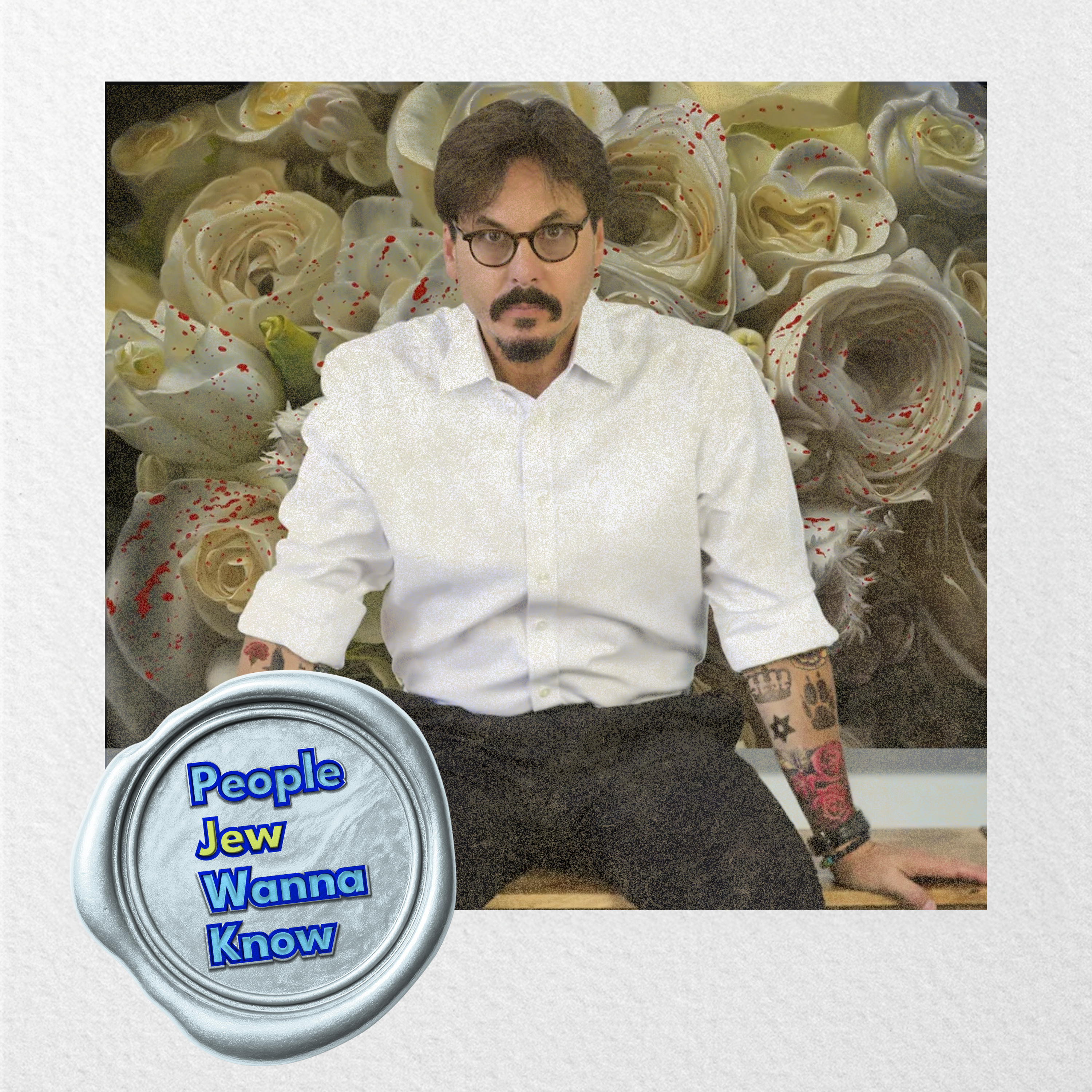
Hi everyone and welcome back to People Do You Wanna Know podcast. My guest today is an iconic, eclectic and very grounded artist, Mark Dennis. Mark Dennis is known for his hyper realistic paintings where he finds new meanings in old masters and explores contemporary questions of culture, humor, and identity. His inspiration comes from personal experiences ranging from accidentally starting a forest fire at age seven to his days camping in the Puerto Rican forest as a middle schooler. His art is also sometimes inspired by his troubled teen years which include multiple arrests, knife fights, several gun-related incidents, a night in jail, his day in court, and his highly influential post-college days living in a tepee on a Native American reservation. All of this you
will hear about in the episode. Mark is also incredibly well-traveled. He's lived in Israel, Rome, Venice, Florence, and Egypt as well as spent extensive time in the mountains of Peru. He considers himself a Jew-ben, a Jewish-Cuban, and is a very acclaimed and respected member of the R community, both as an artist and as an educator. What I'll add is that despite his turbulent upbringing, Mark has done an extraordinary amount for the Jewish community and he is also a highly devoted dad. He's turned himself around but he's retained still this kind of fun and edgy side. If you ever
see Mark anywhere, he will most likely be wearing his signature black and white Puma tracksuit. After we record it together, we split a potato quenish. He is an easy-going, well-rounded mensch and I'm so honored to know him. Hello, Mark. Welcome to People Jew Wanna Know Podcast. Thank you so much for being here. My pleasure. Thank you. Your iconic
tracksuit. I'm told I have to wear it forever now. People notice me in Art Ferris, they notice me in the street. So, you know, it's sort of a blessing and a curse. What's the signature look? I guess
so much. We paid by Puma. Sponsored by Puma. Okay, please tell us about yourself. What do you do and how did you get there? Well, I'm an artist, college professor. I was a tenured, I left the post
at the time to come back to the city. I was teaching up state. So, I now am sort of an independent instructor. I'm a full-time painter, a full-time single-divorce dad of two teenagers, which is a very big part of my life. And I'm represented with a gallery here in New York City called Harpers and I'm represented in Los Angeles with a gallery called an ab-geat gallery. I'm also a Holocaust
researcher, slash scholar and I take that kind of lightly because it's not full-time but I taught Holocaust studies as well. So, I did great pride in that as part of my identity. Tell me a little bit about your Jewish upbringing. You have teenage kids but you yourself as a teenager were a big rebel. So, I'm curious to know how that kind of unfolded. What was your Jewish upbringing
like? I love this topic because it feeds into everything that I kind of stand for today. It's odd. So, let me just say that as a kid, like maybe six or seven, I drew all the time, all day long, all day long. My parents were quite happy that they knew what I was buying me sitting in front of the TV drawing or looking at a book drawing or being out in the backyard drawing birds, whatever it might be.
But I never really wanted to be an artist. I always thought it was just this hobby that came to me naturally. I really enjoyed it. I found some great solace in it. I was also a very active restless kid, one of five boys in a relatively Jewish secular household. However, my dad grew up
in Cuba. He was born in Cuba because of my Zadian Bubby, Jakob and Gusi De Panko came from a very small shtetalab side, Giv came to America and were denied entry. They were told at the time, and this was a quote that my Zadie told me before he passed one time ago. He said, we were told either to go back or to go to Cuba or the rest of the Jews are going. Who knew? I don't know. He didn't know. He didn't speak any English. He spoke Russian,
cranium and Yiddish. So he went to Cuba and that's where he raised a family of four. My dad was one of them. So my dad in this old Jewish section of Havana was studying in Yishiba. He was relatively wealthy, the Doxie of the Sea, the Federal River in the roof. That's my Zadie and my bubby. They
were relatively wealthy dogs coming from a very small shtalab and made it work. And then they decided, you know, let's get out of here because Castro was taking over and that was a circus. So they came to Boston because they learned that they had a cousin and a cousin would sponsor them. You had to be sponsored. And the cousin's last name was D-A-N-I-S, Donis. And they learned it
through a lot of struggles and challenges trying to find out if they could come to America, to respond to it. And they discovered that there was a sponsor outside of Boston, a distant cousin that they never met. They didn't even meet them. They finally got to Boston. But when they finally got to Boston, it was a man, it was a guy who did their paperwork and he said, you got to change your name from the tengco. You got to give it something else. Like you're a sponsor here. You even has a weird name.
Maybe you should find a balance. Like, you know, it's a nice Irish city. This is what I was told. And he said, okay, what should we do? And he said, Dennis, Dennis, that's a good name for you.
And that was it. And my zed, he said, okay, we're Americans. Thank you. We're now Denises. So because my dad was relatively orthodox growing up, in very short time, he met my mom, who was from Roxbury, born in Somerville, but grew up in Roxbury. My dad, his family moved to
Dorchester on Blue Hill Avenue. And we were all born in Boston, me and my brothers. And he met this woman who was a secular Jew, Solomon, Joyce Solomon, Arlene Joyce Solomon. So they got married. They have five boys. And we were raised in a way that was rather, you know, mostly lean secular. But we did
all the high holidays. I think it was very difficult for him to manage. There's a term, you know, I never knew what it meant, hurting cats. But maybe it's good now because to have Shabbat with five of us, teenage boys, a year apart, dating sports, it was really challenging. Friday nights were big nights football and whatnot. So I think he gave that up. And my dad ultimately just became a secular Jew as
well. I, however, and this was a loop perspective when I was drawing as a kid, became fascinated with my ancestry. Like my zedian boy passed away. My nana and poppy on my mom's side were Polish, Hungarian. Maybe there's Lithuanian in there. I wasn't sure. Like no one really knew about the family. And then I
learned I had cousins living in Jerusalem and Maia Shurim, which means they're all to orthodox. And I'm like, I have cousins. I don't know. I mean, my mother said, yeah, Maia, she speaks from Boston. So Maia, you know, you got cousins everywhere. I mean, you want to meet them, reach out. I don't
know what to tell you. It's really hard. You know, but then I began to reach out. I did my research. And in 2001, I learned that I could go to Israel and maybe look for my cousins and Maia Shurim. Maybe,
I don't know, I wanted to try at least some point. And at that time, I was engaged in dialogue with my secular cousin who lived in Jerusalem. But he wasn't all to orthodox. He was, you know, like I said, and we started chatting. And he said, oh, yeah, you know, not only that, but you're like, you know, we have associations directly to Auschwitz, Bicano. And I'm like, wait, what? And he says, yeah, cousins
from the Klein family were all on paperwork, had been murdered at Bicano. And you know, most people don't know that Auschwitz is a massive camp of three camps. There's Auschwitz one, there's Auschwitz two, which was otherwise Bicano. And then they had one of its, which was a work camp, part of all the larger concentration camp unit. And I said, tell me more. So he told me, he gave me a list of the names.
Like, he had a copy of the paperwork somehow. You could find it. Yeah, the sham had paperwork, the Auschwitz memorial and was Shurim Poland had it. I think that's how you pronounce it. So, you know, the Germans changed names. So I had learned that on my mother's side of the family, we lost 24
people at Bicano murdered. And then we had seven distant cousins also on the Klein family who froze the deaths in the woods as partisan fighters. And this really empowered me to do more research. So based upon my research, by the way, I never, I did get to Israel several times and I never got my cousins. They were unreachable. I mean, my dreams really hard to penetrate and normally knew who I wasn't, you know.
So may I show you, I don't know if that was filmed and may I have to look into it, but it's like that. It's a community like that, really. So imagine like Williamsburg, you know, stacked high up. And if you see the movie was busy and I think it's filmed relatively close, which is fascinating, okay. So because I was interested in art and I did my research on the Holocaust, I went to Yad Vashem.
This is how it all started for me. All my studies on the show started on the state 2005. I walk into Yad Vashem. And on a wall was a small drawing of the moon, black and white sort of ink study. Like I looked interesting. And then I read Peter P. I. T. R.
You know, like a Czech spelling Peter Gins that it's seen what the Germans called, you know, the so-called Paradise Ghetto that Hitler had named so that when the American when the international Red Cross came to Prague, they would see that the Jews were being treated fairly, but it was all sham. You know, there's a soccer field and whatnot. But this was like a stopping point to go on to other concentration camps, mostly Auschwitz. So, and this was in Prague. So the little drawing on the wall said, you know, that it's seen Peter Gins age 15. And then it had like a date,
which I probably didn't pay much attention to because I walked immediately up to the person who was meaning multiple women. So I don't know, it was the person behind the front desk. And I said, please explain to me why you have a teenager do a rendering of a moon saying it's like moon over Auschwitz. I mean, why would it sit that odd? Like, was this an assignment to her? She goes,
no, that's an actual drawing that someone made who was in that it's seen the concentration camp with the otherwise referred to as, you know, a prison. And I said, wait, what they made art in the concentration camps? And she said, well, yeah, I mean, it's actually a very popular subject. I'm on certain scholars, but it's really not been studied thoroughly, except by two people, you know, and we have some of the artwork here in the building. And I said, well, I would give anything at the time.
I just accepted a teaching position full time, tenured professor position at a small liberal arts college in upstate New York. And I was on break now and I said, wow, you know, this could, I could bring back some of this information. I could share it. This is really important for me because being a professor, you know, academia really mattered. I was more of a professor at the time than a full-time painter. I mean, I was painting, but being a professor, I took great pride in that and I wanted to gather
as much information as possible to share in that context. And well, I see the drawings. I mean, am I allowed to? I mean, she was well, who are you? I said, well, I'm a professor of painting and drawing up in a small school in upstate New York in America. And, you know, I'm a Jew and it turns out that I
have cousins who perished in Birkenau and I would like to learn more about this and being an artist. I think this would be incredible information for a lot of reasons. And she said, absolutely, it's going on. I was like, wait, what? That easy? Because I'm an intuitive curator. And so we went
upstairs and I have a really cool photo because the curator said, you know, you've got to prove people that you're here. They're not going to believe you in the camera 2005. So I went up with White Glove and I handled artwork. And I noticed that they were made in various concentration camps. I mean, I'm thinking, wait, what? These are made in the camp. I mean, not just in that it's
scene which I learned later had an art program specifically so that the children in prison could make art to impress the international Red Cross, you know, to appease the world. You know, like, this is like 1939 to 40 before, you know, we really hit the fan after the Japanese bomb Pearl Harbor and we got involved and it became a massive deportation of Jews throughout Eastern Europe. And I said to her, well, why would they make art? How did they make art? Like, where did they get the supplies? Like, what? And that's what led me. I'm very proud of this. I wrote,
essentially a book, but it's a syllabus that I wrote that I brought back to the Dean and the President of the Small School that I was teaching. And I get requested that they review it and maybe included in a historical component for whoever teaches world history. And they said, well, this is a lot of art in here. Why don't you teach it? I said, well, I have a master's in art history. I mean,
you know, but the faculty like me, you know, there's a lot of politics in academia. But the faculty read it and they were blown away by it. And they said, let's teach it. You can teach it. So I taught this course called Under the Floorboards, Hidden Art of the Holocaust, because I had learned that mostly the artists that were imprisoned, which was the other question I asked myself if I were imprisoned as a Jew and as an artist, you know, I think I'm pretty skilled. And the Nazis loved
academic art. They loved people who skilled. They loved representational art, realism. So they would have loved my skills, said they would have hated me, but they would have forced me to make paintings of visiting dignitaries or portraits of Hitler and put them in the, you know, in the Houses of the concentration camp officers and the people who oversaw the camp structure. So I had put together this incredible syllabus and I taught it for 14 years. And it became an obsession
and it just grew and it got larger. And then I began to meet survivors. And then I thought about the fact that these survivors would not be around fast forward 10 years, which is kind of where we are today. And they're not around very few. So I joined forces with a friend of mine from Tel Aviv, who was a filmmaker. And we interviewed one particular survivor named Dean Adjakobson for,
I believe it was seven, eight hours, her entire story, but taking breaks, she was old, her husband had just passed. I had met them upstate and I'd become like best friends with them. So I had, this was before I was married with kids. So we're talking like 2005 to 2015. I had spot with them. I had I would go over just to have cookies and milk with Dina because she would
make, she'd call me and say, you know, you have to eat today and come over and have cookies and I'm like, okay, well, I have class and like an hour, you know, she did that in the school. And we got to become best friends and she would tell me her story. And I said, you know, Dean, before, you know, we have to, I want to record this. I want you to, because whatever you want to do, I'll work with you. She sat like we are now right in front of me. I had a camera on my head so that there was no,
like she would be looking at people looking at the camera like you just said to me earlier. And so it's me in front of her, you know, and it's her looking directly at me. And the idea of this film is for the survivor to tell their story. So it's Dina telling her story, their other survivors, but there's so much work in editing and things of that nature that I'm focusing on Dina Jacobson's testimony. And she's looking directly out at the viewer. So it's like just her head
speaking to whomever will take the time to watch it. It's in the editing phase. It's a lot of work. And this has been going on for years. So what do you want to say? That's like 20 years at this point that this has been in the works then?
Right. So that's when kids, so I got married, had kids. And I don't know what else to say, but unless somebody understands what it means to be a parent. Yeah. Devoted, dedicated. I mean, you could be, you know,
apparent, but I took, I took great pride in that more than anything in my life. And I became, that was mine. As you're speaking, I have this thought that, you know, you're telling me the story of an academic and a professor and like an, this like artsy men who is dedicated history to the community, but there's another dimension of you that's like kind of a troublemaker. And someone who pushes boundaries and does unconventional things. As you were speaking, I was curious, you mentioned to me that you lived on an Native American reservation. When was that in the timeline?
So let me loop back. And why did you even do it? I kind of sidestepped it. So I was drawing all the time as a kid and I loved it and I found great solace and I did say that I didn't want to be an artist. I wanted to be, you know, I don't know, as a biologist, a veterinarian. I had a lot of
different thoughts. Mostly had to do with animals of all kinds, you know, people think animals, worry animals, spiders are animals. So fast forward to high school, you know, even before high school, 14, I was, you know, eighth grade, I started stealing things. I was pretty good at it. I don't know where to go with this. I would walk into a store like Walmart and just, you know, clip a block and
a bike and walk out with it. Why did you want to steal stuff? I don't know. I've been asked that question a lot mostly by the cops when they go because I did get caught, which changed my life, which is why I'm an artist, I don't know. But I don't know. I was a challenge. I was restless.
I was a good kid. I did good. I did well in school. I never flunked the class. I'm an art one year, but that's another story. So I just didn't go to class. But anyway, I'm in high school now and I'm
15. I'm a sophomore and I went out of terror. I robbed. I stole. I broke into homes. I broke into businesses.
I never went into a bedroom to take personal things. But you know, I stole things out of people's garages mostly because I had run into a group of oddly bikers in the area. I can't really say much about this, but they always said to me, you know, if you can get me a, you know, makita, real set, you know, give you a hundred bucks or fifty bucks or whatever. And you know, that was 15. It was great. And this was in Massachusetts. Yeah. So in and around the suburbs, I mean,
I have a lot of stories. I mean, so many stories that got me into trouble. But ultimately, it comes down to the fact that I did get busted. I got arrested, cuffed, taking the jail. And then, naturally, I was released, but I had a court date. And in court, again, I didn't know what was going
to happen. But I was told prior, as I entered the courtroom, I was told prior to the judge, who met me independently. She said, I'm going to give you 20 minutes to explain yourself, you know, to a jury of your parents, peers, like they were all adults, people's homes, apparently, who I violated, cars I stolen, people who own those, whatever. I was so scared, but I thought, you know, I got to get a second check. I got something, I mean, something good has to come out of this because that's just the way I thought. And I went off 20 minutes when
the judge said you have 20 minutes to talk. Well, I'll gonna listen. It's just you. Even if you pause, it's still your time. We're not going to interrupt until 20 minutes is up. Everybody here knows that.
I understand being 15 and a half. You know, you could be a little nervous, but take your time. My God, I'm nonstop. I talk nonstop. No breaks. I don't even think I breathe
about how I love art, of how I love comic books, mainly of how my goal in life, once I graduate high school is to put these are my words, because I had this weird patriotic bent where I said that I wanted to be one of those people who could bring the old traditional American comic book back to the forefront so that anime would take a backseat. You have literally done that now, which is a crazy part. Okay. Well, you're really wonderful saying that. But so she's listening. I'm nonstop. And then she leans forward and she has two letters in her hands.
She's I'm going to read these letters out loud. And I was like, why you got letters who, you know, who I didn't know. I don't know who got a letter like what is this going to work with the letters. I didn't know. You know, my head was all over the place. And she said, one of your letters is one
of your teacher. It appears that you're on the you were on the yearbook committee. And that's a little funky. I mean, I didn't want it. I was too cool to get to let people know that. But so I looked
there. Like, really, you know that? I mean, you know, because I was like a hard ass, like, you know, and long hair, I wore a shirt. I had a shirt. I had a collage shirt record. But you know, I was like,
that tough kid. And I didn't want people to know that. And I was like, well, this is relevant. And she says, yeah, I'm gonna have to read this letter and I'm stood down. So please, let me read this.
And apparently the teacher who ran the yearbook club in the yearbook committee was also my English teacher. And you know, I didn't really know that at the time. I mean, I knew that but I didn't know that teachers took on clubs. Like, I only did it because they asked me to be on it. And I liked one of the girls on the club because I could draw. And they're like, dude, you could, can you
put can you draw characters or teachers for the yearbook? Can you draw cartoons and football players and you know, whatever. And it's like, yeah, I'd love to do that. You're gonna put it in print. So that was my motive, my motivation rather. And so she reads the letter and he said, and the letter
states that Mark Ennis is a very talented kid. He's a little restless, a little problematic, some other words, but you know, he's a really good kid. And you know, like, give him a second chance in other words. And then the other letter was from the vice principal of the school, who had said, Mark is a good kid. He's very well liked, no doubt. He's a handful. But I, you know,
it was very touching. He had said that I think the kid's gonna go places. That's simple. And she said, I'll make a decision. I didn't know anything until the next morning, but they gave me my second chance.
Do you think your parents had a role that they played in that? Or it was all the school? Because I imagine your George parents must have had a heart attack at that rate. Yeah, they were pissed. Yeah. Yeah, I remember it's right here. I remember every second when my
dad came to pick me up at the jail. He waited. Right? He said, oh, he waited. And then, you know, he was pissed. You know, I still don't know really why I did what I did, but I was always getting
into trouble. I mean, you know, second grade, I lit the woods on fire and started forest fires. So, I mean, that was a real big mess at the time. Nobody thought it was a kid. Like, I was Dennis the Menace. I was the Dennis the Menace in real life. Once you kind of had your second chance,
what brought you to the Native American reservation? So, like I said, I had really long hair, but I was very intrigued by Plains Tribe's culture, specifically Lakota, Cheyenne, and Arapaho. I was really curious about the American West. And I was more curious about the way that many of the tribes defeated the Calvary post-Civil War, like Custer. I really wanted to know what happened. I was really interested
in their culture, in a sense, that it was important to me to understand because it was what the history of this country was prior to the arrival of the Europeans. So, I did a lot of research, and I began to study the language, Lakota language, which is otherwise referred to as the Western Sioux Indians. And I began to learn the language. I thought it was really intriguing. I began to war war shirts. I had shirts made out of the Deerskin, like I was a dead kid in high school. See, I'm
telling you, I went to the prom. I mean, I got stories. And I had long hair, you know, like, as long as yours. If not a little bit longer, dark, I couldn't grow any facial hairs and people, but I was like, this half breed. I was either a patchy, who I also studied the different Apache tribes, because Geronimo really interested me, but that wasn't a patchy name. So, I wanted to learn
about crazy wars, Tashumko, I wanted to learn about sitting bull, you know, I wanted to learn all about their culture, all about their wars. So, one thing led to another, and then I went out west, much later, after high school. And while I was out west, I ran into a full-blooded Lakota Indian at a restaurant. And he came over to me because he heard me saying, you know, hokahay, watch daylo, I was talking to some other guy. And he said, you speak my language. And I said,
you're Lakota. And he said, yeah, my name's Darryl. And we started talking. And then he said, I want to invite you to the res, which was to me an incredible opportunity, Pine Ridge Indian reservation in South Dakota. So anyway, it butts up against another Indian reservation called Rosebud, which is where he was born, but his relatives and his sister now lived on Pine Ridge, which was a bigger reservation for like where, you know, Crazy Horse lived and Red Cloud, Akpia Lota, where you could see the Wounded Knee Memorial. So I went and I stayed with his sister, Darlene
Wounded Shield, that's her name, but she also goes by Ivis Milk. They have two names, a lot of the Lakota Indians, I met a befriended, had two names. It was an incredible experience. And then they said, you have to meet our holy man, you know, Richard moves camp. That was his name on the res. The res
is pretty big. I mean, you know, compared to the entire status of Dakota, you know, and the surrounding region, this is it's very small for what they knew. Like they no longer were nomadic, you know, buffalo hunters, but they were now on a res, you know, since like 1889 1890. And he said to me, you can live in my teepee on the edge of a creek, but you got to look at it's a ride. He had a big property. He had a
lot of property and it was like an hour ride across his property because he was a very popular guy. I think he's still allowed actually. So I said, okay, cool. So I learned really how to utilize a teepee, which I did not know I was unfamiliar on the flaps work and how to get a fire in the center going and how it stays so warm because I was wicked nervous because it snowed that night. And this was April ninth and it snowed and I'm thinking, Oh my God, I'm gonna go to the teepee for my first time and it's gonna snow. But I had to learn how to control the flaps. It's incredible, actually. So,
you know, I spent some time out there a couple of months and came back east and I was late 90s and I took a teaching job upstate. And so my life is comprised of all these, you know, pocketed and interested are being fed all the time. I'm still very much interested in planes, drive history, obviously the whole constant and painting. I mean, now full time, I like my teaching post. And your art kind of spans a couple of different things from what I saw last. All of
it feels kind of like hyper realistic but cartoonish in a sense. And it has this depth where you feel like you're immersed into the whatever you're looking at. So if there's a bunny with a bubble, the bunny's like right there in front of you in your face. And then at the same time you have the Jewish art that you make in your, you have a self portrait right that you've made where you dress like an Orthodox man. What kind of inspires these completely different pieces or how are you thinking about what you want to create? That's a really good question. As an artist, I really do it
to make sense of the world I live in. I don't know if it's anybody else's world but we share a world and we also, you know, we all have our own imaginations and so I combine the two. So I take what I understand is the real world, the real and physical world. And then I sort of allow it to merge with my imaginary world. So I'm kind of creating an alternate reality in my work. And I always thought that if
that's the case, how are people going to know it's me? Like how are they going to know it's my work? Because my style is not that unique. I am a hyperrealist. That's a term that someone applied to the nature of someone who paints very realistically but not directly from a photograph. Maybe using
photographs as reference but they don't copy a photograph which is what the photorelors did. They work directly from the photo. I violate the photo. I have many, many photos I work from. You know, photos being a screamer of the case. So I thought, well, I'm going to incorporate, you know, things
about me, my identity, my sense of humor, the fact that I grow in comic books. So I applied it all and I'm, and it's been really successful. So for some reason it's working. It resonates with people. And it was so delightful. And it has just like a lightheartedness about it that I think really
draws people in. Yeah, thank you. Look, we all know that there's an incredible sense of division amongst probably every country is sort of an imaginary civil war in their minds. Everybody takes sides. Trying to see both sides and, you know, nurture myself and make sure that I'm taking care of my kids in the way that I need to as they're dead. But as an artist, I don't care what people want.
I think about what is going to inspire and motivate me to spend 12 to 18 hours alone in the studio. And believe me, you said earlier that was a mensch. I love people. Well, you know, it's really hard being alone in the studio for that long. So if I'm going to be in the studio for that long, I better damn well have the proper inspiration. Like I can't think about what others will expect
of me. So I go in there and I just kind of think about my past, my childhood, my memories. And the thing that happens most is that I always want people to feel comfortable. Like I care. Like that's the mensch part. Like you had mentioned when you get up close to what you feel immersed in. You know,
it's like I'm painting blankets for people's minds or their souls. Like I'm giving them something that wrapped their head around. Like I don't make it difficult. I don't want it to be too conceptual. I want to be too disorienting. I want you to say, oh, you know what, I know what I'm
looking at. But my God, the presentation is bizarre. Who is this person? Well, I think that's also the part of the magic because it's so obvious. You're like, well, is that what I'm looking at? What
am I supposed to be looking at? And then you're kind of going through that stream of consciousness when you look at your art. Yeah. So when I was teaching, I was told the students said, listen, you're going to have your ideas. You're going to have your intentions. You're going to have your
inspirations, you know, the three eye component of making art ideas and tensions and inspiration. And there's the three part is you do it through experimentation, exploration, and do all of it with enthusiasm. So for me, I just, you know, it's because I teach that because I live it. I want people to take away whatever it is that they are able or not. I mean, because I have no control once the piece is done, how people might respond or how they might react or how might reverberate with them later. And I've learned that being an artist, you know, I'm always taking a chance.
Because it's all I do. It's all I do is I make art. Thank God there are people out there who want to live with it. And believe me, I go to bed every night, every night. First things I think about are my kids. Second is like, damn, somebody up there likes me. That's true. That is actually
oh, in fact, you know, art, we talk about this a lot on the show that art is a self-development process. And that's all it is. And a lot of art is not even it's kind of like you're just a vessel for conveying something that's provided to you outside of, you know, what you believe or how you want to be received. True artists are just a vessel for a greater message. And throughout all these life experiences, what wisdom do you think you want to pass on to your kids? Because I can see
that like this chapter of your life that you're in. Now you're a very invested father. And that's kind of the project that you're diving deeply on. So what is it that you you want to share with them? Yeah, they're 15, 17. I always impress upon them to be true to themselves. You gotta let kids go.
You gotta let them figure shit out. Like, I mean, no one I had no guidance. Obviously I screwed up a lot. But now that you know, I'm like feet, so to speak, I want I you know, I to just be true to themselves to listen to the world, figure it out. Like don't you know, everything in moderation is going to be extremist. It's going to be people who don't care. There's going to be people who care
too much. You got to take it all and strive and just figure it out. What about your message to Jewish people? What would it be? Well, I don't understand the question. You mean like, well, be true to
yourself. I think there are people who question themselves. And I think if you could take a breather and stop questioning yourself, I mean, you're a Jew, you're a Jew and live your life. I asked because you and I originally met at a dinner with a bunch of kind of content creators and Jewish activists. And a lot of the people in that room are very outspoken. And there's almost an
element of like aggression around. This is what we ought to believe as a Jewish people. Whereas your art, although it is very clearly Jewish, it doesn't really force any which way what the viewers should believe, which is a sign of good art. But I wonder how like how you make sense of that because you're involved in the community. And I want to know what you want the Jewish people to do.
Oh, wow. That's heavy. I love that Shabbat. I wish they did more of that. The Shabbat Dennis was great. I had a lot of fun and I appreciate having been invited. And you're right. There are a
lot of people who are in attendance, you know, different. They have a different perspective on things. So like going back to advice that my Nana gave me, my mom, who's relatives, Parris, didn't be like, you know, although she was born in America, she would always say to me, Mark, seek balance because I was a crazy kid, you know, my boys. Yeah, seek balance. Like, don't like, you don't always have to eat fast. You don't always have to rush. You don't always have to like,
you know, I don't know what she was. I mentioned it was nine. I didn't care about balance. I just, you know, you remember. Yeah, because I tell my kids now, everything in moderation, just seek between yourself, everything in moderation, seek balanced. You know, don't get trapped in
conversations you don't want to be part of, you know, excuse yourself or go for it. If you're that person who loves to debate and you're prepared, go for it. I said, the better informed you are, and more prepared, you're going to be for a debate, you know, whether it's healthy or unhealthy, you're going to be able to hold your ground. And nowadays, you know, with this whole, you know, the horrifying events that occurred in October 7th that pushed everyone to the brink of figuring out what to do next, you know, I can't tell someone not to be extreme and I can't tell someone, you know, who's all killed about it, like, to become more active. Those days, oh, I'm not that person. I'm focused on, I have, like, put it this way. I have a lot of energy, but I know
we're to put it. I can't be there for everyone all the time anymore. Because I used to try to be. But I am certainly a very, I am involved. I don't know what that ultimately means to a person listen to this, but I am part of the community in a sense that I will, I am in attendance to these lectures and discussion groups and Zoom calls that people talk about problem solving. And I don't know if I have
the answers, you know, I come from a family of five boys. I mean, I fucking punch this kid right in the face in seventh grade who called me a kike. Can I curse? Sorry. Just keep calling me a kike. I didn't
even know what kike was. No one had called me a kike up to that point in my life. But I'm thinking, wait, what? I don't even know what you, because I knew it had to mean something bad, like a book, because I just moved to this new town in Newtonville, Massachusetts, and this kid, you know, if only the angel will walk up to me and say, kike, you're in my seat. I'm like, what? Second day of classes,
I just moved there. I was a new kid. But apparently people knew who I was. I don't know why. I don't know how that happened. You know, word spreads a lot in seventh grade. I was like a forest fire.
But I got up and I beat the crap out of this kid and it turned out to be the toughest kid in the grade besides one of the kid Kevin Jones, this black dude who came up to me at lunch that day. It was like, part of the sea, he comes walking up towards me in the lunchroom and he said, you know, I heard you kick the angel's ass today. I'm like, whoa, I don't know if I kick, yeah, I punched him in the face a couple. He goes, yeah, man, that's cool. I hit that kid. So I got you back
from that one. And he walked away. So the toughest kid in the school embraced me because we both felt the kinship. And it was the first time in my life where I realized, you know, I now have this identity in the eyes of others. Like, I'm just a Jew growing up at that point. Like, you know,
at the temple, at high holidays, you know, and other Jewish friends by their mostly non-Jewish friends. No one brought it up till it came up, you know, here in seventh grade. And from that point forward, I thought, you know, I'm proud. I know who I am. I'm giving back to the community, not just the Jewish community, but you know, the global community. Like, I think what matters most
is not to always wake up angry. It was a big concern of mine when I was younger. I was in just restless. I was always, I was ready to fight. I was angry. I was this kid, you know,
and this teenager in this college kid that got into a lot of fights. But one thing I heard most of my life was funny, you don't look Jewish. And I kept thinking, my God, this whole Jewish thing is what would have, and then when I did the research towards the Holocaust course, and this is, you know, I'm a man, I'm reading about the protocols of the Elders of Zion, how it started in Russia, and how the Nazis had adopted it, and I thought, why weren't these? So, and then I did all this research on the history of being a Jew of Judaism, or the way that we reviewed in the eyes of others. And I was really disturbed by it, and I remained so, but I do it so that if I'm going to bring light to the fact that I am a Jew, I'm going to imbue it with my sense of humor, because I don't think I'm pretty funny. It's true. And so I started this body of work called Three Jews,
walk into a bar, and it's the bar that they're walking into. It's metaphorical because they're standing in front of a very famous painting by Edward Manet called the Follies-Barr's Re, and it's a woman's staring out, and it's, you know, the whole, there's a joke. You know, you could pick it, anyone could walk into a bar, like you could pick Rabbi Priest and a Buddhist to walk into a bar, you know, but I thought, fuck it, I'm going to, I'm going to, I'm going to june, I'm going to paint about my identity and the fact that we're funny, you know, I think for the most part, because if you look at comic history, not just comic book history, but comical actual humor history, you know, they're all Jews behind the fight stuff. People don't know that comic books were started as sort of like Batman, in particular Captain America, to fight Nazis. Captain America was only designed to fight the Nazis.
I don't think people even know this, but the comic book industry, you know, something I grew up on, I didn't know at the time, so I began to think, you know what, if I'm going to fight the fight, the good fight, I got to do it in the ways that only I can do it. There's a lot of people out there that can fight the good fight in the ways that they're able, because of not just their skillsets, but the positions that they are in. I'm an artist, so I make paintings, and the paintings, you know, I think they're pre-funny actually. And people love them. In fact, I had no idea that they would be embraced so, so widely, and the majority of buyers are non-Jews. I was there on your opening night,
and I think as interesting as it was to see the different pieces, of course, it was more interesting to see who showed up and how they responded. Wild going, it was a wild night. There was a guy with a parent. You know what I'm talking about? Yeah, the parent was a Jew. How do you know? I don't know.
I'm just walking a lot. There was just a man who brought a parent to the art exhibit. Well, it is, I mean, they were weirdos everywhere, but in the art community, or whatever, we've heard to the art planet, the art orbit, the galaxy, the universe, we exist. I mean, the weirdos come out, because I guess they're allowed to. I mean, they're accepted, which is fine, which is great, but it was also a lot of Hasidic Jews that came from Muncie, Williamsburg, Crown Heights. You had someone helping you on a
painting, right, who was an Orthodox Jew and Finney? Yeah, Finney. Yeah, I was interested, you know, it seems to me that you kind of seek spirituality, whether it's from your time on the reservation to the Jewish work that you do now, connecting with your heritage. Is there anything that really resonates with you and what you've learned? I like that you took notice that I seek spirituality. I do.
I do. And I was asked not long ago, what keeps you painting? Clearly, I have bills to pay and I love my life and I'm blessed and somebody likes me and if I can make art, I'm going to make art because my God, who I could not have imagined this back in the day that I would be doing this. I find my work, the spiritual stronghold. I find even sitting in my yard sketching, say a bird, it could be a nearby blue jarrow, you know, because I do birding. I love birds. I study birds and I study a lot of animal
life, but birds in particular because, you know, they're like, you know, they're dinosaurs and they intrigue me and even that, even putting even filling the blank page with marks that amount to a replication of a bird that I'm seeing in real life, there's something incredibly spiritual about that connection that I'm sharing that time and space with the bird that I'm capturing it on paper, that that paper will be around forever unless it's lost, you know, but the point being is that my takeaway from seeking spirituality, it's not over. I mean, I can answer that in my deathbed because I don't know. I mean, I just do it because, well, one, the world is chaotic. There's a lot of chaos. There's a lot of noise and I seek without knowing it. I think I seek quiet and at the studio is a very quiet place, even though
I might have music on or podcast or whatever, or guests and I'm speaking to them or talking, but, you know, in my mind, paintings are very quiet. I don't ever associate noises or sounds with my work. It's weird, but you know, they're quiet. They're these contemplative places and I think, you know, the takeaway for that is really if I have to, I mean, the reason why I've been seeking is because I need it. I think I just need a thrive on that quiet place. Two years ago on my show, I had a rabbi,
a very famous rabbi, Manus Friedman, and one of the things I dug up about him, that was not well-known, because I always like to dig things up about my guests. They're not obvious on the surface. He is a healer. So he has people flying in from all over the world. They could have diseases or, you know, emotional turmoil and he will heal them. And I heard of somebody, he does this out of Minnesota,
he used to and I'm from Minnesota. So I know a lot of people who know of Manus Friedman. One of the stories that I was able to share with him is someone had told me that their son had some ear infection that wouldn't go away and he had like horrible vertigo because of it and they went to Rabbi Manus Friedman. He wrote something down and piece of paper, gave him the piece of paper, so I put it in your pocket, forget about it. And that was it. And then an infection went out and away
at some point. And then after that, the kid was like, well, what was written on the paper, right? Because there's this paper in the pocket that he was supposed to forget about. Of course he looked, and it was the some random word, the googled word. It's a Latin word for the root of some plant to the plant to reduce infection. So the question is, why do he do all of that? And I asked him about
it. It's really bizarre thing to do, right? And he said, the reason I do that is because Judaism believes that words and things that we kind of emit outward that we put on paper have energy. So if I write a word on a piece of paper and the word is about healing, then I've created that energy on the piece of paper for the person to heal. And I think that's kind of like the philosophy on art is you're putting this energy onto paper to kind of make sense of the world. It's just another
medium. It's not a word. It's a drawing. It's very, it's wonderful to make that connection. Yeah, it's just funny because it was like two years on the dot that I had him and we talked about this and now I get to speak with someone who does it in a different way. But the message is
kind of the same. I definitely have no powers. I do believe in the power. It's going to sound this is probably the most cliche thing I've ever said in my life. But I do believe in the power of love. And I think if love is conveyed through art or through any form of like a medium, like you say
healing, you know, people take notice. I mean, we are animals. We feel the vibe of other creatures and just as humans might feel this will call vibe of another human and you know, they have a connection. And I think that's the great thing about art is that there's this connection that's there's this viable means to connect to others without ever really knowing it. Like, but yet you know, somewhere out there someone is feeling something from what it is that I've made.
Yeah. So moving us on to a less woo woo topic. I wanted to understand where the tracksuit came from. I was watching too many Sopranos episodes. This came much earlier because oddly, you know, I love the Sopranos and people, you know, someone I admit this, no one knows it.
I moved to Montclair, New Jersey, you know, from my kids. And I did not know that Sopranos were filmed out there. But when I moved out there and I was wearing my Plumeic tracksuit and I also had matching pants and people like, dude, what do you, what do you, what do you, what do you with that inspired by this apprentice? Like, come on, I mean, like a few people in that show were tracksuits, but you know, it's kind of funny, you know, and but prior to that, I remember distinctly looking for a jacket that was lightweight that I could wear that I could always have my wallet and my keys on my person, but without being in my pants pockets, I always hated things in my pants pockets always. I never understood that it just feels, you know, in the talk us it feels like an extra lump. It feels like you get a bulge and you don't need in the front. It's just weird. Like,
you know, and I had a lot of keys. I had keys. I had a car, I had a studio. So I, you know, when I grew up, you know, playing sports and, you know, I knew Puma, I know Adidas, Adidas, you know, the whole nature of the story between the German brothers. Yeah. And Nike, of course.
So I tried an Nike coat and Adidas coat and the Puma coat and the Puma coat fit the best. And it still fits the best and I've been wearing it for 20 for 20 years. But I always just liked it was black with a white stripe and I have this affinity for stripes on sleeves. And when I was studying the Lakota war shirts, the same shirts that they wore when they defeated Custer and the Seventh Calvary, you know, war shirts for the Indians, they would bead the sleeves on the outside. And I always was blown away by that design. I thought, why they should make, you know, shirts like that.
And I realized, oh my God, they do what's called a track suit or a track jacket. I loved things on the sleeves. There's a motorcycle store in Williamsburg, because we were living on Williamsburg before we moved. It's unclear, called Jane's motorcycles. And it's a great store. You know, they have a little
cafe in there. So I used to take my son in there and look at these motorcycles they built and they would serve, you know, like blueberry muffins and coffee. And they had a black long-sleeved shirt with the word Jane motorcycle down the side of it. And I bought as many as I could of those, just to have them. I don't know where they are now. But I wear it continually. And everybody takes notice. I go
dude, I never would have known you at, say, you know, at the honorees show or the, another art fair, like Art Basel. The people said, oh, I knew it was you because of the jacket. And I said, really? This is the idea. Look around. Do you think people are wearing Puma track suits at an
art fair? I mean, no way. You know. And I was like, okay. And then I just, you know, I always wore it and people kept commenting on it. So now it's become my thing. It's stuck. Yeah. The funny thing is so if you
read Puma, but you read it using the letters on the Russian alphabet, it spells the word rita, which is my name. So you are wearing my name. And that's so what that's so cool. Yeah. Only you could say that to me. Because that's my name. Russian. Plus it's a nice logo of the
Puma. Yeah. Leaping. You know, I, and I take great pride in that. Like it's a well-designed logo. I mean,
better than Nike and Adidas. There's someone that you need to meet and more clear now that I know that I'm sorry. We should talk about this later then. Okay. You know, the last living Jewish gangster. I thought I was a gangster. Wait, for real? Yeah, he lives there. Sugarman. Yeah. He's like
the modern day Meyer Lansky. Yeah. Uncle Meyer. For real? Well, okay. Let me just talk about it. Okay.
Tell me, how can people connect with you and keep up with your work? I would love if anybody has the wherewithal to get through this, my nonsense. They should message me on Instagram. I would like to hear from people. My Instagram, back in the day I wouldn't have, like I never thought it's a good thing. I mean, it's like, I get, there's a lot I get to share, you know, from my interests,
not just about my art, but you know, the Broadway shows I attend with my daughter. I talk about the food that I might cook. Like, I just cook the voice and steak for my son. I always talk about animals. And, you know, I find it like a way to entertain, you know, and I love that the people are kind of joining me on this crazy trip. So my Instagram is simply Dark Menace, which is, I got to tell you, I can't
take credit for it. You know, my students back in college nicknamed me The Dark Menace. And I didn't know why for like a week. I couldn't figure it out. Because it's like, like, the letter. And they
flip my initials. So not Mark Dennis, but Dark Menace. Why? Because I wore dark clothing. I was kind of a brooding human and dark hair, dark eyes. And I don't know, I always wear black. And they're like,
you're the dark menace. And I was like, okay, whatever. They were talking about me being abrasive or just moody. That might be the case. But nonetheless, it occurred to me. I'm like, you guys are all going to
get an A for the next project. This is a brilliant nickname. So that's my handle or whatever it's called. And your gallery is still in Chelsea, right? Harper's is in Chelsea. Harper's gallery. Harper's 22nd Street. You know, I showed with him. And
absolutely. In fact, Mark Galander's September 10th, I believe is the opening of my next solo show with him. Oh my gosh. I'm excited. Okay. Amazing. I have one final. Say like a Minnesota. Oh my gosh.
You're not that far from South Dakota. You know, you must know. I've been to South Dakota. And I've been to a reservation. Pine Ridge. Pine Ridge. You know, it's right off Costa State National Park,
which is I've been to a reservation. It's really it's like the second you cross energy kind of really changes. I think so for someone who understands the history and I'll just leave it at this, it's inspiring for someone who doesn't know the history and just kind of dress upon the reds because you can drive through it. It's pretty depressing. Yeah. But I'm there. You know, I imagine, you know,
the bison still moving across and no borders. You know, I romanticize it because I why not. Yeah, because you have that chapter in your life. I have one final question for you. It's one that I ask every guest of the show. Who would you like to nominate for people? Do you want to know?
Well, the first person that comes to mind is the person I had you had mentioned that you had been to the opening of my show and Adam Cohen who owns a HUD from the art world, very active also in his own way, the Jewish community gave me that opportunity to have these paintings presented where I don't think any other gallery would have given me that shot. You know, the show was called, which he was walking to a bar. I mean, it's all and he was very happy about it. And I don't know, he'd make a piss or guess plus he has a wicked accent. I don't know where that is from. Like somewhere in England.
I don't know if he's like speaking to Ozzy. Oh, sold got it. Thank you. Thank you so much for doing this. This is a fascinating. Yeah. Okay. Thanks for the invite. I loved it. I love doing this. I
can talk all day actually. If you've enjoyed this podcast, please go ahead and rate us five stars. You the first to hear our episodes by subscribing to people you want to know wherever you get your podcasts and for exclusive content, follow us on Instagram at people you want to know.