
EPISODE · Mar 27, 2025 · 6 MIN
Artificial Ground Truth Data Generation for Map Matching with Open Source Software (fossgis2025)
from Chaos Computer Club - archive feed (high quality) · host Adrian Wöltche
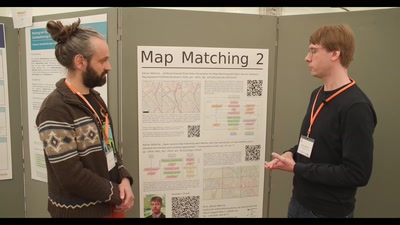
We present an open source pipeline for generating comparably authentic artificial ground truth data for map matching. We evaluate the generated data with our own open source map matching solution, and other existing open source solutions. Map matching is a well-known technology for resolving discrepancies between tracks recorded by Global Navigation Satellite Systems (GNSS) and road networks, such as the OpenStreetMap (OSM) road network. Due to measurement uncertainty of GNSS, e.g., atmospheric interference, signal reflections from buildings, or satellite opacity, the recorded tracks typically contain more or less strong noise of at least a few meters up to several hundreds of meters. This makes accurate map matching a difficult challenge. For developing, evaluating, and improving map matching algorithms, ground truth is necessary. However, providing ground truth is expensive, because it usually requires manual tracking and subsequent mapping with human memorization of personally recorded movements. As a result, there exist only a few isolated ground truth data sets today, consisting of singular tracks for map matching. Other existing map matching data sets are generally not ground truth, because they are hand-corrected map matching results. In addition, since both data set variants are manually mapped and corrected, they sometimes contain errors or at least arguable situations due to the human factor. To address the overall lack of ground truth data, we present in this work a new open source pipeline for generating artificial ground truth data for map matching. We use the open source mobility simulation software SUMO for generating movements for a region. We then extract the ground truth and we apply a newly developed tool for generating comparably authentic artificial GNSS noise on the track. We use the Ornstein-Uhlenbeck process and moving-average smoothing for generating more authentic noise than what is possible with simple Gaussian noise. Additionally, we can introduce some simple outliers into the tracks, which also can happen in practice. The tool allows for various settings to generate multiple diverse track sets with different noise characteristics from the ground truth. Finally, we evaluate and compare the matches of the artificially generated data sets with different open source map matching tools, e.g., Barefoot, GraphHopper, OSRM, Valhalla, Fast Map Matching (FMM), and our own high performance open source map matching solution "Map Matching 2" [1], which we present in more detail in our previous work [2]. Depending on the noise characteristics, the evaluation of the results will show for all solutions in comparison the overall most accurate and fastest ones, as well as individual strengths, weaknesses, and chances of improvement. This shows how our approach of artificially generating ground truth data facilitates future improvement and research of map matching. (Note: The presentation / the poster will be held / shown in German. Der Vortrag / das Poster wird auf Deutsch gehalten / präsentiert.) [1] A. Wöltche, "Map Matching 2", https://github.com/iisys-hof/map-matching-2 [2] A. Wöltche, "Open source map matching with Markov decision processes: A new method and a detailed benchmark with existing approaches", Transactions in GIS, vol. 27, no. 7, pp. 1959–1991, Oct. 2023, doi: https://doi.org/10.1111/tgis.13107 #### Poster und Einreichung im Akademic Track Zenodo-DOI: https://zenodo.org/records/14774143 Licensed to the public under https://creativecommons.org/licenses/by/4.0/ about this event: https://pretalx.com/fossgis2025/talk/YP9GZA/
Embed this episode
NOW PLAYING
Artificial Ground Truth Data Generation for Map Matching with Open Source Software (fossgis2025)
No transcript for this episode yet
Similar Episodes
No similar episodes found.
Similar Podcasts
No similar podcasts found.