
EPISODE · Aug 15, 2019 · 57 MIN
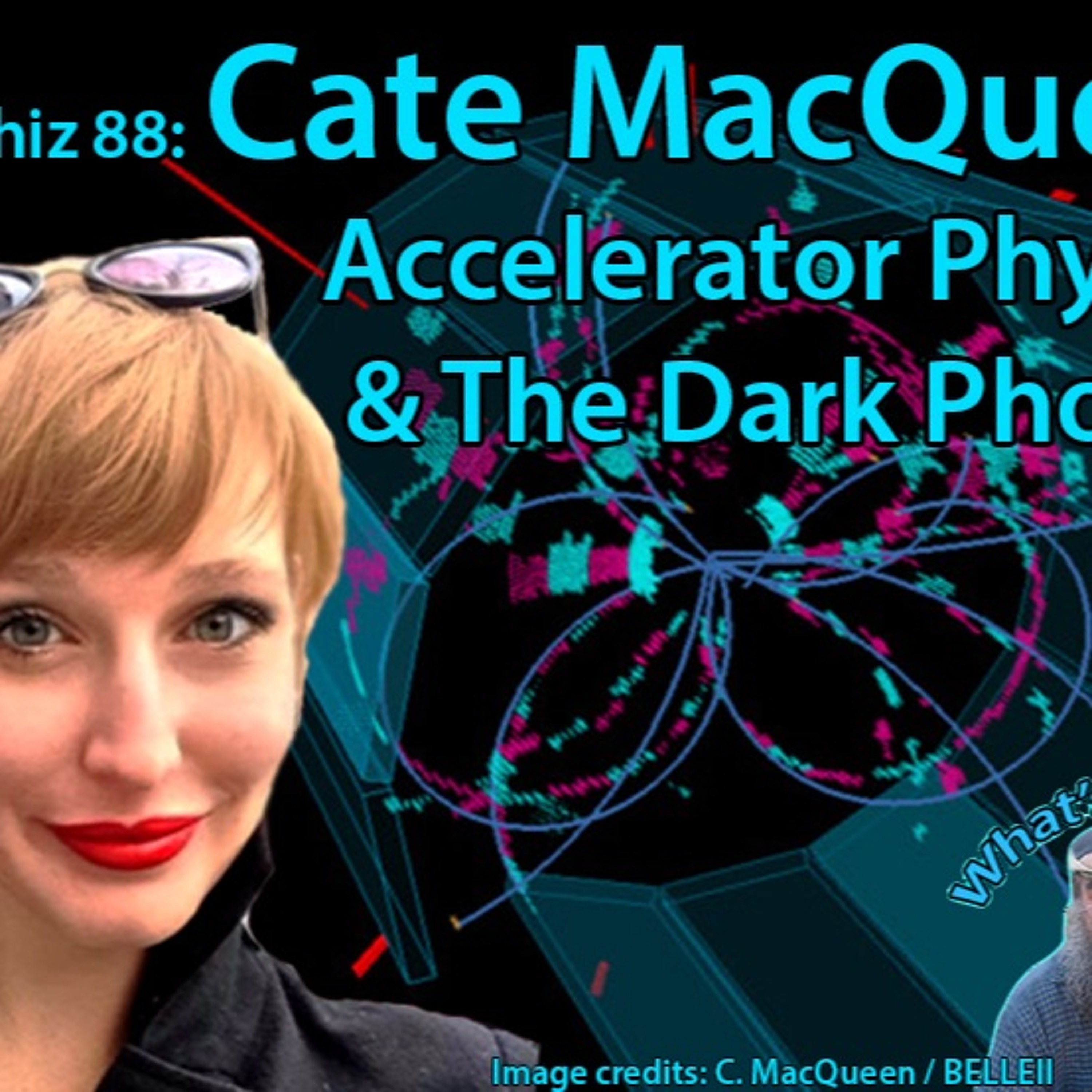
Astrophiz 88- Cate MacQueen- The Dark Photon
from Astronomy Astrophiz Podcast · host Brendan O'Brien: Astronomers, Astrophysicists & Space Scientists
Astrophiz 88: Cate MacQueen – The Dark Photon + ‘What’s Up Doc’ with Dr Ian ‘Astroblog’ Musgrave Listen: Today we are speaking with experimental particle physicist Cate MacQueen, who conducts analyses searching for dark matter at particle accelerators. Cate is currently based at The University of Melbourne and is part of the Dark Sector Physics team who are using the Belle II detector, which is attached to the SuperKEKB accelerator in Tsukuba, Japan. In ‘What’s Up Doc’ Dr Ian ‘Astroblog’ Musgrave tells observers and astrophotographers what to look for in the skies for the next two weeks and in ‘Ian’s tangent’ he tells us about comets captured crashing into Jupiter. In the News ,1. This latest report is assembled from a Nature article 2 days ago and a 9 August ArXiv preprint from Anderson et al available at tinyurlDOTcom/frbrepeaters Astronomers closer to cracking mystery of fast radio bursts Canadian CHIME radio telescope finds another eight repeating blasts These findings mean that there are now enough repeaters to start comparing these with one-off blasts, to find out whether the two kinds of FRB are produced in similar environments. Many, although not all, of the latest haul also share a feature of the first two repeaters. Rather than being a simple blast with a narrow frequency, the signals descend in frequency in a way that the team compares to a ‘sad trombone’ sound, and explaining them poses a challenge to theorists. So there you go. I bet you never thought astrophysicists would ever publish the phrase “Sad Trombone” .2. From Swinburne University of Technology, more exciting FRB news. Swinburne uses AI to detect fast radio bursts in real-time Wael Farah, a Swinburne PhD student has built an automated system that uses artificial intelligence to capture fast radio bursts (FRBs) in real-time from the Molonglo Observatory Synthesis Telescope. Five bursts were captured using the machine learning system and published in the Monthly Notices of the Royal Astronomical Society What this means is that with real-time detection and breakthroughs in localisation, it should be possible for other instruments to quickly examine FRB environments.The mystery of FRB mechanisms is unravelling as we speak. Watch this space. .3. Finally we have a great explanation from asteroid hunter and mathematician Daniel Bamberger on ‘Why couldn’t we use a network of radar equipped satellites to monitor asteroid threats?’ Go to: tinyurlDOTcom/noradar Have a read. It’s fabulous!
Embed this episode
NOW PLAYING
Astrophiz 88- Cate MacQueen- The Dark Photon
No transcript for this episode yet
Similar Episodes
No similar episodes found.
Similar Podcasts
No similar podcasts found.