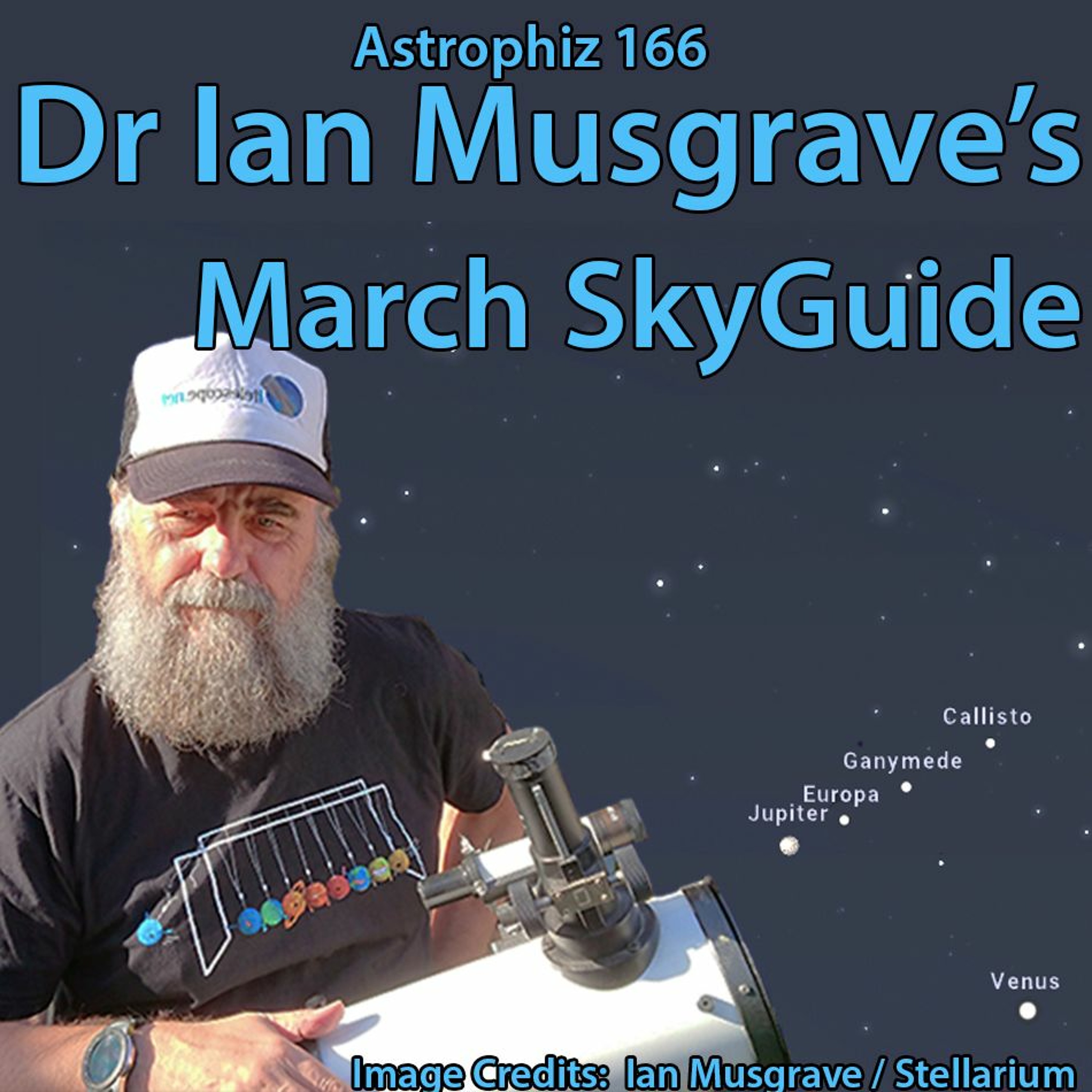
Astrophiz166 - March SkyGuide episode artwork

EPISODE · Feb 28, 2023 · 20 MIN

Astrophiz166 - March SkyGuide

from Astronomy Astrophiz Podcast · host Brendan O'Brien: Astronomers, Astrophysicists & Space Scientists

This month the planetary action is still largely in the western evening skies. Earth is at equinox on Tuesday, 21 March. At this time day and night are roughly equal in duration. March 2; Venus and Jupiter at their closest. March 3; Mercury and Saturn close low in the twilight. March 4; apogee Moon. March 7; Full Moon. March 15; Last Quarter Moon. March 20; the thin crescent moon near Saturn in the morning twilight. March 20; Moon at perigee. March 22; New Moon. March 24; the crescent Moon is very close to Venus in the twilight. March 29; First Quarter Moon. March 28; the Moon is close to Mars. March 30, Mars close to open cluster M35. March 31; Venus is just 1.5 degrees from Uranus. MERCURY: Mercury falls back towards the eastern horizon and is lost to view early in the month, reappearing in the evening twilight late this month. On the 3rd Mercury and Saturn are about 1 degree apart, deep in the twilight. You will need a level, unobstructed horizon and binoculars to see the pair at their best. VENUS: Venus climbs yet higher in the evening sky this month; the low angle of the ecliptic means it never gets really high although it is prominent at nautical twilight by end of the month when Venus is (just) visible when the sky is full dark. Venus has three close encounters this month. The stand out is on the 2nd when Venus and Jupiter are just 0.5 apart, visible well before nautical twilight, difficult telescopically. On the 24th Venus will be just 1° from the crescent moon, making a fine binocular sight. Venus currently looks like a gibbous Moon. On the 31st Venus is just 1.5 degrees from Uranus. MARS: Mars is making a line with Aldebaran and Beta Taurii. At the beginning of the Month Mars also forms a triangle with Beta and Zeta Taurii (the tips of the horns). Mars is shrinking in telescopic view but is still a worthwhile telescopic object this month. By the end of the Month Mars is close to the open cluster M35, an excellent sight in binoculars. On the 28th Mars is around 4° from the waxing moon (very obvious as the brightest object near the moon), mid power binocular fields will just fit the pair in. JUPITER: Jupiter is lowering in the north-western evening sky. Jupiter and Venus have been approaching each other all February, and on the 2nd on March they are just 0.5° apart. Jupiter continues to sink towards the horizon and is lost to view around mid month. SATURN: Saturn enters the morning skies but is only really visible from mid-March. On the 3rd Saturn is about 1 degree from Mercury deep in the twilight. You will need a level, unobstructed horizon and binoculars to see the pair at their best. On the 20th Saturn is close to the thin crescent moon low in the morning twilight.

This month the planetary action is still largely in the western evening skies. Earth is at equinox on Tuesday, 21 March. At this time day and night are roughly equal in duration. March 2; Venus and Jupiter at their closest. March 3; Mercury and Saturn close low in the twilight. March 4; apogee Moon. March 7; Full Moon. March 15; Last Quarter Moon. March 20; the thin crescent moon near Saturn in the morning twilight. March 20; Moon at perigee. March 22; New Moon. March 24; the crescent Moon is very close to Venus in the twilight. March 29; First Quarter Moon. March 28; the Moon is close to Mars. March 30, Mars close to open cluster M35. March 31; Venus is just 1.5 degrees from Uranus. MERCURY: Mercury falls back towards the eastern horizon and is lost to view early in the month, reappearing in the evening twilight late this month. On the 3rd Mercury and Saturn are about 1 degree apart, deep in the twilight. You will need a level, unobstructed horizon and binoculars to see the pair at their best. VENUS: Venus climbs yet higher in the evening sky this month; the low angle of the ecliptic means it never gets really high although it is prominent at nautical twilight by end of the month when Venus is (just) visible when the sky is full dark. Venus has three close encounters this month. The stand out is on the 2nd when Venus and Jupiter are just 0.5 apart, visible well before nautical twilight, difficult telescopically. On the 24th Venus will be just 1° from the crescent moon, making a fine binocular sight. Venus currently looks like a gibbous Moon. On the 31st Venus is just 1.5 degrees from Uranus. MARS: Mars is making a line with Aldebaran and Beta Taurii. At the beginning of the Month Mars also forms a triangle with Beta and Zeta Taurii (the tips of the horns). Mars is shrinking in telescopic view but is still a worthwhile telescopic object this month. By the end of the Month Mars is close to the open cluster M35, an excellent sight in binoculars. On the 28th Mars is around 4° from the waxing moon (very obvious as the brightest object near the moon), mid power binocular fields will just fit the pair in. JUPITER: Jupiter is lowering in the north-western evening sky. Jupiter and Venus have been approaching each other all February, and on the 2nd on March they are just 0.5° apart. Jupiter continues to sink towards the horizon and is lost to view around mid month. SATURN: Saturn enters the morning skies but is only really visible from mid-March. On the 3rd Saturn is about 1 degree from Mercury deep in the twilight. You will need a level, unobstructed horizon and binoculars to see the pair at their best. On the 20th Saturn is close to the thin crescent moon low in the morning twilight.

NOW PLAYING

Astrophiz166 - March SkyGuide

0:00 20:19

No transcript for this episode yet

We transcribe on demand. Request one and we'll notify you when it's ready — usually under 10 minutes.

Ask A Spaceman Archives - 365 Days of Astronomy Ask A Spaceman Archives - 365 Days of Astronomy Podcasting Astronomy Every Day of the Year That Hoarder: Overcome Compulsive Hoarding That Hoarder Hoarding disorder is stigmatised and people who hoard feel vast amounts of shame. This podcast began life as an audio diary, an anonymous outlet for somebody with this weird condition. That Hoarder speaks about her experiences living with compulsive hoarding, she interviews therapists, academics, researchers, children of hoarders, professional organisers and influencers, and she shares insight and tips for others with the problem. Listened to by people who hoard as well as those who love them and those who work with them, Overcome Compulsive Hoarding with That Hoarder aims to shatter the stigma, share the truth and speak openly and honestly to improve lives. The Small Business Startup School – Business Notes | Financial Literacy | Retail Psychology – For Professionals & Entrepreneurs The Small Business Startup School Inc. Starting or buying a small business? While personal circumstances may vary, business patterns remain timeless. On The Small Business Startup School, we explore strategies, insights, and practical solutions to help entrepreneurs confidently navigate their journey.Hosted by Ola Williams—a retail entrepreneur, fintech founder, and financial coach with over two decades of experience—this podcast marries financial awareness and retail psychology with optimism to deliver actionable takeaways.Join us to learn, grow, and connect as we uncover the keys to business success.Let’s continue to learn together and be encouraged to keep on connecting! DIOSA. Carolina Sanper This podcast is a sacred space created by Carolina Sanper where you connect with your inner wisdom and embody your magnetic feminine power.It is the realization that the mystical realm is where you plant the seeds of your desired reality.It is a portal to your true essence: awareness, presence, and receiving with ease. Welcome home, DIOSA. 🖤

Frequently Asked Questions

How long is this episode of Astronomy Astrophiz Podcast?

This episode is 20 minutes long.

When was this Astronomy Astrophiz Podcast episode published?

This episode was published on February 28, 2023.

What is this episode about?

This month the planetary action is still largely in the western evening skies. Earth is at equinox on Tuesday, 21 March. At this time day and night are roughly equal in duration. March 2; Venus and Jupiter at their closest. March 3; Mercury and...

Can I download this Astronomy Astrophiz Podcast episode?

Yes, you can download this episode by clicking the download button on the episode player, or subscribe to the podcast in your preferred podcast app for automatic downloads.
URL copied to clipboard!