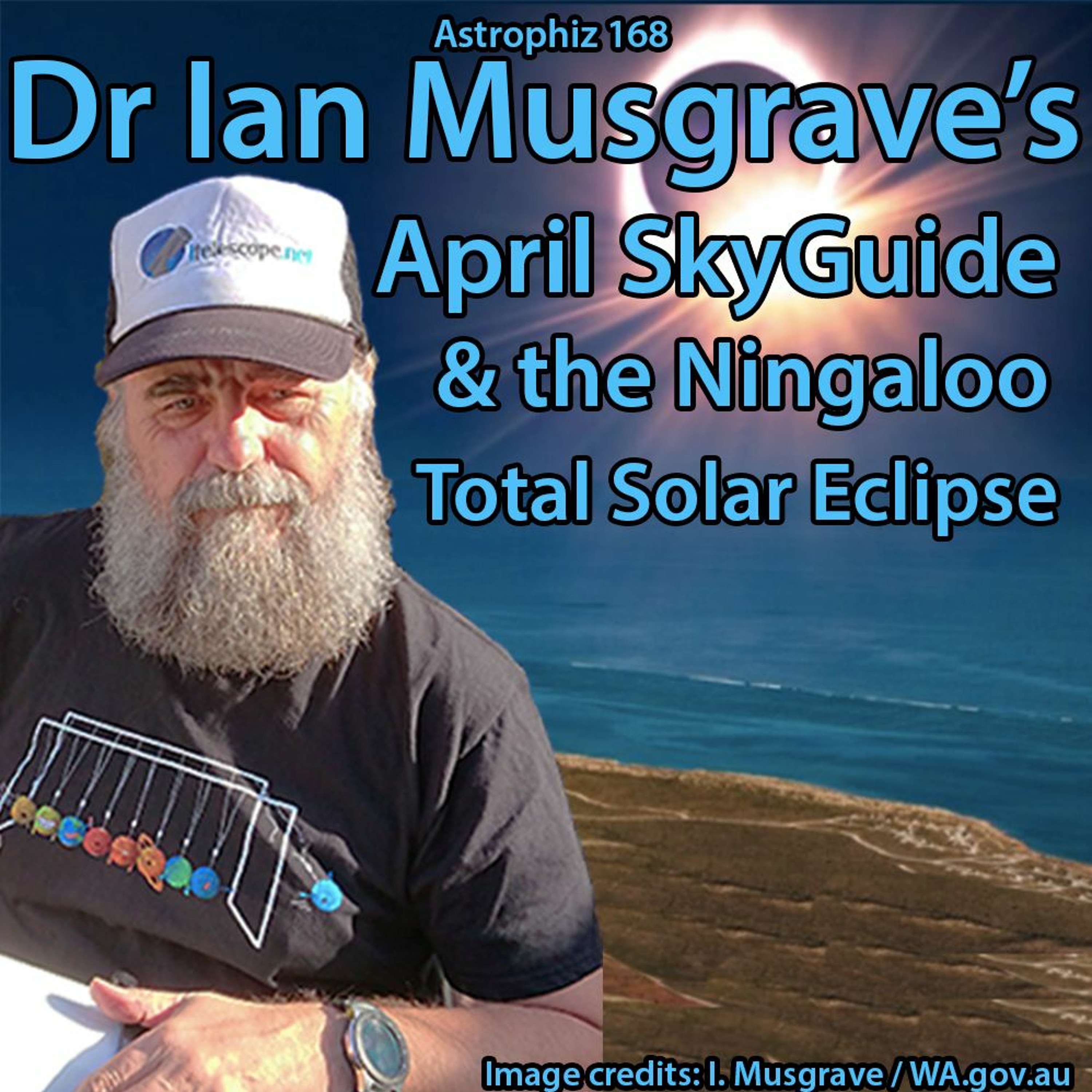
Astrophiz168: April SkyGuide episode artwork

EPISODE · Mar 30, 2023 · 24 MIN

Astrophiz168: April SkyGuide

from Astronomy Astrophiz Podcast · host Brendan O'Brien: Astronomers, Astrophysicists & Space Scientists

Shownotes In Australia Daylight Saving ends on April 2nd Moon Phases: Full moon April 6th So for those out camping over Easter, you’ll have very nice dark skies to see lots of clusters and nebulae as well as Venus and Mars without any interference from the moon. Last Quarter April 13th Perigee moon April 16th New Moon April 20th First Quarter (apogee) Moon appears in evening skies on April 28th. In the Evening Skies Mercury is a very difficult target even for those with very low western horizons. Venus is very easily observed in the West in the early evening just after sunset for an hour and a half. Over April Venus is moving closes and closer to the iconic open cluster the Pleiades and between the 10th and the 12th Venus and the Pleiades close together will make great binocular viewing. On the 23rd Venus is just 3 degrees from the crescent moon. Mars is still prominent, but is shrinking and fading and moving from the Taurus constellation into Gemini. At the start of April is close to the open cluster M35 and within binocular distance from the 1st to the 4th. On the 26th Mars is close to the waxing moon. The Emu dark constellation is always great to see around 10pm when the sky is fully dark. In the Morning Skies Jupiter is lost to view in evening skies and won’t turn up in morning skies till May. Saturn is climbing higher and higher in the morning skies, easily seen an hour before sunrise On the 16th and 17th Saturn is near the thin crescent moon Orion the Hunter is sinking to the West and Scorpius is rising in the East April’s Signature Event ~ A Total Solar Eclipse A Total Solar Eclipse in remote Western Australia is on the April 20, but all accomodation and campsites have been fully booked out years in advance, so if you’re not booked in, you’re best to see totality happen by watching online. Other parts of Australia will experience a partial solar eclipse. On April 20, the shadow of the moon will graze in a 40-kilometre-wide track over one of the most beautiful parts of the world – the World Heritage-listed Ningaloo region near Exmouth. The website at Ningalooeclipse-DOT-com is highly recommended. For Western Australia start to look about 10am Perth residents will see 71% of the sun covered at 11:20am Darwin gets 80% of the sun covered at 1:50pm For Central Australia and Northern Territory their partial eclipse begins around 12 noon. For Eastern States it’s round about 1pm, with only a small percentage of the sun covered. DO NOT LOOK DIRECTLY AT THE SUN. You WILL go blind. Specialist astronomical solar glasses from astronomical supply shops are OK for viewing, and NEVER used ’smoked glass’ or ‘filters’ or you will lose your vision. Ian describe how to make a pinhole projector to safely observe an image of the eclipse which is projected onto a flat surface Further safe observing tips can be found on Ian’s Astroblog at astrobloggerDOTblogspotDOTcom Ian’s Tangent The Colours of Space Our eyes can only see the visible spectrum ROYGBIV Bees can see in the ultra violet. The famous Hubble images are obtained by using filters and assigning colours using the Hubble Pallette. Most meteorites do not have striking colours, some comets and meteors can have spectacular colours. Gases in space can predominantly be Hydrogen, Helium, Methanol and Ethanol, and many complex molecules have been observed and identified. The Orion Nebula’s colour is due to ethanol, and Ian goes on to explain how the spectacular colours of space are out of this world. Next Episode: And in 2 weeks find out all the latest in X-ray astronomy and high energy astrophysics from Dr Rodolfo Montez from The Harvard-Smithsonian Chandra X-ray Observatory.

Shownotes In Australia Daylight Saving ends on April 2nd Moon Phases: Full moon April 6th So for those out camping over Easter, you’ll have very nice dark skies to see lots of clusters and nebulae as well as Venus and Mars without any interference from the moon. Last Quarter April 13th Perigee moon April 16th New Moon April 20th First Quarter (apogee) Moon appears in evening skies on April 28th. In the Evening Skies Mercury is a very difficult target even for those with very low western horizons. Venus is very easily observed in the West in the early evening just after sunset for an hour and a half. Over April Venus is moving closes and closer to the iconic open cluster the Pleiades and between the 10th and the 12th Venus and the Pleiades close together will make great binocular viewing. On the 23rd Venus is just 3 degrees from the crescent moon. Mars is still prominent, but is shrinking and fading and moving from the Taurus constellation into Gemini. At the start of April is close to the open cluster M35 and within binocular distance from the 1st to the 4th. On the 26th Mars is close to the waxing moon. The Emu dark constellation is always great to see around 10pm when the sky is fully dark. In the Morning Skies Jupiter is lost to view in evening skies and won’t turn up in morning skies till May. Saturn is climbing higher and higher in the morning skies, easily seen an hour before sunrise On the 16th and 17th Saturn is near the thin crescent moon Orion the Hunter is sinking to the West and Scorpius is rising in the East April’s Signature Event ~ A Total Solar Eclipse A Total Solar Eclipse in remote Western Australia is on the April 20, but all accomodation and campsites have been fully booked out years in advance, so if you’re not booked in, you’re best to see totality happen by watching online. Other parts of Australia will experience a partial solar eclipse. On April 20, the shadow of the moon will graze in a 40-kilometre-wide track over one of the most beautiful parts of the world – the World Heritage-listed Ningaloo region near Exmouth. The website at Ningalooeclipse-DOT-com is highly recommended. For Western Australia start to look about 10am Perth residents will see 71% of the sun covered at 11:20am Darwin gets 80% of the sun covered at 1:50pm For Central Australia and Northern Territory their partial eclipse begins around 12 noon. For Eastern States it’s round about 1pm, with only a small percentage of the sun covered. DO NOT LOOK DIRECTLY AT THE SUN. You WILL go blind. Specialist astronomical solar glasses from astronomical supply shops are OK for viewing, and NEVER used ’smoked glass’ or ‘filters’ or you will lose your vision. Ian describe how to make a pinhole projector to safely observe an image of the eclipse which is projected onto a flat surface Further safe observing tips can be found on Ian’s Astroblog at astrobloggerDOTblogspotDOTcom Ian’s Tangent The Colours of Space Our eyes can only see the visible spectrum ROYGBIV Bees can see in the ultra violet. The famous Hubble images are obtained by using filters and assigning colours using the Hubble Pallette. Most meteorites do not have striking colours, some comets and meteors can have spectacular colours. Gases in space can predominantly be Hydrogen, Helium, Methanol and Ethanol, and many complex molecules have been observed and identified. The Orion Nebula’s colour is due to ethanol, and Ian goes on to explain how the spectacular colours of space are out of this world. Next Episode: And in 2 weeks find out all the latest in X-ray astronomy and high energy astrophysics from Dr Rodolfo Montez from The Harvard-Smithsonian Chandra X-ray Observatory.

NOW PLAYING

Astrophiz168: April SkyGuide

0:00 24:31

No transcript for this episode yet

We transcribe on demand. Request one and we'll notify you when it's ready — usually under 10 minutes.

Ask A Spaceman Archives - 365 Days of Astronomy Ask A Spaceman Archives - 365 Days of Astronomy Podcasting Astronomy Every Day of the Year That Hoarder: Overcome Compulsive Hoarding That Hoarder Hoarding disorder is stigmatised and people who hoard feel vast amounts of shame. This podcast began life as an audio diary, an anonymous outlet for somebody with this weird condition. That Hoarder speaks about her experiences living with compulsive hoarding, she interviews therapists, academics, researchers, children of hoarders, professional organisers and influencers, and she shares insight and tips for others with the problem. Listened to by people who hoard as well as those who love them and those who work with them, Overcome Compulsive Hoarding with That Hoarder aims to shatter the stigma, share the truth and speak openly and honestly to improve lives. The Small Business Startup School – Business Notes | Financial Literacy | Retail Psychology – For Professionals & Entrepreneurs The Small Business Startup School Inc. Starting or buying a small business? While personal circumstances may vary, business patterns remain timeless. On The Small Business Startup School, we explore strategies, insights, and practical solutions to help entrepreneurs confidently navigate their journey.Hosted by Ola Williams—a retail entrepreneur, fintech founder, and financial coach with over two decades of experience—this podcast marries financial awareness and retail psychology with optimism to deliver actionable takeaways.Join us to learn, grow, and connect as we uncover the keys to business success.Let’s continue to learn together and be encouraged to keep on connecting! DIOSA. Carolina Sanper This podcast is a sacred space created by Carolina Sanper where you connect with your inner wisdom and embody your magnetic feminine power.It is the realization that the mystical realm is where you plant the seeds of your desired reality.It is a portal to your true essence: awareness, presence, and receiving with ease. Welcome home, DIOSA. 🖤

Frequently Asked Questions

How long is this episode of Astronomy Astrophiz Podcast?

This episode is 24 minutes long.

When was this Astronomy Astrophiz Podcast episode published?

This episode was published on March 30, 2023.

What is this episode about?

Shownotes In Australia Daylight Saving ends on April 2nd Moon Phases: Full moon April 6th So for those out camping over Easter, you’ll have very nice dark skies to see lots of clusters and nebulae as well as Venus and Mars without any interference...

Can I download this Astronomy Astrophiz Podcast episode?

Yes, you can download this episode by clicking the download button on the episode player, or subscribe to the podcast in your preferred podcast app for automatic downloads.
URL copied to clipboard!