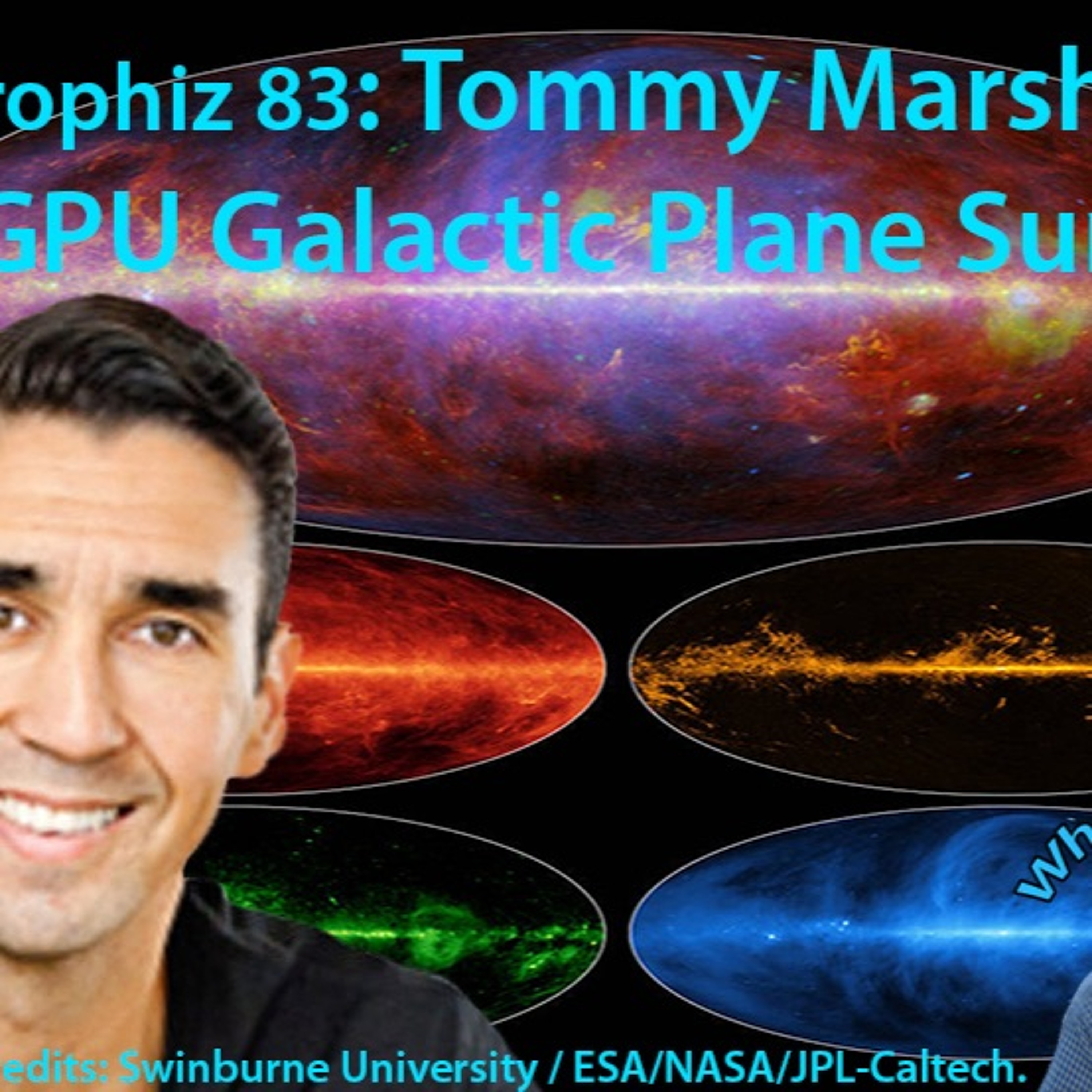
Astrophiz83-Tommy Marshman-GPU Pipelines episode artwork

EPISODE · Jun 6, 2019 · 36 MIN

Astrophiz83-Tommy Marshman-GPU Pipelines

from Astronomy Astrophiz Podcast · host Brendan O'Brien: Astronomers, Astrophysicists & Space Scientists

Today we’d like to welcome Tommy Marshman, an early stage researcher who is completing his Masters of Research at Macquarie University in Sydney Australia. Tommy explains his research comparing the effectiveness of CPU and GPU pipelines when working with galactic plane surveys using Parkes data. In ‘What’s Up Doc’ for astrophotographers and observers, Dr Ian ‘Astroblog’ Musgrave tells us what to look out for in the morning and evening skies. In ‘Ian’s Tangent’ he looks at the controversy surrounding Elon Musk's Starlink 'constellation' of satellites. ere is the Astrophiz news. News: .1. In a paper published today in Nature, another fabulous example of how archival data can be cleverly interrogated to lead to great new discoveries. The paper is titled: A cool accretion disk around the Galactic Centre black hole Lead author, PhD student Lena Murchikova and her colleagues used data gathered in 2015 by the Atacama Large Millimeter/submillimeter Array (ALMA) to discover a thin rotating accretion disk of material extremely close to the black hole that is sending streams of material spiraling inward. Earlier studies had revealed a more distant disk of warm gas farther away from the black hole which may feed the newfound cooler disk. We have detected a number of supermassive black holes with bright hot disks of orbiting gases around them, but up till now, SagA*, the supermassive black hole at the center of our Milky Way has not shown much at all, so while there is still so much more to learn about SagA* kudos to Murchikova and her team. .2. A group of international astronomers say they have observed a "forbidden" planet closely orbiting a star. The discovery of the exoplanet NGTS-4b was revealed in a study published by the Royal Astronomical Society and has challenged our understanding of stars and solar systems. Key points: A team of international astronomers found the exoplanet NGTS-4b by using the transit method and looking for a dip in light in front of the star The planet NGTS-4b exists in a "Neptunian Desert" zone where previous studies found no gaseous planets It was found in the "Neptunian Desert", a zone previously thought to be inhospitable to gaseous Neptune-like planets. This area receives such strong heat and radiation, it was thought planets would not be able to retain their gaseous atmosphere — it would simply evaporate, leaving only a rocky core. But NGTS-4b still has its gaseous atmosphere. The researchers believe the planet may have moved into the zone relatively recently, in the last 1 million years It's about three times the size of Earth and 920 light-years away from our planet. .3. For those who want to have a look for the starlink satellites passing over their home, go to tinyurl.com/starlinkme

Today we’d like to welcome Tommy Marshman, an early stage researcher who is completing his Masters of Research at Macquarie University in Sydney Australia. Tommy explains his research comparing the effectiveness of CPU and GPU pipelines when working with galactic plane surveys using Parkes data. In ‘What’s Up Doc’ for astrophotographers and observers, Dr Ian ‘Astroblog’ Musgrave tells us what to look out for in the morning and evening skies. In ‘Ian’s Tangent’ he looks at the controversy surrounding Elon Musk's Starlink 'constellation' of satellites. ere is the Astrophiz news. News: .1. In a paper published today in Nature, another fabulous example of how archival data can be cleverly interrogated to lead to great new discoveries. The paper is titled: A cool accretion disk around the Galactic Centre black hole Lead author, PhD student Lena Murchikova and her colleagues used data gathered in 2015 by the Atacama Large Millimeter/submillimeter Array (ALMA) to discover a thin rotating accretion disk of material extremely close to the black hole that is sending streams of material spiraling inward. Earlier studies had revealed a more distant disk of warm gas farther away from the black hole which may feed the newfound cooler disk. We have detected a number of supermassive black holes with bright hot disks of orbiting gases around them, but up till now, SagA*, the supermassive black hole at the center of our Milky Way has not shown much at all, so while there is still so much more to learn about SagA* kudos to Murchikova and her team. .2. A group of international astronomers say they have observed a "forbidden" planet closely orbiting a star. The discovery of the exoplanet NGTS-4b was revealed in a study published by the Royal Astronomical Society and has challenged our understanding of stars and solar systems. Key points: A team of international astronomers found the exoplanet NGTS-4b by using the transit method and looking for a dip in light in front of the star The planet NGTS-4b exists in a "Neptunian Desert" zone where previous studies found no gaseous planets It was found in the "Neptunian Desert", a zone previously thought to be inhospitable to gaseous Neptune-like planets. This area receives such strong heat and radiation, it was thought planets would not be able to retain their gaseous atmosphere — it would simply evaporate, leaving only a rocky core. But NGTS-4b still has its gaseous atmosphere. The researchers believe the planet may have moved into the zone relatively recently, in the last 1 million years It's about three times the size of Earth and 920 light-years away from our planet. .3. For those who want to have a look for the starlink satellites passing over their home, go to tinyurl.com/starlinkme

NOW PLAYING

Astrophiz83-Tommy Marshman-GPU Pipelines

0:00 36:52

No transcript for this episode yet

We transcribe on demand. Request one and we'll notify you when it's ready — usually under 10 minutes.

Ask A Spaceman Archives - 365 Days of Astronomy Ask A Spaceman Archives - 365 Days of Astronomy Podcasting Astronomy Every Day of the Year That Hoarder: Overcome Compulsive Hoarding That Hoarder Hoarding disorder is stigmatised and people who hoard feel vast amounts of shame. This podcast began life as an audio diary, an anonymous outlet for somebody with this weird condition. That Hoarder speaks about her experiences living with compulsive hoarding, she interviews therapists, academics, researchers, children of hoarders, professional organisers and influencers, and she shares insight and tips for others with the problem. Listened to by people who hoard as well as those who love them and those who work with them, Overcome Compulsive Hoarding with That Hoarder aims to shatter the stigma, share the truth and speak openly and honestly to improve lives. The Small Business Startup School – Business Notes | Financial Literacy | Retail Psychology – For Professionals & Entrepreneurs The Small Business Startup School Inc. Starting or buying a small business? While personal circumstances may vary, business patterns remain timeless. On The Small Business Startup School, we explore strategies, insights, and practical solutions to help entrepreneurs confidently navigate their journey.Hosted by Ola Williams—a retail entrepreneur, fintech founder, and financial coach with over two decades of experience—this podcast marries financial awareness and retail psychology with optimism to deliver actionable takeaways.Join us to learn, grow, and connect as we uncover the keys to business success.Let’s continue to learn together and be encouraged to keep on connecting! DIOSA. Carolina Sanper This podcast is a sacred space created by Carolina Sanper where you connect with your inner wisdom and embody your magnetic feminine power.It is the realization that the mystical realm is where you plant the seeds of your desired reality.It is a portal to your true essence: awareness, presence, and receiving with ease. Welcome home, DIOSA. 🖤

Frequently Asked Questions

How long is this episode of Astronomy Astrophiz Podcast?

This episode is 36 minutes long.

When was this Astronomy Astrophiz Podcast episode published?

This episode was published on June 6, 2019.

What is this episode about?

Today we’d like to welcome Tommy Marshman, an early stage researcher who is completing his Masters of Research at Macquarie University in Sydney Australia. Tommy explains his research comparing the effectiveness of CPU and GPU pipelines when working...

Can I download this Astronomy Astrophiz Podcast episode?

Yes, you can download this episode by clicking the download button on the episode player, or subscribe to the podcast in your preferred podcast app for automatic downloads.
URL copied to clipboard!