
EPISODE · Dec 5, 2025 · 13 MIN
AT2022zod: An Unusual Tidal Disruption Event
from Multi-messenger astrophysics · host Astro-COLIBRI
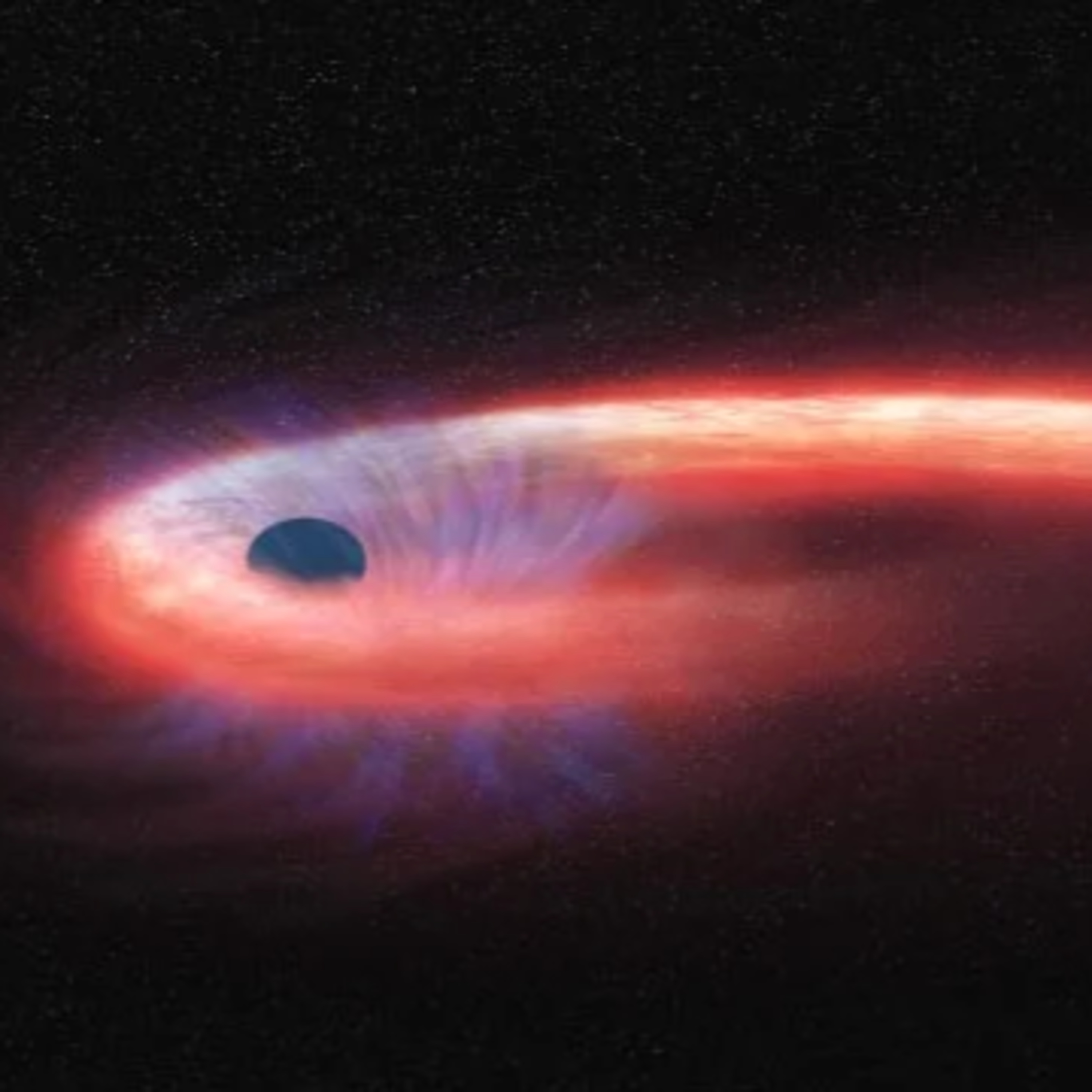
**Topic:** Tidal Disruption Events (TDEs) are short-lived optical flares that occur when a black hole shreds a star, offering valuable insight into black hole demographics. This episode dives into the unusual characteristics and implications of the event AT2022zod.**The Event:*** AT2022zod was identified as an extreme, short-lived optical flare in an elliptical galaxy at a redshift of 0.11.* The event lasted roughly 30 days, with a rapid rise time of approximately 13 days.* It reached a high peak luminosity, positioning it at the extreme end compared to most supernovae.**The Puzzle:*** The host galaxy is estimated to contain a massive central Supermassive Black Hole (SMBH) of about $1.0 \times 10^8 M⊙$.* However, AT2022zod’s short duration and luminosity are **inconsistent** with a TDE powered by this central SMBH.* Modeling and comparison with other TDEs suggest AT2022zod originated from a lower-mass black hole within the system.* The event is highly unlikely to be an AGN flare, as it was the only significant flaring activity detected across five years of monitoring. Alternative explanations like kilonovae, compact-binary mergers, and supernovae were also strongly disfavored by the light-curve analysis.**The Conclusion:*** Lightcurve modeling points to a Massive Black Hole (MBH) in the **intermediate-mass range** (IMBH, $10^4-10^6 M⊙$) as the source of the disruption.* The most plausible origin proposed is the tidal disruption of a star by an MBH embedded in an **Ultra-Compact Dwarf galaxy (UCD)** acquired by the host galaxy.* This discovery highlights the need for flexible search strategies to accommodate unusual events, especially as the Vera C. Rubin Observatory’s Legacy Survey of Space and Time begins.**Article Reference:*** Kristen C. Dage et al. (for the COIN collaboration). "AT2022zod: An Unusual Tidal Disruption Event in an Elliptical Galaxy at Redshift 0.11." Draft version December 3, 2025.Acknowledements: Podcast prepared with Google/NotebookLM. Illustration credits: NASA / CXC / M. Weiss.
Embed this episode
Ready to play
AT2022zod: An Unusual Tidal Disruption Event
No transcript for this episode yet
Similar Episodes
No similar episodes found.
Similar Podcasts
No similar podcasts found.