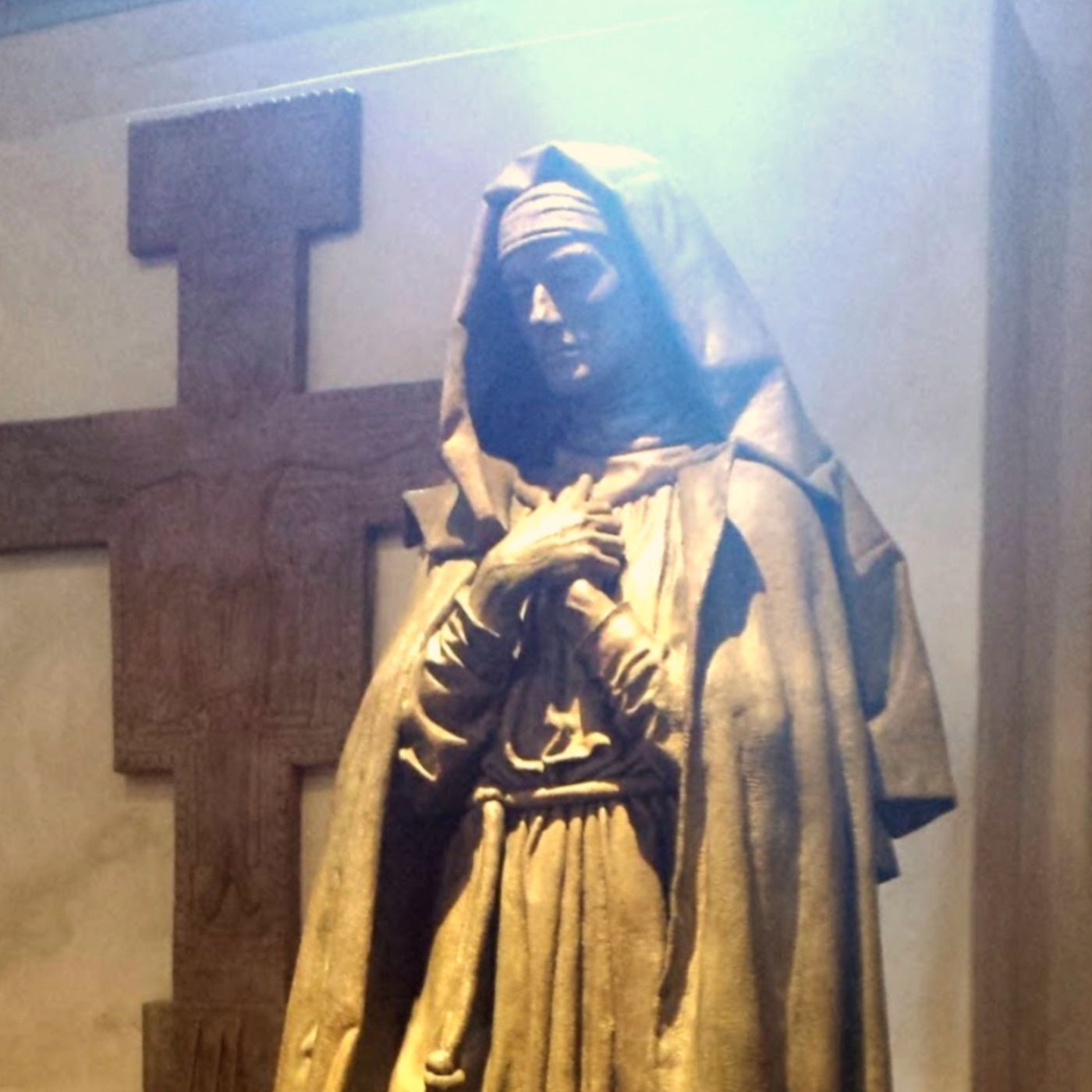
August 11: Saint Clare, Virgin
from Catholic Saints & Feasts Hosted by Fr. Michael Black
August 11: Saint Clare, Virgin c. 1193–1253 Memorial; Liturgical Color: White Patron Saint of embroiderers, goldsmiths, and laundry workers She heard Francis, left comfort, and slept on the floor for forty-one years Silicon Valley is not, topographically, a valley. The name is a contrivance dating from the 1970s and 80s. The actual valley is named after today’s saint. Santa Clara Valley, running southeast from the southern shores of San Francisco Bay, was named after its beating heart, Mission Santa Clara de Asís—a church, school, and farm—founded by Franciscan Friars in 1777. The current mission church, a beautiful twentieth-century idealization of mission architecture, sits on the site of the original Mission structure and is the iconic campus centerpiece of Santa Clara University, California’s oldest. It’s likely that Saint Clare never left her convent in Assisi, Italy, for the last forty years of her life. Yet a valley, city, and university in far away California are named in her honor. That a medieval, cloistered, Catholic nun is still so present to a hyper-modern portion of the world is a testament to the global reach and cultural impact of Catholicism and the Franciscan order. Clare of Assisi was born about a decade after and in the same small town as Saint Francis. Many of Clare’s earliest friends became nuns in her community, survived her, and gave testimony in her canonization process, reporting interesting details about her early life. Clare was from an economically comfortable family in the upper part of Assisi, in the neighborhood of the nobility. She had two younger sisters. Her mother was pious and had gone on long pilgrimages to holy shrines. Her household included knights and soldiers. From an early age she was interested in religious life and gave religious instruction to the many servants and others in her vast household. Clare was a prize to her father, as eligible daughters were like pawns whose marriages could seal alliances with other noble families. An Assisi marriage broker testified, after Clare’s death, that he had approached Clare various times with offers of marriage from interested suitors. She turned him down each time and instead challenged the broker about the quality of his own Christian commitment. If Clare had never met Saint Francis, she may well have become a Benedictine nun in a convent for noble women, putting her education to good use in the copying of sacred manuscripts. But she did meet Saint Francis, so her natural religiosity turned more radical. At the age of eighteen, Clare heard Francis preach in a local church and was deeply moved, as so many were, by his presence as much as his words. She began to meet with him privately to talk about the things of God and a new plan for her life. On Palm Sunday in Assisi, there was a tradition that eligible young ladies would process down the aisle of the Cathedral to receive a blessed palm branch from the Bishop’s own hands. Interested local bachelors showed up to watch this kind of sacred debutante parade. Clare was in the Cathedral on Palm Sunday 1212, but she did not process with all the others. Instead, the Bishop, known to history as Guido, descended the sanctuary steps and extended a palm to her as she remained in her pew. Christ would be her spouse. Her plan was about to unfold. That very night, Palm Sunday 1212, Clare secretly fled her family home and, with Francis’ help, entered behind the barred doors of a local convent. She donned a rough habit, and her hair was shorn. The men in her family were alarmed and rushed to bring her home and to her senses. Clare would not budge. As they tried to drag her out of the chapel, she grabbed the altar as an anchor and tore its linens to the floor. The men finally recognized the law of sanctuary and retreated. Clare never deviated from the path she chose that Palm Sunday night. Her close, holy relationship with Francis would endure until his death. He was the leader, the giver, the essential figure. She provided support and allegiance. Clare would go on to become the first woman to write a rule for other women. She became the foundress of all female Franciscan religious, who number in the tens of thousands today. She had an iron will, a great capacity for physical suffering, and lived a cloistered life of intense and continual prayer. For Clare and her spiritual progeny, the Poor Clares, religion was not primarily an internal disposition. Religion cannot be reduced to mere feelings, pious thoughts, or holy words. It is not a truly great and religious thing to separate the paper from the plastic in the recycle bin. It is a truly great and religious thing to go barefoot, to fast, to abstain from meat, to remain chaste, to wear a coarse habit against the skin, to pray long hours on your knees, to sleep on the floor, and to spend the night shivering in the cold. Such a life is for the few. But there are such few in the world, even today. Of their lives, nothing is counterfeit. Of Saint Clare’s life, nothing was counterfeit either. Saint Clare of Assisi, you chose a radical form of love of God as a cloistered nun. May your example and your prayers inspire all Catholics, especially female religious, to organize their entire lives around God, His Son, and His Church.
Embed this episode
No transcript yet.