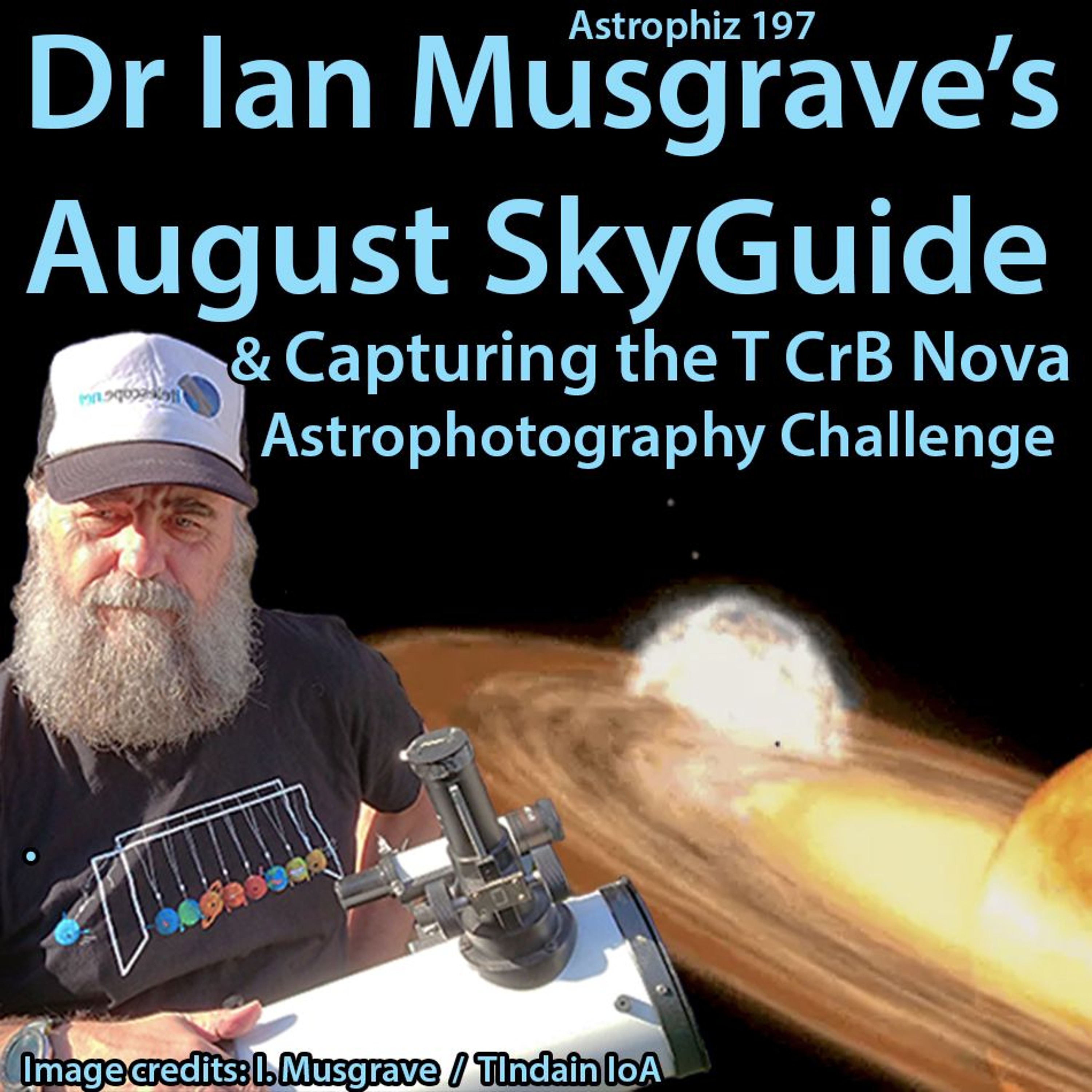
August SkyGuide episode artwork

EPISODE · Jul 30, 2024 · 25 MIN

August SkyGuide

from Astronomy Astrophiz Podcast · host Brendan O'Brien: Astronomers, Astrophysicists & Space Scientists

Astrophiz 197: Dt Ian Musgrave’s August SkyGuide Moon Phases for August New Moon - 4 August - best for seeing the faint fuzzies and clusters Apogee Moon furthest from Earth - 9 August 1st Quarter Moon - 13 August Full Moon - 20 August Perigee Moon closest to Earth - 21 August Last Quarter Moon - 26 August Evening Sky Comet C/2023 A3 Tsuchinshan is binocular-visible in Leo. Mercury is a fine sighting early in the evenings in August near the Western horizon. Mercury, Regulus and Venus are visible till an hour after sunset On the 6th, Mercury, Regulus and Venus form a triangle with the thin crescent moon. Venus is climbing higher and becoming more prominent as the ‘Evening Star' Saturn is rising about 8:30 in the evening and is best telescopically a few hours later when it is higher. Saturns Rings are almost edge on at the moment. Morning Sky Mars has been heading towards Jupiter and the horizon, and in the first week of August lands in the constellation Taurus, forming a second red ‘eye’ with Aldabaran in the bull's head. Between the 12th and 17th Mars and Jupiter are less than a finger width apart, and on the 15th, less than half a finger width apart. Looking East and North East in the morning, the Pliades Cluster, Hyades Cluster, Mars, Jupiter and Aldabaran are making interesting patters throughout the month. Capturing a recurrent Nova Explosion About an hour and a half after sunset when the sky is completely dark, you look North and a little bit West, you’ll spot the bright star Arcturus, then if you look down and a little to the right, you’ll see a circle of stars called Corona Borealis. The Astrophotography Challenge Take a photo of Corona Borealis every clear night during August-September to capture the pre-Nova view and then continue till after TCR-B has gone Nova. Ian’s Tangent : How do we define a planet? We have a definition of a solar system planet: Forms a sphere under its own gravity. It must orbit our sun. It must have cleared its own orbit Now because we cannot yet determine if an exoplanet is a sphere, we now have a proposed definition of an exoplanet, It must orbit a sun, or suns. Its mass must be smaller than can have fusion occurring Its mass must be enough to clear its orbit. Yesterday the ESA released an image of a ‘Cold Jupiter’ named Epsilon Indi Ab. The planet is several times the mass of Jupiter and orbits the K-type star Epsilon Indi A (Eps Ind A), which is around the age of our Sun, but slightly cooler. The team observed Epsilon Indi Ab using the coronagraph on Webb’s MIRI (Mid-Infrared Instrument). Of the 5000+ exoplanets known to date, only a few tens of exoplanets have been directly imaged previously by space- and ground-based observatories. "This discovery is exciting because the planet is quite similar to Jupiter — it is a little warmer and is more massive, but is more similar to Jupiter than any other planet that has been imaged so far,” quoted lead author Elisabeth Matthews of the Max Planck Institute for Astronomy in Germany.

Astrophiz 197: Dt Ian Musgrave’s August SkyGuide Moon Phases for August New Moon - 4 August - best for seeing the faint fuzzies and clusters Apogee Moon furthest from Earth - 9 August 1st Quarter Moon - 13 August Full Moon - 20 August Perigee Moon closest to Earth - 21 August Last Quarter Moon - 26 August Evening Sky Comet C/2023 A3 Tsuchinshan is binocular-visible in Leo. Mercury is a fine sighting early in the evenings in August near the Western horizon. Mercury, Regulus and Venus are visible till an hour after sunset On the 6th, Mercury, Regulus and Venus form a triangle with the thin crescent moon. Venus is climbing higher and becoming more prominent as the ‘Evening Star' Saturn is rising about 8:30 in the evening and is best telescopically a few hours later when it is higher. Saturns Rings are almost edge on at the moment. Morning Sky Mars has been heading towards Jupiter and the horizon, and in the first week of August lands in the constellation Taurus, forming a second red ‘eye’ with Aldabaran in the bull's head. Between the 12th and 17th Mars and Jupiter are less than a finger width apart, and on the 15th, less than half a finger width apart. Looking East and North East in the morning, the Pliades Cluster, Hyades Cluster, Mars, Jupiter and Aldabaran are making interesting patters throughout the month. Capturing a recurrent Nova Explosion About an hour and a half after sunset when the sky is completely dark, you look North and a little bit West, you’ll spot the bright star Arcturus, then if you look down and a little to the right, you’ll see a circle of stars called Corona Borealis. The Astrophotography Challenge Take a photo of Corona Borealis every clear night during August-September to capture the pre-Nova view and then continue till after TCR-B has gone Nova. Ian’s Tangent : How do we define a planet? We have a definition of a solar system planet: Forms a sphere under its own gravity. It must orbit our sun. It must have cleared its own orbit Now because we cannot yet determine if an exoplanet is a sphere, we now have a proposed definition of an exoplanet, It must orbit a sun, or suns. Its mass must be smaller than can have fusion occurring Its mass must be enough to clear its orbit. Yesterday the ESA released an image of a ‘Cold Jupiter’ named Epsilon Indi Ab. The planet is several times the mass of Jupiter and orbits the K-type star Epsilon Indi A (Eps Ind A), which is around the age of our Sun, but slightly cooler. The team observed Epsilon Indi Ab using the coronagraph on Webb’s MIRI (Mid-Infrared Instrument). Of the 5000+ exoplanets known to date, only a few tens of exoplanets have been directly imaged previously by space- and ground-based observatories. "This discovery is exciting because the planet is quite similar to Jupiter — it is a little warmer and is more massive, but is more similar to Jupiter than any other planet that has been imaged so far,” quoted lead author Elisabeth Matthews of the Max Planck Institute for Astronomy in Germany.

NOW PLAYING

August SkyGuide

0:00 25:51

No transcript for this episode yet

We transcribe on demand. Request one and we'll notify you when it's ready — usually under 10 minutes.

Ask A Spaceman Archives - 365 Days of Astronomy Ask A Spaceman Archives - 365 Days of Astronomy Podcasting Astronomy Every Day of the Year That Hoarder: Overcome Compulsive Hoarding That Hoarder Hoarding disorder is stigmatised and people who hoard feel vast amounts of shame. This podcast began life as an audio diary, an anonymous outlet for somebody with this weird condition. That Hoarder speaks about her experiences living with compulsive hoarding, she interviews therapists, academics, researchers, children of hoarders, professional organisers and influencers, and she shares insight and tips for others with the problem. Listened to by people who hoard as well as those who love them and those who work with them, Overcome Compulsive Hoarding with That Hoarder aims to shatter the stigma, share the truth and speak openly and honestly to improve lives. The Small Business Startup School – Business Notes | Financial Literacy | Retail Psychology – For Professionals & Entrepreneurs The Small Business Startup School Inc. Starting or buying a small business? While personal circumstances may vary, business patterns remain timeless. On The Small Business Startup School, we explore strategies, insights, and practical solutions to help entrepreneurs confidently navigate their journey.Hosted by Ola Williams—a retail entrepreneur, fintech founder, and financial coach with over two decades of experience—this podcast marries financial awareness and retail psychology with optimism to deliver actionable takeaways.Join us to learn, grow, and connect as we uncover the keys to business success.Let’s continue to learn together and be encouraged to keep on connecting! DIOSA. Carolina Sanper This podcast is a sacred space created by Carolina Sanper where you connect with your inner wisdom and embody your magnetic feminine power.It is the realization that the mystical realm is where you plant the seeds of your desired reality.It is a portal to your true essence: awareness, presence, and receiving with ease. Welcome home, DIOSA. 🖤

Frequently Asked Questions

How long is this episode of Astronomy Astrophiz Podcast?

This episode is 25 minutes long.

When was this Astronomy Astrophiz Podcast episode published?

This episode was published on July 30, 2024.

What is this episode about?

Astrophiz 197: Dt Ian Musgrave’s August SkyGuide Moon Phases for August New Moon - 4 August - best for seeing the faint fuzzies and clusters Apogee Moon furthest from Earth - 9 August 1st Quarter Moon - 13 August Full Moon - 20 August Perigee...

Can I download this Astronomy Astrophiz Podcast episode?

Yes, you can download this episode by clicking the download button on the episode player, or subscribe to the podcast in your preferred podcast app for automatic downloads.
URL copied to clipboard!