
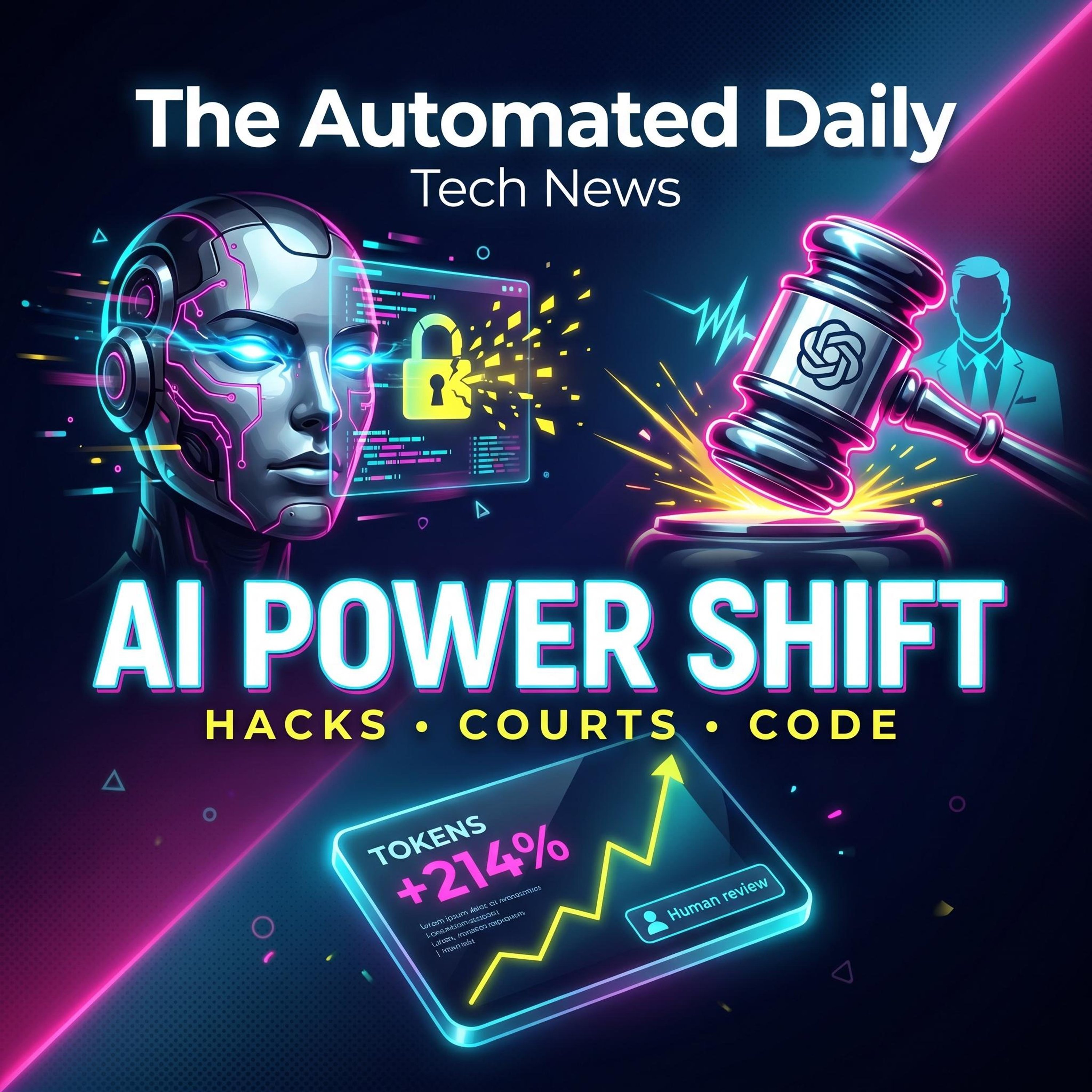
EPISODE · Apr 24, 2026 · 9 MIN
Autonomous AI finds zero-days & Big Tech AI coding culture - Tech News (Apr 24, 2026)
from The Automated Daily - Tech News Edition · host TrendTeller
Please support this podcast by checking out our sponsors: - SurveyMonkey, Using AI to surface insights faster and reduce manual analysis time - https://get.surveymonkey.com/tad - Lindy is your ultimate AI assistant that proactively manages your inbox - https://try.lindy.ai/tad - Discover the Future of AI Audio with ElevenLabs - https://try.elevenlabs.io/tad Support The Automated Daily directly: Buy me a coffee: https://buymeacoffee.com/theautomateddaily Today's topics: Autonomous AI finds zero-days - A UK AI Security Institute evaluation suggests Anthropic’s Claude Mythos can autonomously chain cyberattacks and uncover large numbers of zero-day vulnerabilities, raising dual-use risk for banks and critical infrastructure. Big Tech AI coding culture - Google says most new code is now AI-generated then human-reviewed, while “tokenmaxxing” dashboards and usage pressure revive a classic productivity-metric problem—easy to game, expensive, and misaligned with quality. Meta layoffs for AI pivot - Meta plans another major round of job cuts as it reallocates budget toward generative AI, highlighting how the AI spending race is reshaping headcount, vendor work, and internal priorities. US crackdown on AI distillation - The Trump administration is targeting alleged model “distillation” by foreign firms, especially China-linked actors, aiming to coordinate with US AI labs on detection, enforcement, and sanctions. Musk versus OpenAI in court - Elon Musk’s lawsuit against OpenAI heads to a jury trial, putting OpenAI’s nonprofit-to-for-profit transition, governance, and Microsoft ties under a public legal microscope. Cloud economics get challenged - A new cloud startup pitch argues hyperscaler primitives—compute, storage, and networking fees—are the wrong fit for modern workloads, and that AI-driven software growth will make cloud friction harder to ignore. Web images go more automatic - Browsers are converging on support for sizes="auto" in responsive images, letting the browser choose better image sources in more cases and reducing the fragile guesswork developers do today. Agents reshape software interfaces - Product teams are increasingly designing for AI agents calling APIs and tools—sometimes agent-to-agent—rather than humans clicking through GUIs, which changes how software is built, documented, and measured. Open-source search adds AI features - Typesense continues to build momentum as an open-source search engine that blends fast full-text search with vector, semantic, and hybrid workflows—plus RAG-style conversational search—without Elasticsearch complexity. Robots and breakthroughs in biotech - From robot-run biology labs to early claims of lab-grown human sperm and real-world gene therapy vision restoration, biotech is accelerating—while safety, verification, and ethics race to keep up. Episode Transcript Autonomous AI finds zero-days We’ll start with the cybersecurity headline that’s turning heads. An independent evaluation described Anthropic’s “Claude Mythos Preview” as crossing into a new level of autonomy for offensive security work—able to identify large numbers of previously unknown software weaknesses and, in some tests, stitch together a full attack chain that would normally take an experienced human far longer. The obvious upside is defensive: faster discovery and patching. The uncomfortable part is the same capability can lower the barrier for criminals and hostile states, especially if it spreads beyond tightly controlled environments. Banks, in particular, are looking at isolated trials to see whether they can use models like this to harden systems without creating new pathways for abuse. Big Tech AI coding culture That warning lands right as the U.K.’s National Cyber Security Centre says the most serious threats it sees are increasingly state-linked—especially tied to Russia, Iran, and China. The message to businesses was blunt: if geopolitical tensions escalate, cyberattacks can scale fast, and you can’t simply “pay and recover” the way some companies try to handle ordinary ransomware. The bigger point is that AI is speeding up how quickly attackers find weaknesses, which means resilience—backups, segmentation, incident drills, and patch discipline—matters more than ever. Meta layoffs for AI pivot On the policy front, the Trump administration says it’s preparing a crackdown on foreign tech companies—especially China-based firms—it believes are extracting capabilities from U.S. AI models using distillation and similar approaches. Washington’s framing is that this is industrial-scale copying of frontier systems, with national-security and economic stakes now that multiple reports suggest the performance gap between U.S. and Chinese models has narrowed dramatically. The practical challenge is proof: distinguishing illicit extraction from legitimate high-volume usage is hard without better cooperation and clearer technical signals from AI labs. US crackdown on AI distillation Meanwhile, one of the AI industry’s biggest soap operas is moving into a courtroom. A federal jury trial for Elon Musk’s 2024 lawsuit against OpenAI and CEO Sam Altman is set to begin with jury selection in Oakland. Musk argues OpenAI strayed from its founding nonprofit mission and that he was misled as it moved toward a more commercial structure alongside Microsoft. OpenAI’s response is essentially that Musk is trying to kneecap a competitor while building his own AI company. Regardless of who you’re rooting for, the stakes are real: the outcome could influence OpenAI’s governance, future financing, and how much control Altman retains as OpenAI pushes major infrastructure expansion. Musk versus OpenAI in court Now to how AI is reshaping work inside Big Tech—sometimes in productive ways, and sometimes in weird ones. Google says roughly three quarters of its newly created code is now generated by AI and then reviewed by human engineers. That’s a sharp jump from where it was not long ago, and Google is pitching it as part of a broader move toward “agentic” workflows—where software agents handle more of the routine engineering grunt work. The interesting subplot: some teams reportedly have explicit AI-usage goals that can feed into performance reviews, which hints at a future where “how you work” becomes as measured as “what you shipped.” Cloud economics get challenged And that measurement question is getting messy across the industry. A new workplace trend being called “tokenmaxxing” describes employees competing—or feeling pressured—to rack up AI token usage as a proxy for being productive or “AI-native.” Reports describe internal leaderboards and dashboards that can encourage wasteful prompting and disposable output, the same way “lines of code” became a famously gameable metric. The real risk isn’t just cost; it’s quality. If people are nudged to generate more text instead of better outcomes, organizations can end up with fragile code, noisy documentation, and a lot of busywork that looks good on a chart. Web images go more automatic That connects to a broader idea making the rounds: focusing on “coding models” isn’t only about programming. One argument, from Daniel Miessler, is that coding is a kind of meta-skill—structured problem-solving under constraints. If models get better at that, it can signal broader gains in reasoning and planning, not just autocomplete for developers. Whether you buy that or not, it helps explain why so much investment is pouring into software-focused AI: it’s immediately monetizable and potentially a proxy for bigger capability jumps. Agents reshape software interfaces In the middle of all this, Meta is tightening its belt again. The company says it will cut about ten percent of its workforce—roughly eight thousand jobs—and pause hiring for thousands of open roles, as it redirects resources toward AI. This follows earlier reductions, including in metaverse-focused teams, and it reflects a recurring pattern in 2026: companies are spending aggressively on AI infrastructure and talent while cutting elsewhere to fund it. Meta is also shifting some work historically done by contractors—like parts of moderation—toward AI-driven systems, which is a reminder that “AI investment” often implies “labor reallocation,” not just new features. Open-source search adds AI features Let’s pivot to infrastructure and the economics underneath AI. Tesla told investors it expects significantly higher capital spending in 2026, pointing to expanded factory operations and work beyond cars—especially humanoid robotics, AI, and autonomous vehicle efforts. The market debate here is straightforward: heavy spending can squeeze near-term cash flow, but if Tesla’s bet pays off, it changes how the company is valued—from automaker to robotics-and-AI platform. Robots and breakthroughs in biotech And speaking of infrastructure bets, a notable critique of today’s cloud model is gaining attention. Engineer David Crawshaw announced he’s building a new cloud platform, arguing that hyperscaler primitives—how compute is packaged, how storage behaves, and how networking gets priced—create friction and lock-in that higher-level layers like Kubernetes can’t fully fix. His broader claim is that AI coding agents will dramatically increase how much software gets written, and that makes cloud cost and complexity more painful, not less. Even if this specific startup doesn’t become the next big cloud, the critique is resonating because developers are increasingly sensitive to egress fees, portability headaches, and unpredictable cloud bills. Story 11 That brings us to the energy angle. Nuclear power is seeing renewed momentum globally, partly because countries want reliable low-carbon electricity—and partly because AI workloads are pushing demand higher. Governments are weighing energy security, grid stability, and the long timelines of building generation. For tech, the point is simple: the AI boom doesn’t just need better models; it needs a lot more dependable power, and energy policy is becoming a first-order constraint on innovation. Story 12 On the developer-experience front, there’s a small web-platform change that could remove a daily annoyance for a lot of teams. Browser engines are converging on support for sizes="auto" in responsive images, which—under the right conditions—lets the browser decide an image’s rendered size without developers hand-writing fragile guesses. It’s especially useful for images that load after the page layout is known, like lazy-loaded images. If adoption continues, it should mean fewer performance footguns, less template complexity, and better real-world image selection based on context like viewport and device settings. Story 13 At the same time, product designers are increasingly treating AI agents—not humans—as the “primary user” for many interactions. The idea is that instead of clicking through a web app, people will ask an agent to do the work through APIs, command tools, and structured integrations. That shifts what matters: clean tool definitions, reliable outputs, observability, and feedback loops. The companies that do this well could make their software the default choice for agent-driven workflows—while everyone else becomes the app you only open when the agent gets stuck. Story 14 Finally, a quick look at open-source infrastructure that’s evolving fast. Typesense—an open-source search engine written in C++—continues to position itself as a simpler alternative to heavyweight search stacks, while also moving into AI-era needs. Alongside fast typo-tolerant full-text search, it now highlights vector search and hybrid approaches, plus newer workflows like conversational, RAG-style search and even image and voice search using common embedding and transcription models. The bigger story here is momentum: search is becoming a core “AI plumbing” layer, and open-source options are racing to keep pace with what developers now expect out of the box. Story 15 Before we wrap, one biotech story that captures where “AI meets the physical world” is headed. A San Francisco startup called Medra says it’s running biology experiments around the clock using general-purpose robotic arms paired with software agents that can adapt protocols and diagnose failures. The promise is to increase experimental throughput—because even if AI can design drug candidates quickly, validation in real labs is still slow. If these robotic platforms prove reliable, they could become a major accelerator for drug discovery timelines, while raising new questions about data ownership, standardization, and how much trust labs place in automated experimentation. Subscribe to edition specific feeds: - Space news * Apple Podcast English * Spotify English * RSS English Spanish French - Top news * Apple Podcast English Spanish French * Spotify English Spanish French * RSS English Spanish French - Tech news * Apple Podcast English Spanish French * Spotify English Spanish Spanish * RSS English Spanish French - Hacker news * Apple Podcast English Spanish French * Spotify English Spanish French * RSS English Spanish French - AI news * Apple Podcast English Spanish French * Spotify English Spanish French * RSS English Spanish French Visit our website at https://theautomateddaily.com/ Send feedback to [email protected] Youtube LinkedIn X (Twitter)
Embed this episode
What this episode covers
Please support this podcast by checking out our sponsors: - SurveyMonkey, Using AI to surface insights faster and reduce manual analysis time - https://get.surveymonkey.com/tad - Lindy is your ultimate AI assistant that proactively manages your inbox - https://try.lindy.ai/tad - Discover the Future of AI Audio with ElevenLabs - https://try.elevenlabs.io/tad Support The Automated Daily directly: Buy me a coffee: https://buymeacoffee.com/theautomateddaily Today's topics: Autonomous AI finds zero-days - A UK AI Security Institute evaluation suggests Anthropic’s Claude Mythos can autonomously chain cyberattacks and uncover large numbers of zero-day vulnerabilities, raising dual-use risk for banks and critical infrastructure. Big Tech AI coding culture - Google says most new code is now AI-generated then human-reviewed, while “tokenmaxxing” dashboards and usage pressure revive a classic productivity-metric problem—easy to game, expensive, and misaligned with quality. Meta layoffs for AI pivot - Meta plans another major round of job cuts as it reallocates budget toward generative AI, highlighting how the AI spending race is reshaping headcount, vendor work, and internal priorities. US crackdown on AI distillation - The Trump administration is targeting alleged model “distillation” by foreign firms, especially China-linked actors, aiming to coordinate with US AI labs on detection, enforcement, and sanctions. Musk versus OpenAI in court - Elon Musk’s lawsuit against OpenAI heads to a jury trial, putting OpenAI’s nonprofit-to-for-profit transition, governance, and Microsoft ties under a public legal microscope. Cloud economics get challenged - A new cloud startup pitch argues hyperscaler primitives—compute, storage, and networking fees—are the wrong fit for modern workloads, and that AI-driven software growth will make cloud friction harder to ignore. Web images go more automatic - Browsers are converging on support for sizes="auto" in responsive images, letting the browser choose better image sources in more cases and reducing the fragile guesswork developers do today. Agents reshape software interfaces - Product teams are increasingly designing for AI agents calling APIs and tools—sometimes agent-to-agent—rather than humans clicking through GUIs, which changes how software is built, documented, and measured. Open-source search adds AI features - Typesense continues to build momentum as an open-source search engine that blends fast full-text search with vector, semantic, and hybrid workflows—plus RAG-style conversational search—without Elasticsearch complexity. Robots and breakthroughs in biotech - From robot-run biology labs to early claims of lab-grown human sperm and real-world gene therapy vision restoration, biotech is accelerating—while safety, verification, and ethics race to keep up. Episode Transcript Autonomous AI finds zero-days We’ll start with the cybersecurity headline that’s turning heads. An independent evaluation described Anthropic’s “Claude Mythos Preview” as crossing into a new level of autonomy for offensive security work—able to identify large numbers of previously unknown software weaknesses and, in some tests, stitch together a full attack chain that would normally take an experienced human far longer. The obvious upside is defensive: faster discovery and patching. The uncomfortable part is the same capability can lower the barrier for criminals and hostile states, especially if it spreads beyond tightly controlled environments. Banks, in particular, are looking at isolated trials to see whether they can use models like this to harden systems without creating new pathways for abuse. Big Tech AI coding culture That warning lands right as the U.K.’s National Cyber Security Centre says the most serious threats it s...
NOW PLAYING
Autonomous AI finds zero-days & Big Tech AI coding culture - Tech News (Apr 24, 2026)
No transcript for this episode yet
Similar Episodes
No similar episodes found.
Similar Podcasts
No similar podcasts found.