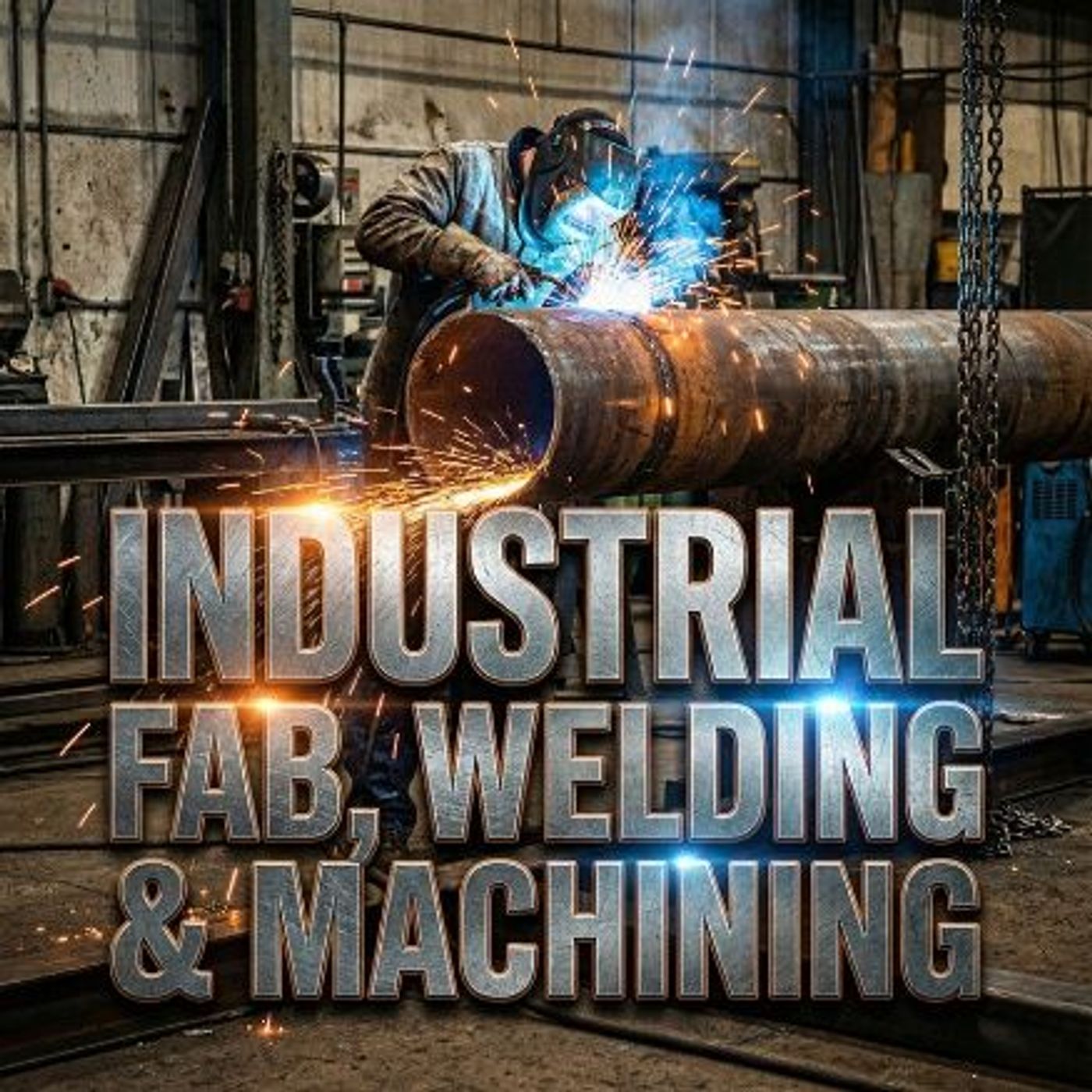
AWS D1.1: The Complete Guide for Structural Steel Welding
from Industrial Fab, Welding & Machining Hosted by Aaron Sova
Mandated by the Federal Highway Administration (FHWA) for bridge fabrication and recognized internationally across mining, oil and gas, and heavy manufacturing, the AWS D1.1 Structural Welding Code – Steel serves as the definitive engineering framework for structural integrity. Far from a voluntary guideline, compliance with AWS D1.1 is legally binding on public infrastructure projects and represents the industry benchmark for preventing catastrophic structural failures on heavy industrial platforms, crane runway girders, and material handling conveyors.On this episode of Industrial Fab, Welding & Machining, the manufacturing and code-compliance team at LTJ Industrial Services breaks down the technical parameters of prequalified Welding Procedure Specifications (WPS), base metal groupings, welder continuity rules, and non-destructive testing (NDT) criteria.Technical Comparison: Prequalified WPS vs. Procedure Qualification Testing (PQR) Procedure Qualification Testing (PQR Requirement): Standard Qualified Procedures: Required whenever joint geometries, welding processes, or material groups fall outside prequalified parameters. Fabricators must prepare test plates, perform mechanical destructive testing (guided bend tests, all-weld-metal tensile tests, and macroetch examinations), and document all essential variables. Prequalified WPS: Allows fabricators to bypass formal mechanical testing by adhering strictly to pre-approved joint designs, base metal groupings, and welding parameters pre-validated within AWS D1.1 (such as standard Complete Joint Penetration [CJP] groove welds and calibrated fillet welds using SMAW, GMAW, or FCAW). Base Metal Groupings & Filler Metal Matching: Standard Non-Code Practices: Risks dangerous galvanic incompatibilities, brittle heat-affected zones (HAZ), and underbead hydrogen cracking by pairing mismatched electrodes with structural plate. AWS D1.1 Metallurgical Control: Categorizes carbon steels, high-strength low-alloy (HSLA) steels, and quenched and tempered steels into distinct groups, specifying approved low-hydrogen filler metals and mandatory minimum preheat and interpass temperatures. Welder Performance Qualification (WPQ) & Continuity: Standard Non-Code Practices: Relies on informal in-house evaluations or unverified past employment claims. AWS D1.1 Certification: Tests welders under strict position constraints (1G through 4G plate, or 6GR tubular configurations) across material thickness limits. Qualifications expire automatically if the welder fails to use the specific qualified process for six consecutive months, requiring formal continuity logging or retesting. Quality Assurance & NDT Coverage: Standard Non-Code Practices: Relies on spot visual checks after component delivery. AWS D1.1 Inspection Matrix: Mandates 100% visual inspection (VT) across all completed welds. Based on structural criticality, non-destructive testing—such as Ultrasonic Testing (UT) or Radiographic Testing (RT)—is systematically assigned, requiring 100% volumetric inspection on fracture-critical members. Actionable Execution Playbook for Structural Steel Fabricators Leverage Prequalified Joint Designs: Audit project blueprints against AWS D1.1 prequalified joint details (including root opening tolerances, bevel angles, and backing strip dimensions) to eliminate the administrative cost and schedule delay of custom PQR testing. Prevent Arc Strikes on Quenched and Tempered Steels: Enforce strict shop floor electrode discipline to eliminate stray arc strikes outside weld grooves. Uncontrolled strikes induce localized martensitic hardening zones that initiate brittle failure under cyclic fatigue. Maintain Real-Time Welder Continuity Logs: Implement a centralized quality management tracking system documenting each welder’s active process utilization every six months, preventing sudden qualification lapses prior to code audits. Establish Strict Preheat and Low-Hydrogen Storage Protocols: Bake and store low-hydrogen electrodes (such as AWS E7018) in holding ovens held at a minimum of 250°F (120°C) after opening to prevent moisture absorption and hydrogen-induced delayed underbead cracking. Archive Complete Traceability Records: Maintain a dedicated job traveler package for every structural assembly, containing primary-source Material Test Reports (MTRs), approved WPS documents, Welder Performance Qualification records, and certified NDT reports. Partner with LTJ Industrial ServicesDefective structural welds compromise human safety, violate statutory building codes, and create catastrophic operational liabilities. Located at 22505 US-6, Rifle, CO 81650, LTJ Industrial Services provides AWS D1.1 and ASME Section IX certified welding, precision multi-axis CNC machining, structural steel plate fabrication, mobile field repair rigs, and industrial sandblasting across Western Colorado and the Intermountain West. Ensure your heavy equipment and structural infrastructure are built to code. Visit LTJindustrial.com or contact our Rifle fabrication facility at (970) 625-9353 to review your engineering prints or request a project bid. Read more Learn more about LTJ Industrial Services at www.ltjindustrial.com/
Embed this episode
No transcript yet.