
EPISODE · Apr 26, 2026 · 9 MIN
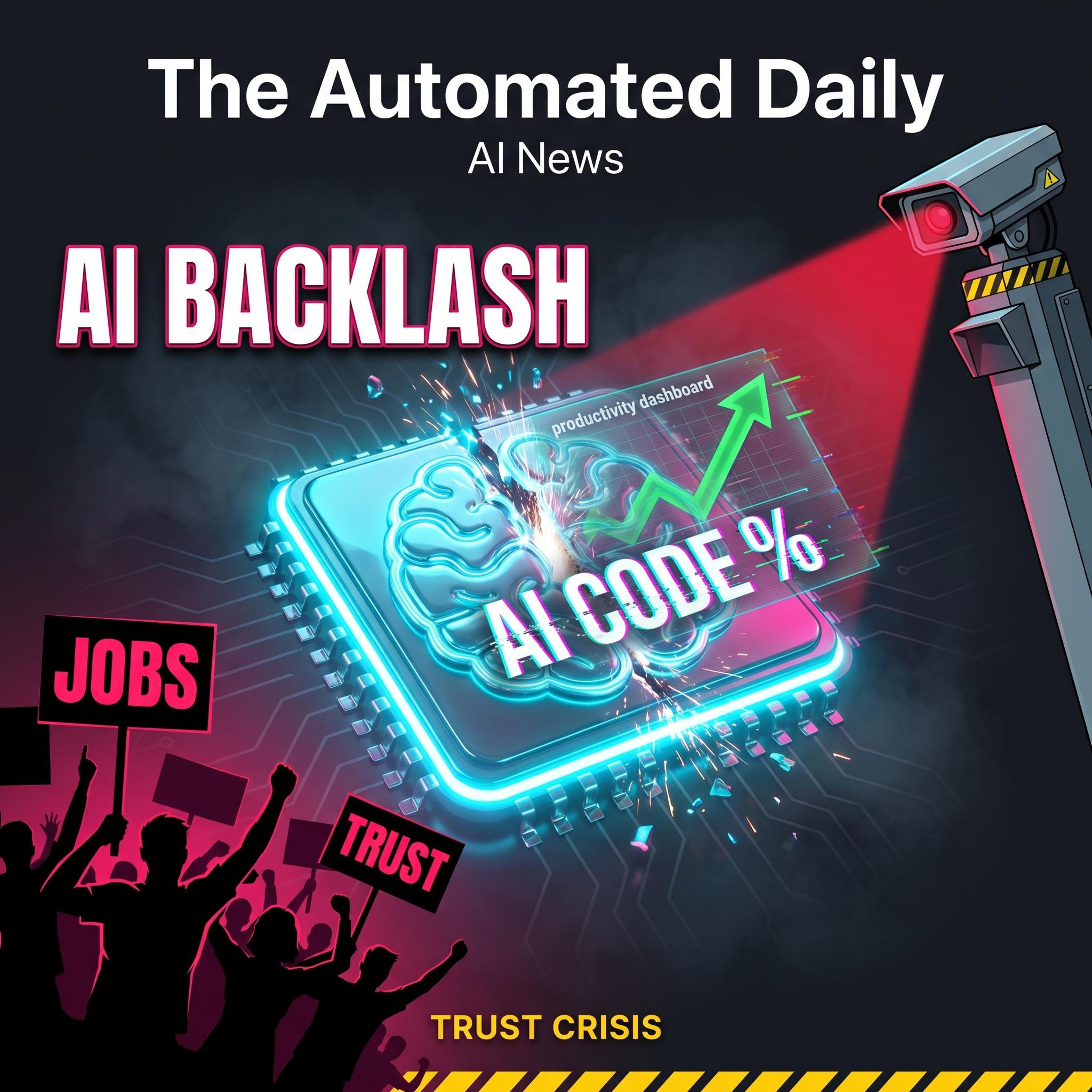
Backlash against AI industry grows & AI coding metrics may be inflated - AI News (Apr 26, 2026)
from The Automated Daily - AI News Edition · host TrendTeller
Please support this podcast by checking out our sponsors: - KrispCall: Agentic Cloud Telephony - https://try.krispcall.com/tad - SurveyMonkey, Using AI to surface insights faster and reduce manual analysis time - https://get.surveymonkey.com/tad - Lindy is your ultimate AI assistant that proactively manages your inbox - https://try.lindy.ai/tad Support The Automated Daily directly: Buy me a coffee: https://buymeacoffee.com/theautomateddaily Today's topics: Backlash against AI industry grows - Violent incidents and new survey data highlight rising anti-AI sentiment, distrust, and anger about jobs, costs, and data-center impacts—raising pressure for transparency and regulation. AI coding metrics may be inflated - A developer investigation suggests AI-enhanced IDE dashboards can overcount “AI-written” code, creating misleading ROI narratives and risky management decisions tied to productivity and copyright concerns. AI agents create comprehension debt - AI coding agents can accelerate prototypes while leaving teams with “comprehension debt,” where maintainability, testing, and operational responsibility lag behind rapidly generated code. Open-source debating agent teams - HATS proposes a multi-agent workflow where roles intentionally disagree to reduce LLM overconfidence, aiming to improve product decisions, architecture trade-offs, and team planning. Border surveillance expands inland - A proposed Anduril surveillance tower in San Clemente shows how AI-enabled border security tools can widen into broad community monitoring, with unresolved concerns over retention and oversight. FSF rejects Responsible AI licenses - The Free Software Foundation argues Responsible AI Licenses are nonfree because they restrict usage, warning they fragment collaboration while failing to ensure real ML accountability like training transparency. Writers lose trust in text - An Ellipsus survey finds a collapse of trust in online writing, with “AI witch hunts,” harassment, and demands for labeling, consent-based datasets, and verification that doesn’t rely on flawed detectors. - Attacks and Polls Signal a Growing Backlash Against the AI Industry - Tests Suggest AI IDE Dashboards Can Overstate How Much Code AI Writes - HATS Brings Six-Thinking-Hats Style Debate to a Multi-Agent AI Team Platform - EFF Urges San Clemente to Block CBP’s Proposed Anduril AI Surveillance Tower - FSF Labels Responsible AI Licenses (RAIL) Nonfree and Unethical - AI Coding Agents Fuel ‘Software Tsundoku,’ Leaving Projects Half-Finished and Poorly Understood - Survey Finds Generative AI Eroding Trust in Writing Communities, Driving Calls for Labels and Consent - Good AI Task launches tool to gauge whether a task is suitable for AI Episode Transcript Backlash against AI industry grows First up today: a growing backlash against the AI industry, with a troubling edge. The New Republic highlights two recent attacks—one involving a Molotov cocktail at OpenAI CEO Sam Altman’s home, and another shooting at a local official’s house in Indiana, paired with a “No Data Centers” note. The article is explicit in condemning violence, but it argues these incidents sit inside a broader, intensifying hostility toward AI. New survey data it cites suggests a widening gap between experts—who tend to be upbeat about AI’s economic upside—and the public, which is far more skeptical about jobs and stability. A key point here is narrative whiplash: industry messaging often swings between existential-risk doom and job-displacement inevitability, while people on the ground feel everyday costs rising and see local downsides like higher utility rates and community disruption tied to data-center buildouts. The piece also points to a quieter issue undermining AI’s promise: research indicating many corporate AI deployments aren’t producing measurable productivity gains or return on investment. If people are paying the costs but not seeing the benefits, trust erodes. The proposed fixes—community benefits, safety nets, and voluntary commitments—don’t land well, the article argues, when paired with weak accountability and lobbying that seeks to narrow regulation or liability. The takeaway is blunt: without verifiable transparency and real community input, anti-AI populism could harden—and the risk of more violence could rise. AI coding metrics may be inflated Staying with trust, let’s talk about the numbers companies use to “prove” AI is paying off—especially in software teams. Engineer William O’Connell argues that analytics inside AI-enhanced IDEs can dramatically overstate how much code is written by AI. In one tool, he saw a dashboard claiming nearly all new code was generated by the AI system. He dug into how the metric was computed and found behavior that can bias the count upward—where routine human actions can get discounted, while AI-assisted edits can get credited in ways that inflate the AI share. He also compared that approach to a different IDE’s commit-based attribution, which he says looked more reasonable overall, but still had moments where partial AI edits caused entire files to be labeled as AI-written. Why this matters: these metrics are increasingly used in ROI stories, performance expectations, and staffing plans. If leadership starts believing the tool is writing “most of the code,” it can distort hiring, timelines, and even legal posture—especially if organizations worry that heavily AI-generated code might be harder to protect or license cleanly. The bigger lesson is that code volume is a lousy proxy for value, and dashboards can incentivize the wrong conclusions. AI agents create comprehension debt That measurement problem connects to a broader developer experience many teams are starting to recognize: AI makes it easier to begin projects than to finish them. Daniel Vaughan describes a “software tsundoku” effect—like buying books you never read—where AI coding agents help create a flood of proofs of concept, but the hard part still belongs to humans: verifying behavior, maintaining systems, handling deployments, and supporting real users. He calls the gap “comprehension debt,” where the amount of code outpaces the team’s understanding of it. This is important because it reframes the productivity conversation. A working demo can look like progress, but if the team can’t explain it, test it, or operate it safely, the long-term cost can outweigh the short-term speed. The practical message is less about rejecting AI and more about constraints: tighter definitions of “done,” stronger review habits, and treating maintenance as a first-class deliverable—not an afterthought. Open-source debating agent teams On a more constructive note, an open-source project called HATS is experimenting with a different way to use AI at work: not one assistant, but a structured disagreement. Inspired by the “Six Thinking Hats” framework, it runs a small team of agents with distinct roles—so instead of getting a single confident answer, you get competing perspectives and then a synthesis. The goal is to surface blind spots and reduce the kind of overconfident mistakes that LLMs can slip into, especially when they sound persuasive. Why it’s interesting: it matches how real teams make better decisions—through tension, trade-offs, and explicit risk discussions—rather than pretending one voice has the truth. If multi-agent workflows become common, the real competitive edge may shift from “who has the smartest model” to “who has the best process for turning model output into reliable decisions.” Border surveillance expands inland Next, a major privacy and governance story from California: U.S. Customs and Border Protection is seeking permission to install an Anduril autonomous surveillance tower on a cliff in San Clemente. The Electronic Frontier Foundation warns that this AI-enabled system could scan widely—potentially far beyond the coastline—and continuously track movement. The sticking point is local control. City staff reportedly proposed lease language to prevent neighborhood surveillance, but CBP rejected contractual limits and instead offered a softer assurance that it would “avoid” scanning residential areas, while keeping the technical capability to look inland during suspected events. EFF is also flagging data retention concerns, including the possibility that some imagery might be kept short-term while other data used for training could be stored much longer, with unclear deletion rules. The bigger significance is normalization: once wide-area monitoring becomes routine “in the name of border security,” it can expand into everyday community surveillance—often without clear oversight, transparency, or meaningful consent. FSF rejects Responsible AI licenses Now to a licensing debate that keeps resurfacing as AI tools spread through open source. The Free Software Foundation says so-called Responsible AI Licenses—often designed to restrict certain uses—are nonfree, and it’s formally adding RAIL-style licenses to its list of nonfree licenses. The FSF’s core argument is straightforward: free software requires the freedom to run a program for any purpose. Once you add usage restrictions, you’re no longer in the same ethical and legal tradition that made open source collaboration scalable. The FSF also argues that these restrictions can be vague and shifting, forcing developers and users into constant interpretation and compliance anxiety, while doing little to stop bad actors who will ignore them anyway. And specifically for machine learning, it says many “responsible” licenses don’t deliver real accountability—like transparency into training data and configurations—so they may create the appearance of ethics without the substance. In their view, strong copyleft and public support for freedom-respecting tools does more to protect users than trying to legislate morality through licensing terms. Writers lose trust in text Finally today, a cultural signal that’s hard to ignore: an Ellipsus survey of more than five thousand respondents suggests trust in online writing is collapsing under the weight of generative AI. A striking theme is how many people say they now read in a “forensic” mode—constantly wondering whether any given piece of text is real. That suspicion has a human cost. Respondents describe “AI witch hunts,” where writers—especially those with polished prose—are accused of being machine-generated, harassed, and pushed to change their style or stop posting to avoid both scrutiny and scraping. At the same time, some writers say the moment is motivating them: they want to create more, not less, as a form of resistance—because they value lived experience, intention, and voice. The practical demands that show up repeatedly are keywords you’ll hear more this year: consent for training data, dataset transparency, clearer rules around scraping, and standardized labeling of AI-generated or AI-assisted content—plus verification approaches that don’t depend on detectors that can easily get it wrong. Subscribe to edition specific feeds: - Space news * Apple Podcast English * Spotify English * RSS English Spanish French - Top news * Apple Podcast English Spanish French * Spotify English Spanish French * RSS English Spanish French - Tech news * Apple Podcast English Spanish French * Spotify English Spanish Spanish * RSS English Spanish French - Hacker news * Apple Podcast English Spanish French * Spotify English Spanish French * RSS English Spanish French - AI news * Apple Podcast English Spanish French * Spotify English Spanish French * RSS English Spanish French Visit our website at https://theautomateddaily.com/ Send feedback to [email protected] Youtube LinkedIn X (Twitter)
Embed this episode
What this episode covers
Please support this podcast by checking out our sponsors: - KrispCall: Agentic Cloud Telephony - https://try.krispcall.com/tad - SurveyMonkey, Using AI to surface insights faster and reduce manual analysis time - https://get.surveymonkey.com/tad - Lindy is your ultimate AI assistant that proactively manages your inbox - https://try.lindy.ai/tad Support The Automated Daily directly: Buy me a coffee: https://buymeacoffee.com/theautomateddaily Today's topics: Backlash against AI industry grows - Violent incidents and new survey data highlight rising anti-AI sentiment, distrust, and anger about jobs, costs, and data-center impacts—raising pressure for transparency and regulation. AI coding metrics may be inflated - A developer investigation suggests AI-enhanced IDE dashboards can overcount “AI-written” code, creating misleading ROI narratives and risky management decisions tied to productivity and copyright concerns. AI agents create comprehension debt - AI coding agents can accelerate prototypes while leaving teams with “comprehension debt,” where maintainability, testing, and operational responsibility lag behind rapidly generated code. Open-source debating agent teams - HATS proposes a multi-agent workflow where roles intentionally disagree to reduce LLM overconfidence, aiming to improve product decisions, architecture trade-offs, and team planning. Border surveillance expands inland - A proposed Anduril surveillance tower in San Clemente shows how AI-enabled border security tools can widen into broad community monitoring, with unresolved concerns over retention and oversight. FSF rejects Responsible AI licenses - The Free Software Foundation argues Responsible AI Licenses are nonfree because they restrict usage, warning they fragment collaboration while failing to ensure real ML accountability like training transparency. Writers lose trust in text - An Ellipsus survey finds a collapse of trust in online writing, with “AI witch hunts,” harassment, and demands for labeling, consent-based datasets, and verification that doesn’t rely on flawed detectors. - Attacks and Polls Signal a Growing Backlash Against the AI Industry - Tests Suggest AI IDE Dashboards Can Overstate How Much Code AI Writes - HATS Brings Six-Thinking-Hats Style Debate to a Multi-Agent AI Team Platform - EFF Urges San Clemente to Block CBP’s Proposed Anduril AI Surveillance Tower - FSF Labels Responsible AI Licenses (RAIL) Nonfree and Unethical - AI Coding Agents Fuel ‘Software Tsundoku,’ Leaving Projects Half-Finished and Poorly Understood - Survey Finds Generative AI Eroding Trust in Writing Communities, Driving Calls for Labels and Consent - Good AI Task launches tool to gauge whether a task is suitable for AI Episode Transcript Backlash against AI industry grows First up today: a growing backlash against the AI industry, with a troubling edge. The New Republic highlights two recent attacks—one involving a Molotov cocktail at OpenAI CEO Sam Altman’s home, and another shooting at a local official’s house in Indiana, paired with a “No Data Centers” note. The article is explicit in condemning violence, but it argues these incidents sit inside a broader, intensifying hostility toward AI. New survey data it cites suggests a widening gap between experts—who tend to be upbeat about AI’s economic upside—and the public, which is far more skeptical about jobs and stability. A key point here is narrative whiplash: industry messaging often swings between existential-risk doom and job-displacement inevitability, while people on the ground feel everyday costs rising and see local downsides like higher utility rates and community disruption tied to data-center buildouts. The piece also points to a quieter issue undermining AI’s promise: research indicating many corporate AI ...
NOW PLAYING
Backlash against AI industry grows & AI coding metrics may be inflated - AI News (Apr 26, 2026)
No transcript for this episode yet
Similar Episodes
No similar episodes found.
Similar Podcasts
No similar podcasts found.